Bootstrapping the Identity Metasystem Mary Ruddy (Meristic), Patrick Harding (Ping ID) & Paul Madsen (NTT)
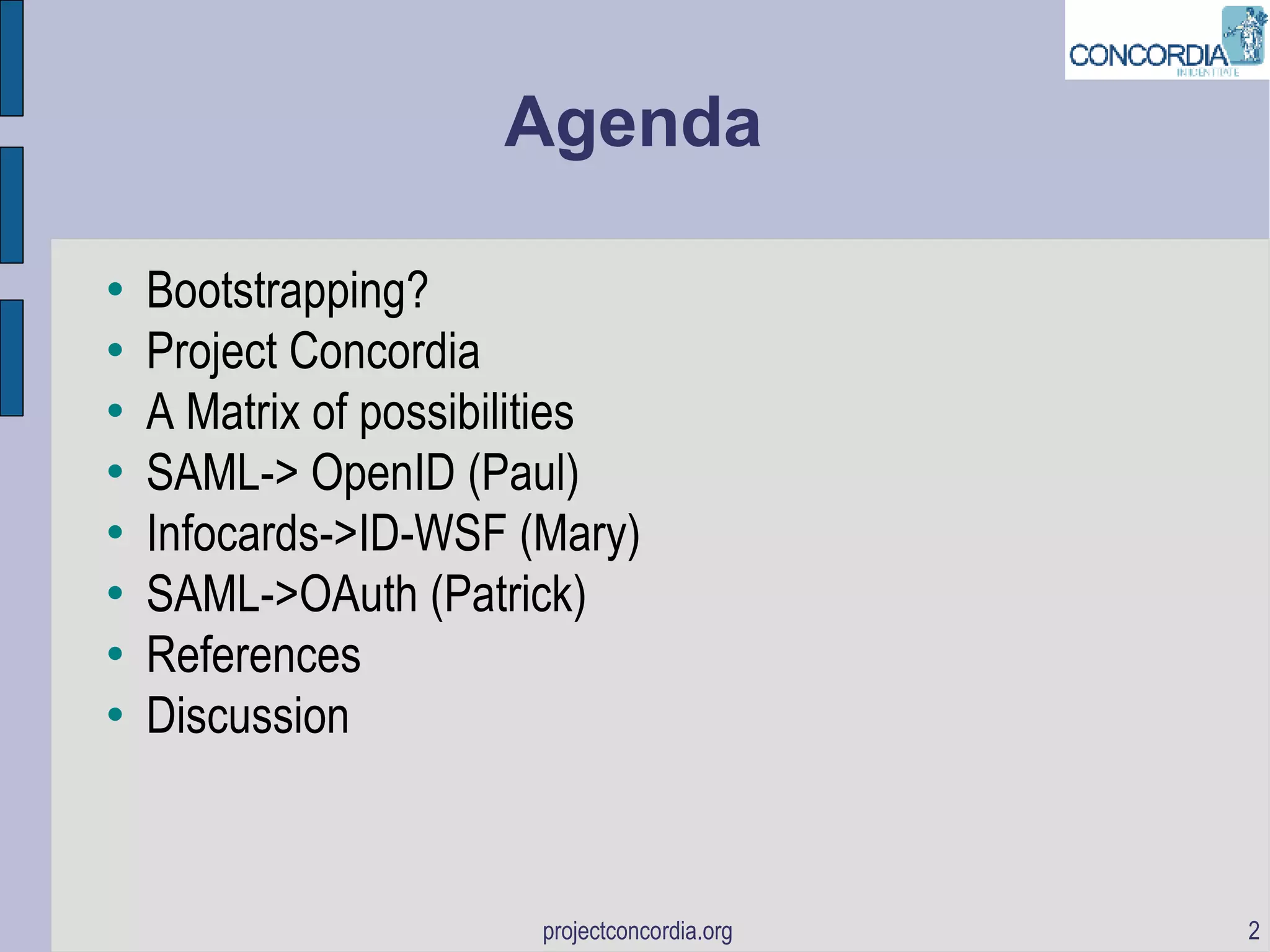
Agenda Bootstrapping? Project Concordia A Matrix of possibilities SAML-> OpenID (Paul)‏ Infocards->ID-WSF (Mary)‏ SAML->OAuth (Patrick)‏ References Discussion
Bootstrapping We enjoy/confront a number of different 'standards' for federated identity protocols/systems, e.g. SAML, OpenID, Oauth, Infocards, ID-WSF, WS-Federation,  Such heterogeneity is both a boon and a bane, while it gives deployers freedom to choose, it creates interoperability challenges  across  the systems More and more, the protocols are expected to be deployed in combination (but they weren't necessarily designed with this expectation)‏ Bootstrapping refers to mechanisms that, when two or more protocols are chained together, enable the transition(s) between them
Project Concordia “ Agreement, understanding, and marital harmony”... Public forum driving interop  among  identity protocols Used together in practice but not originally designed to fit together Practical focus on real-life issues Gathering deployer input is an explicit goal No technology is off-limits PKI, SAML, WS-Fed, OpenID, InfoCard, ID-WSF ... Scenarios are explored, tested, and clarified in turn If further specification work is needed, Concordia may champion its standardization in the appropriate forum
The Matrix  Front channel attributes Back channel attributes Authn SSO SLO OpenID SAML Infocards WS-Fed ID-WSF OAuth Y Y Y Y Y Y Y Y Y Y Y Y Y Y Y Y Y Paul Mary Patrick
SAML ->OpenID
SAML->OpenID Both SAML & OpenID define mechanisms to support statements such as  I require the user to be authenticated with a password The user was authenticated at Level Of Assurance 'Gold' SAML defines Authentication Context, OpenID the Provider Authentication Policy Extension (PAPE)‏ Both effectively ride on top of the core SSO protocol, giving RP & IDP enhanced ability to express such policies AC & PAPE are logically equivalent, differ in syntax
SAML Authentication Context SAML Authentication allows IDP/SP to  indicate policy on SSO messages wrt Identity proofing (e.g. Email verification or f2f)‏ Security processes (e.g. Key storage)‏ Authentication specifics (e.g. Biometric or OTP)‏ Assurance levels (work under way)  Authentication Context 'classes' capture common combinations of above aspects - SSTC defined a number, e.g. 'mobile-nocontract' New classes can be defined by other some communities (not without some difficulty)‏
OpenID PAPE OpenID Provider Authentication Policy Extension PAPE is a (relatively) simple mechanism PAPE standardizes 3 URIs Multi-factor Multi-factor Hard token Phishing Resistant Also allows providers to indicate assurance in terms of NIST 800 63 levels
Motivating Use Case A SAML IDP provides strong authentication services to a community of RPs IDP focuses on strong authentication, and outsources low assurance requests to OPs through OpenID Value For SAML RPs, leveraging their existing IDP relationship to mediate those with OPs For OpenID OPs, (indirect) access to those erstwhile exclusively SAML RPs If and when a SAML RP uses saml:AuthnContext to ask for a low assurance authentication, SAML IDP will proxy that request to the user specified OP – with openid:PAPE Implies that SAML AC class URIs & PAPE URIs must be mapped
Sequence OpenID SAML SAML requestedauthncontext(password) authncontext(password) pape(password) RP IdP/RP OP pape(password) logon(pwd) service? service 1 2 3 4
<Ointment><Fly/><Fly/></Ointment> PAPE does not define a password URI SAML does not (yet) define how to bind the NIST 800 63 assurance levels to Authn Context Can we presume that the two protocols are equivalent with respect to LoA? PAPE gives non-normative guidance on how typical authentication mechanisms (some overlap with SAML's classes) map into the PAPE URIs
Information Cards -> ID-WSF
Infocards->ID-WSF Overview of protocols Motivation for use case Approach
ID-WSF Identity Web Services Framework Developed by Liberty Alliance Framework to support Federated Web Services Specification released in 2003 Supports circles of trust “ Back Channel Identify”
Today you go from site to site filling in forms and passwords Copyright © 2008 Parity. Made available under EPL 1.0 Type, type, type. Click, click.  Here a password, there a password. Everywhere a password. Here a form, there a form, ... Websites…
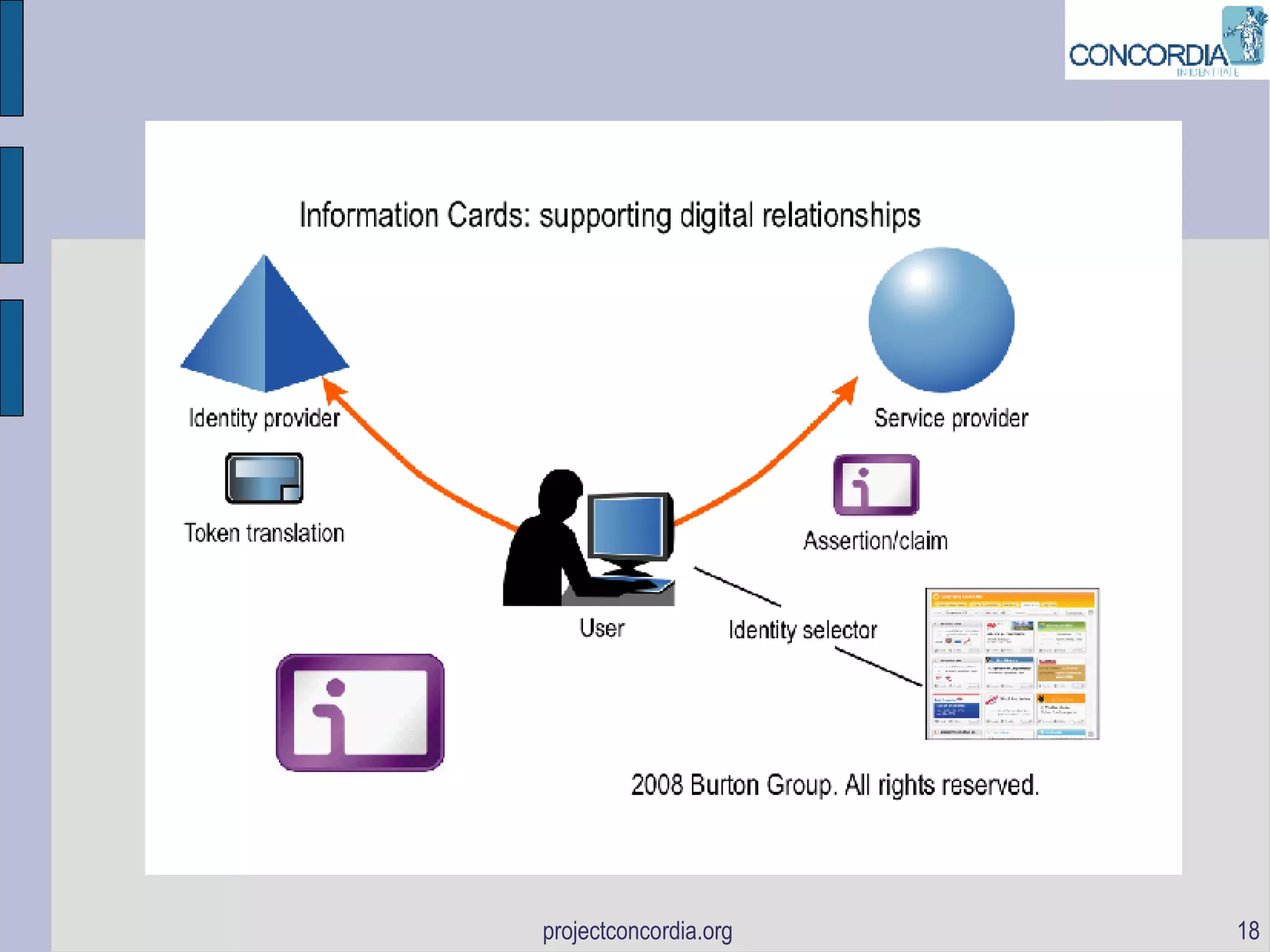
Information Cards Put You in Control Copyright © 2008 Parity. Made available under EPL 1.0 Each card is a slice of the digital you (or a friend of yours) held in some data silo. Any kind of information: your preferences, favorite songs, employee id numbers, drivers licenses, affiliations, your health plan id, ...you get the idea, can be accessed using a card. This wallet-like thing is an app called an  Identity Selector
 
Sample Use Case
The information card ID-WSF bootstrap The opportunity: Information Cards can be handy human consumable ID-WSF Containers (representing Discovery Service Endpoint References [DS-EPRs] EPRs and relationships such as subscriptions) Or from the other perspective, the DS provides a web services interface to the information card service
Bootstrap Flow Identity Selector Browser Extension & Client App  Identity Provider Relying Party  Website or App  Cards are generated and downloaded from here.  Token Service issues tokens as requested by Selector. Cards are stored and selected here Tokens containing claim data are requested and received here  (   tag on Website contains a reference for an ID-WSF service)
ID-WSF integration- Higgins IdP  Identity Selector IdAS LDAP Server ID-WSF Layer ID-WSF Personal Profile Service ID-WSF CP LDAPCP PP  CP I-card Services DS IS AS ID-WSF STS
SAML -> OAuth
SSO + Data SAML handles federated browser SSO  Secure Internet SSO Attribute Sharing Account Linking between different sites OAuth handles delegated web service authentication  secure API authentication  Secure access to web service data API’s Generally with explicit user consent
Sample Use Case Online Brokerage partners with third party Calculators site  Online Brokerage requires Calculators site to implement SSO via SAML Automated upload of account balances and holdings via API Online Brokerage requires user consent and user presence before releasing user account balances to Calculators Site Similar Use Cases Benefits Provider partners with Wellness Site Cable Operator partners with Gaming Site
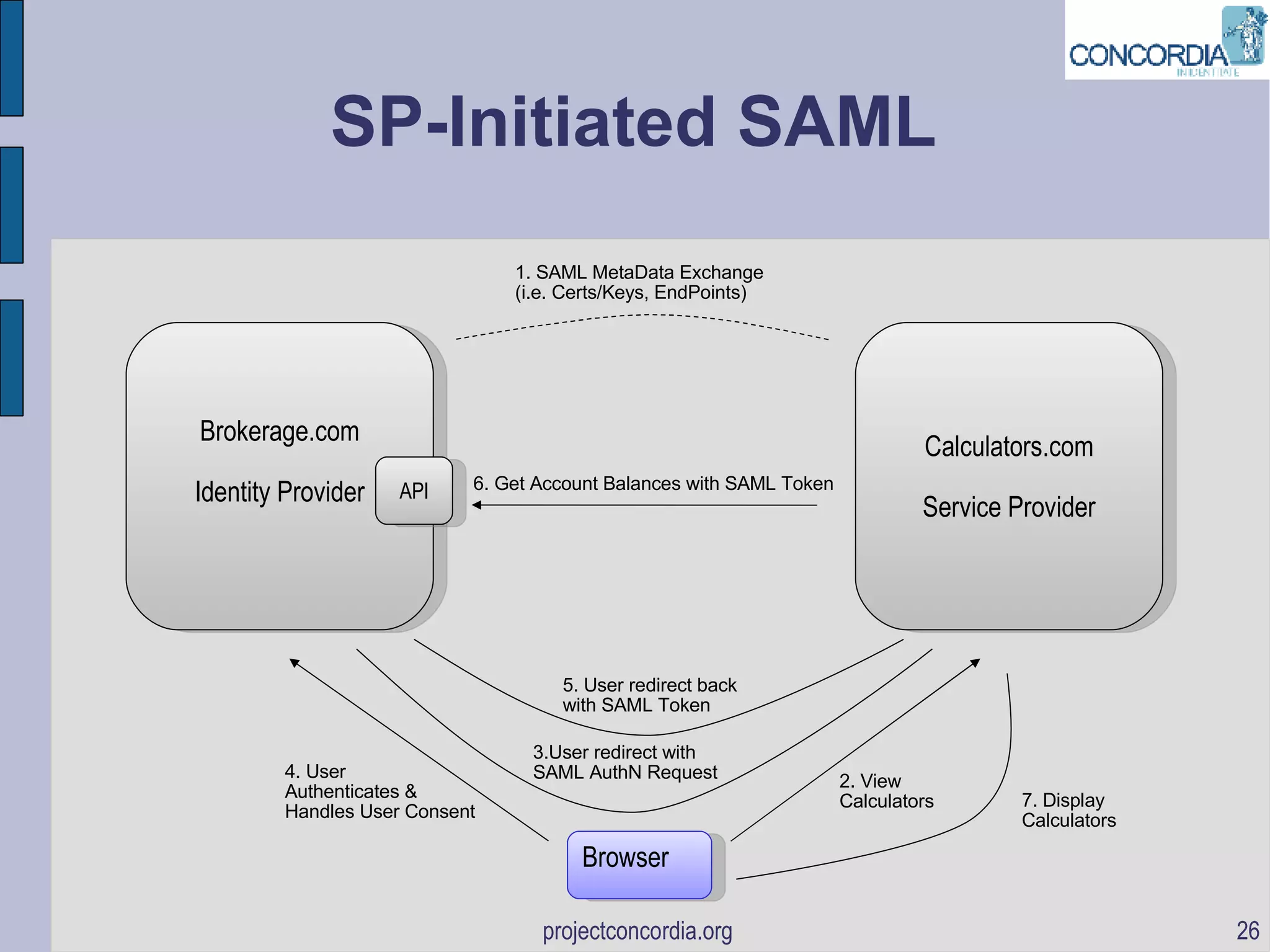
SP-Initiated SAML Brokerage.com Identity Provider Calculators.com Service Provider Browser 1. SAML MetaData Exchange (i.e. Certs/Keys, EndPoints) 5. User redirect back with SAML Token 4. User Authenticates & Handles User Consent 3.User redirect with SAML AuthN Request 6. Get Account Balances with SAML Token 2. View Calculators 7. Display Calculators API
Step 6   Leveraging SAML SSO Token for Web Service Requests SAML SSO Token not profiled for delegated web service authentication Violates multiple SAML processing rules TTL’s, AudienceRestrictions, SubjectConfirmation, InResponseTo IdP must ignore the SAML Token validation failures Not profiled for interoperability between Federation products and Web Service Security tools Limited utility ’
OAuth Brokerage.com Oauth Service Provider Calculators.com OAuth Consumer Browser 1. Consumer Key and Secret 6. User Redirect back with Authorized Request Token 5. User Authenticates & Handles User Consent 4. User Redirect with Unauthorized Request Token 8. Get Account Balances with Access Token 2. View  Calculators 3. Get Unauthorized Request Token  7. Exchange Authorized Token for  AccessToken  API 10. Display  Calculators
Bootstrapping Possibilities Leverages existing SAML partner PKI certificates for oAuth RSA signatures Eliminate consumer key and secret used for HMAC signatures Leverage SAML messages to carry oAuth Request Tokens Eliminates second round of oAuth browser redirects SAML Request includes oAuth Unauthorized Request Token SAML Response includes oAuth Authorized Request Token  Can also works for  IdP initiated SAML SSO Alternate SAML bindings such as Artifact
SAML + oAuth Brokerage.com Identity Provider Calculators.com Service Provider Browser 1. SAML MetaData Exchange (i.e. Certs/Keys, EndPoints) 5. User redirect back with SAML Token +  oAuth Authorised Token 4. User Authenticates & Handles User Consent 3.User redirect with SAML AuthN Request + oAuth Unauthorized Token 2. View Calculators 8. Display Calculators API 7. Get Account Balances with Access Token 6. Exchange Authorized Token for  AccessToken
Optimization Reduce operational complexity Simplify monitoring/troubleshooting Improve User Performance & Latency Eliminate extra browser redirects Leverage existing capabilities and infrastructure given SAML important without oAuth IdP requires vanilla SAML SSO with other partners OAuth important without SAML SP requests data from other oAuth enabled sites
Questions?

DIWD Concordia

  • 1.
    Bootstrapping the IdentityMetasystem Mary Ruddy (Meristic), Patrick Harding (Ping ID) & Paul Madsen (NTT)
  • 2.
    Agenda Bootstrapping? ProjectConcordia A Matrix of possibilities SAML-> OpenID (Paul)‏ Infocards->ID-WSF (Mary)‏ SAML->OAuth (Patrick)‏ References Discussion
  • 3.
    Bootstrapping We enjoy/confronta number of different 'standards' for federated identity protocols/systems, e.g. SAML, OpenID, Oauth, Infocards, ID-WSF, WS-Federation, Such heterogeneity is both a boon and a bane, while it gives deployers freedom to choose, it creates interoperability challenges across the systems More and more, the protocols are expected to be deployed in combination (but they weren't necessarily designed with this expectation)‏ Bootstrapping refers to mechanisms that, when two or more protocols are chained together, enable the transition(s) between them
  • 4.
    Project Concordia “Agreement, understanding, and marital harmony”... Public forum driving interop among identity protocols Used together in practice but not originally designed to fit together Practical focus on real-life issues Gathering deployer input is an explicit goal No technology is off-limits PKI, SAML, WS-Fed, OpenID, InfoCard, ID-WSF ... Scenarios are explored, tested, and clarified in turn If further specification work is needed, Concordia may champion its standardization in the appropriate forum
  • 5.
    The Matrix Front channel attributes Back channel attributes Authn SSO SLO OpenID SAML Infocards WS-Fed ID-WSF OAuth Y Y Y Y Y Y Y Y Y Y Y Y Y Y Y Y Y Paul Mary Patrick
  • 6.
  • 7.
    SAML->OpenID Both SAML& OpenID define mechanisms to support statements such as I require the user to be authenticated with a password The user was authenticated at Level Of Assurance 'Gold' SAML defines Authentication Context, OpenID the Provider Authentication Policy Extension (PAPE)‏ Both effectively ride on top of the core SSO protocol, giving RP & IDP enhanced ability to express such policies AC & PAPE are logically equivalent, differ in syntax
  • 8.
    SAML Authentication ContextSAML Authentication allows IDP/SP to indicate policy on SSO messages wrt Identity proofing (e.g. Email verification or f2f)‏ Security processes (e.g. Key storage)‏ Authentication specifics (e.g. Biometric or OTP)‏ Assurance levels (work under way) Authentication Context 'classes' capture common combinations of above aspects - SSTC defined a number, e.g. 'mobile-nocontract' New classes can be defined by other some communities (not without some difficulty)‏
  • 9.
    OpenID PAPE OpenIDProvider Authentication Policy Extension PAPE is a (relatively) simple mechanism PAPE standardizes 3 URIs Multi-factor Multi-factor Hard token Phishing Resistant Also allows providers to indicate assurance in terms of NIST 800 63 levels
  • 10.
    Motivating Use CaseA SAML IDP provides strong authentication services to a community of RPs IDP focuses on strong authentication, and outsources low assurance requests to OPs through OpenID Value For SAML RPs, leveraging their existing IDP relationship to mediate those with OPs For OpenID OPs, (indirect) access to those erstwhile exclusively SAML RPs If and when a SAML RP uses saml:AuthnContext to ask for a low assurance authentication, SAML IDP will proxy that request to the user specified OP – with openid:PAPE Implies that SAML AC class URIs & PAPE URIs must be mapped
  • 11.
    Sequence OpenID SAMLSAML requestedauthncontext(password) authncontext(password) pape(password) RP IdP/RP OP pape(password) logon(pwd) service? service 1 2 3 4
  • 12.
    <Ointment><Fly/><Fly/></Ointment> PAPE doesnot define a password URI SAML does not (yet) define how to bind the NIST 800 63 assurance levels to Authn Context Can we presume that the two protocols are equivalent with respect to LoA? PAPE gives non-normative guidance on how typical authentication mechanisms (some overlap with SAML's classes) map into the PAPE URIs
  • 13.
  • 14.
    Infocards->ID-WSF Overview ofprotocols Motivation for use case Approach
  • 15.
    ID-WSF Identity WebServices Framework Developed by Liberty Alliance Framework to support Federated Web Services Specification released in 2003 Supports circles of trust “ Back Channel Identify”
  • 16.
    Today you gofrom site to site filling in forms and passwords Copyright © 2008 Parity. Made available under EPL 1.0 Type, type, type. Click, click. Here a password, there a password. Everywhere a password. Here a form, there a form, ... Websites…
  • 17.
    Information Cards PutYou in Control Copyright © 2008 Parity. Made available under EPL 1.0 Each card is a slice of the digital you (or a friend of yours) held in some data silo. Any kind of information: your preferences, favorite songs, employee id numbers, drivers licenses, affiliations, your health plan id, ...you get the idea, can be accessed using a card. This wallet-like thing is an app called an Identity Selector
  • 18.
  • 19.
  • 20.
    The information cardID-WSF bootstrap The opportunity: Information Cards can be handy human consumable ID-WSF Containers (representing Discovery Service Endpoint References [DS-EPRs] EPRs and relationships such as subscriptions) Or from the other perspective, the DS provides a web services interface to the information card service
  • 21.
    Bootstrap Flow IdentitySelector Browser Extension & Client App Identity Provider Relying Party Website or App Cards are generated and downloaded from here. Token Service issues tokens as requested by Selector. Cards are stored and selected here Tokens containing claim data are requested and received here ( tag on Website contains a reference for an ID-WSF service)
  • 22.
    ID-WSF integration- HigginsIdP Identity Selector IdAS LDAP Server ID-WSF Layer ID-WSF Personal Profile Service ID-WSF CP LDAPCP PP CP I-card Services DS IS AS ID-WSF STS
  • 23.
  • 24.
    SSO + DataSAML handles federated browser SSO Secure Internet SSO Attribute Sharing Account Linking between different sites OAuth handles delegated web service authentication secure API authentication Secure access to web service data API’s Generally with explicit user consent
  • 25.
    Sample Use CaseOnline Brokerage partners with third party Calculators site Online Brokerage requires Calculators site to implement SSO via SAML Automated upload of account balances and holdings via API Online Brokerage requires user consent and user presence before releasing user account balances to Calculators Site Similar Use Cases Benefits Provider partners with Wellness Site Cable Operator partners with Gaming Site
  • 26.
    SP-Initiated SAML Brokerage.comIdentity Provider Calculators.com Service Provider Browser 1. SAML MetaData Exchange (i.e. Certs/Keys, EndPoints) 5. User redirect back with SAML Token 4. User Authenticates & Handles User Consent 3.User redirect with SAML AuthN Request 6. Get Account Balances with SAML Token 2. View Calculators 7. Display Calculators API
  • 27.
    Step 6  Leveraging SAML SSO Token for Web Service Requests SAML SSO Token not profiled for delegated web service authentication Violates multiple SAML processing rules TTL’s, AudienceRestrictions, SubjectConfirmation, InResponseTo IdP must ignore the SAML Token validation failures Not profiled for interoperability between Federation products and Web Service Security tools Limited utility ’
  • 28.
    OAuth Brokerage.com OauthService Provider Calculators.com OAuth Consumer Browser 1. Consumer Key and Secret 6. User Redirect back with Authorized Request Token 5. User Authenticates & Handles User Consent 4. User Redirect with Unauthorized Request Token 8. Get Account Balances with Access Token 2. View Calculators 3. Get Unauthorized Request Token 7. Exchange Authorized Token for AccessToken API 10. Display Calculators
  • 29.
    Bootstrapping Possibilities Leveragesexisting SAML partner PKI certificates for oAuth RSA signatures Eliminate consumer key and secret used for HMAC signatures Leverage SAML messages to carry oAuth Request Tokens Eliminates second round of oAuth browser redirects SAML Request includes oAuth Unauthorized Request Token SAML Response includes oAuth Authorized Request Token Can also works for IdP initiated SAML SSO Alternate SAML bindings such as Artifact
  • 30.
    SAML + oAuthBrokerage.com Identity Provider Calculators.com Service Provider Browser 1. SAML MetaData Exchange (i.e. Certs/Keys, EndPoints) 5. User redirect back with SAML Token + oAuth Authorised Token 4. User Authenticates & Handles User Consent 3.User redirect with SAML AuthN Request + oAuth Unauthorized Token 2. View Calculators 8. Display Calculators API 7. Get Account Balances with Access Token 6. Exchange Authorized Token for AccessToken
  • 31.
    Optimization Reduce operationalcomplexity Simplify monitoring/troubleshooting Improve User Performance & Latency Eliminate extra browser redirects Leverage existing capabilities and infrastructure given SAML important without oAuth IdP requires vanilla SAML SSO with other partners OAuth important without SAML SP requests data from other oAuth enabled sites
  • 32.