[8th May 2021]
[Coimbatore] MuleSoft Meetup Group
Identity and Client Management With MuleSoft
Organizers
2
3
Speakers
Jitendra Bafna
Senior Solution Architect
Capgemini
About the speaker:
 Working as Senior Solution Architect at Capgemini.
 MuleSoft Ambassador
 Surat MuleSoft Meetup Leader.
 12.5+ Years of Experience in Integrations and API Technologies.
 Certified MuleSoft Integration Architect and platform Architect.
CHEERS..!!
We have prizes to give away!
3 Winners a special prize is ready
4
A SHOW OF HANDS:
New Members With Us.!!
5
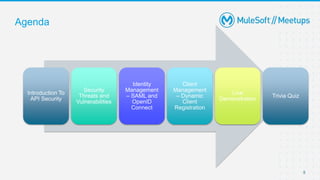
Agenda
Introduction To
API Security
Security
Threats and
Vulnerabilities
Identity
Management
– SAML and
OpenID
Connect
Client
Management
– Dynamic
Client
Registration
Live
Demonstration
Trivia Quiz
What is API Security?
7
API Security is an essentials elements of the applications, especially in regards to APIs where
you have hundreds or thousands of calls on daily basis.
Everyday new threats and vulnerabilities are created and in such case it is very important to
secure the APIs.
MuleSoft provided the API manager which can minimize the risks from attacks like DDoS, DoS or
any security vulnerabilities.
API manager provides option for creating the API proxy for the backend API running on Anypoint
platform and thereby secures requests coming into the platform again the API.
What is API Security?
8
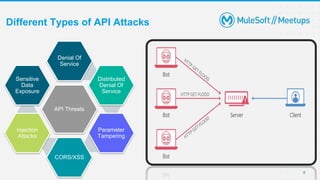
Different Types of API Attacks
API Threats
Denial Of
Service
Distributed
Denial Of
Service
Parameter
Tampering
CORS/XSS
Injection
Attacks
Sensitive
Data
Exposure
9
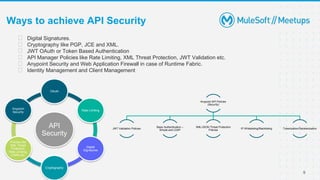
⮚ Digital Signatures.
⮚ Cryptography like PGP, JCE and XML.
⮚ JWT OAuth or Token Based Authentication
⮚ API Manager Policies like Rate Limiting, XML Threat Protection, JWT Validation etc.
⮚ Anypoint Security and Web Application Firewall in case of Runtime Fabric.
⮚ Identity Management and Client Management
Ways to achieve API Security
API
Security
OAuth
Rate Limiting
Digital
Signatures
Cryptography
Policies like
XML Threat
Protection,
Rate Limiting,
CORS etc.
Anypoint
Security
Anypoint API Policies
(Security)
JWT Validation Policies
Basic Authentication –
Simple and LDAP
XML/JSON Threat Protection
Policies
IP Whitelisting/Blacklisting Tokenization/Detokenization
10
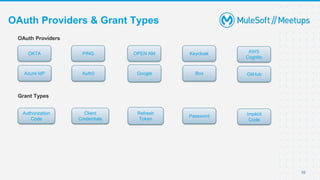
OAuth Providers
Grant Types
OAuth Providers & Grant Types
OKTA PING OPEN AM Keycloak AWS
Cognito
Azure IdP Auth0 Google Box GitHub
Authorization
Code
Client
Credentials
Refresh
Token
Password Implicit
Code
11
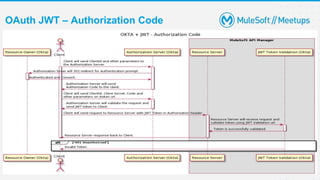
OAuth JWT – Authorization Code
12
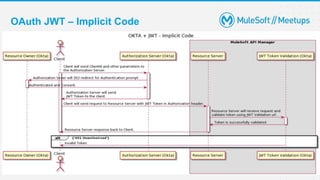
OAuth JWT – Implicit Code
13
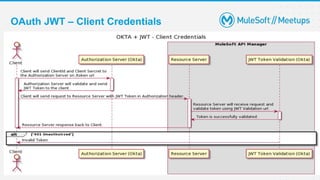
OAuth JWT – Client Credentials
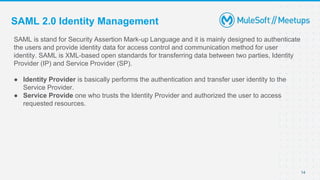
SAML 2.0 Identity Management
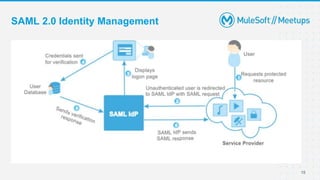
SAML is stand for Security Assertion Mark-up Language and it is mainly designed to authenticate
the users and provide identity data for access control and communication method for user
identity. SAML is XML-based open standards for transferring data between two parties, Identity
Provider (IP) and Service Provider (SP).
● Identity Provider is basically performs the authentication and transfer user identity to the
Service Provider.
● Service Provide one who trusts the Identity Provider and authorized the user to access
requested resources.
14
SAML 2.0 Identity Management
15
16
OpenID Connect extends OAuth 2.0. The OAuth 2.0 protocol provides API security via scoped
access tokens, and OpenID Connect provides user authentication and single sign-on (SSO)
functionality.
As the Anypoint Platform organization administrator, you can configure identity management in
Anypoint Platform to set up users for single sign-on (SSO). Configure identity management using
one of the following single sign-on standards:
● OpenID Connect: End user identity verification by an authorization server including SSO.
● SAML 2.0: Web-based authorization including cross-domain SSO.
OpenID Connect Identity Management
17
SAML (SAML 1.0 and 2.0) and OpenID Connect (OIDC) are identity protocols, designed to
authenticate users, and provide identity data for access control and as a communication method
for a user’s identity.
Mainly used for Enterprise and Government applications, SAML 2.0 is a mature technology
dating from 2005 and supports a wide range of identity functionality. SAML uses XML for its
identity data format and simple HTTP or SOAP for data transport mechanisms.
A relatively new protocol, continuously evolving, OIDC was designed with web and mobile
applications in mind. Designed to be easy to adopt and use, OIDC is an extension of OAuth2,
with data structures in JSON format (JWT), and simple HTTPS flows for transport.
SAML V/S OpenID Connect
18
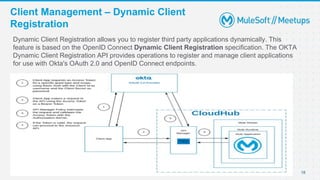
Dynamic Client Registration allows you to register third party applications dynamically. This
feature is based on the OpenID Connect Dynamic Client Registration specification. The OKTA
Dynamic Client Registration API provides operations to register and manage client applications
for use with Okta's OAuth 2.0 and OpenID Connect endpoints.
Client Management – Dynamic Client
Registration
Demonstration
1. Identity Management With OpenID Connect
2. Client Management With OpenID Connect –
Dynamic Client Registration
3. Identity Management With SAML
Thank you!

Identity and Client Management using OpenID Connect and SAML

  • 1.
    [8th May 2021] [Coimbatore]MuleSoft Meetup Group Identity and Client Management With MuleSoft
  • 2.
  • 3.
    3 Speakers Jitendra Bafna Senior SolutionArchitect Capgemini About the speaker:  Working as Senior Solution Architect at Capgemini.  MuleSoft Ambassador  Surat MuleSoft Meetup Leader.  12.5+ Years of Experience in Integrations and API Technologies.  Certified MuleSoft Integration Architect and platform Architect.
  • 4.
    CHEERS..!! We have prizesto give away! 3 Winners a special prize is ready 4 A SHOW OF HANDS: New Members With Us.!!
  • 5.
    5 Agenda Introduction To API Security Security Threatsand Vulnerabilities Identity Management – SAML and OpenID Connect Client Management – Dynamic Client Registration Live Demonstration Trivia Quiz
  • 6.
    What is APISecurity?
  • 7.
    7 API Security isan essentials elements of the applications, especially in regards to APIs where you have hundreds or thousands of calls on daily basis. Everyday new threats and vulnerabilities are created and in such case it is very important to secure the APIs. MuleSoft provided the API manager which can minimize the risks from attacks like DDoS, DoS or any security vulnerabilities. API manager provides option for creating the API proxy for the backend API running on Anypoint platform and thereby secures requests coming into the platform again the API. What is API Security?
  • 8.
    8 Different Types ofAPI Attacks API Threats Denial Of Service Distributed Denial Of Service Parameter Tampering CORS/XSS Injection Attacks Sensitive Data Exposure
  • 9.
    9 ⮚ Digital Signatures. ⮚Cryptography like PGP, JCE and XML. ⮚ JWT OAuth or Token Based Authentication ⮚ API Manager Policies like Rate Limiting, XML Threat Protection, JWT Validation etc. ⮚ Anypoint Security and Web Application Firewall in case of Runtime Fabric. ⮚ Identity Management and Client Management Ways to achieve API Security API Security OAuth Rate Limiting Digital Signatures Cryptography Policies like XML Threat Protection, Rate Limiting, CORS etc. Anypoint Security Anypoint API Policies (Security) JWT Validation Policies Basic Authentication – Simple and LDAP XML/JSON Threat Protection Policies IP Whitelisting/Blacklisting Tokenization/Detokenization
  • 10.
    10 OAuth Providers Grant Types OAuthProviders & Grant Types OKTA PING OPEN AM Keycloak AWS Cognito Azure IdP Auth0 Google Box GitHub Authorization Code Client Credentials Refresh Token Password Implicit Code
  • 11.
    11 OAuth JWT –Authorization Code
  • 12.
    12 OAuth JWT –Implicit Code
  • 13.
    13 OAuth JWT –Client Credentials
  • 14.
    SAML 2.0 IdentityManagement SAML is stand for Security Assertion Mark-up Language and it is mainly designed to authenticate the users and provide identity data for access control and communication method for user identity. SAML is XML-based open standards for transferring data between two parties, Identity Provider (IP) and Service Provider (SP). ● Identity Provider is basically performs the authentication and transfer user identity to the Service Provider. ● Service Provide one who trusts the Identity Provider and authorized the user to access requested resources. 14
  • 15.
    SAML 2.0 IdentityManagement 15
  • 16.
    16 OpenID Connect extendsOAuth 2.0. The OAuth 2.0 protocol provides API security via scoped access tokens, and OpenID Connect provides user authentication and single sign-on (SSO) functionality. As the Anypoint Platform organization administrator, you can configure identity management in Anypoint Platform to set up users for single sign-on (SSO). Configure identity management using one of the following single sign-on standards: ● OpenID Connect: End user identity verification by an authorization server including SSO. ● SAML 2.0: Web-based authorization including cross-domain SSO. OpenID Connect Identity Management
  • 17.
    17 SAML (SAML 1.0and 2.0) and OpenID Connect (OIDC) are identity protocols, designed to authenticate users, and provide identity data for access control and as a communication method for a user’s identity. Mainly used for Enterprise and Government applications, SAML 2.0 is a mature technology dating from 2005 and supports a wide range of identity functionality. SAML uses XML for its identity data format and simple HTTP or SOAP for data transport mechanisms. A relatively new protocol, continuously evolving, OIDC was designed with web and mobile applications in mind. Designed to be easy to adopt and use, OIDC is an extension of OAuth2, with data structures in JSON format (JWT), and simple HTTPS flows for transport. SAML V/S OpenID Connect
  • 18.
    18 Dynamic Client Registrationallows you to register third party applications dynamically. This feature is based on the OpenID Connect Dynamic Client Registration specification. The OKTA Dynamic Client Registration API provides operations to register and manage client applications for use with Okta's OAuth 2.0 and OpenID Connect endpoints. Client Management – Dynamic Client Registration
  • 19.
    Demonstration 1. Identity ManagementWith OpenID Connect 2. Client Management With OpenID Connect – Dynamic Client Registration 3. Identity Management With SAML
  • 20.