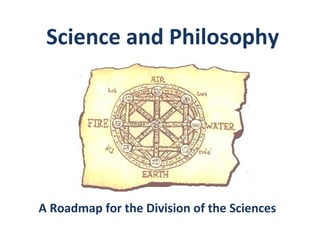
Science and Philosophy A Roadmap for the Division of the Sciences
I. Definition of “Science” ( Scientia ) Nominal Definition The term “science” is derived form the Latin  scientia , which means “knowledge.” Scientia  is an abstract noun derived from the verb  scio, “ to know.” “ Science,” therefore, nominally means “knowledge.”
I. Definition of “Science” ( Scientia ) B. The Nominal Definition: Not Enough But nominal definitions only tell us what the word  means , i.e., they only allow us to identify the  referent  of the word, what the word  refers to. Nominal definitions do not tell us what the  essence of the referent  is. Obviously, science is not just any kind of knowledge… So, what exactly is the essence of this knowledge that we call “science”? In other words, what is the  real  definition of “science”?
I. Definition of “Science” ( Scientia ) C. Real Definition Aristotle and Aquinas define “science” ( scientia ) as “knowledge through causes” ( cognitio per causas ). That is, for knowledge to be scientific, it must be a knowledge of  why  something is, and not just of the mere  fact  that it is . Science gives  reasons  for things.
II. “Science” Taken Objectively and Subjectively All knowledge implies a knowing subject and a known object. Science, because it is a kind of knowledge, may be thought of  objectively , or  subjectively . Objectively , “science” refers to the concepts that are known scientifically: the body of knowledge which is handed down from scientist to scientist. Subjectively , “science” refers to an intellectual virtue, a good habit in the intellect of the scientist.
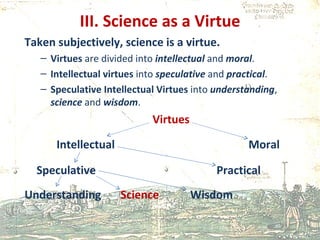
III. Science as a Virtue Taken subjectively, science is a virtue. Virtues  are divided into  intellectual   and  moral . Intellectual   virtues  into  speculative  and  practical . Speculative Intellectual Virtues  into  understanding ,  science  and  wisdom . Virtues Intellectual  Moral Speculative      Practical Understanding Science   Wisdom
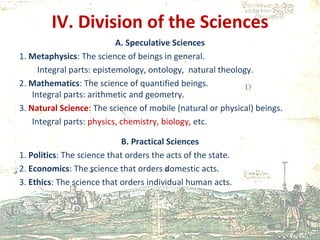
IV. Division of the Sciences A. Speculative Sciences 1.  Metaphysics : The science of beings in general. Integral parts: epistemology, ontology,  natural theology. 2.  Mathematics : The science of quantified beings. Integral parts: arithmetic and geometry. 3.  Natural Science : The science of mobile (natural or physical) beings. Integral parts:  physics, chemistry, biology,  etc.  B. Practical Sciences 1.  Politics : The science that orders the acts of the state. 2.  Economics : The science that orders domestic acts. 3.  Ethics : The science that orders individual human acts.
V. “Science” and the Sciences Our modern popular concept of “science” is (almost) coextensive concept of  natural  science. So, as you can see, our modern popular concept of “science” is too narrow.  “ Science” is broader than natural science.  There are sciences that are not part of natural science.  One obvious case is mathematics, which is a science, yet not natural science. And there are other sciences (knowledge through causes), which are neither empirical nor mathematical.
VI. Science and Philosophy Questions at this Point: But what does all this have to do with philosophy? How exactly does ‘philosophy’ fit into all of this? You may be Thinking: Philosophy is not listed: it belongs to the humanities, not to the sciences. Philosophy is not listed: it belongs to the arts, not to the sciences. But the Truth of the Matter Is: Philosophy is not listed because it is  coextensive  with science….
VI. Science and Philosophy Nominal Definition of “ Philosophy”  ( φιλοσοφια ) 1.  Philo  ( φιλο )   = Greek term for “love.” 2.  Sophia  ( σοφια )  = Greek term for “wisdom.” 3. So  “philosophy” means “love of wisdom,”  because it is a  search or pursuit for wisdom.
VI. Science and Philosophy  The Story of Pythagoras  (St Thomas Aquinas,  Commentary on Aristotle’s Metaphysics  Bk. I, L. 3, n. 56.):  While the ancients who pursued the study of wisdom were called sophists ( sophoi ) ,  i.e., wise men,  Pythagoras, when asked what he professed himself to be, refused to call himself a wise man ( sophos )  as his predecessors had done, because he thought this was presumptuous,  but called himself a philosopher ( philosophos ) ,  i.e., a lover of wisdom . And from that time the name “wise man” was changed to “philosopher,” and “wisdom” to “philosophy.
VI. Science and Philosophy Three Senses of “ Philosophy” The term “philosophy,” as a search for wisdom, can have at least three meanings or usages.  The term can be used:  1. As coextensive with  Science  in general, and  especially those elements of each science that are most directly a search for wisdom ––this is St Thomas’s usage  and this is how we will understand it in this course. 2. As coextensive with  Metaphysics  (which is the science that most directly searches wisdom)– this is the Aristotle’s special usage. 3. As referring to a study of reality that is separate and independent from the sciences — this is the modern-day usage:  and we will reject this usage in this course .
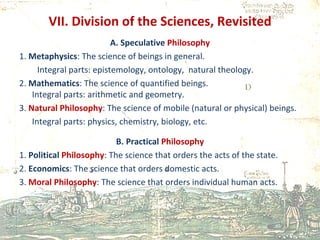
VII. Division of the Sciences, Revisited A. Speculative  Philosophy 1.  Metaphysics : The science of beings in general. Integral parts: epistemology, ontology,  natural theology. 2.  Mathematics : The science of quantified beings. Integral parts: arithmetic and geometry. 3.  Natural Philosophy : The science of mobile (natural or physical) beings. Integral parts: physics, chemistry, biology, etc.  B. Practical  Philosophy 1.  Political  Philosophy : The science that orders the acts of the state. 2.  Economics : The science that orders domestic acts. 3.  Moral Philosophy : The science that orders individual human acts.

Divisionofsciences

  • 1.
    Science and PhilosophyA Roadmap for the Division of the Sciences
  • 2.
    I. Definition of“Science” ( Scientia ) Nominal Definition The term “science” is derived form the Latin scientia , which means “knowledge.” Scientia is an abstract noun derived from the verb scio, “ to know.” “ Science,” therefore, nominally means “knowledge.”
  • 3.
    I. Definition of“Science” ( Scientia ) B. The Nominal Definition: Not Enough But nominal definitions only tell us what the word means , i.e., they only allow us to identify the referent of the word, what the word refers to. Nominal definitions do not tell us what the essence of the referent is. Obviously, science is not just any kind of knowledge… So, what exactly is the essence of this knowledge that we call “science”? In other words, what is the real definition of “science”?
  • 4.
    I. Definition of“Science” ( Scientia ) C. Real Definition Aristotle and Aquinas define “science” ( scientia ) as “knowledge through causes” ( cognitio per causas ). That is, for knowledge to be scientific, it must be a knowledge of why something is, and not just of the mere fact that it is . Science gives reasons for things.
  • 5.
    II. “Science” TakenObjectively and Subjectively All knowledge implies a knowing subject and a known object. Science, because it is a kind of knowledge, may be thought of objectively , or subjectively . Objectively , “science” refers to the concepts that are known scientifically: the body of knowledge which is handed down from scientist to scientist. Subjectively , “science” refers to an intellectual virtue, a good habit in the intellect of the scientist.
  • 6.
    III. Science asa Virtue Taken subjectively, science is a virtue. Virtues are divided into intellectual and moral . Intellectual virtues into speculative and practical . Speculative Intellectual Virtues into understanding , science and wisdom . Virtues Intellectual Moral Speculative Practical Understanding Science Wisdom
  • 7.
    IV. Division ofthe Sciences A. Speculative Sciences 1. Metaphysics : The science of beings in general. Integral parts: epistemology, ontology, natural theology. 2. Mathematics : The science of quantified beings. Integral parts: arithmetic and geometry. 3. Natural Science : The science of mobile (natural or physical) beings. Integral parts: physics, chemistry, biology, etc. B. Practical Sciences 1. Politics : The science that orders the acts of the state. 2. Economics : The science that orders domestic acts. 3. Ethics : The science that orders individual human acts.
  • 8.
    V. “Science” andthe Sciences Our modern popular concept of “science” is (almost) coextensive concept of natural science. So, as you can see, our modern popular concept of “science” is too narrow. “ Science” is broader than natural science. There are sciences that are not part of natural science. One obvious case is mathematics, which is a science, yet not natural science. And there are other sciences (knowledge through causes), which are neither empirical nor mathematical.
  • 9.
    VI. Science andPhilosophy Questions at this Point: But what does all this have to do with philosophy? How exactly does ‘philosophy’ fit into all of this? You may be Thinking: Philosophy is not listed: it belongs to the humanities, not to the sciences. Philosophy is not listed: it belongs to the arts, not to the sciences. But the Truth of the Matter Is: Philosophy is not listed because it is coextensive with science….
  • 10.
    VI. Science andPhilosophy Nominal Definition of “ Philosophy” ( φιλοσοφια ) 1. Philo ( φιλο ) = Greek term for “love.” 2. Sophia ( σοφια ) = Greek term for “wisdom.” 3. So “philosophy” means “love of wisdom,” because it is a search or pursuit for wisdom.
  • 11.
    VI. Science andPhilosophy The Story of Pythagoras (St Thomas Aquinas, Commentary on Aristotle’s Metaphysics Bk. I, L. 3, n. 56.): While the ancients who pursued the study of wisdom were called sophists ( sophoi ) , i.e., wise men, Pythagoras, when asked what he professed himself to be, refused to call himself a wise man ( sophos ) as his predecessors had done, because he thought this was presumptuous, but called himself a philosopher ( philosophos ) , i.e., a lover of wisdom . And from that time the name “wise man” was changed to “philosopher,” and “wisdom” to “philosophy.
  • 12.
    VI. Science andPhilosophy Three Senses of “ Philosophy” The term “philosophy,” as a search for wisdom, can have at least three meanings or usages. The term can be used: 1. As coextensive with Science in general, and especially those elements of each science that are most directly a search for wisdom ––this is St Thomas’s usage and this is how we will understand it in this course. 2. As coextensive with Metaphysics (which is the science that most directly searches wisdom)– this is the Aristotle’s special usage. 3. As referring to a study of reality that is separate and independent from the sciences — this is the modern-day usage: and we will reject this usage in this course .
  • 13.
    VII. Division ofthe Sciences, Revisited A. Speculative Philosophy 1. Metaphysics : The science of beings in general. Integral parts: epistemology, ontology, natural theology. 2. Mathematics : The science of quantified beings. Integral parts: arithmetic and geometry. 3. Natural Philosophy : The science of mobile (natural or physical) beings. Integral parts: physics, chemistry, biology, etc. B. Practical Philosophy 1. Political Philosophy : The science that orders the acts of the state. 2. Economics : The science that orders domestic acts. 3. Moral Philosophy : The science that orders individual human acts.