Diversifying Immediate FeedbackCAIS PresentationMs. Pamela Horrocks&Ms. Shauna CallahanThe Archer School for Girls
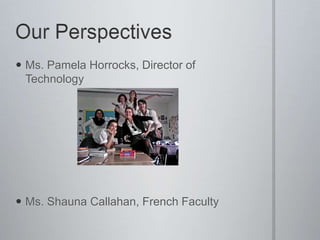
Our PerspectivesMs. Pamela Horrocks, Director of Technology Ms. Shauna Callahan, French Faculty
Defining Immediate FeedbackImmediate feedback provides teachers and students with data. Specifically:Are students’ needs being met?Is the learning target being met?Is the lesson on track to meet the mastery objective?Immediate feedback can be in written or oral formImmediate feedback can be external or internal. Think, pair, share: How do you or your students currently give immediate feedback in your classroom?
Classroom ApplicationStudent: Teacher Teacher: Student Student: StudentStudent: Self
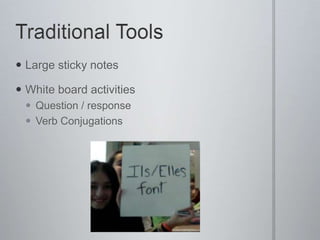
Traditional ToolsLarge sticky notesWhite board activitiesQuestion / responseVerb Conjugations
Digital ToolsPodcasts (recorded in “Garage Band”)Warm-up/Reflection activities: Give students a prompt connecting to your mastery objective. Students will have an opportunity to write their ideas, share with a partner, and then summarize their partners’ ideas.Mini-assessments : Provides students with an opportunity to demonstrate their proficiency in an activity that supports a specific learning objective and the lesson’s mastery objective.
iMovie, iPhoto, Photo BoothiMovieStudents have the opportunity to observe their ability and to apply their knowledge in specific contextsTeacher and peers can actively engage in  observation and commentary of students’ synthesized knowledge and skills in the classroom and beyond.Feedback is more objective and can model skill mastery or learning challenges in the classroom.
A virtual e-pal letter
iPhoto: Slideshow
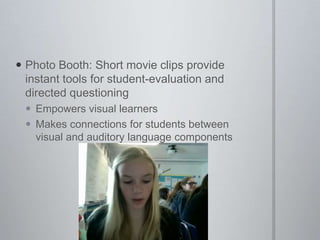
Photo Booth: Short movie clips provide instant tools for student-evaluation and directed questioningEmpowers visual learnersMakes connections for students between visual and auditory language components
Email, Wikis & Voice threadTeacher Feedback: Have my students mastered this material? Teacher to Student and Student to Student Feedback: How are you coming to this thought/analysis/answer?Student to Self: How can I apply the feedback from my teacher and peers to strengthen my skills?Email:Wiki:Voice Thread: www.voicethread.com
Vokis and iPod TouchesVoki: Insert link to Voki Page (avatar)iPod Touches: Voice recording, apps for immediate feedback
Practical Application How can you apply some of the new techniques for immediate feedback in your classroom?Craft an immediate feedback activity with a specific learning target to share with the group.
Pedagogical BenefitsEnabling Teachers and students to effectively evaluate learning process Personalizing students’ connection to materialEmpowering learners to develop life-long learning toolsProviding formative assessment that meets the needs of diverse learning stylesComplementing the 21st century learner

Diversifying Immediate Feedback

  • 1.
    Diversifying Immediate FeedbackCAISPresentationMs. Pamela Horrocks&Ms. Shauna CallahanThe Archer School for Girls
  • 2.
    Our PerspectivesMs. PamelaHorrocks, Director of Technology Ms. Shauna Callahan, French Faculty
  • 3.
    Defining Immediate FeedbackImmediatefeedback provides teachers and students with data. Specifically:Are students’ needs being met?Is the learning target being met?Is the lesson on track to meet the mastery objective?Immediate feedback can be in written or oral formImmediate feedback can be external or internal. Think, pair, share: How do you or your students currently give immediate feedback in your classroom?
  • 4.
    Classroom ApplicationStudent: TeacherTeacher: Student Student: StudentStudent: Self
  • 5.
    Traditional ToolsLarge stickynotesWhite board activitiesQuestion / responseVerb Conjugations
  • 6.
    Digital ToolsPodcasts (recordedin “Garage Band”)Warm-up/Reflection activities: Give students a prompt connecting to your mastery objective. Students will have an opportunity to write their ideas, share with a partner, and then summarize their partners’ ideas.Mini-assessments : Provides students with an opportunity to demonstrate their proficiency in an activity that supports a specific learning objective and the lesson’s mastery objective.
  • 7.
    iMovie, iPhoto, PhotoBoothiMovieStudents have the opportunity to observe their ability and to apply their knowledge in specific contextsTeacher and peers can actively engage in observation and commentary of students’ synthesized knowledge and skills in the classroom and beyond.Feedback is more objective and can model skill mastery or learning challenges in the classroom.
  • 8.
  • 9.
  • 10.
    Photo Booth: Shortmovie clips provide instant tools for student-evaluation and directed questioningEmpowers visual learnersMakes connections for students between visual and auditory language components
  • 11.
    Email, Wikis &Voice threadTeacher Feedback: Have my students mastered this material? Teacher to Student and Student to Student Feedback: How are you coming to this thought/analysis/answer?Student to Self: How can I apply the feedback from my teacher and peers to strengthen my skills?Email:Wiki:Voice Thread: www.voicethread.com
  • 12.
    Vokis and iPodTouchesVoki: Insert link to Voki Page (avatar)iPod Touches: Voice recording, apps for immediate feedback
  • 13.
    Practical Application Howcan you apply some of the new techniques for immediate feedback in your classroom?Craft an immediate feedback activity with a specific learning target to share with the group.
  • 14.
    Pedagogical BenefitsEnabling Teachersand students to effectively evaluate learning process Personalizing students’ connection to materialEmpowering learners to develop life-long learning toolsProviding formative assessment that meets the needs of diverse learning stylesComplementing the 21st century learner

Editor's Notes

  • #2 Digital tools; feedback for classrooms without technology: Traditional; bridge activities; Digital; teacher based/student basedPersonal Info
  • #4 Examples of participants’ experiences with it.Internal vs. External feedback – example (teacher vs. student “driven”) Feedback for me about my students’ experiences; feedback I give to my students that they can immediately apply; providing students with tools and a context to self assess
  • #5 Within each category, we will discuss teacher to student feedback, as well as student self-evaluative feedback
  • #6 Have large sticky notes hung to model this (ask participants what the three types of immediate feedback our presentation will be covering).THINK!Thumb; color cards (look in RBT notebook)
  • #7 How-to specifics (class procedure/process)Examples of how teachers in other disciplines are giving immediate feedbackThe ability for student to listen to herself/ get input from teacher (always available through recording/ listening /playback)
  • #8 Look for other examples/ edit phrasingEDIT WORDING
  • #10 Citations for pictures
  • #12 StudyGuides Analysis and Discussion [Grammar Point; Literature]Voice thread as internal reflection (adjust what they said)Student feedback via email (recording voice through certain email programs) or in Word (oral or written/ notebook mode / record voice in keynote with presentation)
  • #14 Participants share their ideas