DIURETICS
BY:-ANUSHKA DUBEY
DEFINATION
•These are drugs which cause a net loss of
sodium and water in the urine.
• all the diuretics increases the excretion of the
water from the body.
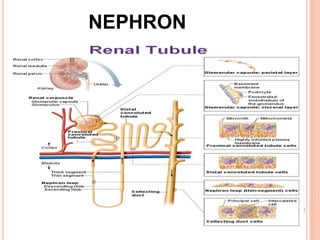
ANATOMY OF KIDNEY
NEPHRON
MOVEMENT OF ELECTROLYTES
MAJOR SITES FOR REABSORPTION
Site 1 :- Proximal Convoluted Tubule (PCT).
Site 2 :- Ascending Loop of Henle.
Site 3 :- Distal Convoluted Tubule (DCT).
Site 4 :- Late Distal Tubule and Collecting Duct.
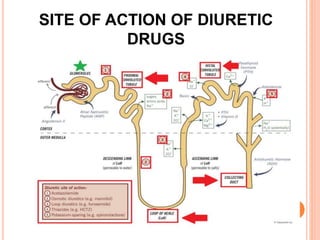
SITE OF ACTION OF DIURETIC
DRUGS
MAJOR CLASSIFICATION
1.) High efficacy diuretics.
2.) Medium efficacy diuretics.
3.) Low efficacy diuretics.
CLASSIFICATION
 There are classified into 6 types:-
1.) Loop diuretics/High ceiling.
2.) Thiazides
3.) Carbonic anhydrase inhibitors.
4.) Potassium-sparing diuretics.
5.) Osmatic diuretics.
6.) Low ceiling diuretics.
HIGH EFFICACY DIURETICS
 Inhibitors of sodium , potassium and chlorides co-
transport.
 Examples :-
1.) Furosemide.
2.) Torasemide.
3.) Ethacrynic acid.
MEDIUM EFFICACY DIURETICS
 Inhibitors of sodium and calcium symport
system.
 Examples :-
1.) Benzthiazide.
2.) Metolazone.
LOW EFFICACY DIURETICS
 It is further divided into 4 sub-class :-
(a) CA inhibitors.
Example:- Acetazolamide.
(b) Potassium-sparing diuretics.
Example:- Spironolactone , Amiloride.
(c) Osmotic diuretics.
Example:- Glycerol, Mannitol.
(d) Xanthines
Example:- Theophlline.
MECHANISM OF DIURETIC DRUGS
MOA on LOOP
LOOP DIURETICS
1.) Site of action :- On Ascending loop of Henle.
2.) Mechanism :- Inhibits the symporter of
Na+/K+/2Cl-
3.) Urine :- Increased excretion of all ions
(sodium, potassium, chloride, magnesium,
calcium as well as bicarbonates.
INDICATIONS & SIDE EFFECTS OF
LOOP DIURETICS
• Loop Diuretics :-
Large volume diuresis.
 Isotonic urine (compared to plasma).
• Indications :-
Edema
• Congestive heart failure.
• Acute pulmonary edema.
• Cirrhosis.
Hypertension.
 Hypercalcemia.
 Forced diuresis.
• Side Effects :-
Excess volume
depletion.
 Hypokalemia.
 Hypocalcemia.
 Hypomagnesemia.
 Ototoxicity.
THIAZIDE
 Act in the distal tubule.
 Inhibits reabsorption of sodium and potassium.
 Stimulate the reabsorption of calcium.
 Loss of water as urine.
 Adverse effect :- hyperglycemia, hyperlipidemia,
Hypotension, Electrolyte imbalance and
Hypersensitivity.
MOA of DISTAL TUBULE
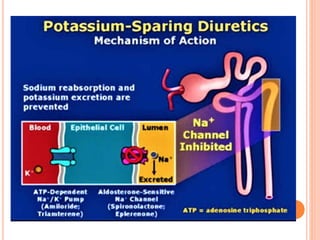
POTASSIUM-SPARING DIURETICS
 The potassium is retained inside the body which
prevents the loss of potassium in the urine.
◦ Aldosterone joins the sodium channels in the cells of
collecting duct and lately to the distal tubule in the
nephron.
◦ But spironolactone blocks the entry of aldosterone into
the cells which prevents the reabsorption of sodium.
Mechanism of the drug :- Spironolactone
◦ Binds with the aldosterone receptor that prevents the
hormone from binding to the receptor.
◦ This binding is competitive.
OSMOTIC DIURETICS
 Rise in the osmotic pressure of the plasma which
draws water out from the tissue and produces the
osmotic diuresis.
 Sodium excretion does not get effected.
 The compounds are filtered by glomerulus but can
not be reabsorbed.
 This osmotic balance prevents the loss of water in
the urine.
CARBONIC ANHYDRASE INHIBITORS
 CA Inhibitors inhibits the enzyme that is
present in the proximal tubule of the nephron.
 This inhibition leads to retention of several
electrolytes like bicarbonates, magnesium, etc.
 Sodium reabsorption is prevented or
decreased in the cell.
MEDICINAL USES
Diuretics are used to treat:-
1.) Heart failure.
2.) Liver cirrhosis.
3.) Hypertension.
4.) Certain kidney diseases.
5.) Cerebral edema.
6.) Reduction of intracranial pressure.
7.) Reduction of certain toxins.
8.) Hypercalciuria.
USES AND SIDE EFFECTS OF DIURETICS
REFERENCE
1.) Textbook of Pharmacology.
2.) Book of Medicinal Chemistry.
3.) Medical book of Pharmacotherapeutics.
Diuretics

Diuretics

  • 1.
  • 2.
    DEFINATION •These are drugswhich cause a net loss of sodium and water in the urine. • all the diuretics increases the excretion of the water from the body.
  • 3.
  • 4.
  • 5.
  • 6.
    MAJOR SITES FORREABSORPTION Site 1 :- Proximal Convoluted Tubule (PCT). Site 2 :- Ascending Loop of Henle. Site 3 :- Distal Convoluted Tubule (DCT). Site 4 :- Late Distal Tubule and Collecting Duct.
  • 7.
    SITE OF ACTIONOF DIURETIC DRUGS
  • 8.
    MAJOR CLASSIFICATION 1.) Highefficacy diuretics. 2.) Medium efficacy diuretics. 3.) Low efficacy diuretics.
  • 9.
    CLASSIFICATION  There areclassified into 6 types:- 1.) Loop diuretics/High ceiling. 2.) Thiazides 3.) Carbonic anhydrase inhibitors. 4.) Potassium-sparing diuretics. 5.) Osmatic diuretics. 6.) Low ceiling diuretics.
  • 10.
    HIGH EFFICACY DIURETICS Inhibitors of sodium , potassium and chlorides co- transport.  Examples :- 1.) Furosemide. 2.) Torasemide. 3.) Ethacrynic acid.
  • 11.
    MEDIUM EFFICACY DIURETICS Inhibitors of sodium and calcium symport system.  Examples :- 1.) Benzthiazide. 2.) Metolazone.
  • 12.
    LOW EFFICACY DIURETICS It is further divided into 4 sub-class :- (a) CA inhibitors. Example:- Acetazolamide. (b) Potassium-sparing diuretics. Example:- Spironolactone , Amiloride. (c) Osmotic diuretics. Example:- Glycerol, Mannitol. (d) Xanthines Example:- Theophlline.
  • 13.
  • 14.
  • 15.
    LOOP DIURETICS 1.) Siteof action :- On Ascending loop of Henle. 2.) Mechanism :- Inhibits the symporter of Na+/K+/2Cl- 3.) Urine :- Increased excretion of all ions (sodium, potassium, chloride, magnesium, calcium as well as bicarbonates.
  • 16.
    INDICATIONS & SIDEEFFECTS OF LOOP DIURETICS • Loop Diuretics :- Large volume diuresis.  Isotonic urine (compared to plasma). • Indications :- Edema • Congestive heart failure. • Acute pulmonary edema. • Cirrhosis. Hypertension.  Hypercalcemia.  Forced diuresis. • Side Effects :- Excess volume depletion.  Hypokalemia.  Hypocalcemia.  Hypomagnesemia.  Ototoxicity.
  • 17.
    THIAZIDE  Act inthe distal tubule.  Inhibits reabsorption of sodium and potassium.  Stimulate the reabsorption of calcium.  Loss of water as urine.  Adverse effect :- hyperglycemia, hyperlipidemia, Hypotension, Electrolyte imbalance and Hypersensitivity.
  • 18.
  • 19.
    POTASSIUM-SPARING DIURETICS  Thepotassium is retained inside the body which prevents the loss of potassium in the urine. ◦ Aldosterone joins the sodium channels in the cells of collecting duct and lately to the distal tubule in the nephron. ◦ But spironolactone blocks the entry of aldosterone into the cells which prevents the reabsorption of sodium. Mechanism of the drug :- Spironolactone ◦ Binds with the aldosterone receptor that prevents the hormone from binding to the receptor. ◦ This binding is competitive.
  • 21.
    OSMOTIC DIURETICS  Risein the osmotic pressure of the plasma which draws water out from the tissue and produces the osmotic diuresis.  Sodium excretion does not get effected.  The compounds are filtered by glomerulus but can not be reabsorbed.  This osmotic balance prevents the loss of water in the urine.
  • 22.
    CARBONIC ANHYDRASE INHIBITORS CA Inhibitors inhibits the enzyme that is present in the proximal tubule of the nephron.  This inhibition leads to retention of several electrolytes like bicarbonates, magnesium, etc.  Sodium reabsorption is prevented or decreased in the cell.
  • 23.
    MEDICINAL USES Diuretics areused to treat:- 1.) Heart failure. 2.) Liver cirrhosis. 3.) Hypertension. 4.) Certain kidney diseases. 5.) Cerebral edema. 6.) Reduction of intracranial pressure. 7.) Reduction of certain toxins. 8.) Hypercalciuria.
  • 24.
    USES AND SIDEEFFECTS OF DIURETICS
  • 25.
    REFERENCE 1.) Textbook ofPharmacology. 2.) Book of Medicinal Chemistry. 3.) Medical book of Pharmacotherapeutics.