Introduction	 to -Raghunath Soman(with valuable inputs from Taher Oliya)
What is DITA?DITA stands for Darwin Information Type ArchitectureXML-based, open-source documentation frameworkOriginally created by IBM, currently managed by OASIS committeeLatest specification version is 1.2
Why DITA?Enforces structured authoringFacilitates content re-useSupports single-sourcingReduces translation costsAllows extension in form of specializationsEffective for collaborative documentation projectsEnables conditional processing based on target audienceGenerates output in all major formats: PDF, CHM, WebHelp, RTF, JavaHelp
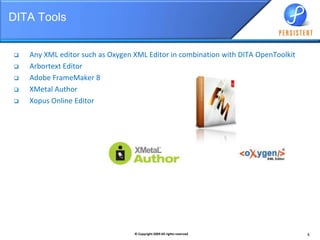
DITA ToolsAny XML editor such as Oxygen XML Editor in combination with DITA OpenToolkitArbortext EditorAdobe FrameMaker 8XMetal AuthorXopus Online Editor
DITA ConceptsSchema: base document that outlines the structure of XMLTopics: generic document typeConcepts:  subjective information such as definitions, explanation, guidelinesReferences: factual details, such as API description, command syntaxTasks: describes how to perform a specific procedureDITA Maps: logical organization of concepts, tasks and referencesBookmaps:  special kind of DITA map that defines the major structures for producing documentation as a book.Relationship TablesDITA elements and their attributesAs of now, there are approximately 300 elements (tags) in DITA.Each element has a number of attributes specific to that element.
DITA SpecializationsSpecialization feature of DITA allows extension of the core framework by adding  industry-specific topic types, elements and attributes.Specialization is broadly categorized into two types:Topic specialization: creating new topic typesDomain specialization: creating new elements and attributesExamples of topic specialization are:Message specializationBookmap specializationExamples of domain specialization are:Training specializationSemiconductor industry specialization
Rules & Benefits of SpecializationBasic Rules:The new information type and element must map to an existing one.The new information type must be more restrictive than the existing one in the content that they allow.For each new information type or topic specialization, a new DTD or a schema must be created.Major Benefits:Avoid re-inventing the wheel by re-using the base vocabularyEnables customized output  with more specific search, filtering, and reuseMaintain consistency across multi-author teams  Enforces explicit support of product architectural requirements
DITA Best PracticesNOTE: These guidelines are only suggestions for best approach, and can/should be modified as per project-specific style guides.Analyze the content and break it into concepts, tasks and references.Avoid spaces in file names and folder names. Maintain a consistent naming convention across all file names.Nesting of multiple topics within  a single file is discouraged.All root nodes should contain both a  <title> and a <shortdesc> node immediately after it. Short description should be about 50 words long. Use complete sentences, and not sentence fragments. Do not merely re-state the topic title in different words. Use appropriate elements and attributes that best suit the content semantic. For example, use <ul>, <ol> and <dl> to enumerate bullets, numbers or definitions  respectively.
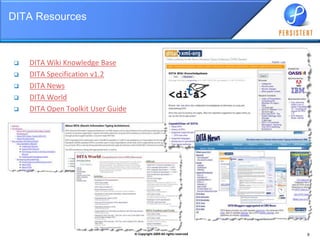
DITA ResourcesDITA Wiki Knowledge BaseDITA Specification v1.2DITA NewsDITA WorldDITA Open Toolkit User Guide
Happy Learning in DITA…Thank You!

DITA introduction

  • 1.
    Introduction to -RaghunathSoman(with valuable inputs from Taher Oliya)
  • 2.
    What is DITA?DITAstands for Darwin Information Type ArchitectureXML-based, open-source documentation frameworkOriginally created by IBM, currently managed by OASIS committeeLatest specification version is 1.2
  • 3.
    Why DITA?Enforces structuredauthoringFacilitates content re-useSupports single-sourcingReduces translation costsAllows extension in form of specializationsEffective for collaborative documentation projectsEnables conditional processing based on target audienceGenerates output in all major formats: PDF, CHM, WebHelp, RTF, JavaHelp
  • 4.
    DITA ToolsAny XMLeditor such as Oxygen XML Editor in combination with DITA OpenToolkitArbortext EditorAdobe FrameMaker 8XMetal AuthorXopus Online Editor
  • 5.
    DITA ConceptsSchema: basedocument that outlines the structure of XMLTopics: generic document typeConcepts: subjective information such as definitions, explanation, guidelinesReferences: factual details, such as API description, command syntaxTasks: describes how to perform a specific procedureDITA Maps: logical organization of concepts, tasks and referencesBookmaps: special kind of DITA map that defines the major structures for producing documentation as a book.Relationship TablesDITA elements and their attributesAs of now, there are approximately 300 elements (tags) in DITA.Each element has a number of attributes specific to that element.
  • 6.
    DITA SpecializationsSpecialization featureof DITA allows extension of the core framework by adding industry-specific topic types, elements and attributes.Specialization is broadly categorized into two types:Topic specialization: creating new topic typesDomain specialization: creating new elements and attributesExamples of topic specialization are:Message specializationBookmap specializationExamples of domain specialization are:Training specializationSemiconductor industry specialization
  • 7.
    Rules & Benefitsof SpecializationBasic Rules:The new information type and element must map to an existing one.The new information type must be more restrictive than the existing one in the content that they allow.For each new information type or topic specialization, a new DTD or a schema must be created.Major Benefits:Avoid re-inventing the wheel by re-using the base vocabularyEnables customized output with more specific search, filtering, and reuseMaintain consistency across multi-author teams Enforces explicit support of product architectural requirements
  • 8.
    DITA Best PracticesNOTE:These guidelines are only suggestions for best approach, and can/should be modified as per project-specific style guides.Analyze the content and break it into concepts, tasks and references.Avoid spaces in file names and folder names. Maintain a consistent naming convention across all file names.Nesting of multiple topics within a single file is discouraged.All root nodes should contain both a <title> and a <shortdesc> node immediately after it. Short description should be about 50 words long. Use complete sentences, and not sentence fragments. Do not merely re-state the topic title in different words. Use appropriate elements and attributes that best suit the content semantic. For example, use <ul>, <ol> and <dl> to enumerate bullets, numbers or definitions respectively.
  • 9.
    DITA ResourcesDITA WikiKnowledge BaseDITA Specification v1.2DITA NewsDITA WorldDITA Open Toolkit User Guide
  • 10.
    Happy Learning inDITA…Thank You!