

Keith Schengili-Roberts
Market Researcher and
DITA Evangelist, IXIASOFT
10 Million DITA
Topics Can't Be
Wrong
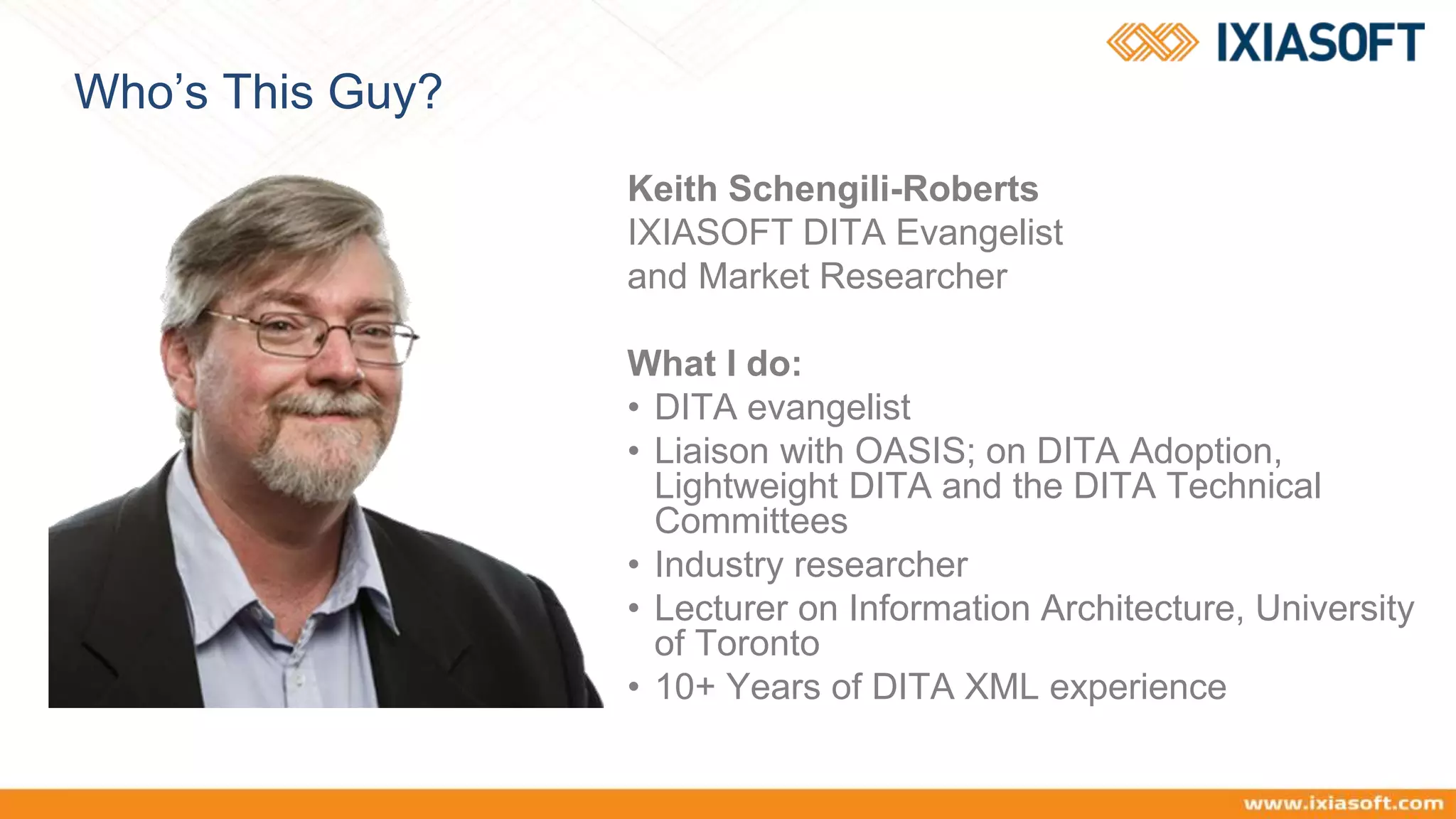
Who’s This Guy?
Keith Schengili-Roberts
IXIASOFT DITA Evangelist
and Market Researcher
What I do:
• DITA evangelist
• Liaison with OASIS; on DITA Adoption,
Lightweight DITA and the DITA Technical
Committees
• Industry researcher
• Lecturer on Information Architecture, University
of Toronto
• 10+ Years of DITA XML experience
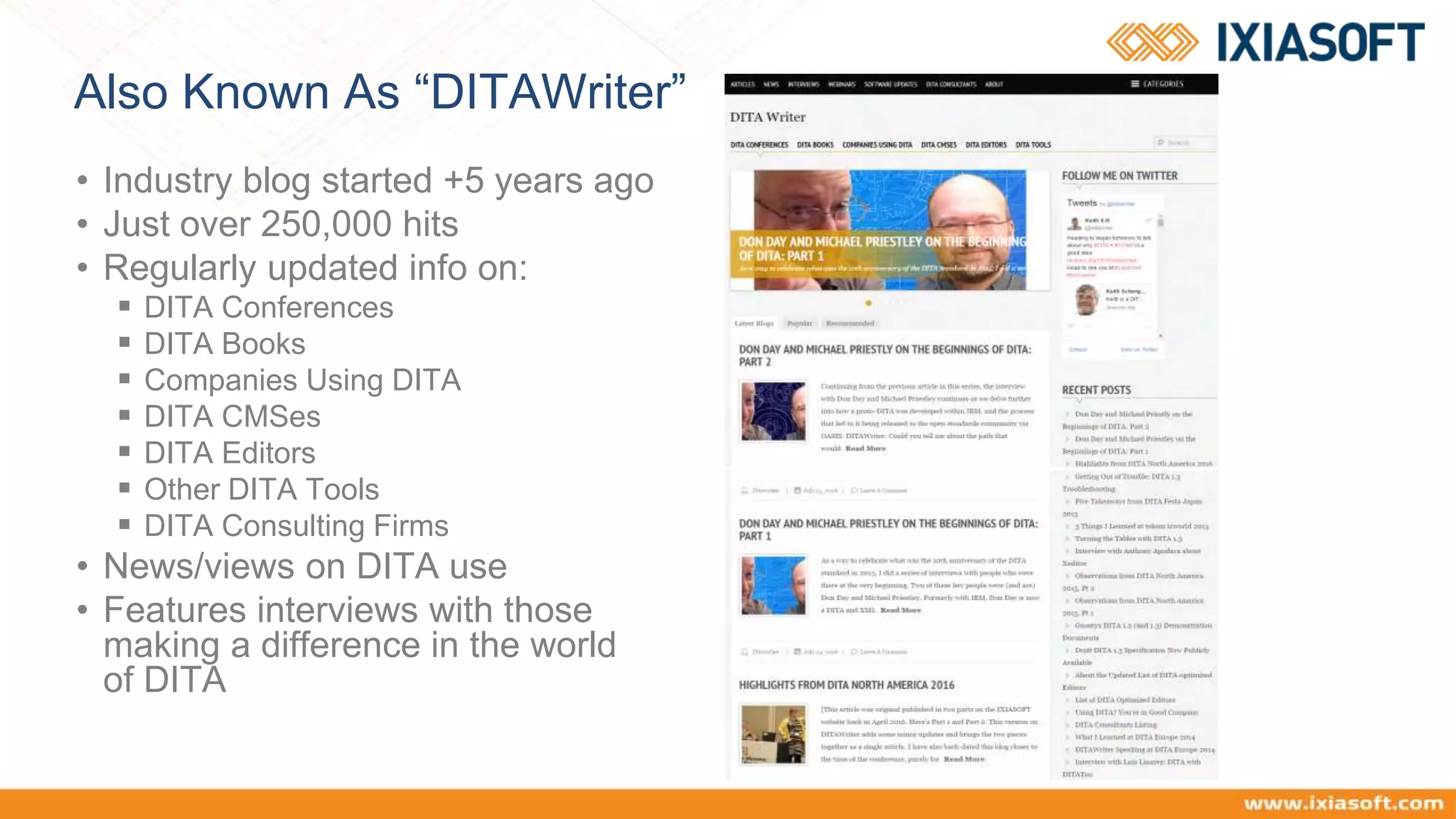
Also Known As “DITAWriter”
• Industry blog started +5 years ago
• Just over 250,000 hits
• Regularly updated info on:
 DITA Conferences
 DITA Books
 Companies Using DITA
 DITA CMSes
 DITA Editors
 Other DITA Tools
 DITA Consulting Firms
• News/views on DITA use
• Features interviews with those
making a difference in the world
of DITA
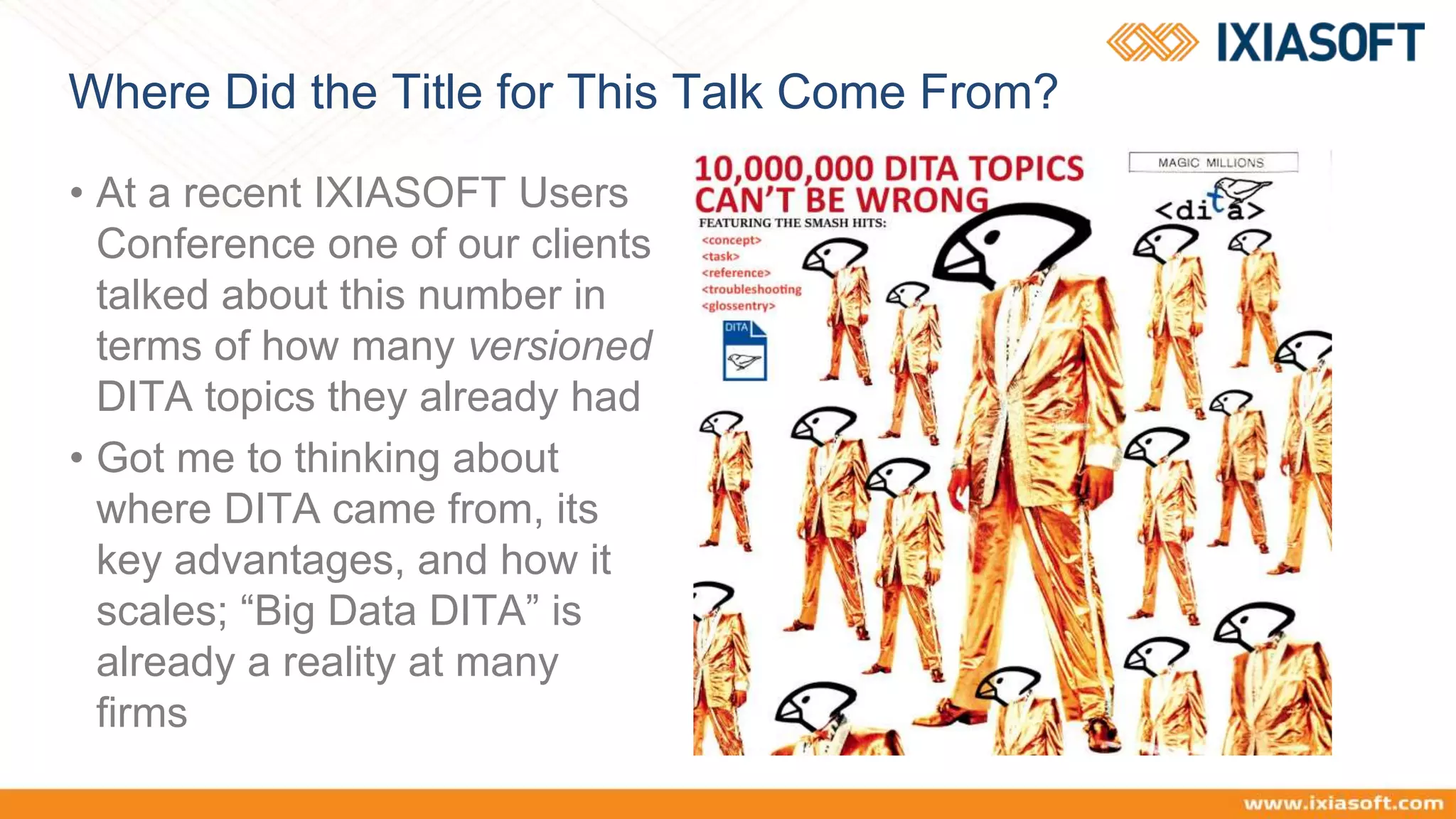
Where Did the Title for This Talk Come From?
• At a recent IXIASOFT Users
Conference one of our clients
talked about this number in
terms of how many versioned
DITA topics they already had
• Got me to thinking about
where DITA came from, its
key advantages, and how it
scales; “Big Data DITA” is
already a reality at many
firms
Starting Small…
• Focus of this talk is how something that
started out small (DITA) has become a big
deal
• Will do a quick survey of main features of
DITA
• Will also look at DITA’s impact on technical
documentation careers
• The specific pain points that DITA
addresses at firms
• A closer look at “Big Data DITA”
What is this DITA Stuff?
• It’s an open XML
standard for creating
structured content built
primarily around the idea
of content reuse
• Has been around for just
over 10 years, has
gained significant
traction in technical
authoring community
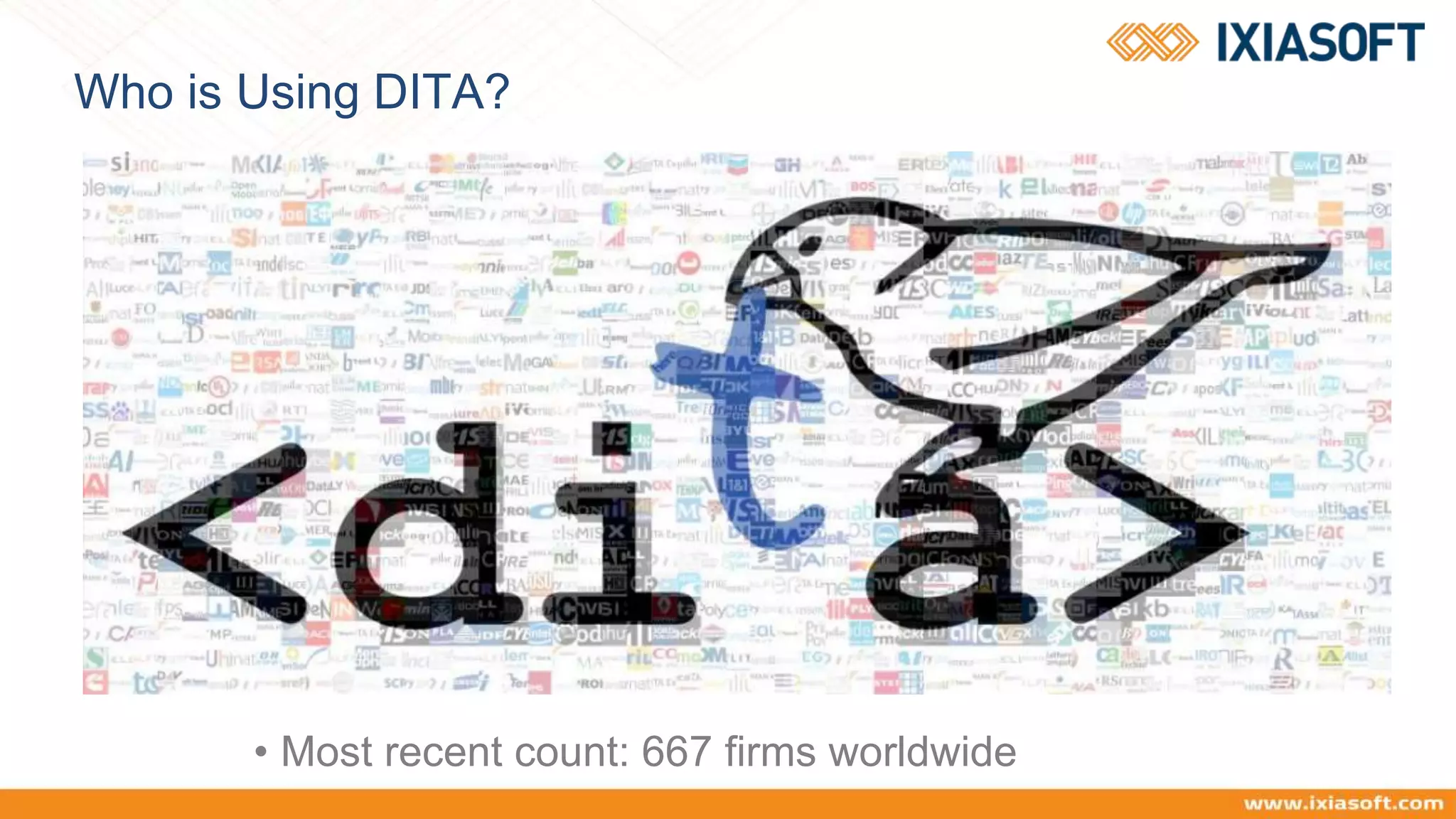
Who is Using DITA?
• Most recent count: 667 firms worldwide
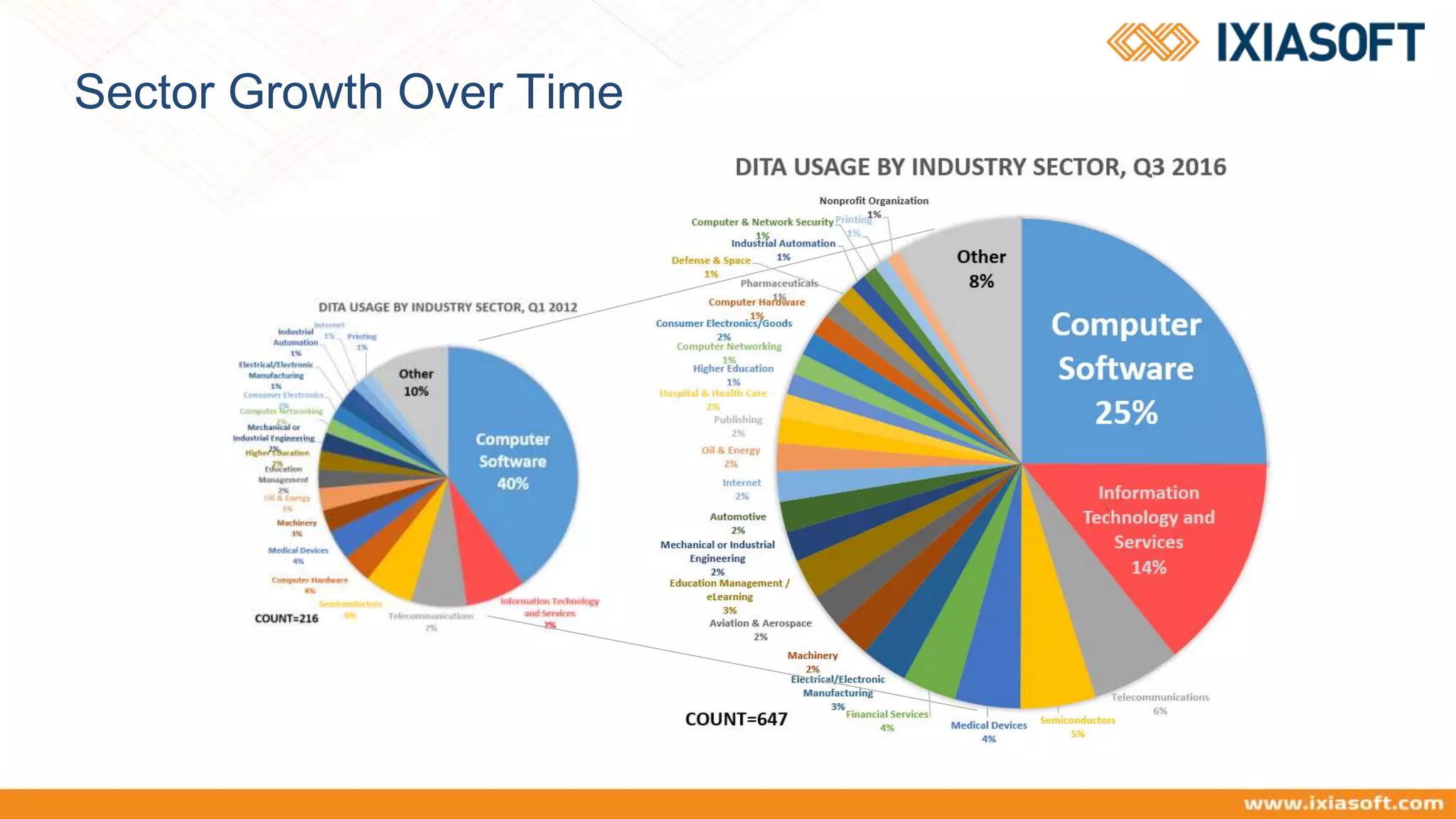
What Sectors are Using DITA?
• Overall trend is
that DITA adoption
is firmly
entrenched in tech-
related sectors and
is moving gradually
into other sectors
Sector Growth Over Time
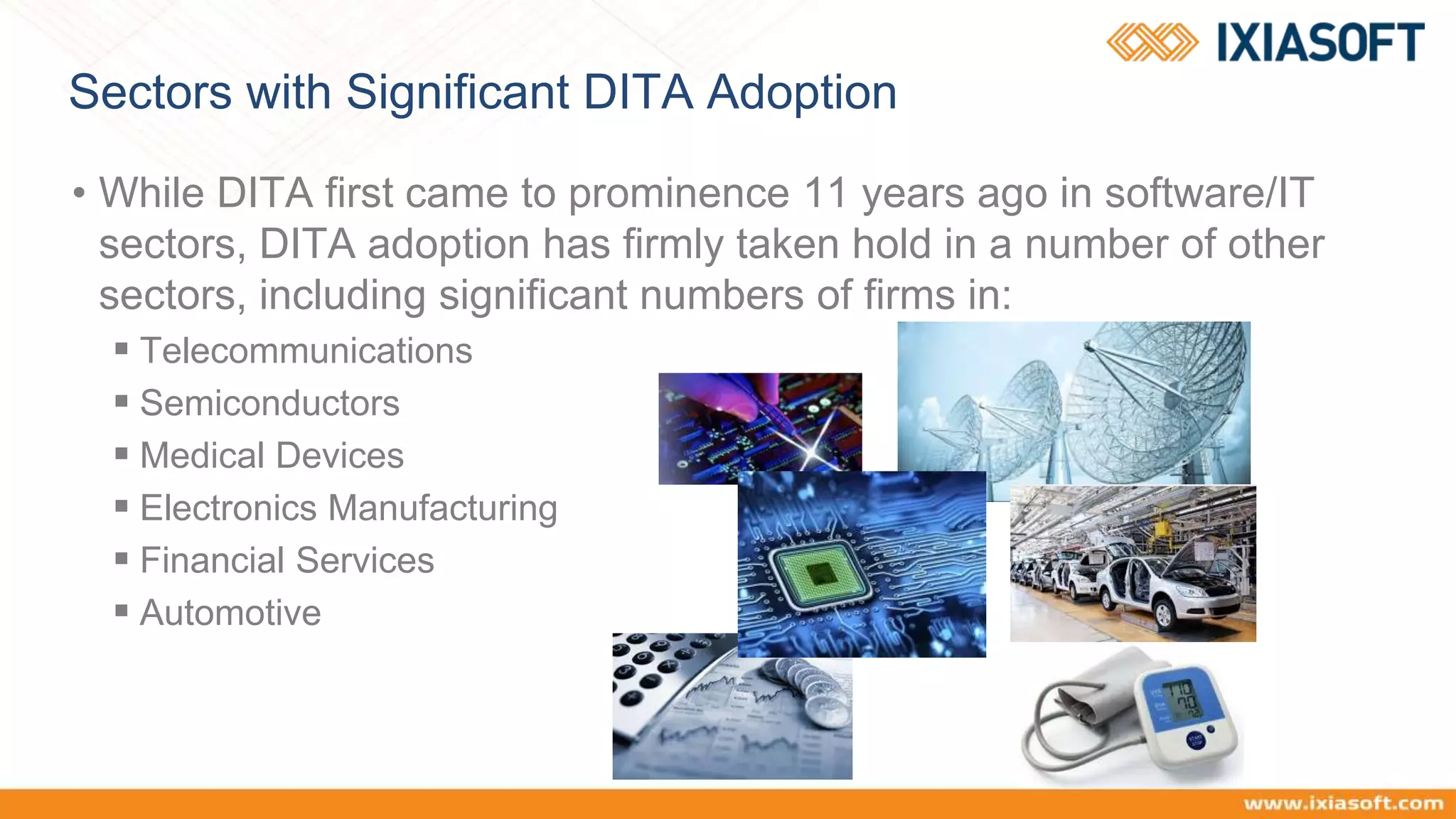
Sectors with Significant DITA Adoption
• While DITA first came to prominence 11 years ago in software/IT
sectors, DITA adoption has firmly taken hold in a number of other
sectors, including significant numbers of firms in:
 Telecommunications
 Semiconductors
 Medical Devices
 Electronics Manufacturing
 Financial Services
 Automotive
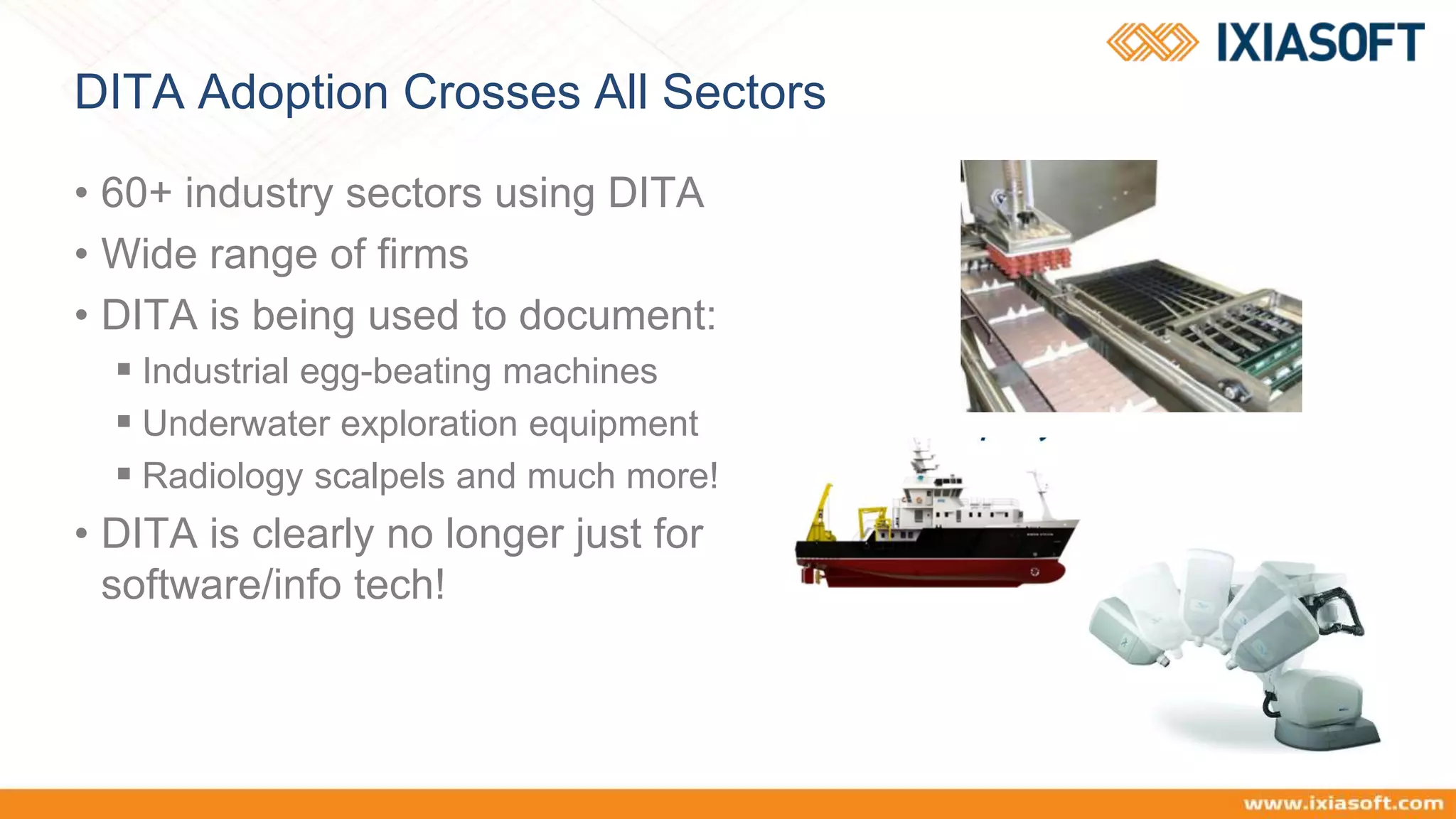
DITA Adoption Crosses All Sectors
• 60+ industry sectors using DITA
• Wide range of firms
• DITA is being used to document:
 Industrial egg-beating machines
 Underwater exploration equipment
 Radiology scalpels and much more!
• DITA is clearly no longer just for
software/info tech!
0
50
100
150
200
250
300
350
FrameMaker and XML (+ DITA) in Technical Writer Job
Postings on Indeed.com
+ FrameMaker + XML + DITA
XML Knowledge Has Eclipsed FrameMaker
Knowledge for Tech Writing Hires in U.S.
DITA
XML
FrameMaker
DITA Usage is Definitely Growing
• From a survey of 700 technical writing professionals:
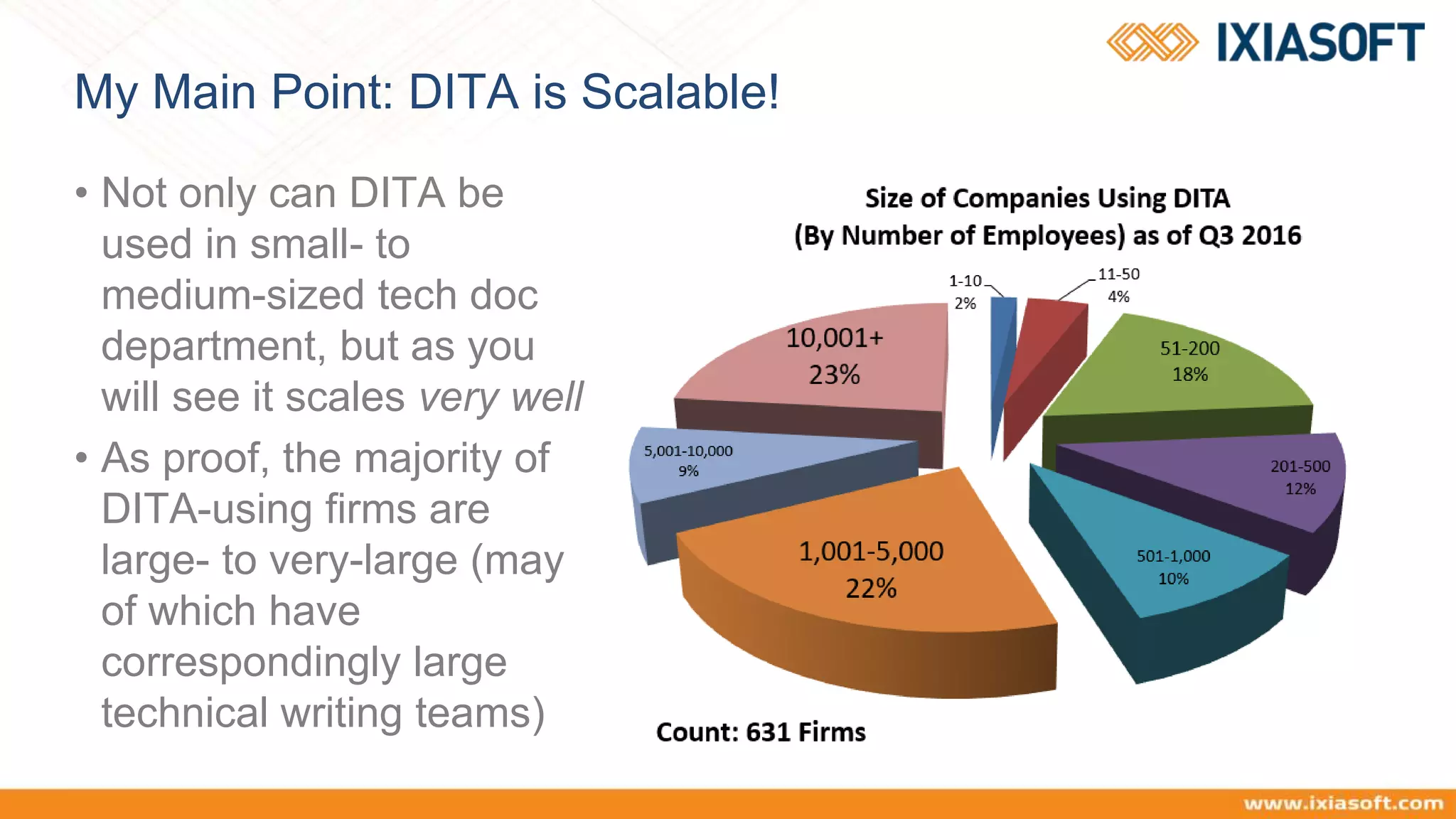
My Main Point: DITA is Scalable!
• Not only can DITA be
used in small- to
medium-sized tech doc
department, but as you
will see it scales very well
• As proof, the majority of
DITA-using firms are
large- to very-large (may
of which have
correspondingly large
technical writing teams)
THE MAIN FEATURES OF DITA
The features that make DITA, DITA!
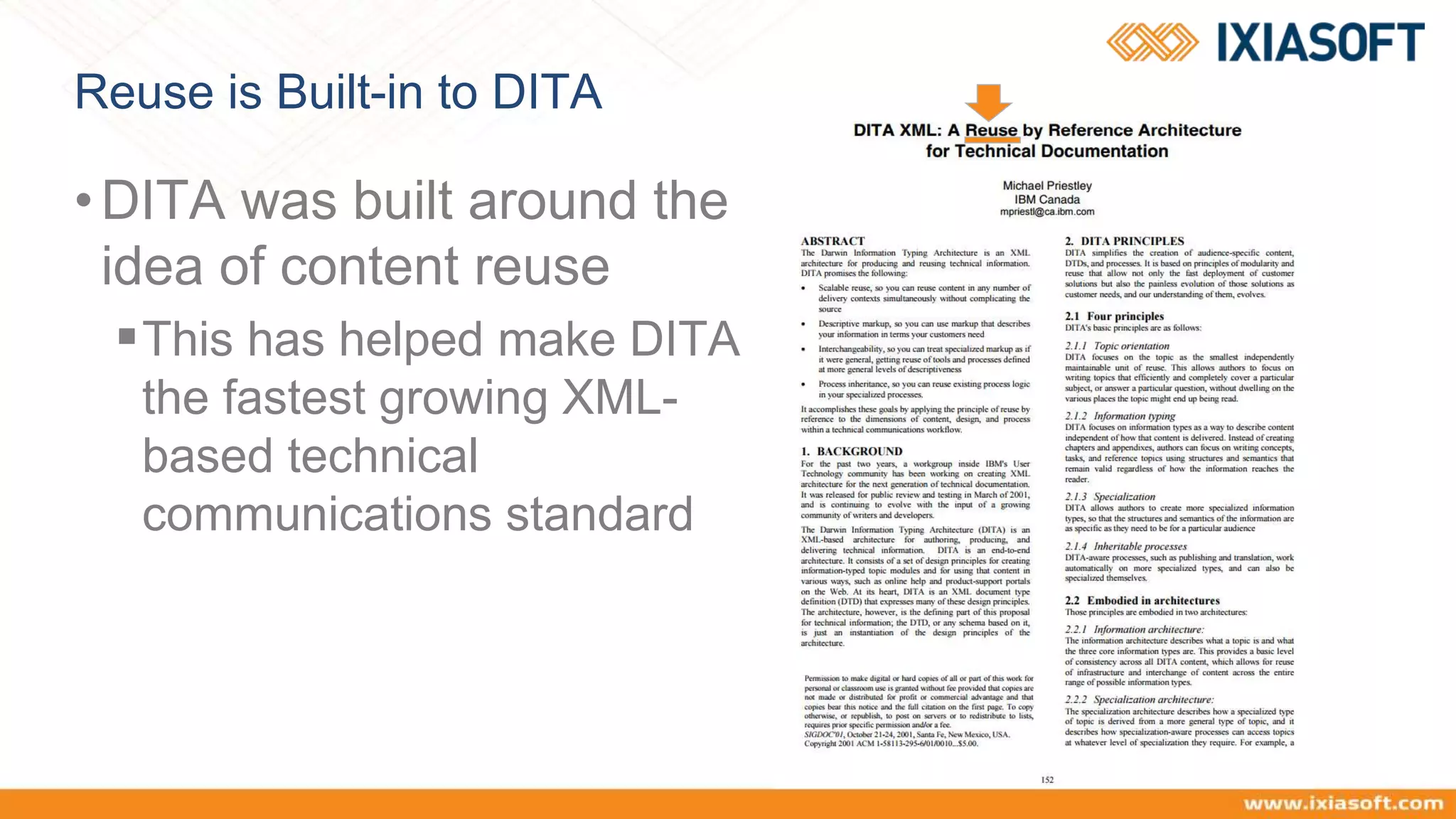
Reuse is Built-in to DITA
•DITA was built around the
idea of content reuse
This has helped make DITA
the fastest growing XML-
based technical
communications standard
DITA Content Reuse = Consistent Messaging
• Benefit of consistent content and messaging
• Consistent content means consistent user experience
 Along with being seamless, available and context-specific
Reduced Localization Costs with DITA
• Content reuse in English = localization savings
• If many target languages, ROI argument for moving to DITA
(+ CCMS) is easier
Separation of Form from Content
• In a study I did prior to moving to DITA
at AMD, found that fully half of the time
spent using DTP software was on
formatting content
• Suggests considerable time savings,
making content creators more nimble
and able to concentrate on making
additional content
 From a localization perspective, also
removed DTP charges from Localization
Service Providers
DITA Was Built with Multi-channel Publishing in Mind
• This was a key design feature when
DITA was still being devised at IBM;
intent was to tame a multitude of
output processes then in place with a
single
• DITA-OT by default supports 11
output types, including PDF, RTF,
HTML5/XHTML
• Other output types possible
Specialization
• The “D” from DITA stands for
“Darwin”, alluding to the
specialization mechanism which
enables users to create new topic
types/elements to suit their specific
needs
• It is also possible to “generalize”
specialized content back for use in
other contexts
DITA and Other Tech Doc XML Formats
• DocBook focuses on book rather than
individual topics; most recent version
(v5.1) now includes “assemblies” which
allows some level of reuse
• S1000D focuses primarily on needs of
aerospace industry; reuse is limited to
data module level (and only one use per
document)
• Focus is at book/
article level
• No reuse model until
very recently
• Aerospace focused
• Reuse only at data
modules level, and
only one per doc
DITA Reuse is More Granular in Nature
• Reuse in DITA is akin to that of a
Russian Doll, as it is possible to
reuse content at various levels
• So a reused map might (for
example) contain a topic from
another map, which in turn uses
a conref, conditional processing
and keys
0
20
40
60
80
100
120
140
160
AxisTitle
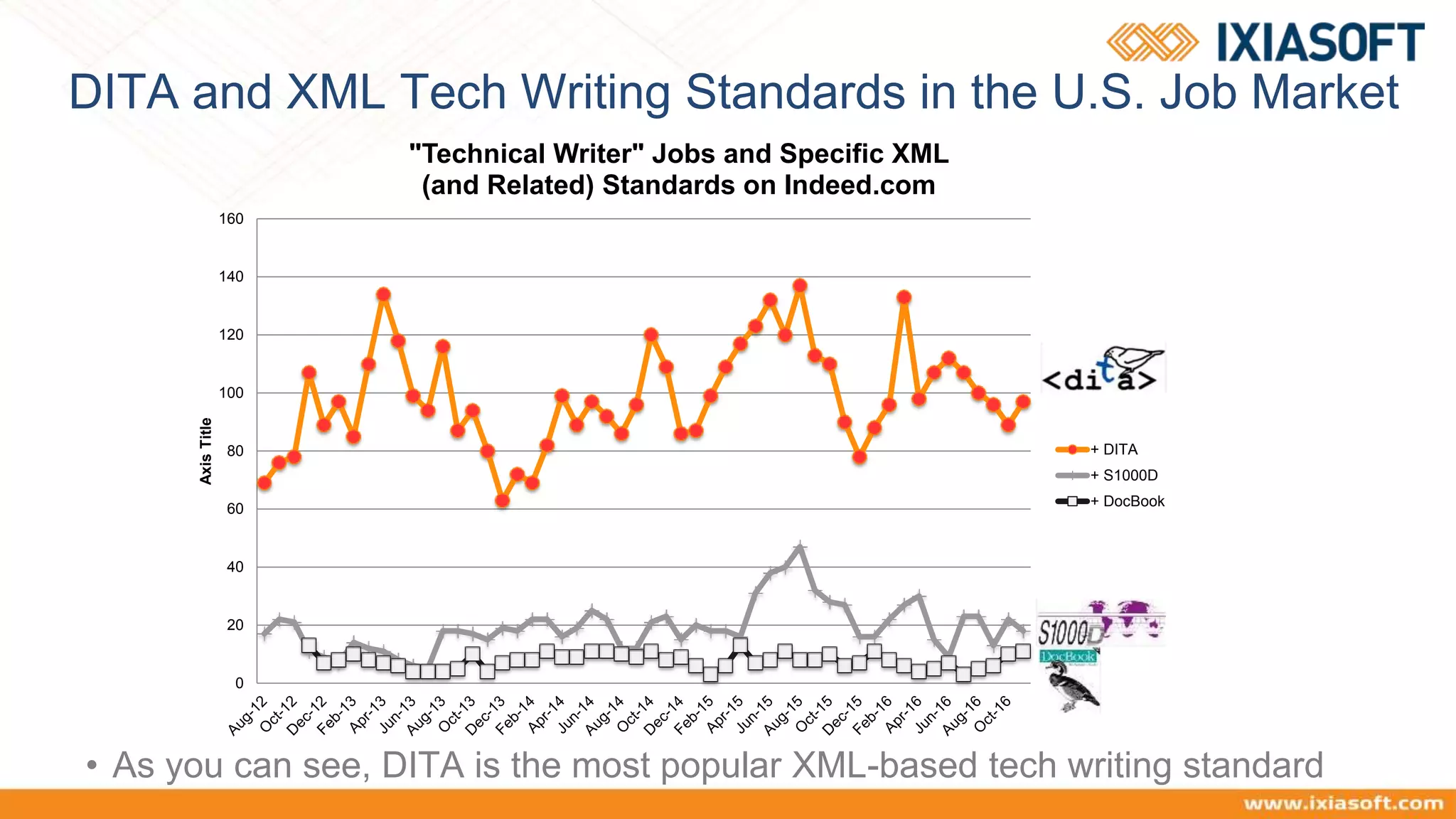
"Technical Writer" Jobs and Specific XML
(and Related) Standards on Indeed.com
+ DITA
+ S1000D
+ DocBook
DITA and XML Tech Writing Standards in the U.S. Job Market
• As you can see, DITA is the most popular XML-based tech writing standard
Firms Are Willing to Pay More for DITA Experience
• Avg. starting wages vary over time, but for now, technical writers with DITA experience
consistently command a higher starting wage than those with FrameMaker experience
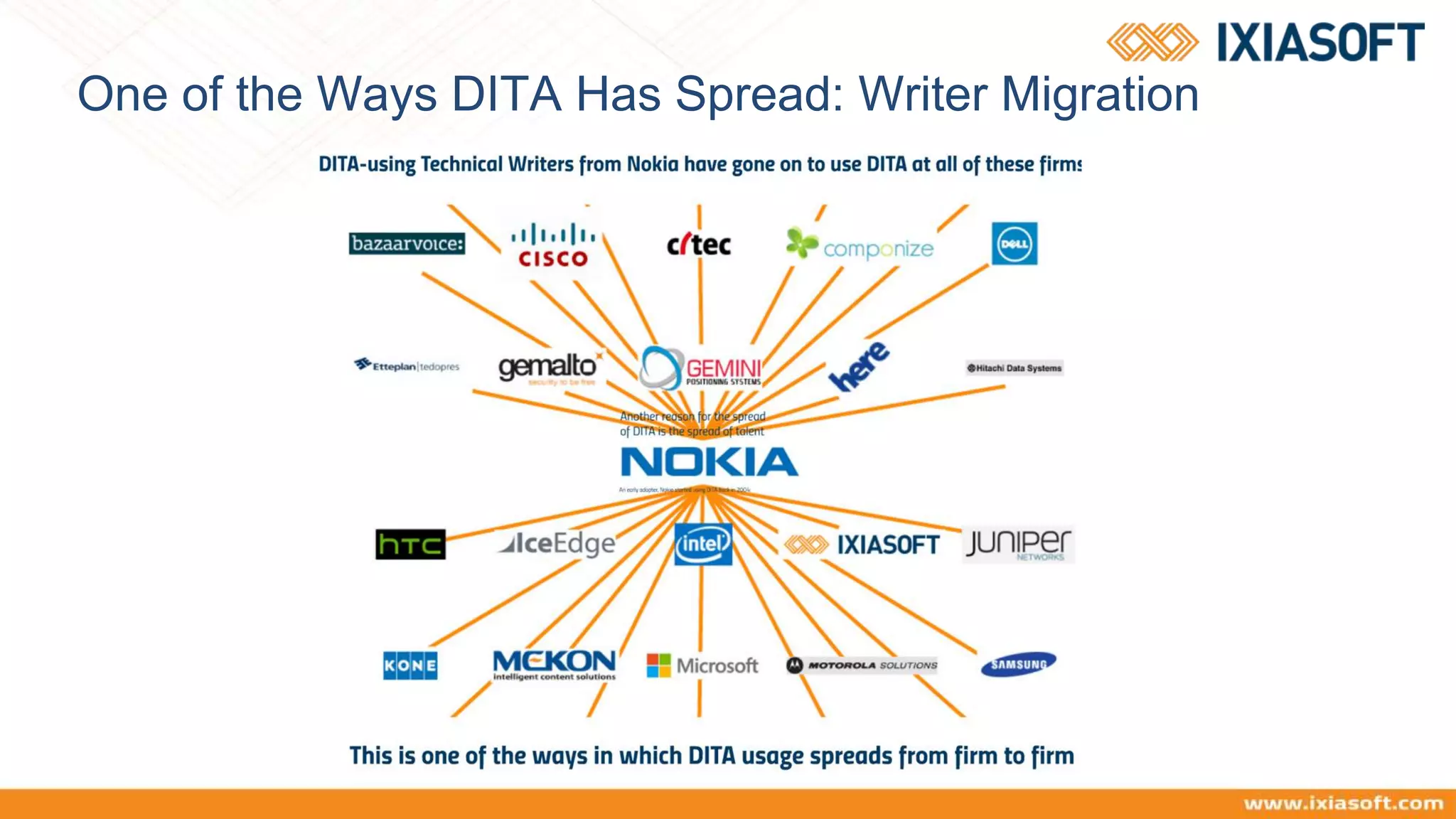
One of the Ways DITA Has Spread: Writer Migration
THE CHIEF REASONS WHY FIRMS
MOVE TO DITA + CCMS
Typical pain points documentation teams encounter and how
DITA + CCMS can help lessen them
Pain Points that DITA + CCMS Can Solve
• Need to be more efficient/do more
with less
• Have outgrown current toolset
• Escalating localization costs
• Requirement to verify content before
it goes out the door
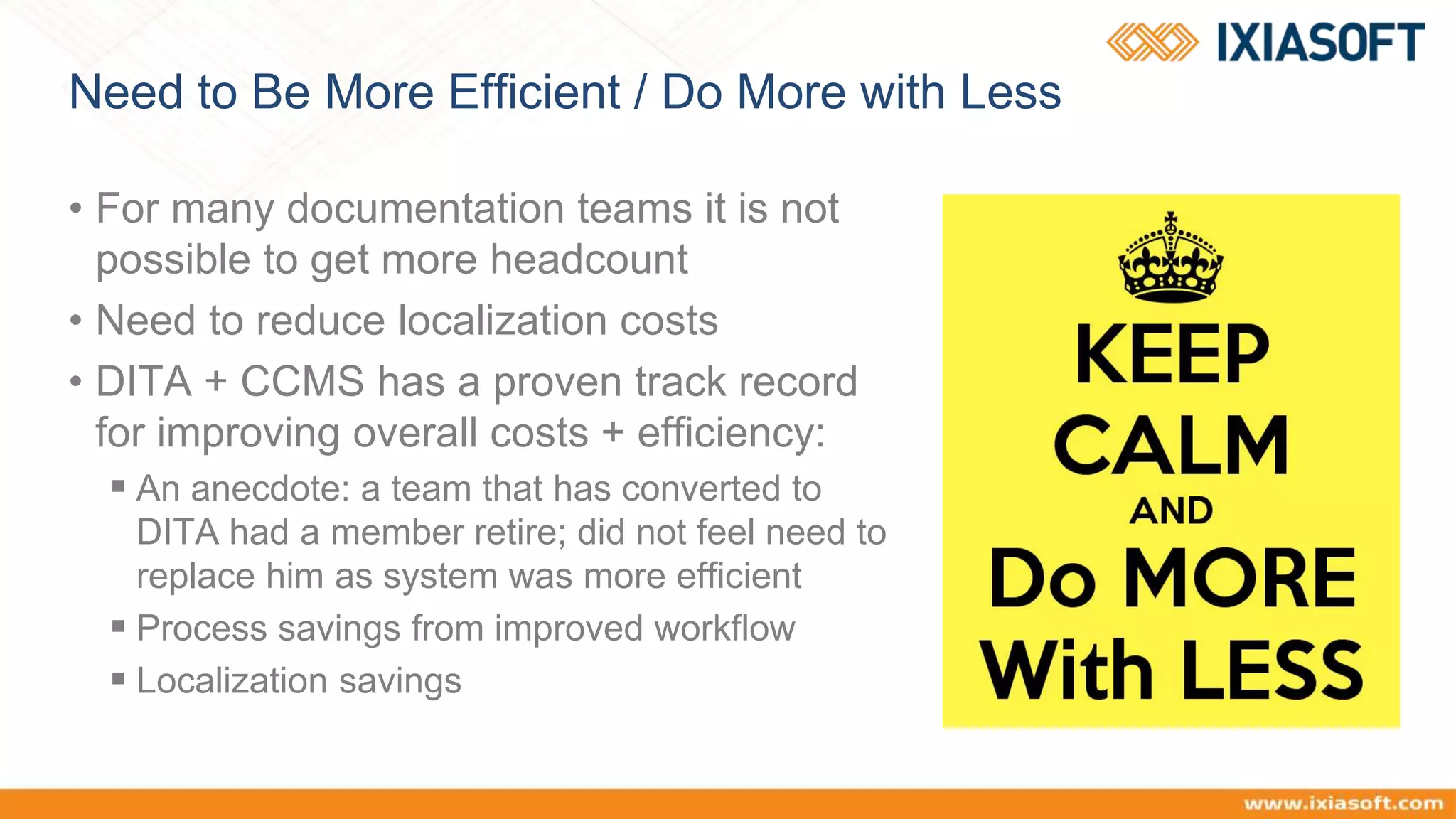
Need to Be More Efficient / Do More with Less
• For many documentation teams it is not
possible to get more headcount
• Need to reduce localization costs
• DITA + CCMS has a proven track record
for improving overall costs + efficiency:
 An anecdote: a team that has converted to
DITA had a member retire; did not feel need to
replace him as system was more efficient
 Process savings from improved workflow
 Localization savings
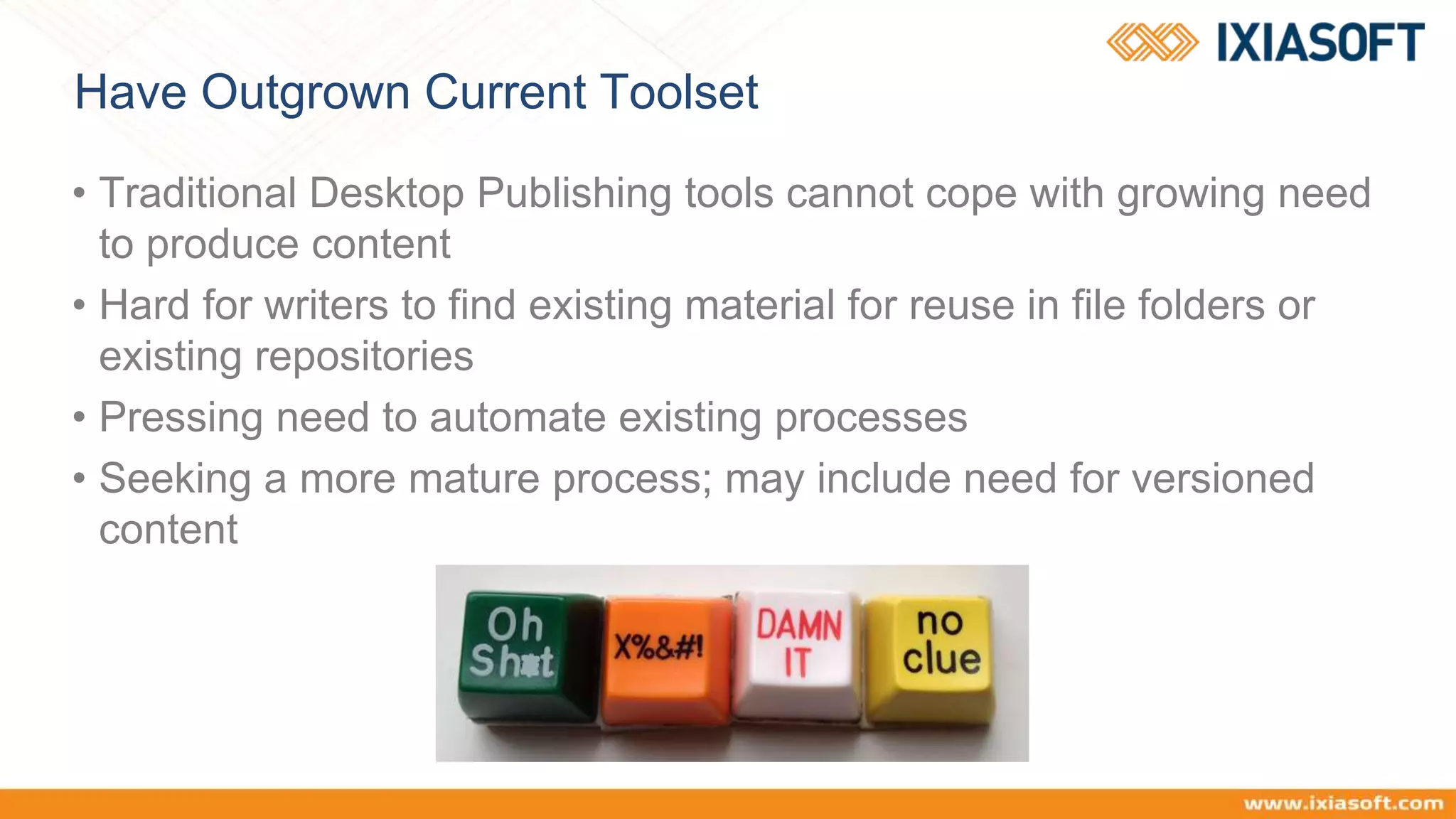
Have Outgrown Current Toolset
• Traditional Desktop Publishing tools cannot cope with growing need
to produce content
• Hard for writers to find existing material for reuse in file folders or
existing repositories
• Pressing need to automate existing processes
• Seeking a more mature process; may include need for versioned
content
Escalating Localization Costs
• Ongoing need to produce localized content,
but costs (especially with desktop
publishing-based processes) have become
prohibitive
• Additional costs are incurred for:
 Formatting content
 Fixing code-page errors (a glyph is transformed
into a different character)
 Sending more content than necessary for
localization
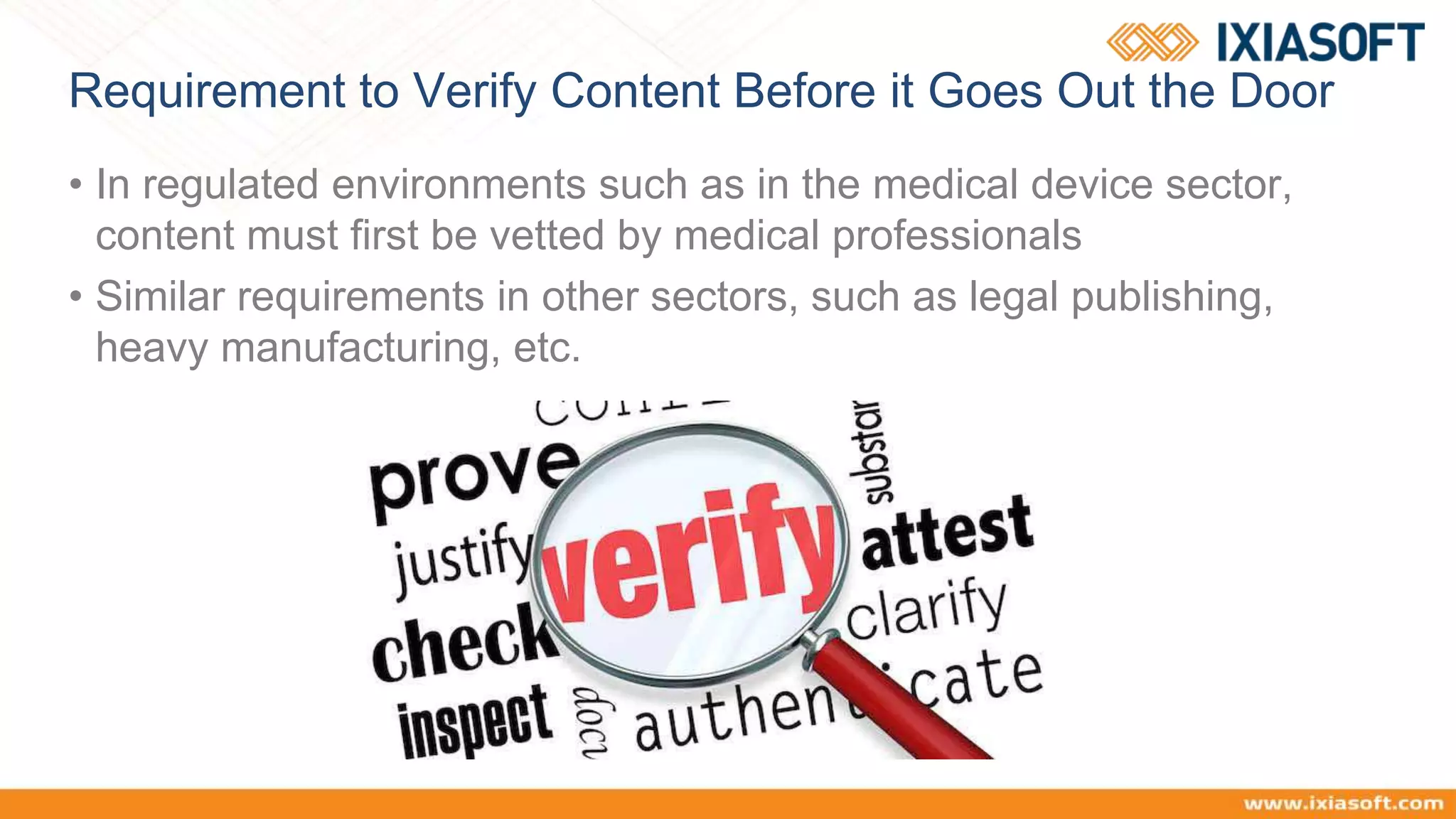
Requirement to Verify Content Before it Goes Out the Door
• In regulated environments such as in the medical device sector,
content must first be vetted by medical professionals
• Similar requirements in other sectors, such as legal publishing,
heavy manufacturing, etc.
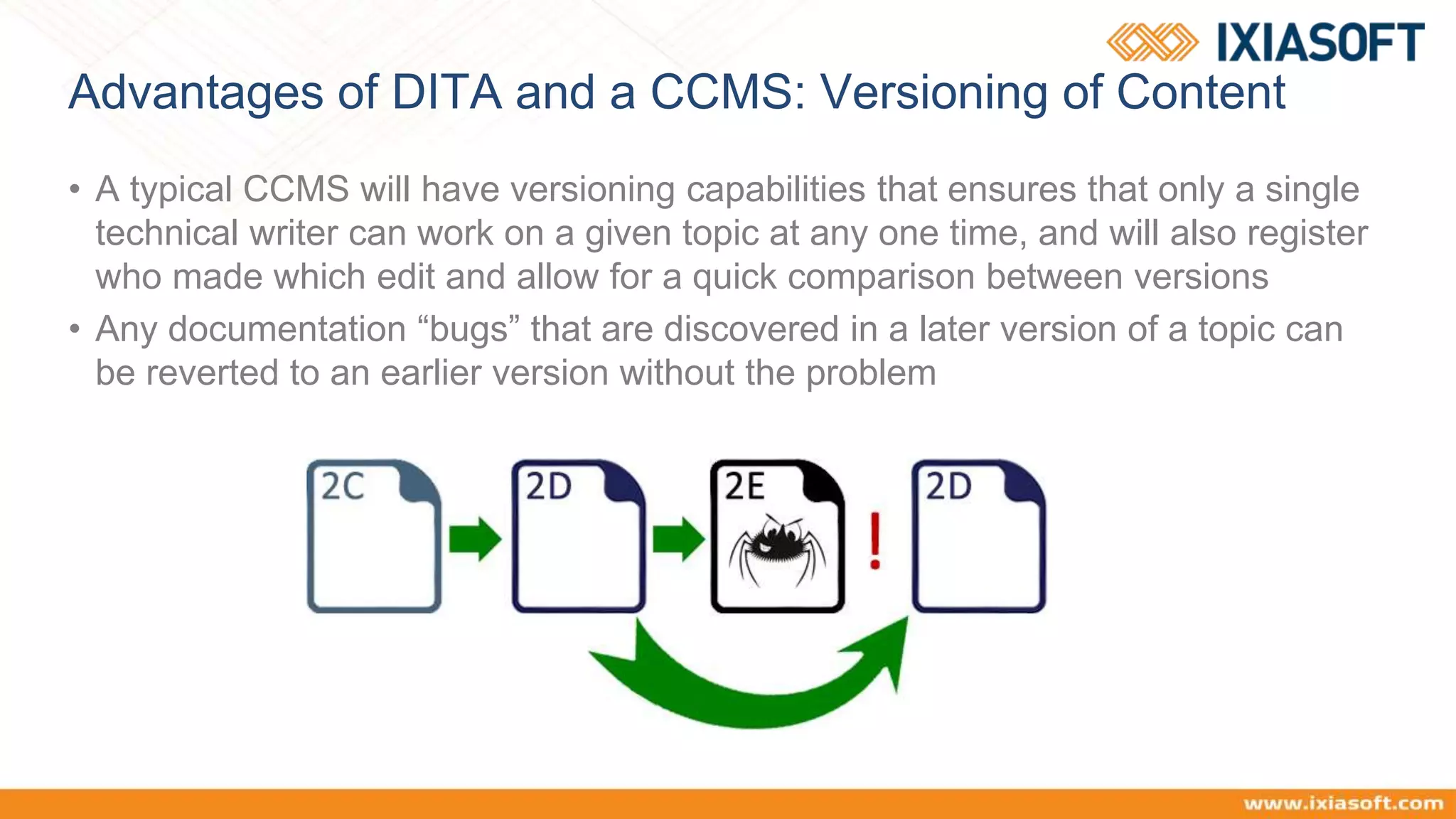
Advantages of DITA and a CCMS: Versioning of Content
• A typical CCMS will have versioning capabilities that ensures that only a single
technical writer can work on a given topic at any one time, and will also register
who made which edit and allow for a quick comparison between versions
• Any documentation “bugs” that are discovered in a later version of a topic can
be reverted to an earlier version without the problem
Advantages of DITA and a CCMS: Automation
• A capable DITA CCMS will enable a
firm to automate localization processes
• Some of IXIASOFT’s customers send
individual topics out for localization
while rest of document being worked on
 New and changed content can be merged,
enabling much faster turnaround times
Writing: Complete
Localization: Complete
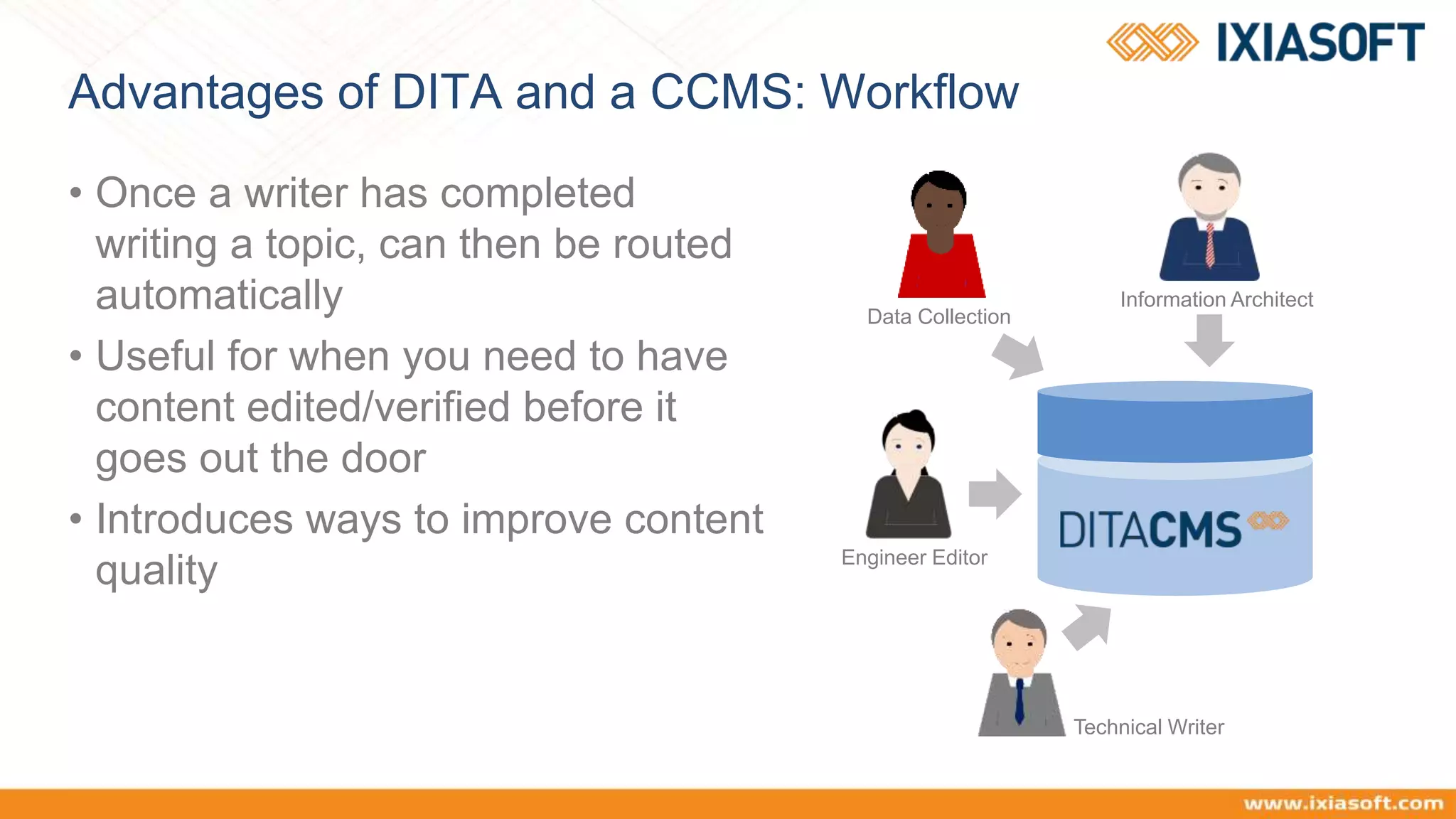
Advantages of DITA and a CCMS: Workflow
• Once a writer has completed
writing a topic, can then be routed
automatically
• Useful for when you need to have
content edited/verified before it
goes out the door
• Introduces ways to improve content
quality
Information Architect
Data Collection
Engineer Editor
Technical Writer
Typical Workflow Examples
• An example: a Subject Matter Expert (SME)
may be assigned within the system to write
content which is then “polished” by a
technical writer, and then sent to another
SME for approval
• Or: technical writer creates content, is
routed to another writer/editor who verifies
quality
Engineer
(SME)
Technical
Writer
Engineer
Who Approves
Content
Accuracy
Advantages of DITA and a CCMS: Measurement
• Having modular content opens
up the possibility of measuring
content production more
accurately
• Not every topic will be the
same size, but there will be an
average value
+
A CLOSER LOOK AT “BIG DATA DITA”
The surprising scalability of DITA and what it can do
DITA Can Help Doc Teams Become Scalable
• What I have learned in the past few years meeting with clients are
some very cool things that DITA has enabled tech doc teams to do,
including:
 Working with Agile
 Measurement used for quality control purposes
 Expand reach of localization budget
 Not only deal with very large volumes of content, but do so efficiently
 Provide new services to users
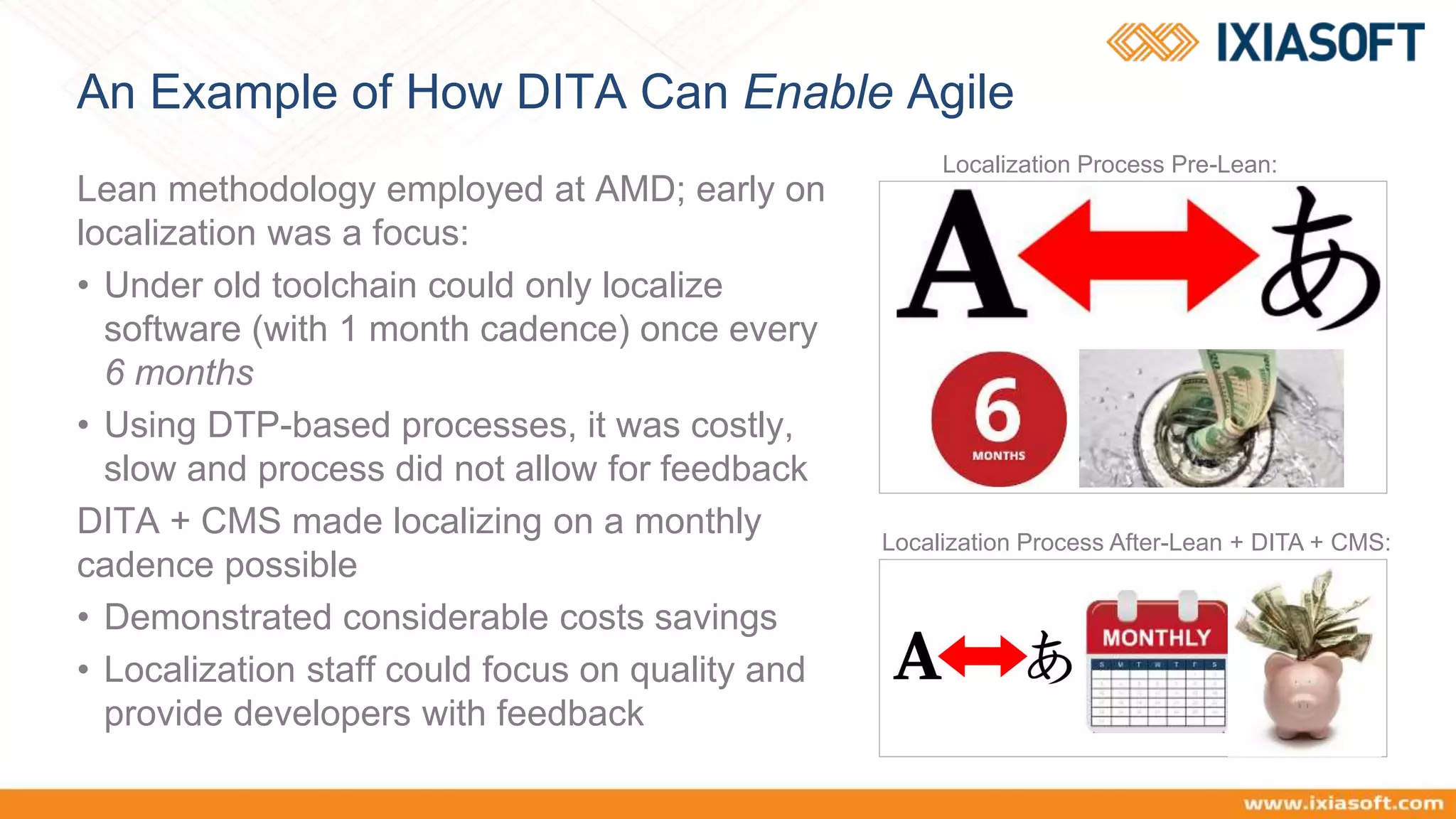
An Example of How DITA Can Enable Agile
Lean methodology employed at AMD; early on
localization was a focus:
• Under old toolchain could only localize
software (with 1 month cadence) once every
6 months
• Using DTP-based processes, it was costly,
slow and process did not allow for feedback
DITA + CMS made localizing on a monthly
cadence possible
• Demonstrated considerable costs savings
• Localization staff could focus on quality and
provide developers with feedback
Localization Process Pre-Lean:
Localization Process After-Lean + DITA + CMS:
• At Scrum meetings doc manager can
report on topics assigned to their
group and report on how “done” they
are
• This is typically only feasible within a
CCMS containing workflow metadata
“Our project managers could track
progress of documentation deliverables
within our DITA-based CMS on a daily
basis.”
- Jason Owen
Agile and DITA Metrics
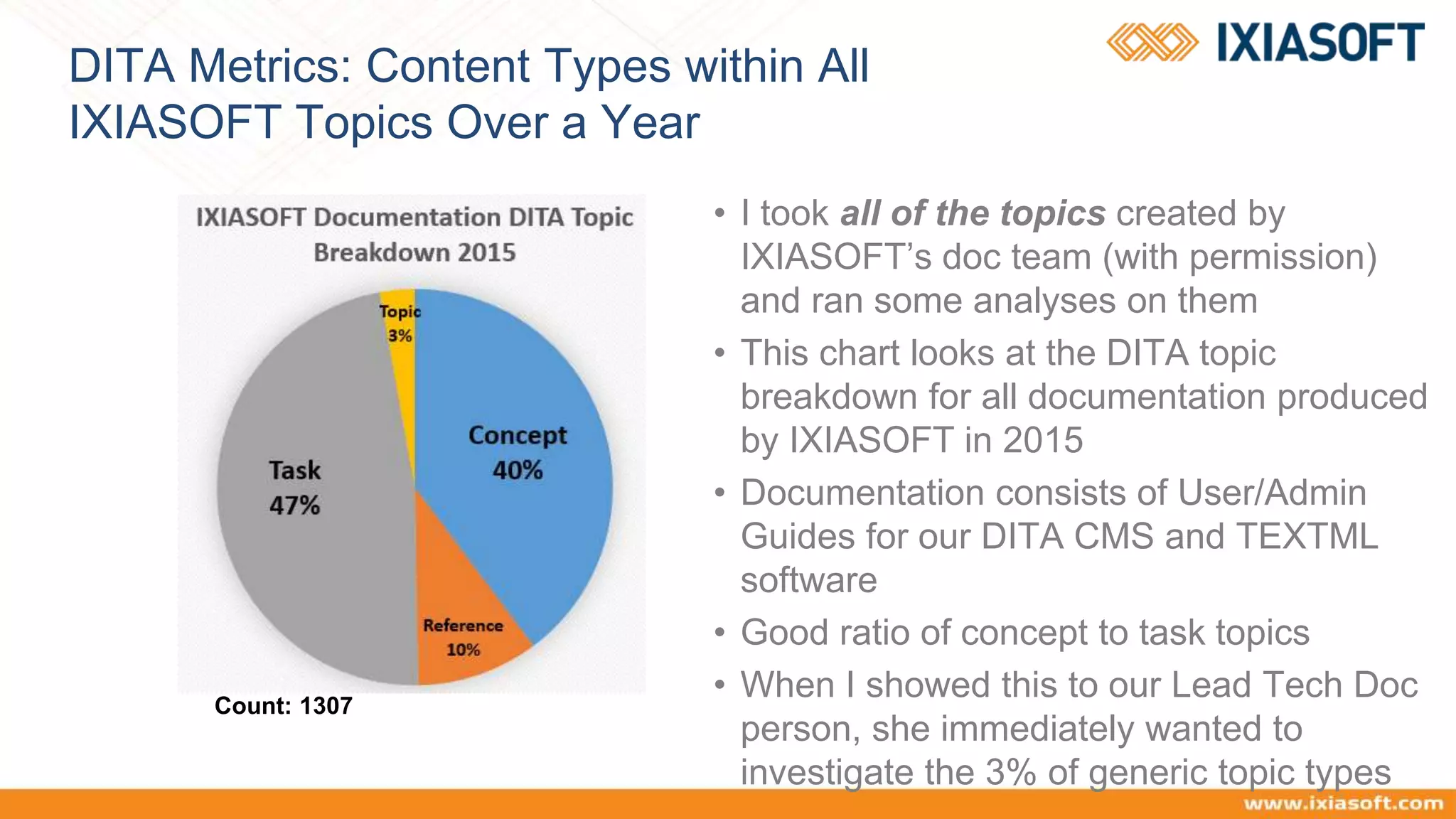
DITA Metrics: Content Types within All
IXIASOFT Topics Over a Year
• I took all of the topics created by
IXIASOFT’s doc team (with permission)
and ran some analyses on them
• This chart looks at the DITA topic
breakdown for all documentation produced
by IXIASOFT in 2015
• Documentation consists of User/Admin
Guides for our DITA CMS and TEXTML
software
• Good ratio of concept to task topics
• When I showed this to our Lead Tech Doc
person, she immediately wanted to
investigate the 3% of generic topic types
Count: 1307
Scalability + Automating Content Processes
• With IXIASOFT DITA CMS a client
started making nightly content builds of
their documentation
 Select customers now able to obtain
early release content
• Firm localizes content in 30+
languages
 Were able to plug IXIASOFT DITA CMS
into existing process; translation firms
can now get hourly drops of content to
work on
An Example of Cumulative Localization Cost Savings
$255,791.60
$(61,124.20) $(77,221.41)
$177,656.24
$448,239.70
$715,394.34
$839,506.06
$985,951.06
$(200,000.00)
$-
$200,000.00
$400,000.00
$600,000.00
$800,000.00
$1,000,000.00
$1,200,000.00
2003 2004 2005 2006 2007 2008 2009 2010 (Q1-Q3)
Annual Localization Budget and Spent 2005-2009 with Cumulative Budget Unspent/Saved
Since 2006
Cumulative Budget Unspent Since 2006 Annual Localization Budget Actual Localization Spend
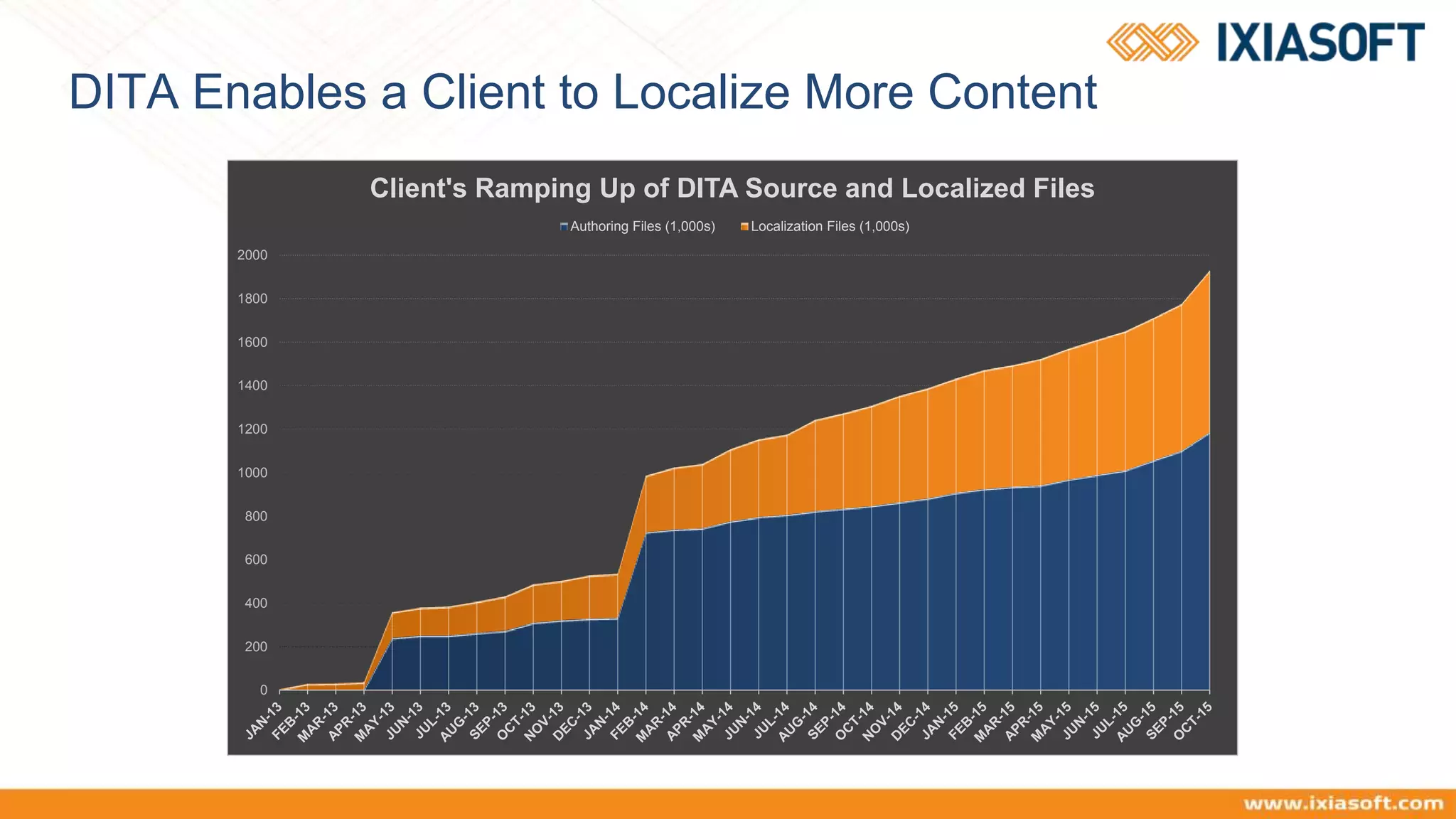
DITA Enables a Client to Localize More Content
0
200
400
600
800
1000
1200
1400
1600
1800
2000
Client's Ramping Up of DITA Source and Localized Files
Authoring Files (1,000s) Localization Files (1,000s)
DITA Enables Another Client to Localize More Content
• A different client, showing their ramp-up of DITA-based publications and the
number of languages they were able to do
0
5
10
15
20
25
30
0
50
100
150
200
250
300
350
400
450
2011 2012 2013 2014 1H 2015
Client's DITA-based Publications & Number of Languages
Publications # Languages
Greater Content Consistency
• One pharma client's ROI for DITA + IXIASOFT was based on localization
savings; translated Operations Manuals, Training materials and Interface
Manuals into 14 languages
• Content consistency is greatly improved; PDF and HTML use same
formatting template as English, so formatting consistency is ensured
• Localization process with their Localization Service Providers are much
shorter and cheaper than with the DTP software they previously used
Large Data = Large Latency? Not Necessarily…
• Geographically-spread users might ordinarily have to wait for content to download,
lock/unlock content
• Because of the component nature of DITA, it is possible to replicate content
seamlessly between different locations to speed up access to content
IXIASOFT DITA
CMS can have
replicated severs
for DITA content;
all content is
effectively “local”
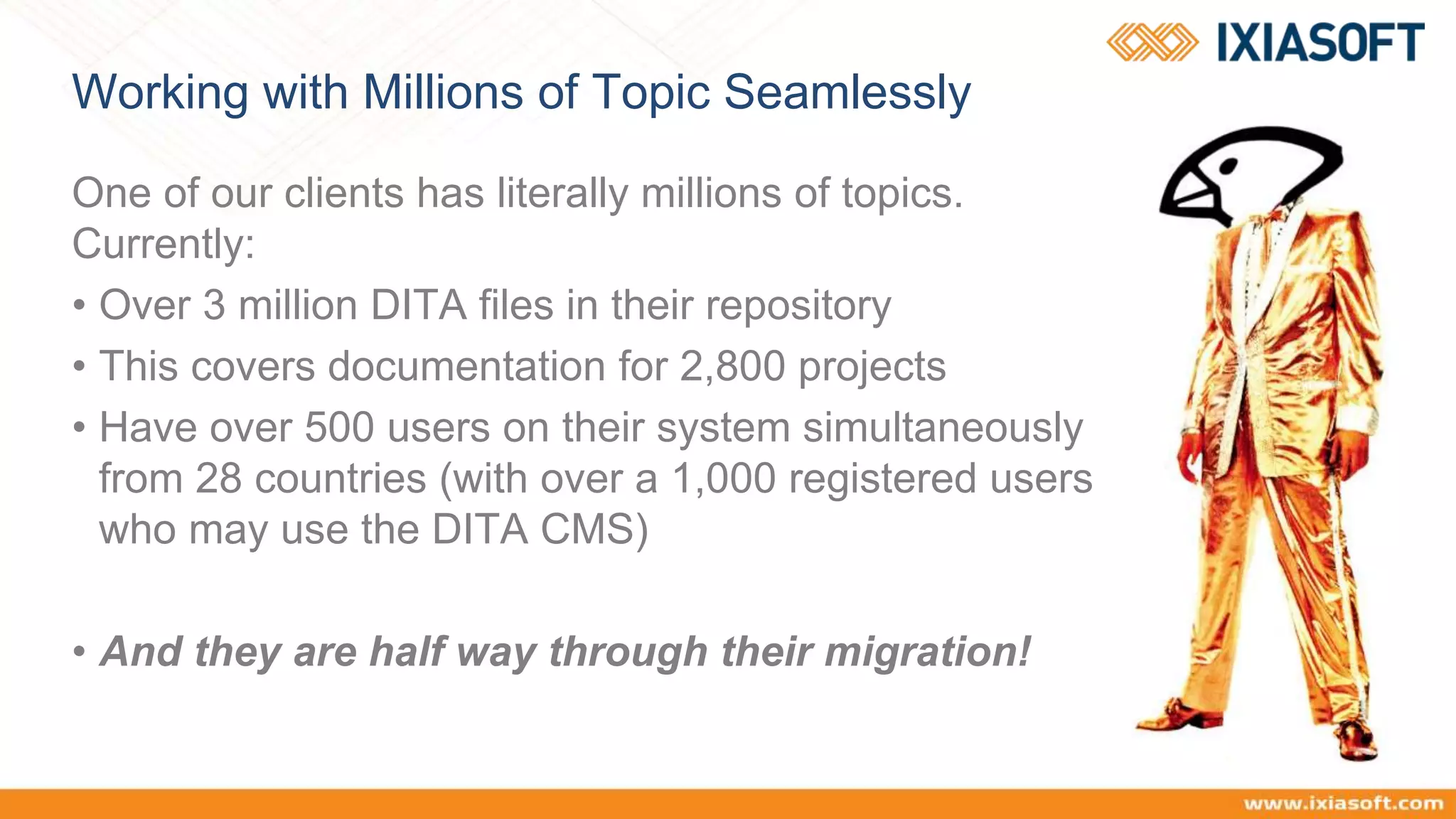
Working with Millions of Topic Seamlessly
One of our clients has literally millions of topics.
Currently:
• Over 3 million DITA files in their repository
• This covers documentation for 2,800 projects
• Have over 500 users on their system simultaneously
from 28 countries (with over a 1,000 registered users
who may use the DITA CMS)
• And they are half way through their migration!
How Do They Keep Track of it All? DRM!
• IXIASOFT DITA CMS uses a key-based mechanism called
Dynamic Release Management which can divvy up content
efficiently so that writers can search/access the content they need
to work with
More Content = Better Customer Service
• A client produces over 60,000 outputs daily
• What are these outputs? Mainly updates (including localized
content) to software their customers use every day
• Some customers are given special, early access to content as it is
created
QA
• Blog: www.ixiasoft.com/en/news-and-events/blog
• Twitter: @IXIASOFT (and @KeithIXIASOFT)
• IXIASOFT DITA CMS Users LinkedIn group:
www.linkedin.com/groups?gid=3820030
• OASIS DITA Adoption Committee articles
• Member of OASIS DITA Technical Committee
• My recently-published article on DITA and Agile: “Ten reasons why DITA
and Agile are made for each other”: http://ow.ly/Vhfo306L2ES
• Also, look for my chapter on the DITA marketplace in the upcoming book
Current Practices and Trends in Technical and Professional
Communication, due out sometime in 2017
10 Million Dita Topics Can't Be Wrong

10 Million Dita Topics Can't Be Wrong

  • 11.
    Keith Schengili-Roberts Market Researcherand DITA Evangelist, IXIASOFT 10 Million DITA Topics Can't Be Wrong
  • 12.
    Who’s This Guy? KeithSchengili-Roberts IXIASOFT DITA Evangelist and Market Researcher What I do: • DITA evangelist • Liaison with OASIS; on DITA Adoption, Lightweight DITA and the DITA Technical Committees • Industry researcher • Lecturer on Information Architecture, University of Toronto • 10+ Years of DITA XML experience
  • 13.
    Also Known As“DITAWriter” • Industry blog started +5 years ago • Just over 250,000 hits • Regularly updated info on:  DITA Conferences  DITA Books  Companies Using DITA  DITA CMSes  DITA Editors  Other DITA Tools  DITA Consulting Firms • News/views on DITA use • Features interviews with those making a difference in the world of DITA
  • 14.
    Where Did theTitle for This Talk Come From? • At a recent IXIASOFT Users Conference one of our clients talked about this number in terms of how many versioned DITA topics they already had • Got me to thinking about where DITA came from, its key advantages, and how it scales; “Big Data DITA” is already a reality at many firms
  • 15.
    Starting Small… • Focusof this talk is how something that started out small (DITA) has become a big deal • Will do a quick survey of main features of DITA • Will also look at DITA’s impact on technical documentation careers • The specific pain points that DITA addresses at firms • A closer look at “Big Data DITA”
  • 16.
    What is thisDITA Stuff? • It’s an open XML standard for creating structured content built primarily around the idea of content reuse • Has been around for just over 10 years, has gained significant traction in technical authoring community
  • 17.
    Who is UsingDITA? • Most recent count: 667 firms worldwide
  • 18.
    What Sectors areUsing DITA? • Overall trend is that DITA adoption is firmly entrenched in tech- related sectors and is moving gradually into other sectors
  • 19.
  • 20.
    Sectors with SignificantDITA Adoption • While DITA first came to prominence 11 years ago in software/IT sectors, DITA adoption has firmly taken hold in a number of other sectors, including significant numbers of firms in:  Telecommunications  Semiconductors  Medical Devices  Electronics Manufacturing  Financial Services  Automotive
  • 21.
    DITA Adoption CrossesAll Sectors • 60+ industry sectors using DITA • Wide range of firms • DITA is being used to document:  Industrial egg-beating machines  Underwater exploration equipment  Radiology scalpels and much more! • DITA is clearly no longer just for software/info tech!
  • 22.
    0 50 100 150 200 250 300 350 FrameMaker and XML(+ DITA) in Technical Writer Job Postings on Indeed.com + FrameMaker + XML + DITA XML Knowledge Has Eclipsed FrameMaker Knowledge for Tech Writing Hires in U.S. DITA XML FrameMaker
  • 23.
    DITA Usage isDefinitely Growing • From a survey of 700 technical writing professionals:
  • 24.
    My Main Point:DITA is Scalable! • Not only can DITA be used in small- to medium-sized tech doc department, but as you will see it scales very well • As proof, the majority of DITA-using firms are large- to very-large (may of which have correspondingly large technical writing teams)
  • 25.
    THE MAIN FEATURESOF DITA The features that make DITA, DITA!
  • 26.
    Reuse is Built-into DITA •DITA was built around the idea of content reuse This has helped make DITA the fastest growing XML- based technical communications standard
  • 27.
    DITA Content Reuse= Consistent Messaging • Benefit of consistent content and messaging • Consistent content means consistent user experience  Along with being seamless, available and context-specific
  • 28.
    Reduced Localization Costswith DITA • Content reuse in English = localization savings • If many target languages, ROI argument for moving to DITA (+ CCMS) is easier
  • 29.
    Separation of Formfrom Content • In a study I did prior to moving to DITA at AMD, found that fully half of the time spent using DTP software was on formatting content • Suggests considerable time savings, making content creators more nimble and able to concentrate on making additional content  From a localization perspective, also removed DTP charges from Localization Service Providers
  • 30.
    DITA Was Builtwith Multi-channel Publishing in Mind • This was a key design feature when DITA was still being devised at IBM; intent was to tame a multitude of output processes then in place with a single • DITA-OT by default supports 11 output types, including PDF, RTF, HTML5/XHTML • Other output types possible
  • 31.
    Specialization • The “D”from DITA stands for “Darwin”, alluding to the specialization mechanism which enables users to create new topic types/elements to suit their specific needs • It is also possible to “generalize” specialized content back for use in other contexts
  • 32.
    DITA and OtherTech Doc XML Formats • DocBook focuses on book rather than individual topics; most recent version (v5.1) now includes “assemblies” which allows some level of reuse • S1000D focuses primarily on needs of aerospace industry; reuse is limited to data module level (and only one use per document) • Focus is at book/ article level • No reuse model until very recently • Aerospace focused • Reuse only at data modules level, and only one per doc
  • 33.
    DITA Reuse isMore Granular in Nature • Reuse in DITA is akin to that of a Russian Doll, as it is possible to reuse content at various levels • So a reused map might (for example) contain a topic from another map, which in turn uses a conref, conditional processing and keys
  • 34.
    0 20 40 60 80 100 120 140 160 AxisTitle "Technical Writer" Jobsand Specific XML (and Related) Standards on Indeed.com + DITA + S1000D + DocBook DITA and XML Tech Writing Standards in the U.S. Job Market • As you can see, DITA is the most popular XML-based tech writing standard
  • 35.
    Firms Are Willingto Pay More for DITA Experience • Avg. starting wages vary over time, but for now, technical writers with DITA experience consistently command a higher starting wage than those with FrameMaker experience
  • 36.
    One of theWays DITA Has Spread: Writer Migration
  • 37.
    THE CHIEF REASONSWHY FIRMS MOVE TO DITA + CCMS Typical pain points documentation teams encounter and how DITA + CCMS can help lessen them
  • 38.
    Pain Points thatDITA + CCMS Can Solve • Need to be more efficient/do more with less • Have outgrown current toolset • Escalating localization costs • Requirement to verify content before it goes out the door
  • 39.
    Need to BeMore Efficient / Do More with Less • For many documentation teams it is not possible to get more headcount • Need to reduce localization costs • DITA + CCMS has a proven track record for improving overall costs + efficiency:  An anecdote: a team that has converted to DITA had a member retire; did not feel need to replace him as system was more efficient  Process savings from improved workflow  Localization savings
  • 40.
    Have Outgrown CurrentToolset • Traditional Desktop Publishing tools cannot cope with growing need to produce content • Hard for writers to find existing material for reuse in file folders or existing repositories • Pressing need to automate existing processes • Seeking a more mature process; may include need for versioned content
  • 41.
    Escalating Localization Costs •Ongoing need to produce localized content, but costs (especially with desktop publishing-based processes) have become prohibitive • Additional costs are incurred for:  Formatting content  Fixing code-page errors (a glyph is transformed into a different character)  Sending more content than necessary for localization
  • 42.
    Requirement to VerifyContent Before it Goes Out the Door • In regulated environments such as in the medical device sector, content must first be vetted by medical professionals • Similar requirements in other sectors, such as legal publishing, heavy manufacturing, etc.
  • 43.
    Advantages of DITAand a CCMS: Versioning of Content • A typical CCMS will have versioning capabilities that ensures that only a single technical writer can work on a given topic at any one time, and will also register who made which edit and allow for a quick comparison between versions • Any documentation “bugs” that are discovered in a later version of a topic can be reverted to an earlier version without the problem
  • 44.
    Advantages of DITAand a CCMS: Automation • A capable DITA CCMS will enable a firm to automate localization processes • Some of IXIASOFT’s customers send individual topics out for localization while rest of document being worked on  New and changed content can be merged, enabling much faster turnaround times Writing: Complete Localization: Complete
  • 45.
    Advantages of DITAand a CCMS: Workflow • Once a writer has completed writing a topic, can then be routed automatically • Useful for when you need to have content edited/verified before it goes out the door • Introduces ways to improve content quality Information Architect Data Collection Engineer Editor Technical Writer
  • 46.
    Typical Workflow Examples •An example: a Subject Matter Expert (SME) may be assigned within the system to write content which is then “polished” by a technical writer, and then sent to another SME for approval • Or: technical writer creates content, is routed to another writer/editor who verifies quality Engineer (SME) Technical Writer Engineer Who Approves Content Accuracy
  • 47.
    Advantages of DITAand a CCMS: Measurement • Having modular content opens up the possibility of measuring content production more accurately • Not every topic will be the same size, but there will be an average value +
  • 48.
    A CLOSER LOOKAT “BIG DATA DITA” The surprising scalability of DITA and what it can do
  • 49.
    DITA Can HelpDoc Teams Become Scalable • What I have learned in the past few years meeting with clients are some very cool things that DITA has enabled tech doc teams to do, including:  Working with Agile  Measurement used for quality control purposes  Expand reach of localization budget  Not only deal with very large volumes of content, but do so efficiently  Provide new services to users
  • 50.
    An Example ofHow DITA Can Enable Agile Lean methodology employed at AMD; early on localization was a focus: • Under old toolchain could only localize software (with 1 month cadence) once every 6 months • Using DTP-based processes, it was costly, slow and process did not allow for feedback DITA + CMS made localizing on a monthly cadence possible • Demonstrated considerable costs savings • Localization staff could focus on quality and provide developers with feedback Localization Process Pre-Lean: Localization Process After-Lean + DITA + CMS:
  • 51.
    • At Scrummeetings doc manager can report on topics assigned to their group and report on how “done” they are • This is typically only feasible within a CCMS containing workflow metadata “Our project managers could track progress of documentation deliverables within our DITA-based CMS on a daily basis.” - Jason Owen Agile and DITA Metrics
  • 52.
    DITA Metrics: ContentTypes within All IXIASOFT Topics Over a Year • I took all of the topics created by IXIASOFT’s doc team (with permission) and ran some analyses on them • This chart looks at the DITA topic breakdown for all documentation produced by IXIASOFT in 2015 • Documentation consists of User/Admin Guides for our DITA CMS and TEXTML software • Good ratio of concept to task topics • When I showed this to our Lead Tech Doc person, she immediately wanted to investigate the 3% of generic topic types Count: 1307
  • 53.
    Scalability + AutomatingContent Processes • With IXIASOFT DITA CMS a client started making nightly content builds of their documentation  Select customers now able to obtain early release content • Firm localizes content in 30+ languages  Were able to plug IXIASOFT DITA CMS into existing process; translation firms can now get hourly drops of content to work on
  • 54.
    An Example ofCumulative Localization Cost Savings $255,791.60 $(61,124.20) $(77,221.41) $177,656.24 $448,239.70 $715,394.34 $839,506.06 $985,951.06 $(200,000.00) $- $200,000.00 $400,000.00 $600,000.00 $800,000.00 $1,000,000.00 $1,200,000.00 2003 2004 2005 2006 2007 2008 2009 2010 (Q1-Q3) Annual Localization Budget and Spent 2005-2009 with Cumulative Budget Unspent/Saved Since 2006 Cumulative Budget Unspent Since 2006 Annual Localization Budget Actual Localization Spend
  • 55.
    DITA Enables aClient to Localize More Content 0 200 400 600 800 1000 1200 1400 1600 1800 2000 Client's Ramping Up of DITA Source and Localized Files Authoring Files (1,000s) Localization Files (1,000s)
  • 56.
    DITA Enables AnotherClient to Localize More Content • A different client, showing their ramp-up of DITA-based publications and the number of languages they were able to do 0 5 10 15 20 25 30 0 50 100 150 200 250 300 350 400 450 2011 2012 2013 2014 1H 2015 Client's DITA-based Publications & Number of Languages Publications # Languages
  • 57.
    Greater Content Consistency •One pharma client's ROI for DITA + IXIASOFT was based on localization savings; translated Operations Manuals, Training materials and Interface Manuals into 14 languages • Content consistency is greatly improved; PDF and HTML use same formatting template as English, so formatting consistency is ensured • Localization process with their Localization Service Providers are much shorter and cheaper than with the DTP software they previously used
  • 58.
    Large Data =Large Latency? Not Necessarily… • Geographically-spread users might ordinarily have to wait for content to download, lock/unlock content • Because of the component nature of DITA, it is possible to replicate content seamlessly between different locations to speed up access to content IXIASOFT DITA CMS can have replicated severs for DITA content; all content is effectively “local”
  • 59.
    Working with Millionsof Topic Seamlessly One of our clients has literally millions of topics. Currently: • Over 3 million DITA files in their repository • This covers documentation for 2,800 projects • Have over 500 users on their system simultaneously from 28 countries (with over a 1,000 registered users who may use the DITA CMS) • And they are half way through their migration!
  • 60.
    How Do TheyKeep Track of it All? DRM! • IXIASOFT DITA CMS uses a key-based mechanism called Dynamic Release Management which can divvy up content efficiently so that writers can search/access the content they need to work with
  • 61.
    More Content =Better Customer Service • A client produces over 60,000 outputs daily • What are these outputs? Mainly updates (including localized content) to software their customers use every day • Some customers are given special, early access to content as it is created
  • 62.
    QA • Blog: www.ixiasoft.com/en/news-and-events/blog •Twitter: @IXIASOFT (and @KeithIXIASOFT) • IXIASOFT DITA CMS Users LinkedIn group: www.linkedin.com/groups?gid=3820030 • OASIS DITA Adoption Committee articles • Member of OASIS DITA Technical Committee • My recently-published article on DITA and Agile: “Ten reasons why DITA and Agile are made for each other”: http://ow.ly/Vhfo306L2ES • Also, look for my chapter on the DITA marketplace in the upcoming book Current Practices and Trends in Technical and Professional Communication, due out sometime in 2017

Editor's Notes

  • #17 Word Cloud graphic is derived from the most common words from the self-descriptions of firms that are using DITA
  • #18 This image is compiled from the logos of only 560 companies ;) I also keep track of just under 1,800 individuals who claim DITA knowledge and where they currently work
  • #23 So consistently since late 2014 there have been more job postings calling for general XML knowledge than FrameMaker (note that there is overlap between these terms)
  • #33 v5.1 of DocBook was ratified very recently; late November 2016
  • #38 As you will see, this also sets the groundwork for “Big Data DITA”
  • #52 Quote is from an interview I did with Jason Owen from his Agile experience at TruePosition An article I did recently on Agile and DITA is now available online; URL will appear on my final slide
  • #53 A nice practical example of how DITA metrics can improve quality!
  • #57 Noticing a trend here? ;)
  • #61 This works for search as well as retrieval