
Excerpts from a blog post by Zbyněk Dráb
Blog URL: http://www.wisdomination.com/
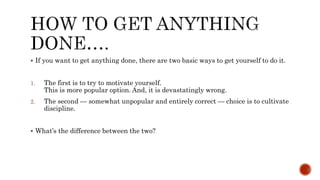
 If you want to get anything done, there are two basic ways to get yourself to do it.
1. The first is to try to motivate yourself.
This is more popular option. And, it is devastatingly wrong.
2. The second — somewhat unpopular and entirely correct — choice is to cultivate
discipline.
 What’s the difference between the two?
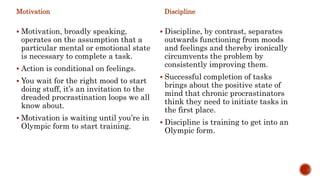
Motivation
 Motivation, broadly speaking,
operates on the assumption that a
particular mental or emotional state
is necessary to complete a task.
 Action is conditional on feelings.
 You wait for the right mood to start
doing stuff, it’s an invitation to the
dreaded procrastination loops we all
know about.
 Motivation is waiting until you’re in
Olympic form to start training.
Discipline
 Discipline, by contrast, separates
outwards functioning from moods
and feelings and thereby ironically
circumvents the problem by
consistently improving them.
 Successful completion of tasks
brings about the positive state of
mind that chronic procrastinators
think they need to initiate tasks in
the first place.
 Discipline is training to get into an
Olympic form.
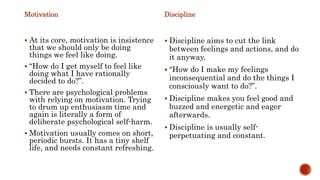
Motivation
 At its core, motivation is insistence
that we should only be doing
things we feel like doing.
 “How do I get myself to feel like
doing what I have rationally
decided to do?”.
 There are psychological problems
with relying on motivation. Trying
to drum up enthusiasm time and
again is literally a form of
deliberate psychological self-harm.
 Motivation usually comes on short,
periodic bursts. It has a tiny shelf
life, and needs constant refreshing.
Discipline
 Discipline aims to cut the link
between feelings and actions, and do
it anyway.
 “How do I make my feelings
inconsequential and do the things I
consciously want to do?”.
 Discipline makes you feel good and
buzzed and energetic and eager
afterwards.
 Discipline is usually self-
perpetuating and constant.
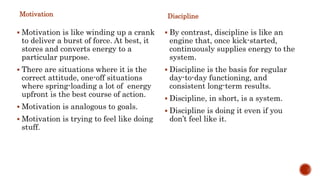
Motivation
 Motivation is like winding up a crank
to deliver a burst of force. At best, it
stores and converts energy to a
particular purpose.
 There are situations where it is the
correct attitude, one-off situations
where spring-loading a lot of energy
upfront is the best course of action.
 Motivation is analogous to goals.
 Motivation is trying to feel like doing
stuff.
Discipline
 By contrast, discipline is like an
engine that, once kick-started,
continuously supplies energy to the
system.
 Discipline is the basis for regular
day-to-day functioning, and
consistent long-term results.
 Discipline, in short, is a system.
 Discipline is doing it even if you
don’t feel like it.
 Productivity has no requisite mental states.
 For consistent, long-term results, discipline trumps motivation.
 How do you cultivate discipline? By building habits.
 Start as small as you can manage, even microscopic, and keep gathering
momentum. Re-invest it in progressively bigger changes to your routine, and build
a positive feedback loop.
 Forget motivation…
What we really need is discipline.

Motivation Vs. Discipline

  • 1.
    Excerpts from ablog post by Zbyněk Dráb Blog URL: http://www.wisdomination.com/
  • 2.
     If youwant to get anything done, there are two basic ways to get yourself to do it. 1. The first is to try to motivate yourself. This is more popular option. And, it is devastatingly wrong. 2. The second — somewhat unpopular and entirely correct — choice is to cultivate discipline.  What’s the difference between the two?
  • 3.
    Motivation  Motivation, broadlyspeaking, operates on the assumption that a particular mental or emotional state is necessary to complete a task.  Action is conditional on feelings.  You wait for the right mood to start doing stuff, it’s an invitation to the dreaded procrastination loops we all know about.  Motivation is waiting until you’re in Olympic form to start training. Discipline  Discipline, by contrast, separates outwards functioning from moods and feelings and thereby ironically circumvents the problem by consistently improving them.  Successful completion of tasks brings about the positive state of mind that chronic procrastinators think they need to initiate tasks in the first place.  Discipline is training to get into an Olympic form.
  • 4.
    Motivation  At itscore, motivation is insistence that we should only be doing things we feel like doing.  “How do I get myself to feel like doing what I have rationally decided to do?”.  There are psychological problems with relying on motivation. Trying to drum up enthusiasm time and again is literally a form of deliberate psychological self-harm.  Motivation usually comes on short, periodic bursts. It has a tiny shelf life, and needs constant refreshing. Discipline  Discipline aims to cut the link between feelings and actions, and do it anyway.  “How do I make my feelings inconsequential and do the things I consciously want to do?”.  Discipline makes you feel good and buzzed and energetic and eager afterwards.  Discipline is usually self- perpetuating and constant.
  • 5.
    Motivation  Motivation islike winding up a crank to deliver a burst of force. At best, it stores and converts energy to a particular purpose.  There are situations where it is the correct attitude, one-off situations where spring-loading a lot of energy upfront is the best course of action.  Motivation is analogous to goals.  Motivation is trying to feel like doing stuff. Discipline  By contrast, discipline is like an engine that, once kick-started, continuously supplies energy to the system.  Discipline is the basis for regular day-to-day functioning, and consistent long-term results.  Discipline, in short, is a system.  Discipline is doing it even if you don’t feel like it.
  • 6.
     Productivity hasno requisite mental states.  For consistent, long-term results, discipline trumps motivation.  How do you cultivate discipline? By building habits.  Start as small as you can manage, even microscopic, and keep gathering momentum. Re-invest it in progressively bigger changes to your routine, and build a positive feedback loop.  Forget motivation… What we really need is discipline.