


NEGOTIATION
MOHAMMED IRSHAD.P
INTRODUCTION
 Negotiation is the process of bargaining,
Where two parties ,trying to reach an
agreement on mutually accepted terms to
acquire each others wants.
Example:- Customer trying to negotiate
with buyer over a price of a product.
Negotiation for salary between employee
& employer.
DEFINITIONS OF NEGOTIATION
 In the words of Bill Scott
“a negotiation is a form of meeting between
two parties: OUR PARTIES & OTHER
PARTIES”.
 According to J.A. Wall ”negotiation is a
process in which two or more parties
exchange goods or services and attempt
to agree on the exchange rate for them.”
NATURE OF NEGOTIATION
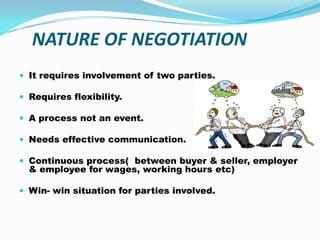
 It requires involvement of two parties.
 Requires flexibility.
 A process not an event.
 Needs effective communication.
 Continuous process( between buyer & seller, employer
& employee for wages, working hours etc)
 Win- win situation for parties involved.
FACTORS AFFECTING NEGOTIATION
 PLACE:
Familiarity with surrounding helps in boosting confidence.
 TIME :
Time should be adequate for smooth exchange of ideas &
securing agreement before it is to late .
 ATTITUDE :
Attitude of both parties should be positive , ie . , willingness
to make an agreement or deal.
 SUBJECTIVE FACTORS :
Like relation of two parties involved, status difference,
information &expertise.
NEGOTIATION PROCESS
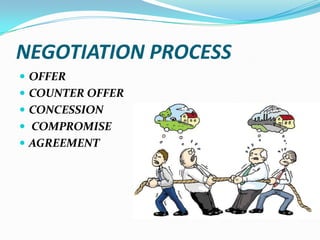
 OFFER
 COUNTER OFFER
 CONCESSION
 COMPROMISE
 AGREEMENT
 OFFER:
First proposal made by one party to another in the negotiation
stage.
 COUNTER OFFER:
Offer made by second party to first party, or proposing their
offer against first party offer.
 CONCESSION:
Increase or decrease made in the offer or change in the idea.
 COMPROMISE:
Sacrifice made by both or one party.
 AGREEMENT:
Point where both parties agrees , which is beneficial to both.
GUIDELINES FOR SUCCESSFUL NEGOTIATION
 Positive Attitudes
 Step By step approach
 Find out the other parties state of mind
culture background's Likes & dislikes
 Hide your prove desire
 Don’t disclose your deadlines
 Think before you speak
 Know your market information
 Bring your own expert
Negotiation

Negotiation

  • 2.
  • 3.
    INTRODUCTION  Negotiation isthe process of bargaining, Where two parties ,trying to reach an agreement on mutually accepted terms to acquire each others wants. Example:- Customer trying to negotiate with buyer over a price of a product. Negotiation for salary between employee & employer.
  • 4.
    DEFINITIONS OF NEGOTIATION In the words of Bill Scott “a negotiation is a form of meeting between two parties: OUR PARTIES & OTHER PARTIES”.  According to J.A. Wall ”negotiation is a process in which two or more parties exchange goods or services and attempt to agree on the exchange rate for them.”
  • 5.
    NATURE OF NEGOTIATION It requires involvement of two parties.  Requires flexibility.  A process not an event.  Needs effective communication.  Continuous process( between buyer & seller, employer & employee for wages, working hours etc)  Win- win situation for parties involved.
  • 6.
    FACTORS AFFECTING NEGOTIATION PLACE: Familiarity with surrounding helps in boosting confidence.  TIME : Time should be adequate for smooth exchange of ideas & securing agreement before it is to late .  ATTITUDE : Attitude of both parties should be positive , ie . , willingness to make an agreement or deal.  SUBJECTIVE FACTORS : Like relation of two parties involved, status difference, information &expertise.
  • 7.
    NEGOTIATION PROCESS  OFFER COUNTER OFFER  CONCESSION  COMPROMISE  AGREEMENT
  • 8.
     OFFER: First proposalmade by one party to another in the negotiation stage.  COUNTER OFFER: Offer made by second party to first party, or proposing their offer against first party offer.  CONCESSION: Increase or decrease made in the offer or change in the idea.  COMPROMISE: Sacrifice made by both or one party.  AGREEMENT: Point where both parties agrees , which is beneficial to both.
  • 9.
    GUIDELINES FOR SUCCESSFULNEGOTIATION  Positive Attitudes  Step By step approach  Find out the other parties state of mind culture background's Likes & dislikes  Hide your prove desire  Don’t disclose your deadlines  Think before you speak  Know your market information  Bring your own expert