DRUG DISTRIBUTION
1
Dr. Nilesh S. Kulkarni
Department of Pharmaceutics,
PES Modern college of Pharmacy ( For
Ladies), Moshi, Pune 412105
Volume of Distribution
Apparent volume of distribution :It is defined as the hypothetical
volume of body fluid into which a drug distributed.
It is called as Apparent Volume because all parts of the body
equilibrated with the drug do not have equal concentration.
The real volume of body fluid containing plasma ,intracellular,
extracellular fluids 40 to 50 liter.
Standard value of body fluid plasma 6,intracellular 12, extracellular
24, Total body water 42 liters.
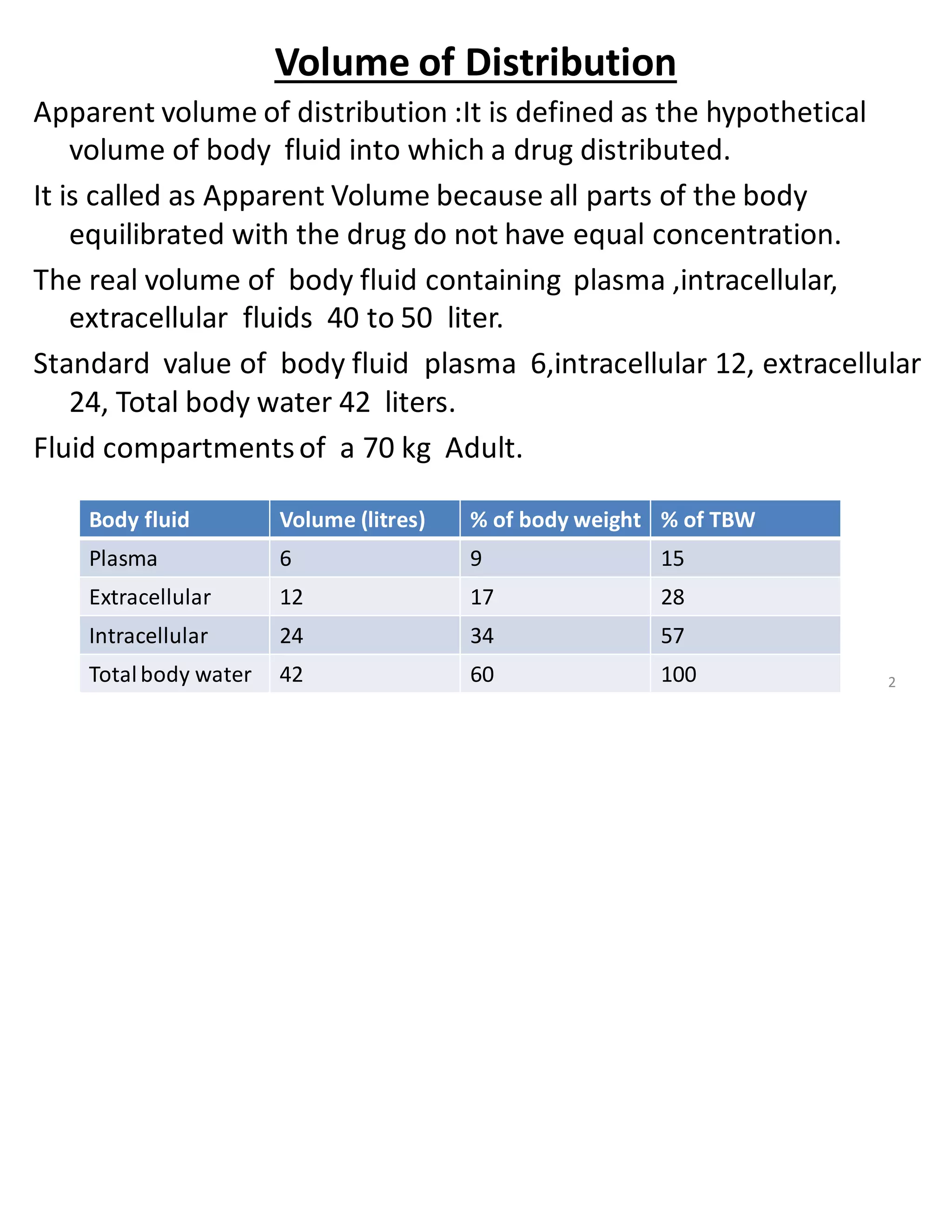
Fluid compartmentsof a 70 kg Adult.
2
Body fluid Volume (litres) % of body weight % of TBW
Plasma 6 9 15
Extracellular 12 17 28
Intracellular 24 34 57
Totalbody water 42 60 100
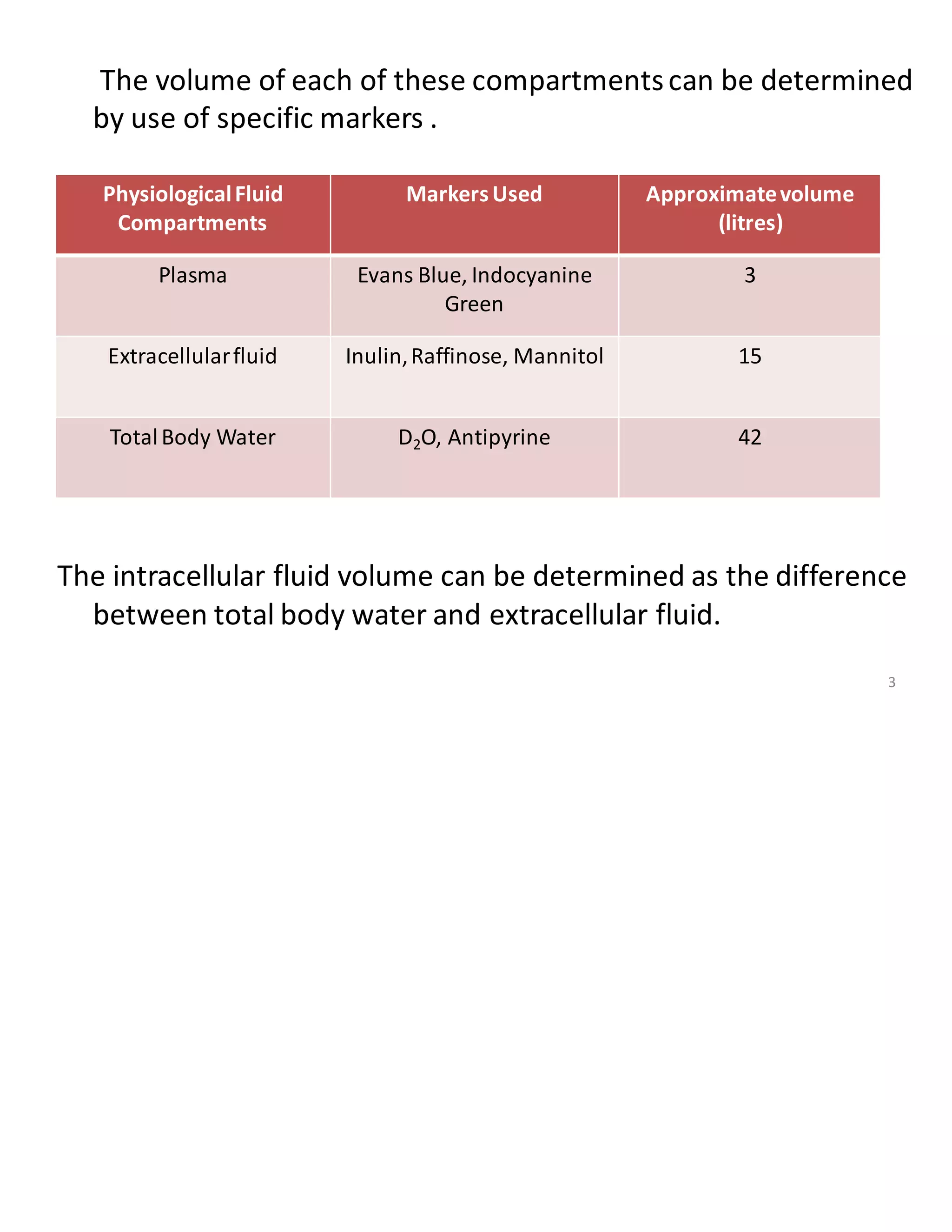
The volume of each of these compartmentscan be determined
by use of specific markers .
The intracellular fluid volume can be determined as the difference
between total body water and extracellular fluid.
PhysiologicalFluid
Compartments
MarkersUsed Approximatevolume
(litres)
Plasma Evans Blue, Indocyanine
Green
3
Extracellularfluid Inulin,Raffinose, Mannitol 15
TotalBody Water D2O, Antipyrine 42
3
Drugs which bind selectively to Plasma proteins e.g. Warfarin have
Apparent volume of distribution smaller than their Real volume
of distribution.
The Vd of such drugs lies between blood volume and total body
water i.e. between 6 to 42 liters.
Drugs which bind selectively to Extravascular Tissues e.g.
Chloroquine have Apparent volume of distribution larger than
their Real volume of distribution.
The Vd of such drugs is always greater than 42 liters.
4
Factor affecting drug-Protein
binding , Significant , Kinetics of
drug-protein binding
5
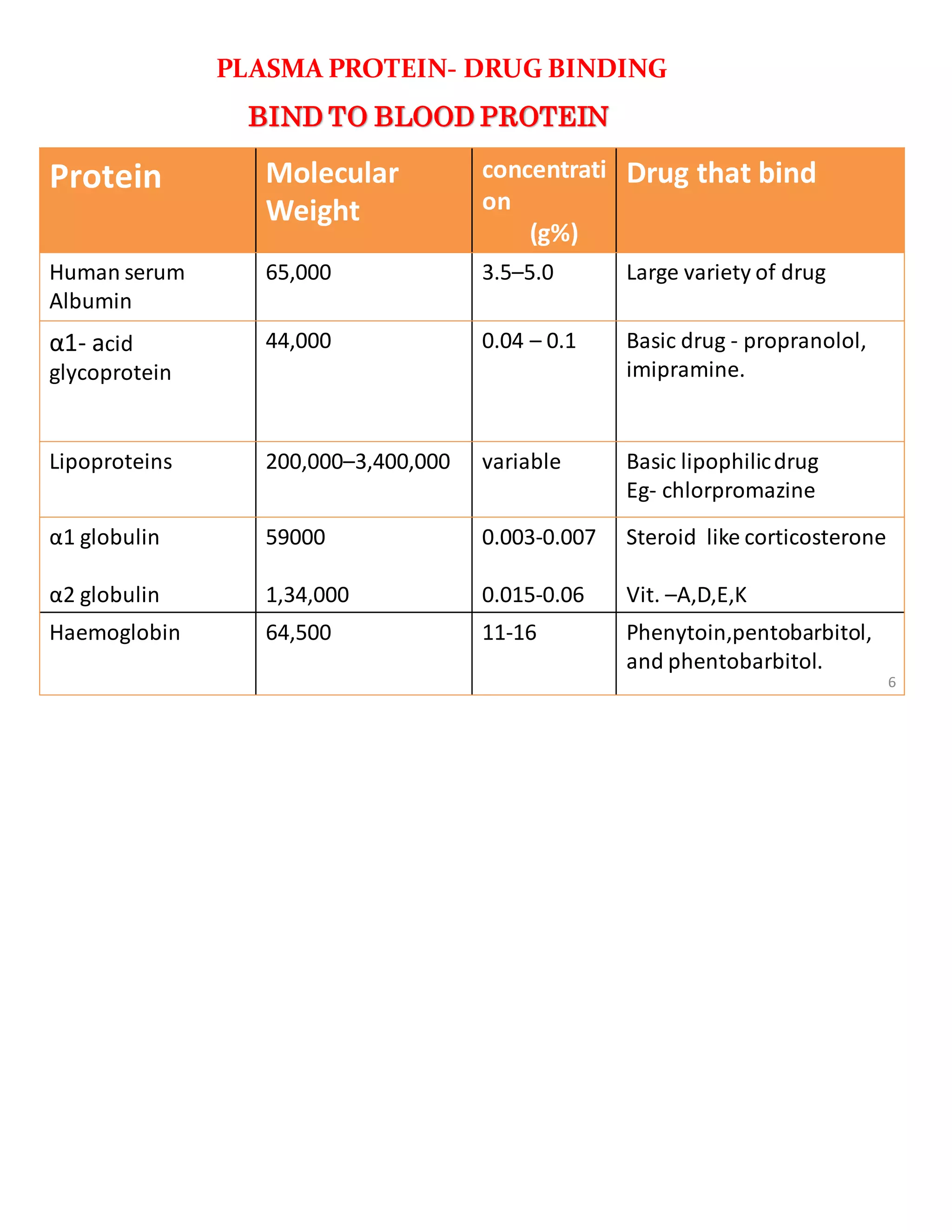
Protein Molecular
Weight
concentrati
on
(g%)
Drug that bind
Human serum
Albumin
65,000 3.5–5.0 Large variety of drug
α1- acid
glycoprotein
44,000 0.04 – 0.1 Basic drug - propranolol,
imipramine.
Lipoproteins 200,000–3,400,000 variable Basic lipophilicdrug
Eg- chlorpromazine
α1 globulin
α2 globulin
59000
1,34,000
0.003-0.007
0.015-0.06
Steroid like corticosterone
Vit. –A,D,E,K
Haemoglobin 64,500 11-16 Phenytoin,pentobarbitol,
and phentobarbitol.
PLASMA PROTEIN- DRUG BINDING
BIND TO BLOOD PROTEIN
6
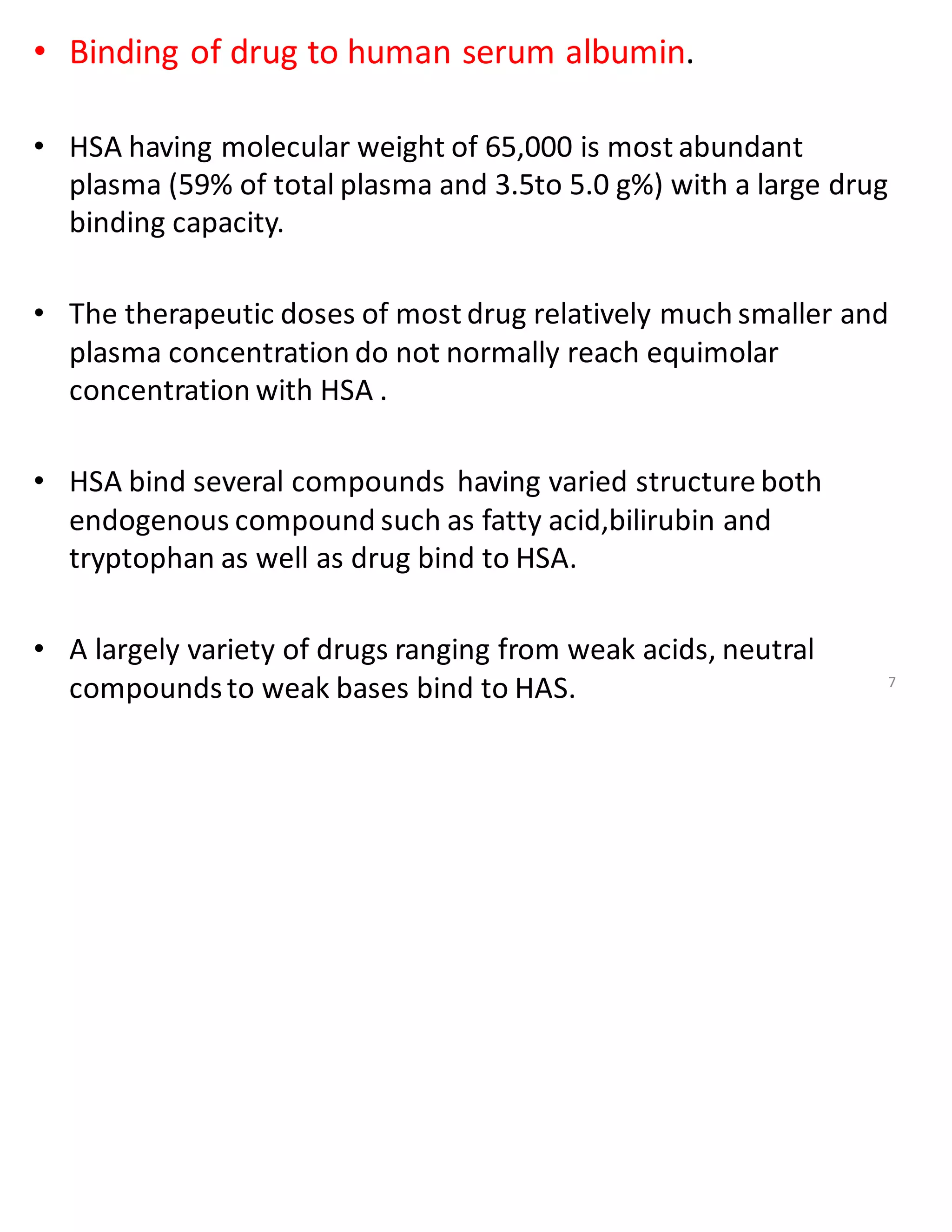
• Binding of drug to human serum albumin.
• HSA having molecular weight of 65,000 is most abundant
plasma (59% of total plasma and 3.5to 5.0 g%) with a large drug
binding capacity.
• The therapeutic doses of most drug relatively much smaller and
plasma concentration do not normally reach equimolar
concentration with HSA .
• HSA bind several compounds having varied structure both
endogenous compound such as fatty acid,bilirubin and
tryptophan as well as drug bind to HSA.
• A largely variety of drugs ranging from weak acids, neutral
compoundsto weak bases bind to HAS. 7
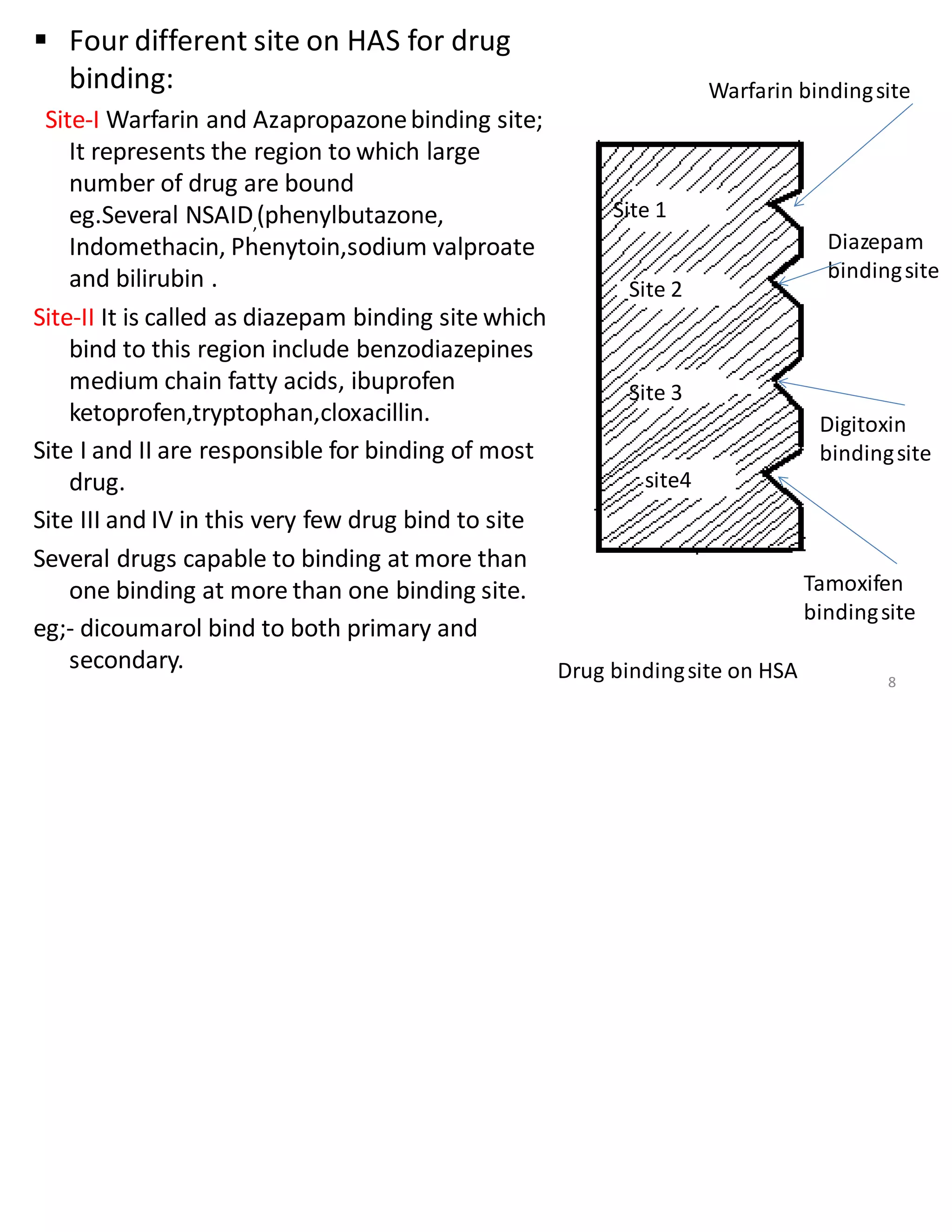
▪ Four different site on HAS for drug
binding:
Site-I Warfarin and Azapropazonebinding site;
It represents the region to which large
number of drug are bound
eg.Several NSAID,(phenylbutazone,
Indomethacin, Phenytoin,sodium valproate
and bilirubin .
Site-II It is called as diazepam binding site which
bind to this region include benzodiazepines
medium chain fatty acids, ibuprofen
ketoprofen,tryptophan,cloxacillin.
Site I and II are responsible for binding of most
drug.
Site III and IV in this very few drug bind to site
Several drugs capable to binding at more than
one binding at more than one binding site.
eg;- dicoumarol bind to both primary and
secondary.
Site 1
Site 2
Site 3
site4
Drug bindingsite on HSA
Warfarin bindingsite
Diazepam
bindingsite
Digitoxin
bindingsite
Tamoxifen
bindingsite
8
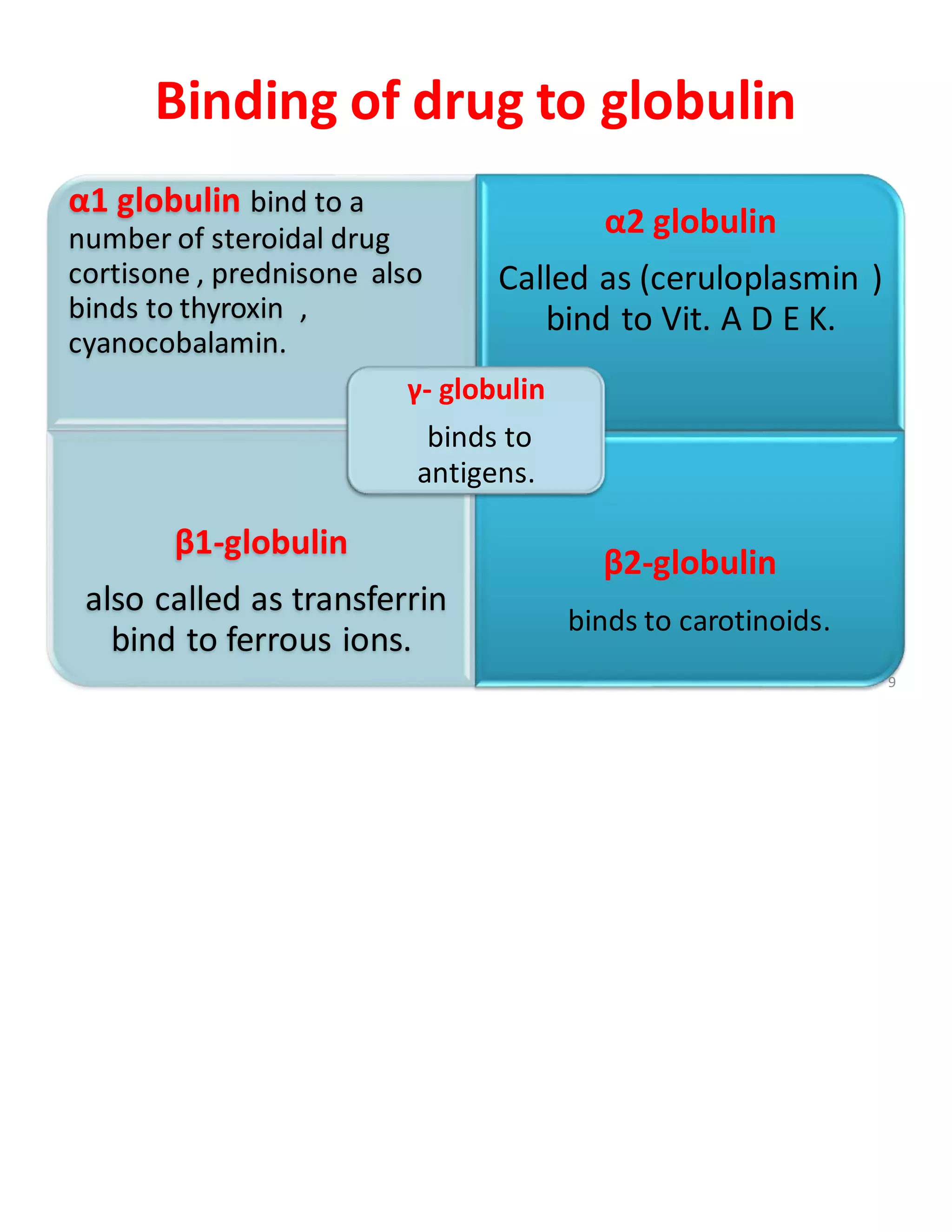
Binding of drug to globulin
α1 globulin bind to a
number of steroidal drug
cortisone , prednisone also
binds to thyroxin ,
cyanocobalamin.
α2 globulin
Called as (ceruloplasmin )
bind to Vit. A D E K.
β1-globulin
also called as transferrin
bind to ferrous ions.
β2-globulin
binds to carotinoids.
γ- globulin
binds to
antigens.
9
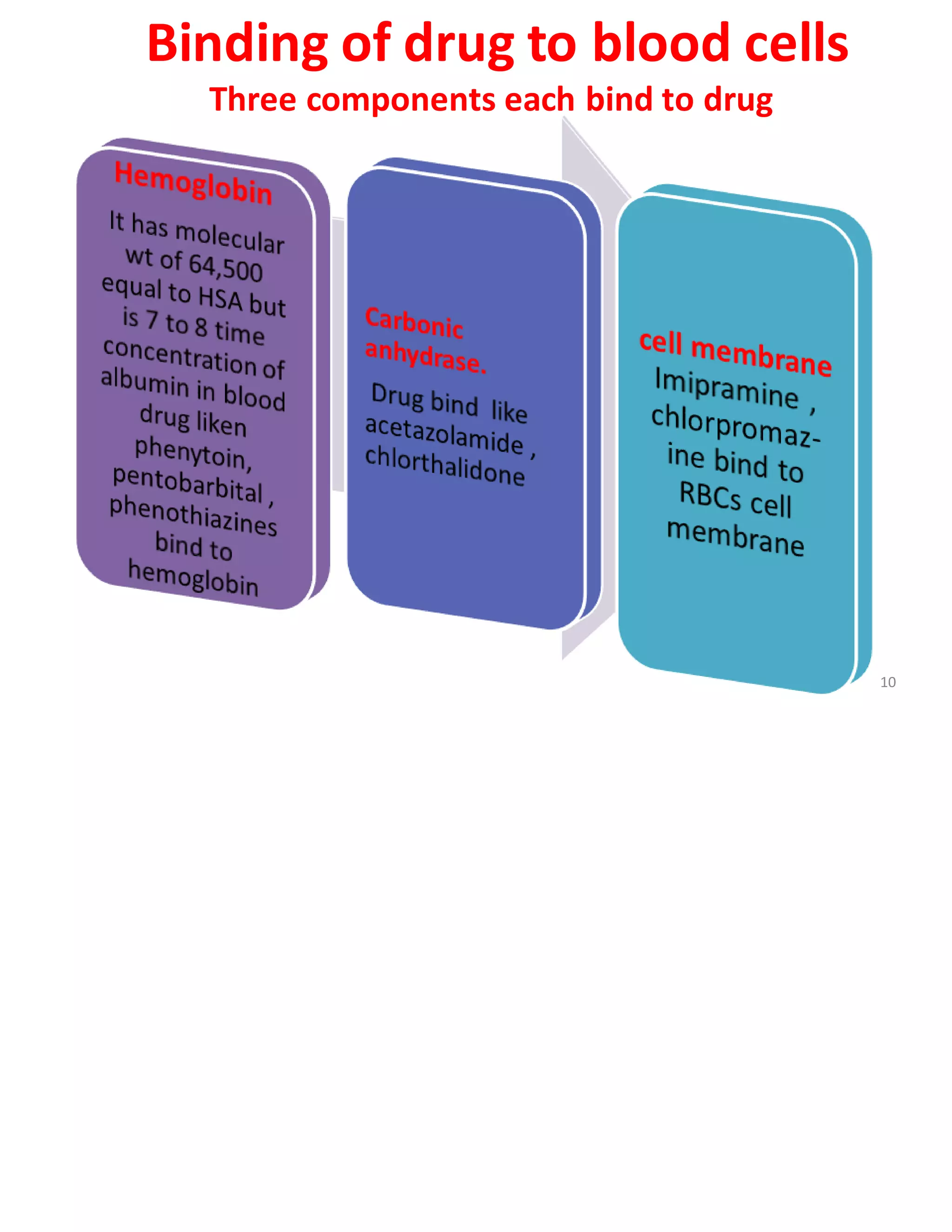
Binding of drug to blood cells
Three components each bind to drug
10
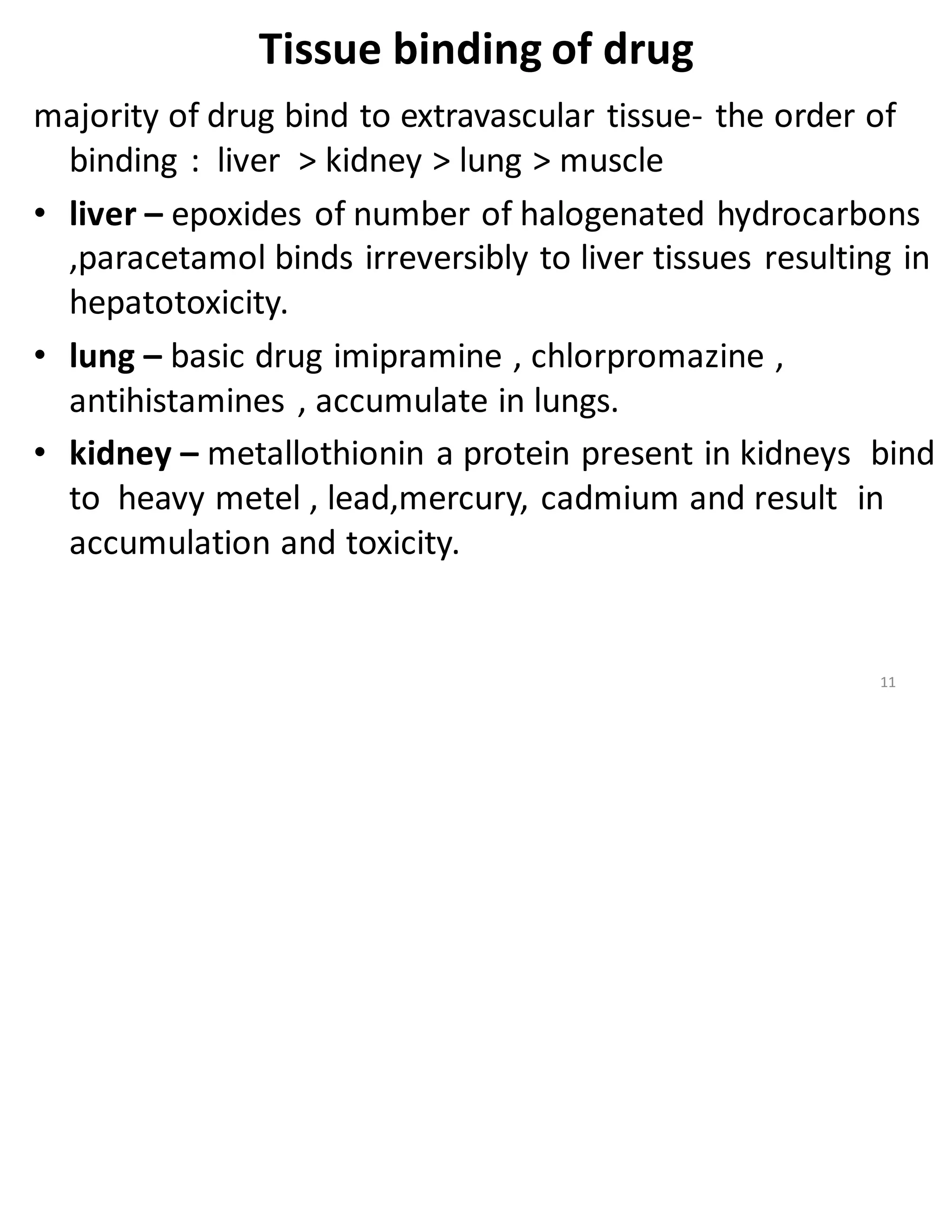
Tissue binding of drug
majority of drug bind to extravascular tissue- the order of
binding : liver > kidney > lung > muscle
• liver – epoxides of number of halogenated hydrocarbons
,paracetamol binds irreversibly to liver tissues resulting in
hepatotoxicity.
• lung – basic drug imipramine , chlorpromazine ,
antihistamines , accumulate in lungs.
• kidney – metallothionin a protein present in kidneys bind
to heavy metel , lead,mercury, cadmium and result in
accumulation and toxicity.
11
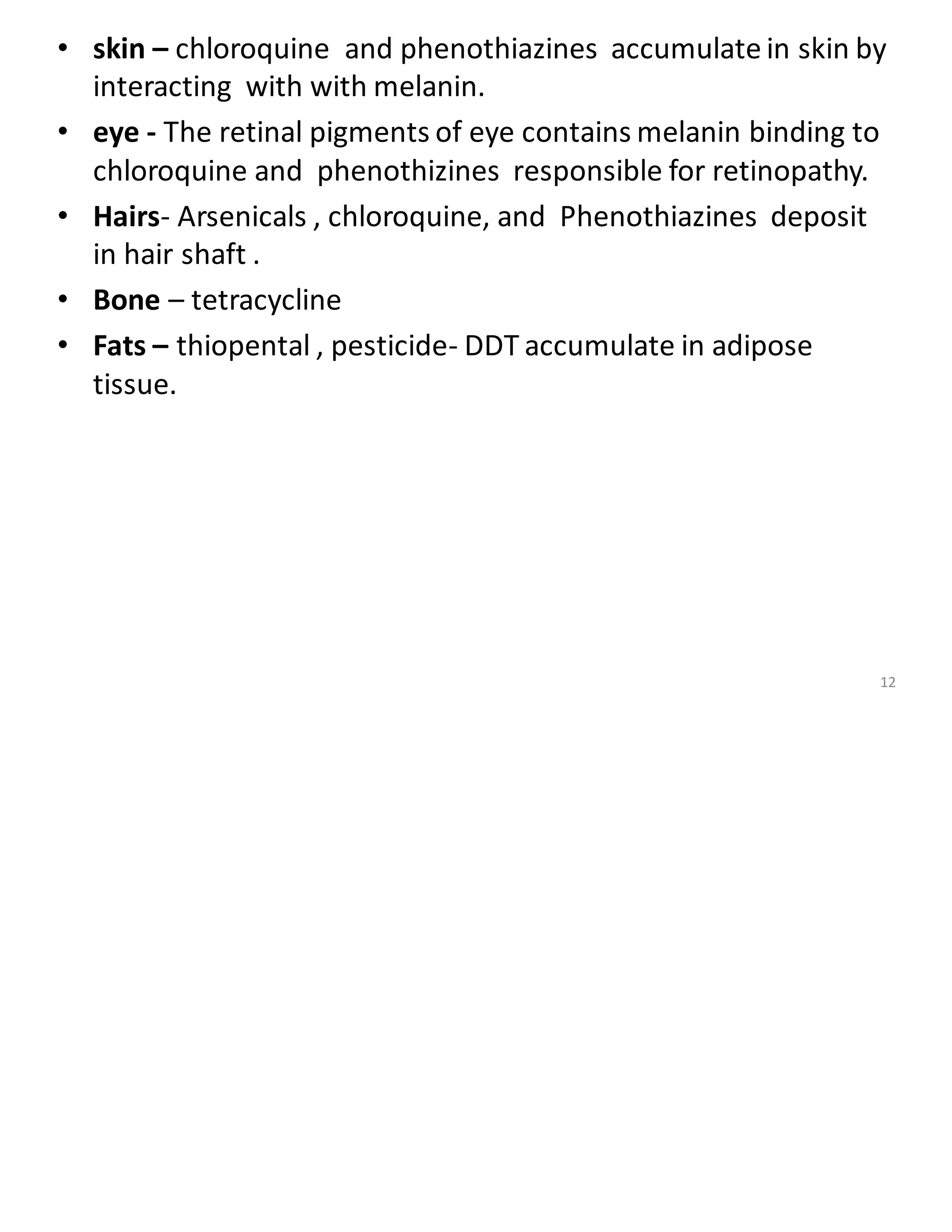
• skin – chloroquine and phenothiazines accumulate in skin by
interacting with with melanin.
• eye - The retinal pigments of eye contains melanin binding to
chloroquine and phenothizines responsible for retinopathy.
• Hairs- Arsenicals , chloroquine, and Phenothiazines deposit
in hair shaft .
• Bone – tetracycline
• Fats – thiopental , pesticide- DDT accumulate in adipose
tissue.
12
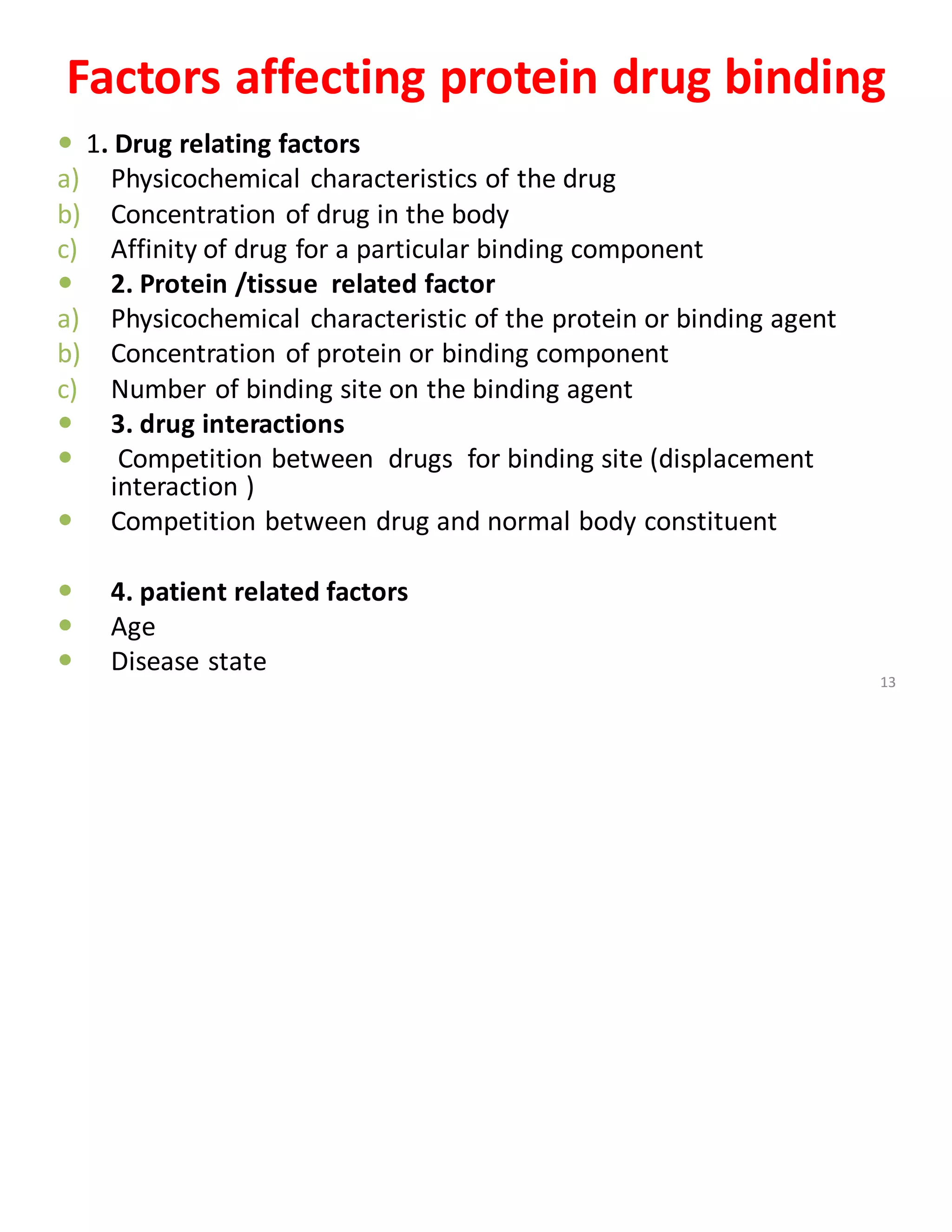
Factors affecting protein drug binding
 1. Drug relating factors
a) Physicochemical characteristics of the drug
b) Concentration of drug in the body
c) Affinity of drug for a particular binding component
 2. Protein /tissue related factor
a) Physicochemical characteristic of the protein or binding agent
b) Concentration of protein or binding component
c) Number of binding site on the binding agent
 3. drug interactions
 Competition between drugs for binding site (displacement
interaction )
 Competition between drug and normal body constituent
 4. patient related factors
 Age
 Disease state
13
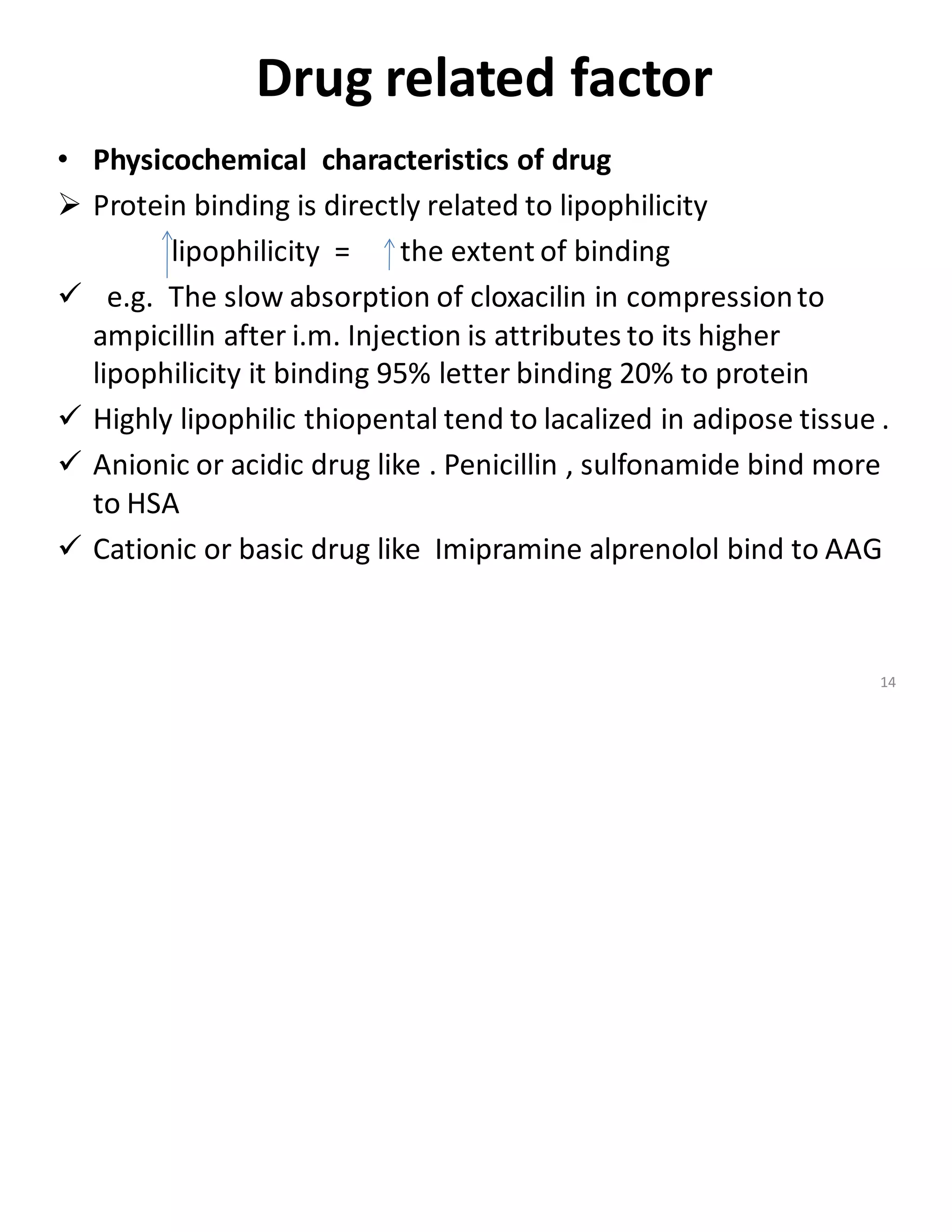
Drug related factor
• Physicochemical characteristics of drug
➢ Protein binding is directly related to lipophilicity
lipophilicity = the extent of binding
✓ e.g. The slow absorption of cloxacilin in compressionto
ampicillin after i.m. Injection is attributes to its higher
lipophilicity it binding 95% letter binding 20% to protein
✓ Highly lipophilic thiopental tend to lacalized in adipose tissue .
✓ Anionic or acidic drug like . Penicillin , sulfonamide bind more
to HSA
✓ Cationic or basic drug like Imipramine alprenolol bind to AAG
14
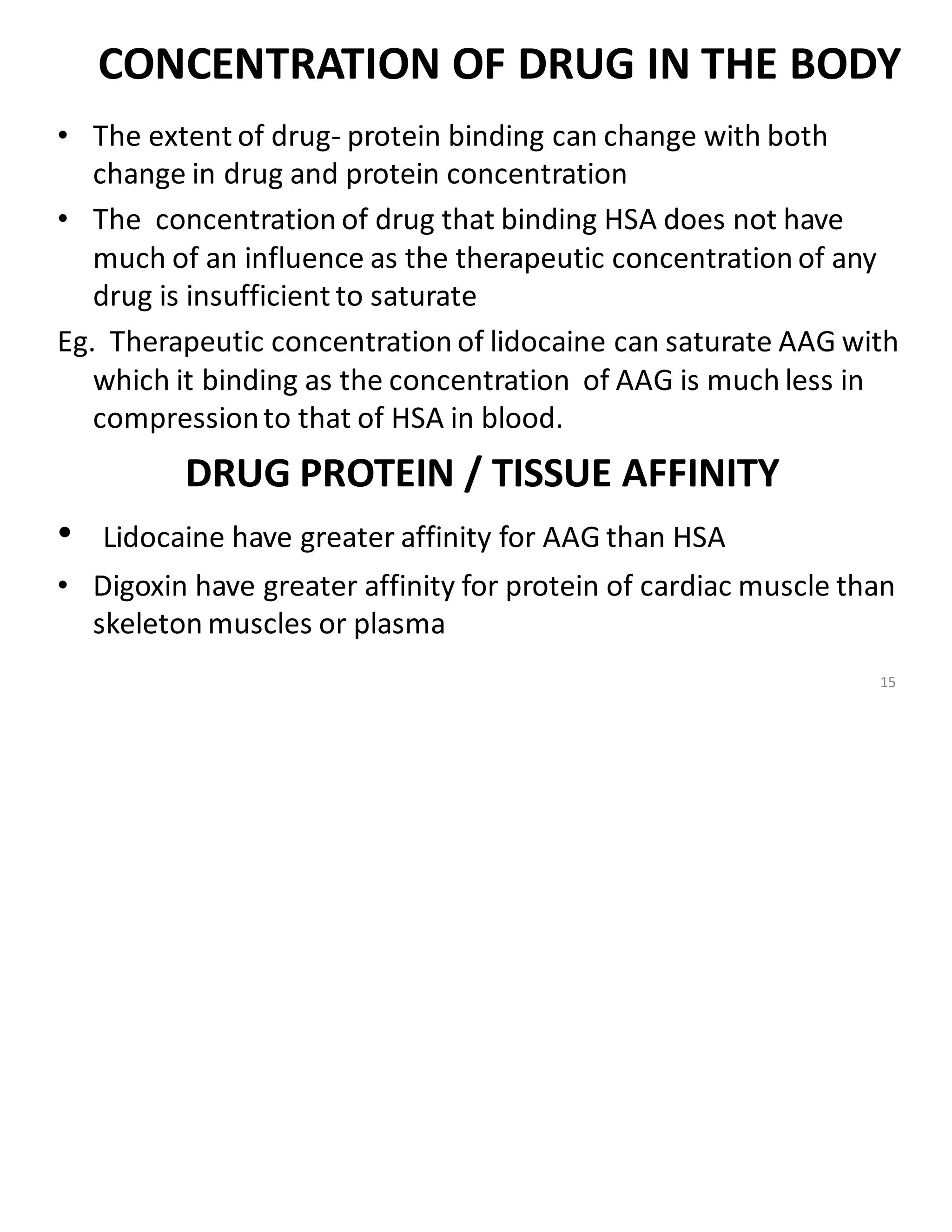
CONCENTRATION OF DRUG IN THE BODY
• The extent of drug- protein binding can change with both
change in drug and protein concentration
• The concentration of drug that binding HSA does not have
much of an influence as the therapeutic concentration of any
drug is insufficient to saturate
Eg. Therapeutic concentration of lidocaine can saturate AAG with
which it binding as the concentration of AAG is much less in
compressionto that of HSA in blood.
DRUG PROTEIN / TISSUE AFFINITY
• Lidocaine have greater affinity for AAG than HSA
• Digoxin have greater affinity for protein of cardiac muscle than
skeleton muscles or plasma
15
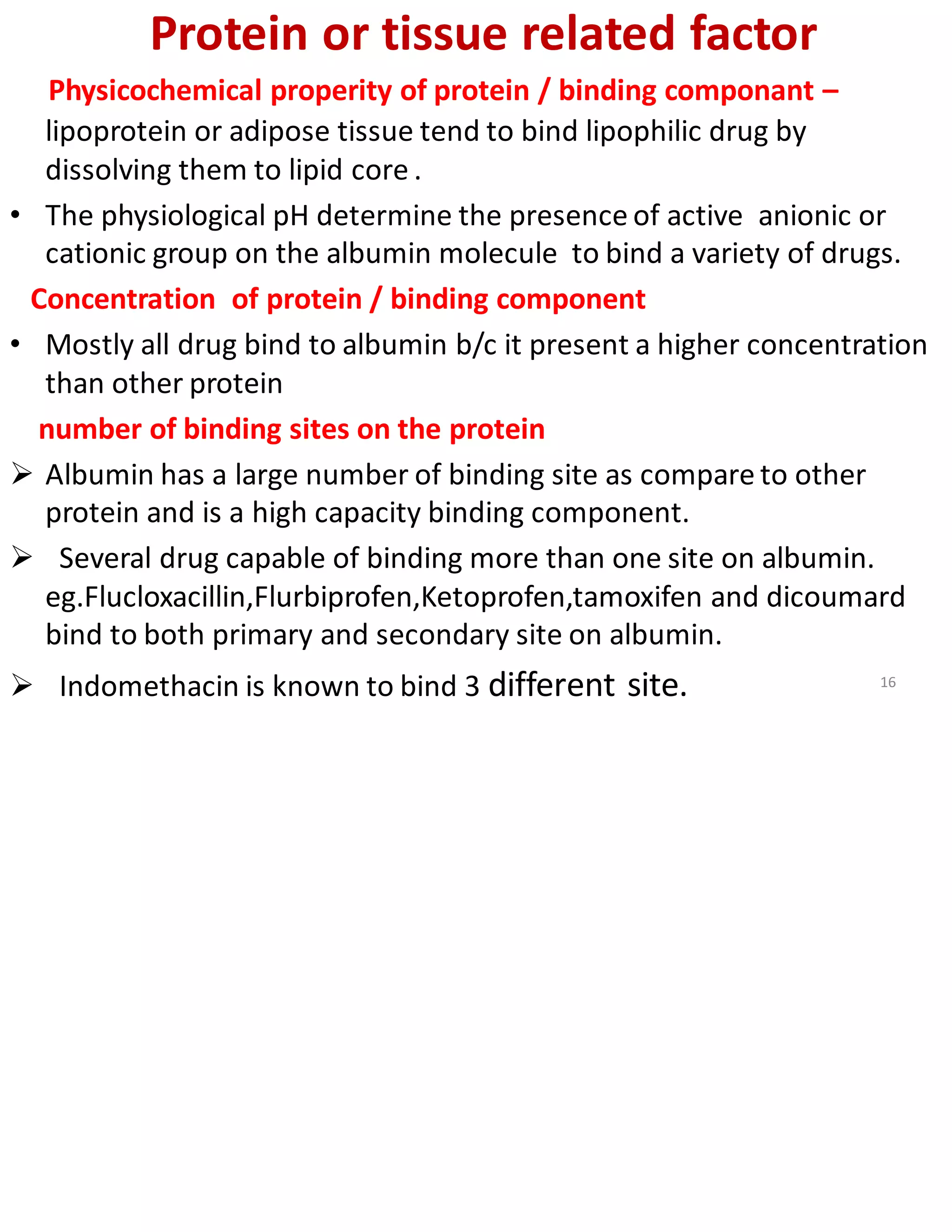
Protein or tissue related factor
Physicochemical properity of protein / binding componant –
lipoprotein or adipose tissue tend to bind lipophilic drug by
dissolving them to lipid core .
• The physiological pH determine the presence of active anionic or
cationic group on the albumin molecule to bind a variety of drugs.
Concentration of protein / binding component
• Mostly all drug bind to albumin b/c it present a higher concentration
than other protein
number of binding sites on the protein
➢ Albumin has a large number of binding site as compare to other
protein and is a high capacity binding component.
➢ Several drug capable of binding more than one site on albumin.
eg.Flucloxacillin,Flurbiprofen,Ketoprofen,tamoxifen and dicoumard
bind to both primary and secondary site on albumin.
➢ Indomethacin is known to bind 3 different site. 16
Drug interaction
Competition between drugs for binding site (displacement
interaction )
➢ When two or more drug present to the same site , competition
between them for interaction with same binding site .
➢ If one of the drug (A) is bound to such a site , then administration
of the another drug (B) having high affinity for same binding site
result in displacement of drugs (A) from its binding site .
➢ drug-drug interaction for the common binding site is called as
displacement interaction. This type of interaction is known as
displacement interaction .
➢ Where drug (A) here is called as the displaced drug and drug (B)
as the displacer .
Eg. Phenylbutazone displace warfarin and sulfonamide from its
binding site
➢ Even a drug metabolite can affect displacement interaction. 17
Displaced drug
1.More than 95% bound
2.Has small volume of distribution
3.Shows rapid onset of action, has narrow therapeutic index
Displacer drug
1.High degree of affinity as the drug to be displaced
2.competes for the same binding sites.
3.Shows rapid and largeincrease in plasma concentration
4.Drug to plasma conc.rate is more
5.displaced drug produce 100% increases in pharmacological action response.
Heparin-Acts as Anticoagulant. Synthesis of lipoprotein lipase to metabolises
triglycerides to free fatty acids they have similar affinityto HAS.
Indirect inteaction :-Heparin with propranolol . Free fatty acid displacer to
propranolol and Heparin is displaced drug.
Free fatty acid which bind to albumin influence binding of several benzodiaepines and
propranolol (decreased binding) and warfarin(increased binding) .
Bilirubin:- It also have affinityto HAS.
18
Competition betweendrug and normal body
constituent
• The free fatty acids are interact to with a number of drug that
bind primarily to HSA . When free fatty acid level is increase in
several condition – fasting , - pathologic – diabeties ,
myocardial infraction , alcohol abstinence – the fatty acid
which also bind to albumin influence binding of several drug
binding – diazepam
- propanolol
binding - warfarin
Acidic drug like – sod. Salicilate , sod . Benzoate ,
sulfonamide displace bilirubin from its albumin binding site
result in neonate it cross to BBB and precipitate toxicity .
19
Patient related factor
• Age
➢ Neonate – albumin contentis low in new born as result in
increase conc. of unbound drug that primarily bind to albumin
eg. Phenytoin , diazepam .
• Elderly –
➢ albumin contentis lowered result in increase conc. of drug that
primarily bind to albumin .
➢ In old age AAG level is increase thus decrease in free conc. of
drug that bind to AAG .
20
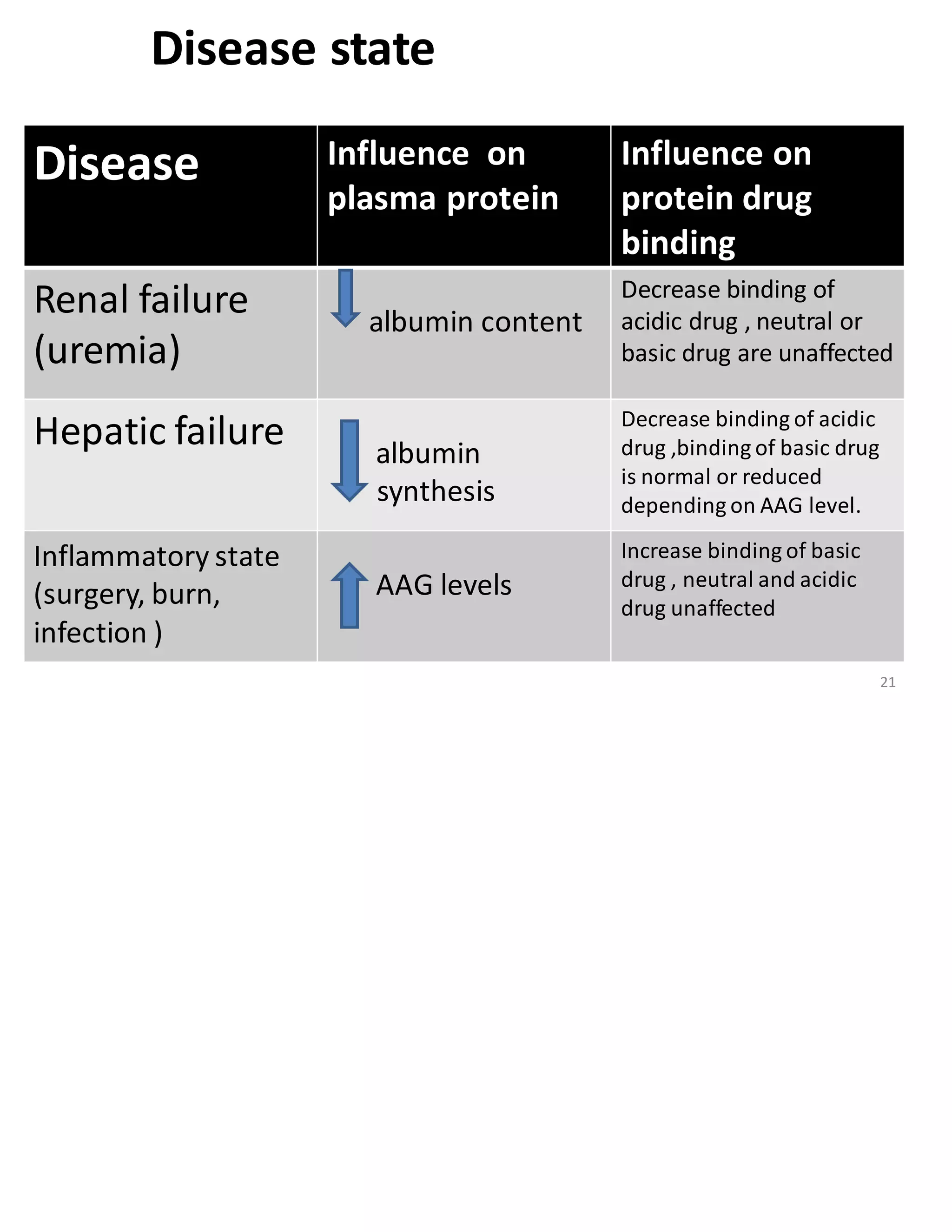
Disease state
Disease Influence on
plasma protein
Influence on
protein drug
binding
Renal failure
(uremia)
albumin content
Decrease binding of
acidic drug , neutral or
basic drug are unaffected
Hepatic failure albumin
synthesis
Decrease binding of acidic
drug ,binding of basic drug
is normal or reduced
depending on AAG level.
Inflammatory state
(surgery, burn,
infection )
AAG levels
Increase binding of basic
drug , neutral and acidic
drug unaffected
21
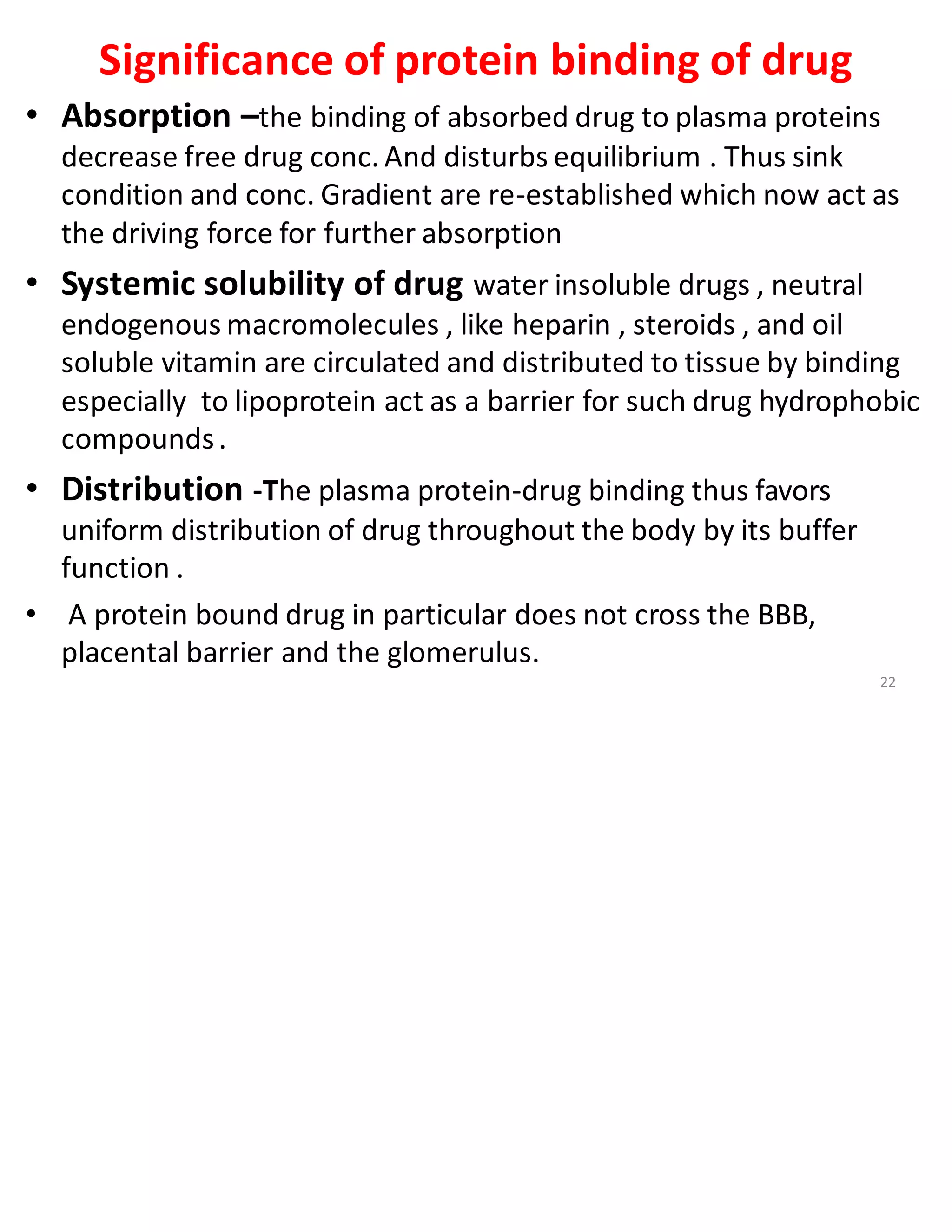
Significance of protein binding of drug
• Absorption –the binding of absorbed drug to plasma proteins
decrease free drug conc. And disturbs equilibrium . Thus sink
condition and conc. Gradient are re-established which now act as
the driving force for further absorption
• Systemic solubility of drug water insoluble drugs , neutral
endogenous macromolecules , like heparin , steroids , and oil
soluble vitamin are circulated and distributed to tissue by binding
especially to lipoprotein act as a barrier for such drug hydrophobic
compounds.
• Distribution -The plasma protein-drug binding thus favors
uniform distribution of drug throughout the body by its buffer
function .
• A protein bound drug in particular does not cross the BBB,
placental barrier and the glomerulus.
22
• Tissue binding , apparent volume of distribution and
drug storage
✓ A drug that bind to blood component remains confined to blood
have small volume of distribution.
✓ Drug that show extra-vascular tissue binding have large volume of
distribution .
✓ the relationship b/w tissue drug binding and apparent volume of
distribution-
Vd = amount of drug in the body = X
plasma drug concentration C
the amount of drug in the body X = Vd C
SIMILAR , amount of drug in plasma = Vp C
Amount of drug in extravascular tissue = Vt Ct
23
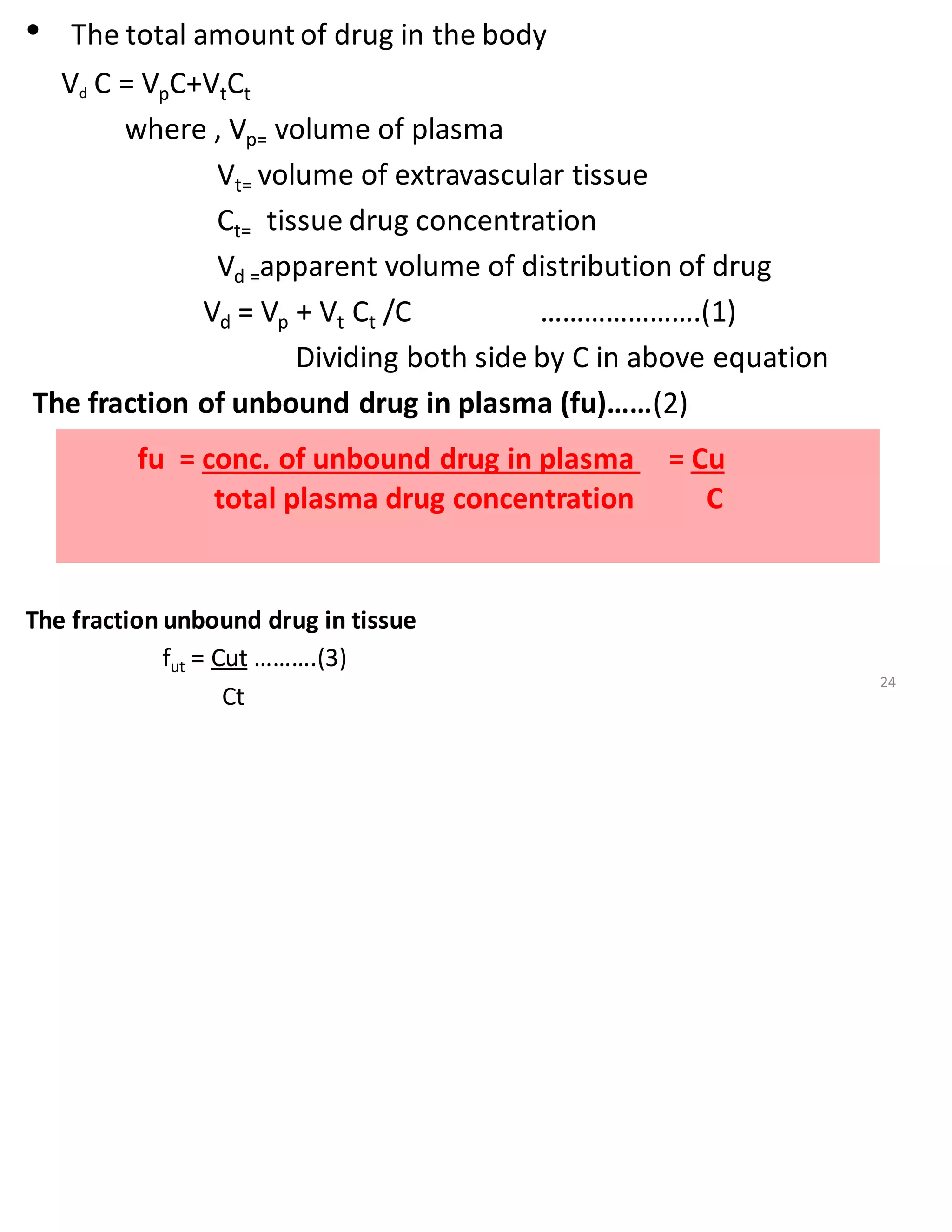
• The total amount of drug in the body
Vd C = VpC+VtCt
where , Vp= volume of plasma
Vt= volume of extravascular tissue
Ct= tissue drug concentration
Vd =apparent volume of distribution of drug
Vd = Vp + Vt Ct /C ………………….(1)
Dividing both side by C in above equation
The fraction of unbound drug in plasma (fu)……(2)
The fraction unbound drug in tissue
fut = Cut ……….(3)
Ct
fu = conc. of unbound drug in plasma = Cu
total plasma drug concentration C
24
Assuming that equilibrium unbound or free drug conc. In plasma
equal that in extravascular tissue i.e Cu=Cut
mean Cu = Cut then,equation 2 and 3 can combined to give.
…..(4)
Substitution of equation 4 in 1
from above equation It is clear that greater the unbound or free
concentration of drug in plasma larger its Vd.
Vd = Vp + Vt . fu
fut
C t = fu
C fut
25
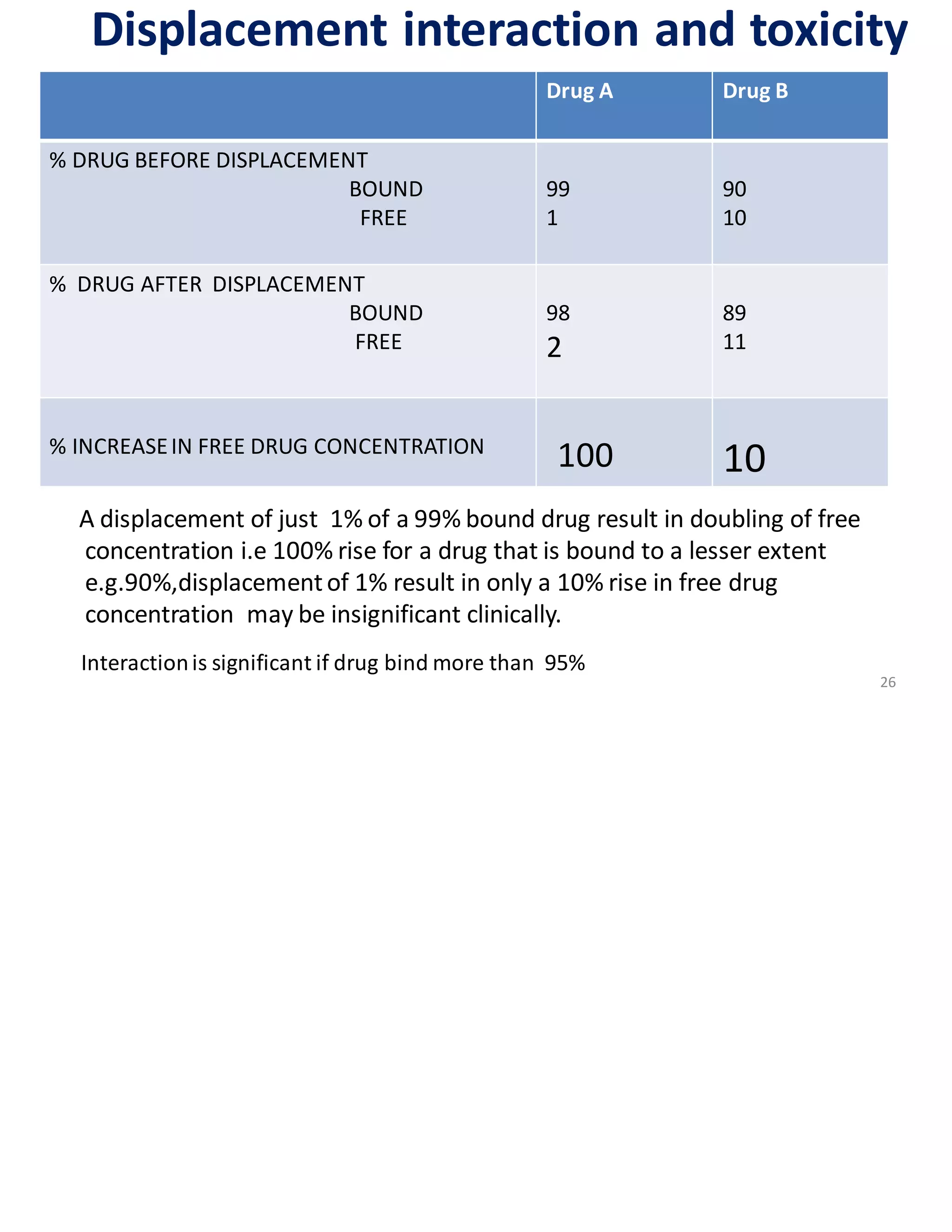
Displacement interaction and toxicity
Drug A Drug B
% DRUG BEFORE DISPLACEMENT
BOUND
FREE
99
1
90
10
% DRUG AFTER DISPLACEMENT
BOUND
FREE
98
2
89
11
% INCREASEIN FREE DRUG CONCENTRATION
100 10
Interactionis significant if drug bind more than 95%
A displacement of just 1% of a 99% bound drug result in doubling of free
concentration i.e 100% rise for a drug that is bound to a lesser extent
e.g.90%,displacementof 1% result in only a 10% rise in free drug
concentration may be insignificant clinically.
26
Eg; kernicterus – in infants an example of disorder cause by
displacement of bilirubin from albumin binding site by NSAID’S
and sulphonamides.
Displacement of warfarin by phenylbutazone
➢ Displacement of digoxine by qunidine .digoxin represent a drug
large volume distribution.showsextravascular tissue
binding.since displacement interactions may precipitate toxicity
of displaced drug,reduction in its dose
➢ Drug having small vd such as warfarin displacement can result in
a large increase in free drug concentration in plasma .
27

12 Drug Distribution part 2

  • 1.
    DRUG DISTRIBUTION 1 Dr. NileshS. Kulkarni Department of Pharmaceutics, PES Modern college of Pharmacy ( For Ladies), Moshi, Pune 412105
  • 2.
    Volume of Distribution Apparentvolume of distribution :It is defined as the hypothetical volume of body fluid into which a drug distributed. It is called as Apparent Volume because all parts of the body equilibrated with the drug do not have equal concentration. The real volume of body fluid containing plasma ,intracellular, extracellular fluids 40 to 50 liter. Standard value of body fluid plasma 6,intracellular 12, extracellular 24, Total body water 42 liters. Fluid compartmentsof a 70 kg Adult. 2 Body fluid Volume (litres) % of body weight % of TBW Plasma 6 9 15 Extracellular 12 17 28 Intracellular 24 34 57 Totalbody water 42 60 100
  • 3.
    The volume ofeach of these compartmentscan be determined by use of specific markers . The intracellular fluid volume can be determined as the difference between total body water and extracellular fluid. PhysiologicalFluid Compartments MarkersUsed Approximatevolume (litres) Plasma Evans Blue, Indocyanine Green 3 Extracellularfluid Inulin,Raffinose, Mannitol 15 TotalBody Water D2O, Antipyrine 42 3
  • 4.
    Drugs which bindselectively to Plasma proteins e.g. Warfarin have Apparent volume of distribution smaller than their Real volume of distribution. The Vd of such drugs lies between blood volume and total body water i.e. between 6 to 42 liters. Drugs which bind selectively to Extravascular Tissues e.g. Chloroquine have Apparent volume of distribution larger than their Real volume of distribution. The Vd of such drugs is always greater than 42 liters. 4
  • 5.
    Factor affecting drug-Protein binding, Significant , Kinetics of drug-protein binding 5
  • 6.
    Protein Molecular Weight concentrati on (g%) Drug thatbind Human serum Albumin 65,000 3.5–5.0 Large variety of drug α1- acid glycoprotein 44,000 0.04 – 0.1 Basic drug - propranolol, imipramine. Lipoproteins 200,000–3,400,000 variable Basic lipophilicdrug Eg- chlorpromazine α1 globulin α2 globulin 59000 1,34,000 0.003-0.007 0.015-0.06 Steroid like corticosterone Vit. –A,D,E,K Haemoglobin 64,500 11-16 Phenytoin,pentobarbitol, and phentobarbitol. PLASMA PROTEIN- DRUG BINDING BIND TO BLOOD PROTEIN 6
  • 7.
    • Binding ofdrug to human serum albumin. • HSA having molecular weight of 65,000 is most abundant plasma (59% of total plasma and 3.5to 5.0 g%) with a large drug binding capacity. • The therapeutic doses of most drug relatively much smaller and plasma concentration do not normally reach equimolar concentration with HSA . • HSA bind several compounds having varied structure both endogenous compound such as fatty acid,bilirubin and tryptophan as well as drug bind to HSA. • A largely variety of drugs ranging from weak acids, neutral compoundsto weak bases bind to HAS. 7
  • 8.
    ▪ Four differentsite on HAS for drug binding: Site-I Warfarin and Azapropazonebinding site; It represents the region to which large number of drug are bound eg.Several NSAID,(phenylbutazone, Indomethacin, Phenytoin,sodium valproate and bilirubin . Site-II It is called as diazepam binding site which bind to this region include benzodiazepines medium chain fatty acids, ibuprofen ketoprofen,tryptophan,cloxacillin. Site I and II are responsible for binding of most drug. Site III and IV in this very few drug bind to site Several drugs capable to binding at more than one binding at more than one binding site. eg;- dicoumarol bind to both primary and secondary. Site 1 Site 2 Site 3 site4 Drug bindingsite on HSA Warfarin bindingsite Diazepam bindingsite Digitoxin bindingsite Tamoxifen bindingsite 8
  • 9.
    Binding of drugto globulin α1 globulin bind to a number of steroidal drug cortisone , prednisone also binds to thyroxin , cyanocobalamin. α2 globulin Called as (ceruloplasmin ) bind to Vit. A D E K. β1-globulin also called as transferrin bind to ferrous ions. β2-globulin binds to carotinoids. γ- globulin binds to antigens. 9
  • 10.
    Binding of drugto blood cells Three components each bind to drug 10
  • 11.
    Tissue binding ofdrug majority of drug bind to extravascular tissue- the order of binding : liver > kidney > lung > muscle • liver – epoxides of number of halogenated hydrocarbons ,paracetamol binds irreversibly to liver tissues resulting in hepatotoxicity. • lung – basic drug imipramine , chlorpromazine , antihistamines , accumulate in lungs. • kidney – metallothionin a protein present in kidneys bind to heavy metel , lead,mercury, cadmium and result in accumulation and toxicity. 11
  • 12.
    • skin –chloroquine and phenothiazines accumulate in skin by interacting with with melanin. • eye - The retinal pigments of eye contains melanin binding to chloroquine and phenothizines responsible for retinopathy. • Hairs- Arsenicals , chloroquine, and Phenothiazines deposit in hair shaft . • Bone – tetracycline • Fats – thiopental , pesticide- DDT accumulate in adipose tissue. 12
  • 13.
    Factors affecting proteindrug binding  1. Drug relating factors a) Physicochemical characteristics of the drug b) Concentration of drug in the body c) Affinity of drug for a particular binding component  2. Protein /tissue related factor a) Physicochemical characteristic of the protein or binding agent b) Concentration of protein or binding component c) Number of binding site on the binding agent  3. drug interactions  Competition between drugs for binding site (displacement interaction )  Competition between drug and normal body constituent  4. patient related factors  Age  Disease state 13
  • 14.
    Drug related factor •Physicochemical characteristics of drug ➢ Protein binding is directly related to lipophilicity lipophilicity = the extent of binding ✓ e.g. The slow absorption of cloxacilin in compressionto ampicillin after i.m. Injection is attributes to its higher lipophilicity it binding 95% letter binding 20% to protein ✓ Highly lipophilic thiopental tend to lacalized in adipose tissue . ✓ Anionic or acidic drug like . Penicillin , sulfonamide bind more to HSA ✓ Cationic or basic drug like Imipramine alprenolol bind to AAG 14
  • 15.
    CONCENTRATION OF DRUGIN THE BODY • The extent of drug- protein binding can change with both change in drug and protein concentration • The concentration of drug that binding HSA does not have much of an influence as the therapeutic concentration of any drug is insufficient to saturate Eg. Therapeutic concentration of lidocaine can saturate AAG with which it binding as the concentration of AAG is much less in compressionto that of HSA in blood. DRUG PROTEIN / TISSUE AFFINITY • Lidocaine have greater affinity for AAG than HSA • Digoxin have greater affinity for protein of cardiac muscle than skeleton muscles or plasma 15
  • 16.
    Protein or tissuerelated factor Physicochemical properity of protein / binding componant – lipoprotein or adipose tissue tend to bind lipophilic drug by dissolving them to lipid core . • The physiological pH determine the presence of active anionic or cationic group on the albumin molecule to bind a variety of drugs. Concentration of protein / binding component • Mostly all drug bind to albumin b/c it present a higher concentration than other protein number of binding sites on the protein ➢ Albumin has a large number of binding site as compare to other protein and is a high capacity binding component. ➢ Several drug capable of binding more than one site on albumin. eg.Flucloxacillin,Flurbiprofen,Ketoprofen,tamoxifen and dicoumard bind to both primary and secondary site on albumin. ➢ Indomethacin is known to bind 3 different site. 16
  • 17.
    Drug interaction Competition betweendrugs for binding site (displacement interaction ) ➢ When two or more drug present to the same site , competition between them for interaction with same binding site . ➢ If one of the drug (A) is bound to such a site , then administration of the another drug (B) having high affinity for same binding site result in displacement of drugs (A) from its binding site . ➢ drug-drug interaction for the common binding site is called as displacement interaction. This type of interaction is known as displacement interaction . ➢ Where drug (A) here is called as the displaced drug and drug (B) as the displacer . Eg. Phenylbutazone displace warfarin and sulfonamide from its binding site ➢ Even a drug metabolite can affect displacement interaction. 17
  • 18.
    Displaced drug 1.More than95% bound 2.Has small volume of distribution 3.Shows rapid onset of action, has narrow therapeutic index Displacer drug 1.High degree of affinity as the drug to be displaced 2.competes for the same binding sites. 3.Shows rapid and largeincrease in plasma concentration 4.Drug to plasma conc.rate is more 5.displaced drug produce 100% increases in pharmacological action response. Heparin-Acts as Anticoagulant. Synthesis of lipoprotein lipase to metabolises triglycerides to free fatty acids they have similar affinityto HAS. Indirect inteaction :-Heparin with propranolol . Free fatty acid displacer to propranolol and Heparin is displaced drug. Free fatty acid which bind to albumin influence binding of several benzodiaepines and propranolol (decreased binding) and warfarin(increased binding) . Bilirubin:- It also have affinityto HAS. 18
  • 19.
    Competition betweendrug andnormal body constituent • The free fatty acids are interact to with a number of drug that bind primarily to HSA . When free fatty acid level is increase in several condition – fasting , - pathologic – diabeties , myocardial infraction , alcohol abstinence – the fatty acid which also bind to albumin influence binding of several drug binding – diazepam - propanolol binding - warfarin Acidic drug like – sod. Salicilate , sod . Benzoate , sulfonamide displace bilirubin from its albumin binding site result in neonate it cross to BBB and precipitate toxicity . 19
  • 20.
    Patient related factor •Age ➢ Neonate – albumin contentis low in new born as result in increase conc. of unbound drug that primarily bind to albumin eg. Phenytoin , diazepam . • Elderly – ➢ albumin contentis lowered result in increase conc. of drug that primarily bind to albumin . ➢ In old age AAG level is increase thus decrease in free conc. of drug that bind to AAG . 20
  • 21.
    Disease state Disease Influenceon plasma protein Influence on protein drug binding Renal failure (uremia) albumin content Decrease binding of acidic drug , neutral or basic drug are unaffected Hepatic failure albumin synthesis Decrease binding of acidic drug ,binding of basic drug is normal or reduced depending on AAG level. Inflammatory state (surgery, burn, infection ) AAG levels Increase binding of basic drug , neutral and acidic drug unaffected 21
  • 22.
    Significance of proteinbinding of drug • Absorption –the binding of absorbed drug to plasma proteins decrease free drug conc. And disturbs equilibrium . Thus sink condition and conc. Gradient are re-established which now act as the driving force for further absorption • Systemic solubility of drug water insoluble drugs , neutral endogenous macromolecules , like heparin , steroids , and oil soluble vitamin are circulated and distributed to tissue by binding especially to lipoprotein act as a barrier for such drug hydrophobic compounds. • Distribution -The plasma protein-drug binding thus favors uniform distribution of drug throughout the body by its buffer function . • A protein bound drug in particular does not cross the BBB, placental barrier and the glomerulus. 22
  • 23.
    • Tissue binding, apparent volume of distribution and drug storage ✓ A drug that bind to blood component remains confined to blood have small volume of distribution. ✓ Drug that show extra-vascular tissue binding have large volume of distribution . ✓ the relationship b/w tissue drug binding and apparent volume of distribution- Vd = amount of drug in the body = X plasma drug concentration C the amount of drug in the body X = Vd C SIMILAR , amount of drug in plasma = Vp C Amount of drug in extravascular tissue = Vt Ct 23
  • 24.
    • The totalamount of drug in the body Vd C = VpC+VtCt where , Vp= volume of plasma Vt= volume of extravascular tissue Ct= tissue drug concentration Vd =apparent volume of distribution of drug Vd = Vp + Vt Ct /C ………………….(1) Dividing both side by C in above equation The fraction of unbound drug in plasma (fu)……(2) The fraction unbound drug in tissue fut = Cut ……….(3) Ct fu = conc. of unbound drug in plasma = Cu total plasma drug concentration C 24
  • 25.
    Assuming that equilibriumunbound or free drug conc. In plasma equal that in extravascular tissue i.e Cu=Cut mean Cu = Cut then,equation 2 and 3 can combined to give. …..(4) Substitution of equation 4 in 1 from above equation It is clear that greater the unbound or free concentration of drug in plasma larger its Vd. Vd = Vp + Vt . fu fut C t = fu C fut 25
  • 26.
    Displacement interaction andtoxicity Drug A Drug B % DRUG BEFORE DISPLACEMENT BOUND FREE 99 1 90 10 % DRUG AFTER DISPLACEMENT BOUND FREE 98 2 89 11 % INCREASEIN FREE DRUG CONCENTRATION 100 10 Interactionis significant if drug bind more than 95% A displacement of just 1% of a 99% bound drug result in doubling of free concentration i.e 100% rise for a drug that is bound to a lesser extent e.g.90%,displacementof 1% result in only a 10% rise in free drug concentration may be insignificant clinically. 26
  • 27.
    Eg; kernicterus –in infants an example of disorder cause by displacement of bilirubin from albumin binding site by NSAID’S and sulphonamides. Displacement of warfarin by phenylbutazone ➢ Displacement of digoxine by qunidine .digoxin represent a drug large volume distribution.showsextravascular tissue binding.since displacement interactions may precipitate toxicity of displaced drug,reduction in its dose ➢ Drug having small vd such as warfarin displacement can result in a large increase in free drug concentration in plasma . 27