5 March, 2002 1
06-06798 Distributed Systems
Lecture 13:
Transactions
in a Distributed Environment
5 March, 2002 2
Overview
• Distributed transactions
– multiple servers
– atomicity
• Atomic commit protocols
– 2-phase commit
• Concurrency control
– locking
– timestamping
– optimistic concurrency control
• Other issues (deadlocks, recovery)
5 March, 2002 3
Transactions
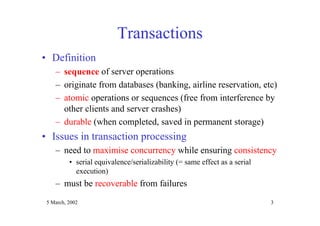
• Definition
– sequence of server operations
– originate from databases (banking, airline reservation, etc)
– atomic operations or sequences (free from interference by
other clients and server crashes)
– durable (when completed, saved in permanent storage)
• Issues in transaction processing
– need to maximise concurrency while ensuring consistency
• serial equivalence/serializability (= same effect as a serial
execution)
– must be recoverable from failures
5 March, 2002 4
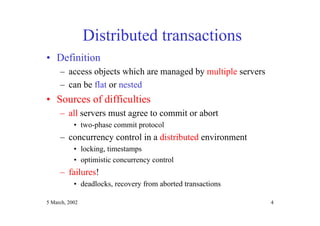
Distributed transactions
• Definition
– access objects which are managed by multiple servers
– can be flat or nested
• Sources of difficulties
– all servers must agree to commit or abort
• two-phase commit protocol
– concurrency control in a distributed environment
• locking, timestamps
• optimistic concurrency control
– failures!
• deadlocks, recovery from aborted transactions
5 March, 2002 5
Transaction handling
• Requires coordinator server, with open/close/abort
• Start new transaction (returns unique TID)
openTransaction() -> trans;
• Then invoke operations on recoverable objects
A.withdraw(100);
B.deposit(300)
• If all goes well end transaction (commit or abort)
– closeTransaction(trans) -> (commit, abort);
• Otherwise
– abortTransaction(trans);
5 March, 2002 6
Distributed transactions
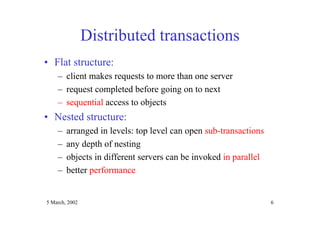
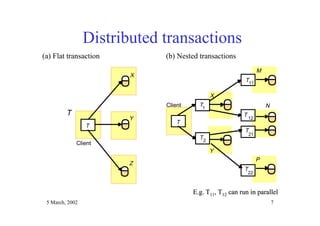
• Flat structure:
– client makes requests to more than one server
– request completed before going on to next
– sequential access to objects
• Nested structure:
– arranged in levels: top level can open sub-transactions
– any depth of nesting
– objects in different servers can be invoked in parallel
– better performance
5 March, 2002 7
Distributed transactions
Client
X
Y
Z
X
Y
M
NT1
T2
T11
Client
P
T
T 12
T
21
T
22
(a) Flat transaction (b) Nested transactions
T
T
E.g. TE.g. T1111, T, T1212 can run in parallelcan run in parallel
5 March, 2002 8
How it works...
• Client
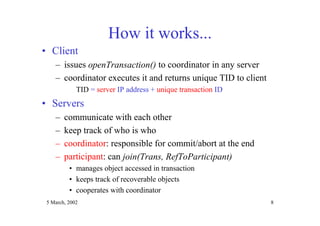
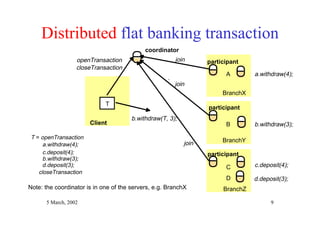
– issues openTransaction() to coordinator in any server
– coordinator executes it and returns unique TID to client
TID = server IP address + unique transaction ID
• Servers
– communicate with each other
– keep track of who is who
– coordinator: responsible for commit/abort at the end
– participant: can join(Trans, RefToParticipant)
• manages object accessed in transaction
• keeps track of recoverable objects
• cooperates with coordinator
5 March, 2002 9
Distributed flat banking transaction
..
BranchZ
BranchX
participant
participant
C
D
Client
BranchY
B
A
participantjoin
join
join
T
a.withdraw(4);
c.deposit(4);
b.withdraw(3);
d.deposit(3);
openTransaction
b.withdraw(T, 3);
closeTransaction
T = openTransaction
a.withdraw(4);
c.deposit(4);
b.withdraw(3);
d.deposit(3);
closeTransaction
Note: the coordinator is in one of the servers, e.g. BranchX
coordinator
5 March, 2002 10
One-phase commit
• Distributed transactions
– multiple servers, must either be committed or aborted
• One-phase commit
– coordinator communicates commit/abort to participants
– keeps repeating the request until all acknowledged
• But… server cannot abort part of a transaction:
– when the server crashed and has been replaced...
– when deadlock has been detected and resolved…
• Problem
– when part aborted, the whole transaction may have to be
aborted
5 March, 2002 11
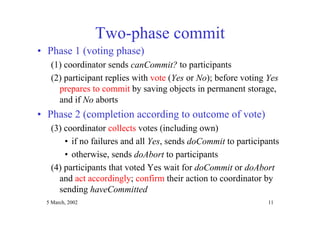
Two-phase commit
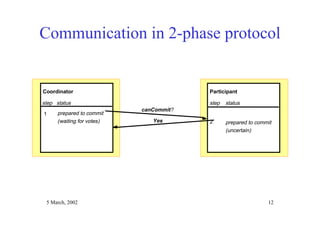
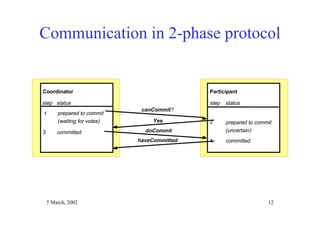
• Phase 1 (voting phase)
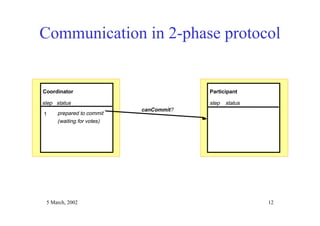
(1) coordinator sends canCommit? to participants
(2) participant replies with vote (Yes or No); before voting Yes
prepares to commit by saving objects in permanent storage,
and if No aborts
• Phase 2 (completion according to outcome of vote)
(3) coordinator collects votes (including own)
• if no failures and all Yes, sends doCommit to participants
• otherwise, sends doAbort to participants
(4) participants that voted Yes wait for doCommit or doAbort
and act accordingly; confirm their action to coordinator by
sending haveCommitted
5 March, 2002 12
Communication in 2-phase protocol
Coordinator
step
Participant
statusstepstatus
5 March, 2002 12
Communication in 2-phase protocol
Coordinator
step
Participant
statusstepstatus
canCommit?
1
(waiting for votes)
prepared to commit
5 March, 2002 12
Communication in 2-phase protocol
Coordinator
step
Participant
statusstepstatus
canCommit?
1
(waiting for votes)
prepared to commit
Yes 2
(uncertain)
prepared to commit
5 March, 2002 12
Communication in 2-phase protocol
Coordinator
step
Participant
statusstepstatus
canCommit?
1
(waiting for votes)
prepared to commit
Yes 2
(uncertain)
prepared to commit
doCommit3 committed
5 March, 2002 12
Communication in 2-phase protocol
Coordinator
step
Participant
statusstepstatus
canCommit?
1
(waiting for votes)
prepared to commit
Yes 2
(uncertain)
prepared to commit
doCommit3 committed
haveCommitted 4 committed
5 March, 2002 12
Communication in 2-phase protocol
Coordinator
step
Participant
statusstepstatus
canCommit?
1
(waiting for votes)
prepared to commit
Yes 2
(uncertain)
prepared to commit
doCommit3 committed
haveCommitted 4 committed
done
5 March, 2002 13
What can go wrong...
• In distributed systems
– objects stored/managed at different servers
• Server crashes
– participant: save in permanent storage when preparing to
commit, retrieve data after crash
– coordinator: delay till replaced, or cooperative approach
• Messages fail to arrive (server crash or link failure)
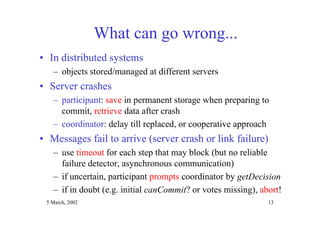
– use timeout for each step that may block (but no reliable
failure detector, asynchronous communication)
– if uncertain, participant prompts coordinator by getDecision
– if in doubt (e.g. initial canCommit? or votes missing), abort!
5 March, 2002 14
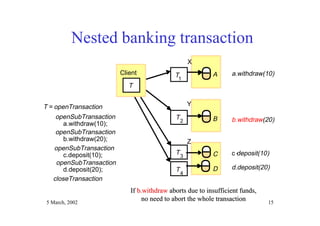
Nested transactions
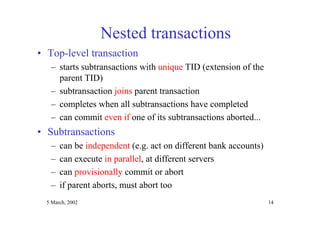
• Top-level transaction
– starts subtransactions with unique TID (extension of the
parent TID)
– subtransaction joins parent transaction
– completes when all subtransactions have completed
– can commit even if one of its subtransactions aborted...
• Subtransactions
– can be independent (e.g. act on different bank accounts)
– can execute in parallel, at different servers
– can provisionally commit or abort
– if parent aborts, must abort too
5 March, 2002 15
Nested banking transaction
a.withdraw(10)
c.deposit(10)
b.withdraw(20)
d.deposit(20)
Client A
B
C
T1
T2
T3
T4
T
D
X
Y
Z
T = openTransaction
openSubTransaction
a.withdraw(10);
closeTransaction
openSubTransaction
b.withdraw(20);
openSubTransaction
c.deposit(10);
openSubTransaction
d.deposit(20);
IfIf b.withdrawb.withdraw aborts due to insufficient funds,aborts due to insufficient funds,
no need to abort the whole transactionno need to abort the whole transaction
5 March, 2002 16
Nested two-phase commit
• Used to decide when top-level transaction commits
• Top-level transaction
– is coordinator in two-phase commit
– knows all subtransactions that joined
– keeps record of subtransaction info
• Subtransactions
– report status back to parent
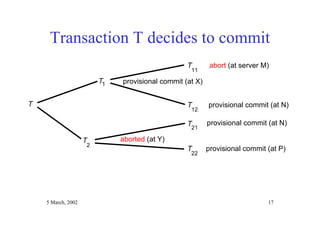
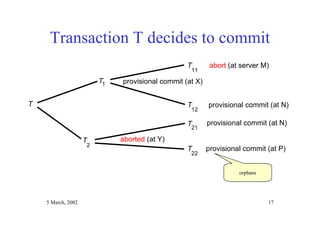
– when abort: reports abort, ignoring children status (now
orphans)
– when provisionally commit: reports status of all child
subtransactions
5 March, 2002 17
Transaction T decides to commit
1
2
T
11
T
12
T
22
T21
abort (at server M)
provisional commit (at N)
provisional commit (at X)
aborted (at Y)
provisional commit (at N)
provisional commit (at P)
T
T
T
5 March, 2002 17
Transaction T decides to commit
1
2
T
11
T
12
T
22
T21
abort (at server M)
provisional commit (at N)
provisional commit (at X)
aborted (at Y)
provisional commit (at N)
provisional commit (at P)
T
T
T
orphansorphans
5 March, 2002 18
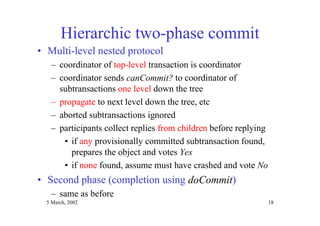
Hierarchic two-phase commit
• Multi-level nested protocol
– coordinator of top-level transaction is coordinator
– coordinator sends canCommit? to coordinator of
subtransactions one level down the tree
– propagate to next level down the tree, etc
– aborted subtransactions ignored
– participants collect replies from children before replying
• if any provisionally committed subtransaction found,
prepares the object and votes Yes
• if none found, assume must have crashed and vote No
• Second phase (completion using doCommit)
– same as before
5 March, 2002 19
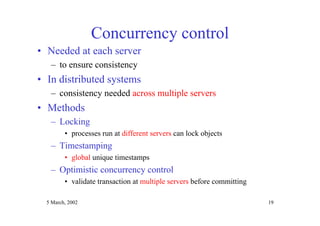
Concurrency control
• Needed at each server
– to ensure consistency
• In distributed systems
– consistency needed across multiple servers
• Methods
– Locking
• processes run at different servers can lock objects
– Timestamping
• global unique timestamps
– Optimistic concurrency control
• validate transaction at multiple servers before committing
5 March, 2002 20
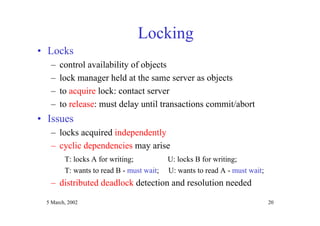
Locking
• Locks
– control availability of objects
– lock manager held at the same server as objects
– to acquire lock: contact server
– to release: must delay until transactions commit/abort
• Issues
– locks acquired independently
– cyclic dependencies may arise
T: locks A for writing; U: locks B for writing;
T: wants to read B - must wait; U: wants to read A - must wait;
– distributed deadlock detection and resolution needed
5 March, 2002 21
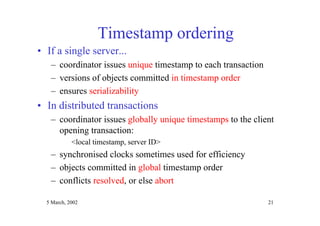
Timestamp ordering
• If a single server...
– coordinator issues unique timestamp to each transaction
– versions of objects committed in timestamp order
– ensures serializability
• In distributed transactions
– coordinator issues globally unique timestamps to the client
opening transaction:
<local timestamp, server ID>
– synchronised clocks sometimes used for efficiency
– objects committed in global timestamp order
– conflicts resolved, or else abort
5 March, 2002 22
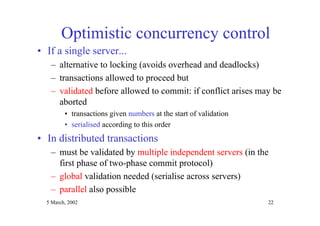
Optimistic concurrency control
• If a single server...
– alternative to locking (avoids overhead and deadlocks)
– transactions allowed to proceed but
– validated before allowed to commit: if conflict arises may be
aborted
• transactions given numbers at the start of validation
• serialised according to this order
• In distributed transactions
– must be validated by multiple independent servers (in the
first phase of two-phase commit protocol)
– global validation needed (serialise across servers)
– parallel also possible
5 March, 2002 23
Other issues
• Distributed deadlocks!
– often unavoidable, since cannot predict dependencies and
server crashes possible
– use deadlock detection, priorities, etc
• Recovery
– must ensure all of committed transactions and none of the
aborted transactions recorded in permanent storage
– use logging, recovery files, shadowing, etc
• See textbook for more info
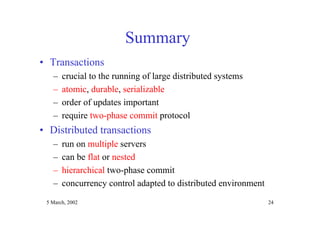
5 March, 2002 24
Summary
• Transactions
– crucial to the running of large distributed systems
– atomic, durable, serializable
– order of updates important
– require two-phase commit protocol
• Distributed transactions
– run on multiple servers
– can be flat or nested
– hierarchical two-phase commit
– concurrency control adapted to distributed environment

Lec13s transaction

  • 1.
    5 March, 20021 06-06798 Distributed Systems Lecture 13: Transactions in a Distributed Environment
  • 2.
    5 March, 20022 Overview • Distributed transactions – multiple servers – atomicity • Atomic commit protocols – 2-phase commit • Concurrency control – locking – timestamping – optimistic concurrency control • Other issues (deadlocks, recovery)
  • 3.
    5 March, 20023 Transactions • Definition – sequence of server operations – originate from databases (banking, airline reservation, etc) – atomic operations or sequences (free from interference by other clients and server crashes) – durable (when completed, saved in permanent storage) • Issues in transaction processing – need to maximise concurrency while ensuring consistency • serial equivalence/serializability (= same effect as a serial execution) – must be recoverable from failures
  • 4.
    5 March, 20024 Distributed transactions • Definition – access objects which are managed by multiple servers – can be flat or nested • Sources of difficulties – all servers must agree to commit or abort • two-phase commit protocol – concurrency control in a distributed environment • locking, timestamps • optimistic concurrency control – failures! • deadlocks, recovery from aborted transactions
  • 5.
    5 March, 20025 Transaction handling • Requires coordinator server, with open/close/abort • Start new transaction (returns unique TID) openTransaction() -> trans; • Then invoke operations on recoverable objects A.withdraw(100); B.deposit(300) • If all goes well end transaction (commit or abort) – closeTransaction(trans) -> (commit, abort); • Otherwise – abortTransaction(trans);
  • 6.
    5 March, 20026 Distributed transactions • Flat structure: – client makes requests to more than one server – request completed before going on to next – sequential access to objects • Nested structure: – arranged in levels: top level can open sub-transactions – any depth of nesting – objects in different servers can be invoked in parallel – better performance
  • 7.
    5 March, 20027 Distributed transactions Client X Y Z X Y M NT1 T2 T11 Client P T T 12 T 21 T 22 (a) Flat transaction (b) Nested transactions T T E.g. TE.g. T1111, T, T1212 can run in parallelcan run in parallel
  • 8.
    5 March, 20028 How it works... • Client – issues openTransaction() to coordinator in any server – coordinator executes it and returns unique TID to client TID = server IP address + unique transaction ID • Servers – communicate with each other – keep track of who is who – coordinator: responsible for commit/abort at the end – participant: can join(Trans, RefToParticipant) • manages object accessed in transaction • keeps track of recoverable objects • cooperates with coordinator
  • 9.
    5 March, 20029 Distributed flat banking transaction .. BranchZ BranchX participant participant C D Client BranchY B A participantjoin join join T a.withdraw(4); c.deposit(4); b.withdraw(3); d.deposit(3); openTransaction b.withdraw(T, 3); closeTransaction T = openTransaction a.withdraw(4); c.deposit(4); b.withdraw(3); d.deposit(3); closeTransaction Note: the coordinator is in one of the servers, e.g. BranchX coordinator
  • 10.
    5 March, 200210 One-phase commit • Distributed transactions – multiple servers, must either be committed or aborted • One-phase commit – coordinator communicates commit/abort to participants – keeps repeating the request until all acknowledged • But… server cannot abort part of a transaction: – when the server crashed and has been replaced... – when deadlock has been detected and resolved… • Problem – when part aborted, the whole transaction may have to be aborted
  • 11.
    5 March, 200211 Two-phase commit • Phase 1 (voting phase) (1) coordinator sends canCommit? to participants (2) participant replies with vote (Yes or No); before voting Yes prepares to commit by saving objects in permanent storage, and if No aborts • Phase 2 (completion according to outcome of vote) (3) coordinator collects votes (including own) • if no failures and all Yes, sends doCommit to participants • otherwise, sends doAbort to participants (4) participants that voted Yes wait for doCommit or doAbort and act accordingly; confirm their action to coordinator by sending haveCommitted
  • 12.
    5 March, 200212 Communication in 2-phase protocol Coordinator step Participant statusstepstatus
  • 13.
    5 March, 200212 Communication in 2-phase protocol Coordinator step Participant statusstepstatus canCommit? 1 (waiting for votes) prepared to commit
  • 14.
    5 March, 200212 Communication in 2-phase protocol Coordinator step Participant statusstepstatus canCommit? 1 (waiting for votes) prepared to commit Yes 2 (uncertain) prepared to commit
  • 15.
    5 March, 200212 Communication in 2-phase protocol Coordinator step Participant statusstepstatus canCommit? 1 (waiting for votes) prepared to commit Yes 2 (uncertain) prepared to commit doCommit3 committed
  • 16.
    5 March, 200212 Communication in 2-phase protocol Coordinator step Participant statusstepstatus canCommit? 1 (waiting for votes) prepared to commit Yes 2 (uncertain) prepared to commit doCommit3 committed haveCommitted 4 committed
  • 17.
    5 March, 200212 Communication in 2-phase protocol Coordinator step Participant statusstepstatus canCommit? 1 (waiting for votes) prepared to commit Yes 2 (uncertain) prepared to commit doCommit3 committed haveCommitted 4 committed done
  • 18.
    5 March, 200213 What can go wrong... • In distributed systems – objects stored/managed at different servers • Server crashes – participant: save in permanent storage when preparing to commit, retrieve data after crash – coordinator: delay till replaced, or cooperative approach • Messages fail to arrive (server crash or link failure) – use timeout for each step that may block (but no reliable failure detector, asynchronous communication) – if uncertain, participant prompts coordinator by getDecision – if in doubt (e.g. initial canCommit? or votes missing), abort!
  • 19.
    5 March, 200214 Nested transactions • Top-level transaction – starts subtransactions with unique TID (extension of the parent TID) – subtransaction joins parent transaction – completes when all subtransactions have completed – can commit even if one of its subtransactions aborted... • Subtransactions – can be independent (e.g. act on different bank accounts) – can execute in parallel, at different servers – can provisionally commit or abort – if parent aborts, must abort too
  • 20.
    5 March, 200215 Nested banking transaction a.withdraw(10) c.deposit(10) b.withdraw(20) d.deposit(20) Client A B C T1 T2 T3 T4 T D X Y Z T = openTransaction openSubTransaction a.withdraw(10); closeTransaction openSubTransaction b.withdraw(20); openSubTransaction c.deposit(10); openSubTransaction d.deposit(20); IfIf b.withdrawb.withdraw aborts due to insufficient funds,aborts due to insufficient funds, no need to abort the whole transactionno need to abort the whole transaction
  • 21.
    5 March, 200216 Nested two-phase commit • Used to decide when top-level transaction commits • Top-level transaction – is coordinator in two-phase commit – knows all subtransactions that joined – keeps record of subtransaction info • Subtransactions – report status back to parent – when abort: reports abort, ignoring children status (now orphans) – when provisionally commit: reports status of all child subtransactions
  • 22.
    5 March, 200217 Transaction T decides to commit 1 2 T 11 T 12 T 22 T21 abort (at server M) provisional commit (at N) provisional commit (at X) aborted (at Y) provisional commit (at N) provisional commit (at P) T T T
  • 23.
    5 March, 200217 Transaction T decides to commit 1 2 T 11 T 12 T 22 T21 abort (at server M) provisional commit (at N) provisional commit (at X) aborted (at Y) provisional commit (at N) provisional commit (at P) T T T orphansorphans
  • 24.
    5 March, 200218 Hierarchic two-phase commit • Multi-level nested protocol – coordinator of top-level transaction is coordinator – coordinator sends canCommit? to coordinator of subtransactions one level down the tree – propagate to next level down the tree, etc – aborted subtransactions ignored – participants collect replies from children before replying • if any provisionally committed subtransaction found, prepares the object and votes Yes • if none found, assume must have crashed and vote No • Second phase (completion using doCommit) – same as before
  • 25.
    5 March, 200219 Concurrency control • Needed at each server – to ensure consistency • In distributed systems – consistency needed across multiple servers • Methods – Locking • processes run at different servers can lock objects – Timestamping • global unique timestamps – Optimistic concurrency control • validate transaction at multiple servers before committing
  • 26.
    5 March, 200220 Locking • Locks – control availability of objects – lock manager held at the same server as objects – to acquire lock: contact server – to release: must delay until transactions commit/abort • Issues – locks acquired independently – cyclic dependencies may arise T: locks A for writing; U: locks B for writing; T: wants to read B - must wait; U: wants to read A - must wait; – distributed deadlock detection and resolution needed
  • 27.
    5 March, 200221 Timestamp ordering • If a single server... – coordinator issues unique timestamp to each transaction – versions of objects committed in timestamp order – ensures serializability • In distributed transactions – coordinator issues globally unique timestamps to the client opening transaction: <local timestamp, server ID> – synchronised clocks sometimes used for efficiency – objects committed in global timestamp order – conflicts resolved, or else abort
  • 28.
    5 March, 200222 Optimistic concurrency control • If a single server... – alternative to locking (avoids overhead and deadlocks) – transactions allowed to proceed but – validated before allowed to commit: if conflict arises may be aborted • transactions given numbers at the start of validation • serialised according to this order • In distributed transactions – must be validated by multiple independent servers (in the first phase of two-phase commit protocol) – global validation needed (serialise across servers) – parallel also possible
  • 29.
    5 March, 200223 Other issues • Distributed deadlocks! – often unavoidable, since cannot predict dependencies and server crashes possible – use deadlock detection, priorities, etc • Recovery – must ensure all of committed transactions and none of the aborted transactions recorded in permanent storage – use logging, recovery files, shadowing, etc • See textbook for more info
  • 30.
    5 March, 200224 Summary • Transactions – crucial to the running of large distributed systems – atomic, durable, serializable – order of updates important – require two-phase commit protocol • Distributed transactions – run on multiple servers – can be flat or nested – hierarchical two-phase commit – concurrency control adapted to distributed environment