Introduction
to
Distributed
Database
‫العارف‬
‫عبد‬
‫الباسط‬
‫أبو‬
‫شعالة‬
‫مروان‬
‫احمد‬
‫القاضي‬
‫مقدمة‬
‫لقواعد‬
‫البيانات‬
‫الموزعة‬
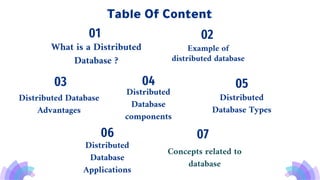
02
What is a Distributed
Database ?
01
Distributed
Database Types
05
Concepts related to
database
07
Distributed Database
Advantages
03
Example of
distributed database
Table Of Content
Distributed
Database
Applications
06
Distributed
Database
components
04
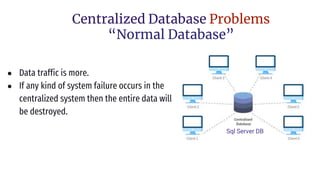
Centralized Database Problems
“Normal Database”
● Data traffic is more.
● If any kind of system failure occurs in the
centralized system then the entire data will
be destroyed.
Sql Server DB
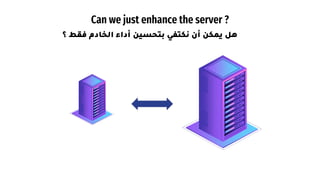
Can we just enhance the server ?
‫هل‬
‫يمكن‬
‫أن‬
‫نكتفي‬
‫بتحسين‬
‫أداء‬
‫الخادم‬
‫فقط‬
‫؟‬
01
What is a
distributed
Database ?
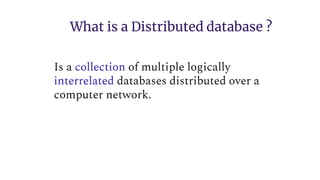
What is a Distributed database ?
Is a collection of multiple logically
interrelated databases distributed over a
computer network.
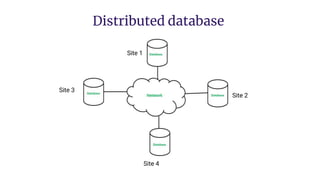
Distributed database
Site 2
Site 1
Site 3
Site 4
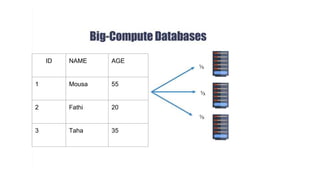
ID NAME AGE
1 Mousa 55
2 Fathi 20
3 Taha 35
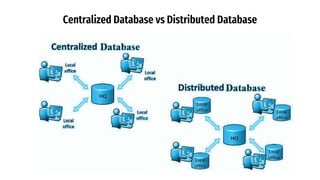
Centralized Database vs Distributed Database
02
Distributed
Database
Example
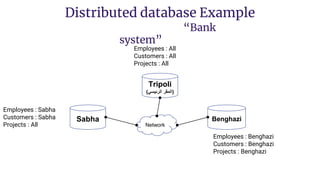
Network
Tripoli
( ‫المقر‬
‫الرئيسي‬ )
Benghazi
Sabha
Employees : All
Customers : All
Projects : All
Employees : Benghazi
Customers : Benghazi
Projects : Benghazi
Employees : Sabha
Customers : Sabha
Projects : All
Distributed database Example
“Bank
system”
03
Distributed
Database
Advantages
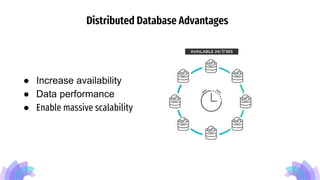
Distributed Database Advantages
● Increase availability
● Data performance
● Enable massive scalability
04
Distributed
Database
Components
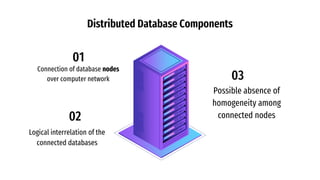
Possible absence of
homogeneity among
connected nodes
03
Logical interrelation of the
connected databases
02
Connection of database nodes
over computer network
01
Distributed Database Components
05
Distributed Databases
Classifications
Distributed Database Classifications
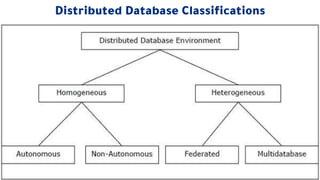
Distributed databases can be broadly classified into homogeneous and
heterogeneous distributed database environments.
Each has its own pros and cons and sub-divisions
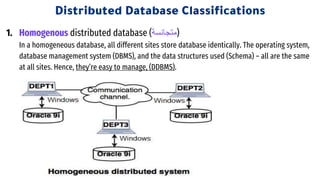
1. Homogenous distributed database (‫)متجانسة‬
In a homogeneous database, all different sites store database identically. The operating system,
database management system (DBMS), and the data structures used (Schema) – all are the same
at all sites. Hence, they’re easy to manage, (DDBMS).
Distributed Database Classifications
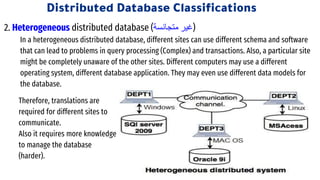
2. Heterogeneous distributed database ( ‫غير‬
‫متجانسة‬ )
In a heterogeneous distributed database, different sites can use different schema and software
that can lead to problems in query processing (Complex) and transactions. Also, a particular site
might be completely unaware of the other sites. Different computers may use a different
operating system, different database application. They may even use different data models for
the database.
Distributed Database Classifications
Therefore, translations are
required for different sites to
communicate.
Also it requires more knowledge
to manage the database
(harder).
Distributed Database Classifications
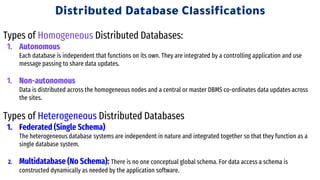
Types of Homogeneous Distributed Databases:
1. Autonomous
Each database is independent that functions on its own. They are integrated by a controlling application and use
message passing to share data updates.
1. Non-autonomous
Data is distributed across the homogeneous nodes and a central or master DBMS co-ordinates data updates across
the sites.
Types of Heterogeneous Distributed Databases
1. Federated (Single Schema)
The heterogeneous database systems are independent in nature and integrated together so that they function as a
single database system.
2. Multidatabase (No Schema): There is no one conceptual global schema. For data access a schema is
constructed dynamically as needed by the application software.
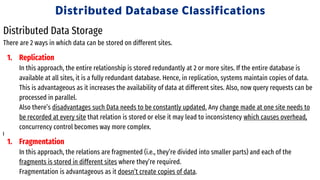
Distributed Data Storage
There are 2 ways in which data can be stored on different sites.
1. Replication
In this approach, the entire relationship is stored redundantly at 2 or more sites. If the entire database is
available at all sites, it is a fully redundant database. Hence, in replication, systems maintain copies of data.
This is advantageous as it increases the availability of data at different sites. Also, now query requests can be
processed in parallel.
Also there’s disadvantages such Data needs to be constantly updated. Any change made at one site needs to
be recorded at every site that relation is stored or else it may lead to inconsistency which causes overhead,
concurrency control becomes way more complex.
1. Fragmentation
In this approach, the relations are fragmented (i.e., they’re divided into smaller parts) and each of the
fragments is stored in different sites where they’re required.
Fragmentation is advantageous as it doesn’t create copies of data.
Distributed Database Classifications
06
Distributed Databases
Applications
Distributed Databases Applications
Distributed Systems and Distributed Databases.
Distributed Systems: A distributed system is a computing environment in which various
components are spread across multiple computers (or multiple locations) on a network that
shares information with each other.
Applications of Distributed Database:
1. It is used in Corporate Management Information System.
2. It is used in multimedia applications.
3. Used in Military’s control system, Hotel chains etc.
4. It is also used in manufacturing control system.
5. Big Data and data mining
Distributed Databases Applications
When/where to use Distributed Databases !?
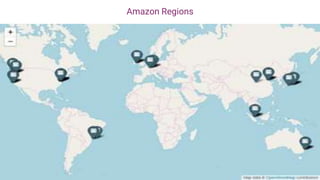
Amazon Regions
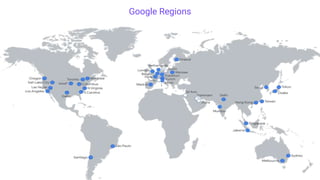
Google Regions
Apple (uses cassandra database to distribute 100 petabytes of data)
Netflix
Uber
eBay
Zalando ( ‫شركة‬
‫ألمانية‬
‫لبيع‬
‫االحذية‬
‫واألزياء‬ )
SoundCloud
Banks in general
Distributed Databases Applications
Companies That use Distributed Databases:
07
Concepts related to
Distributed
Databases
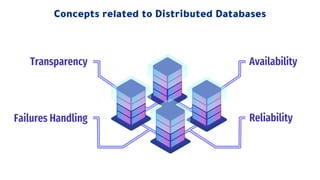
Concepts related to Distributed Databases
Transparency Availability
Reliability
Failures Handling
Transparency (‫)الشفافية‬
Concepts related to Distributed Databases
It’s all about hiding implementation details from end users.
Transparency Includes to not share the following:
● Data organization transparency
● Data Fragmentation Transparency
○ Horizontal Fragmentation (tuples/rows)
○ Vertical Fragmentation (attributes/columns)
● Database Design
● Execution Transparency
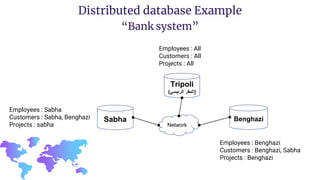
Network
Tripoli
( ‫المقر‬
‫الرئيسي‬ )
Benghazi
Sabha
Employees : All
Customers : All
Projects : All
Employees : Benghazi
Customers : Benghazi, Sabha
Projects : Benghazi
Employees : Sabha
Customers : Sabha, Benghazi
Projects : sabha
Distributed database Example
“Bank system”
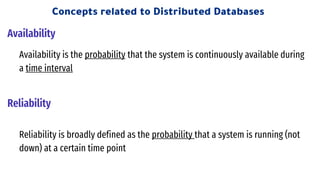
Availability
Reliability
Availability is the probability that the system is continuously available during
a time interval
Reliability is broadly defined as the probability that a system is running (not
down) at a certain time point
Concepts related to Distributed Databases
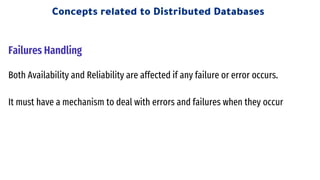
Failures Handling
Both Availability and Reliability are affected if any failure or error occurs.
It must have a mechanism to deal with errors and failures when they occur
Concepts related to Distributed Databases
References
References
● Fundamentals of Database Systems Pearson 2015
By Ramez Elmasri Shamkant B. Navathe
● https://www.quora.com/What-are-applications-of-distributed-database-systems
● https://www.youtube.com/watch?v=A7lKQhmo0ZE&t=1s
● https://www.geeksforgeeks.org/distributed-database-system/
● https://www.tutorialspoint.com/distributed_dbms/distributed_dbms_database_envir
onments.htm
● https://cloud.google.com/about/locations
● https://www.ventureradar.com/keyword/Distributed%20computing
● https://www.confluent.io/learn/distributed-systems/

Distributed Database

  • 1.
  • 2.
    02 What is aDistributed Database ? 01 Distributed Database Types 05 Concepts related to database 07 Distributed Database Advantages 03 Example of distributed database Table Of Content Distributed Database Applications 06 Distributed Database components 04
  • 3.
    Centralized Database Problems “NormalDatabase” ● Data traffic is more. ● If any kind of system failure occurs in the centralized system then the entire data will be destroyed. Sql Server DB
  • 4.
    Can we justenhance the server ? ‫هل‬ ‫يمكن‬ ‫أن‬ ‫نكتفي‬ ‫بتحسين‬ ‫أداء‬ ‫الخادم‬ ‫فقط‬ ‫؟‬
  • 5.
  • 6.
    What is aDistributed database ? Is a collection of multiple logically interrelated databases distributed over a computer network.
  • 7.
  • 8.
    ID NAME AGE 1Mousa 55 2 Fathi 20 3 Taha 35
  • 9.
    Centralized Database vsDistributed Database
  • 10.
  • 11.
    Network Tripoli ( ‫المقر‬ ‫الرئيسي‬ ) Benghazi Sabha Employees: All Customers : All Projects : All Employees : Benghazi Customers : Benghazi Projects : Benghazi Employees : Sabha Customers : Sabha Projects : All Distributed database Example “Bank system”
  • 12.
  • 13.
    Distributed Database Advantages ●Increase availability ● Data performance ● Enable massive scalability
  • 14.
  • 15.
    Possible absence of homogeneityamong connected nodes 03 Logical interrelation of the connected databases 02 Connection of database nodes over computer network 01 Distributed Database Components
  • 16.
  • 17.
    Distributed Database Classifications Distributeddatabases can be broadly classified into homogeneous and heterogeneous distributed database environments. Each has its own pros and cons and sub-divisions
  • 18.
    1. Homogenous distributeddatabase (‫)متجانسة‬ In a homogeneous database, all different sites store database identically. The operating system, database management system (DBMS), and the data structures used (Schema) – all are the same at all sites. Hence, they’re easy to manage, (DDBMS). Distributed Database Classifications
  • 19.
    2. Heterogeneous distributeddatabase ( ‫غير‬ ‫متجانسة‬ ) In a heterogeneous distributed database, different sites can use different schema and software that can lead to problems in query processing (Complex) and transactions. Also, a particular site might be completely unaware of the other sites. Different computers may use a different operating system, different database application. They may even use different data models for the database. Distributed Database Classifications Therefore, translations are required for different sites to communicate. Also it requires more knowledge to manage the database (harder).
  • 20.
  • 21.
    Distributed Database Classifications Typesof Homogeneous Distributed Databases: 1. Autonomous Each database is independent that functions on its own. They are integrated by a controlling application and use message passing to share data updates. 1. Non-autonomous Data is distributed across the homogeneous nodes and a central or master DBMS co-ordinates data updates across the sites. Types of Heterogeneous Distributed Databases 1. Federated (Single Schema) The heterogeneous database systems are independent in nature and integrated together so that they function as a single database system. 2. Multidatabase (No Schema): There is no one conceptual global schema. For data access a schema is constructed dynamically as needed by the application software.
  • 22.
    Distributed Data Storage Thereare 2 ways in which data can be stored on different sites. 1. Replication In this approach, the entire relationship is stored redundantly at 2 or more sites. If the entire database is available at all sites, it is a fully redundant database. Hence, in replication, systems maintain copies of data. This is advantageous as it increases the availability of data at different sites. Also, now query requests can be processed in parallel. Also there’s disadvantages such Data needs to be constantly updated. Any change made at one site needs to be recorded at every site that relation is stored or else it may lead to inconsistency which causes overhead, concurrency control becomes way more complex. 1. Fragmentation In this approach, the relations are fragmented (i.e., they’re divided into smaller parts) and each of the fragments is stored in different sites where they’re required. Fragmentation is advantageous as it doesn’t create copies of data. Distributed Database Classifications
  • 23.
  • 24.
    Distributed Databases Applications DistributedSystems and Distributed Databases. Distributed Systems: A distributed system is a computing environment in which various components are spread across multiple computers (or multiple locations) on a network that shares information with each other.
  • 25.
    Applications of DistributedDatabase: 1. It is used in Corporate Management Information System. 2. It is used in multimedia applications. 3. Used in Military’s control system, Hotel chains etc. 4. It is also used in manufacturing control system. 5. Big Data and data mining Distributed Databases Applications When/where to use Distributed Databases !?
  • 26.
  • 27.
  • 28.
    Apple (uses cassandradatabase to distribute 100 petabytes of data) Netflix Uber eBay Zalando ( ‫شركة‬ ‫ألمانية‬ ‫لبيع‬ ‫االحذية‬ ‫واألزياء‬ ) SoundCloud Banks in general Distributed Databases Applications Companies That use Distributed Databases:
  • 29.
  • 30.
    Concepts related toDistributed Databases Transparency Availability Reliability Failures Handling
  • 31.
    Transparency (‫)الشفافية‬ Concepts relatedto Distributed Databases It’s all about hiding implementation details from end users. Transparency Includes to not share the following: ● Data organization transparency ● Data Fragmentation Transparency ○ Horizontal Fragmentation (tuples/rows) ○ Vertical Fragmentation (attributes/columns) ● Database Design ● Execution Transparency
  • 32.
    Network Tripoli ( ‫المقر‬ ‫الرئيسي‬ ) Benghazi Sabha Employees: All Customers : All Projects : All Employees : Benghazi Customers : Benghazi, Sabha Projects : Benghazi Employees : Sabha Customers : Sabha, Benghazi Projects : sabha Distributed database Example “Bank system”
  • 33.
    Availability Reliability Availability is theprobability that the system is continuously available during a time interval Reliability is broadly defined as the probability that a system is running (not down) at a certain time point Concepts related to Distributed Databases
  • 34.
    Failures Handling Both Availabilityand Reliability are affected if any failure or error occurs. It must have a mechanism to deal with errors and failures when they occur Concepts related to Distributed Databases
  • 35.
  • 36.
    References ● Fundamentals ofDatabase Systems Pearson 2015 By Ramez Elmasri Shamkant B. Navathe ● https://www.quora.com/What-are-applications-of-distributed-database-systems ● https://www.youtube.com/watch?v=A7lKQhmo0ZE&t=1s ● https://www.geeksforgeeks.org/distributed-database-system/ ● https://www.tutorialspoint.com/distributed_dbms/distributed_dbms_database_envir onments.htm ● https://cloud.google.com/about/locations ● https://www.ventureradar.com/keyword/Distributed%20computing ● https://www.confluent.io/learn/distributed-systems/ ● https://www.confluent.io/learn/distributed-systems/