Marathwada Mitramandal’s
COLLEGE OF ENGINEERING
Karvenagar, Pune
Accredited with ‘A++’ Grade by NAAC
Presentation
On
Subject: Database Managemnet System
by
Prof. Shinde S.A.
Department of Artificial Intelligence & Data Science
Unit-5:NoSQL Databases
Session-27/40
Introduction to Distributed Database System
Session Plan
Outline:
A. Attendance
B. Review of the previous session
C. Learning Outcomes of the session
D. Content
E. Student’s evaluation
F. Preparation for next session
G. Wrap up
B. Review of previous session:
●Overall discussion of concept of distributed databases.
C. Learning Outcomes of the session:
• To know the basics of Distributed databases
● Advantages n disadvantages of distributed databases
● Different examples in day-to-day life.
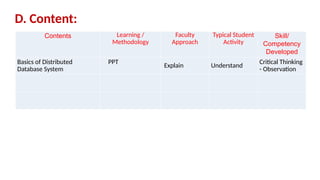
D. Content:
Contents Learning /
Methodology
Faculty
Approach
Typical Student
Activity
Skill/
Competency
Developed
Basics of Distributed
Database System
PPT
Explain Understand
Critical Thinking
- Observation
Slide 25- 7
Distributed Database Concepts
• A transaction can be executed by multiple networked computers in
a unified manner.
• A distributed database (DDB) processes Unit of execution (a
transaction) in a distributed manner. A distributed database (DDB)
can be defined as
• A distributed database (DDB) is a collection of multiple logically related
database distributed over a computer network, and a distributed database
management system as a software system that manages a distributed
database while making the distribution transparent to the user.
Slide 25- 8
Types of Distributed Database Systems
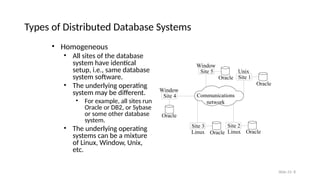
• Homogeneous
• All sites of the database
system have identical
setup, i.e., same database
system software.
• The underlying operating
system may be different.
• For example, all sites run
Oracle or DB2, or Sybase
or some other database
system.
• The underlying operating
systems can be a mixture
of Linux, Window, Unix,
etc.
Site 5
Site 1
Site 2
Site 3
Oracle Oracle
Oracle
Oracle
Site 4
Oracle
Linux
Linux
Window
Window
Unix
Communications
network
Slide 25- 9
Types of Distributed Database Systems
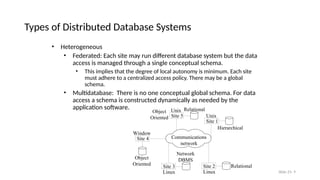
• Heterogeneous
• Federated: Each site may run different database system but the data
access is managed through a single conceptual schema.
• This implies that the degree of local autonomy is minimum. Each site
must adhere to a centralized access policy. There may be a global
schema.
• Multidatabase: There is no one conceptual global schema. For data
access a schema is constructed dynamically as needed by the
application software.
Communications
network
Site 5
Site 1
Site 2
Site 3
Network
DBMS
Relational
Site 4
Object
Oriented
Linux
Linux
Unix
Hierarchical
Object
Oriented
Relational
Unix
Window
Slide 25- 10
Types of Distributed Database Systems
• Federated Database Management Systems Issues
• Differences in data models:
• Relational, Objected oriented, hierarchical, network, etc.
• Differences in constraints:
• Each site may have their own data accessing and processing constraints.
• Differences in query language:
• Some site may use SQL, some may use SQL-89, some may use SQL-92, and so on.
E. Student’s evaluation
Discussion , Question answer during the session.
● Advantages, Disadvantages, CAP Theorem.
F. Preparation for Next Session:-
G. Wrap Up
In this lecture we have learned
∙ ● Basics of Distributed databases.
∙ ● Advantages & disadvantages of DD.

U5-DataBase_Management_System_123-S1.pptx

  • 1.
    Marathwada Mitramandal’s COLLEGE OFENGINEERING Karvenagar, Pune Accredited with ‘A++’ Grade by NAAC Presentation On Subject: Database Managemnet System by Prof. Shinde S.A. Department of Artificial Intelligence & Data Science
  • 2.
    Unit-5:NoSQL Databases Session-27/40 Introduction toDistributed Database System Session Plan
  • 3.
    Outline: A. Attendance B. Reviewof the previous session C. Learning Outcomes of the session D. Content E. Student’s evaluation F. Preparation for next session G. Wrap up
  • 4.
    B. Review ofprevious session: ●Overall discussion of concept of distributed databases.
  • 5.
    C. Learning Outcomesof the session: • To know the basics of Distributed databases ● Advantages n disadvantages of distributed databases ● Different examples in day-to-day life.
  • 6.
    D. Content: Contents Learning/ Methodology Faculty Approach Typical Student Activity Skill/ Competency Developed Basics of Distributed Database System PPT Explain Understand Critical Thinking - Observation
  • 7.
    Slide 25- 7 DistributedDatabase Concepts • A transaction can be executed by multiple networked computers in a unified manner. • A distributed database (DDB) processes Unit of execution (a transaction) in a distributed manner. A distributed database (DDB) can be defined as • A distributed database (DDB) is a collection of multiple logically related database distributed over a computer network, and a distributed database management system as a software system that manages a distributed database while making the distribution transparent to the user.
  • 8.
    Slide 25- 8 Typesof Distributed Database Systems • Homogeneous • All sites of the database system have identical setup, i.e., same database system software. • The underlying operating system may be different. • For example, all sites run Oracle or DB2, or Sybase or some other database system. • The underlying operating systems can be a mixture of Linux, Window, Unix, etc. Site 5 Site 1 Site 2 Site 3 Oracle Oracle Oracle Oracle Site 4 Oracle Linux Linux Window Window Unix Communications network
  • 9.
    Slide 25- 9 Typesof Distributed Database Systems • Heterogeneous • Federated: Each site may run different database system but the data access is managed through a single conceptual schema. • This implies that the degree of local autonomy is minimum. Each site must adhere to a centralized access policy. There may be a global schema. • Multidatabase: There is no one conceptual global schema. For data access a schema is constructed dynamically as needed by the application software. Communications network Site 5 Site 1 Site 2 Site 3 Network DBMS Relational Site 4 Object Oriented Linux Linux Unix Hierarchical Object Oriented Relational Unix Window
  • 10.
    Slide 25- 10 Typesof Distributed Database Systems • Federated Database Management Systems Issues • Differences in data models: • Relational, Objected oriented, hierarchical, network, etc. • Differences in constraints: • Each site may have their own data accessing and processing constraints. • Differences in query language: • Some site may use SQL, some may use SQL-89, some may use SQL-92, and so on.
  • 11.
    E. Student’s evaluation Discussion, Question answer during the session.
  • 12.
    ● Advantages, Disadvantages,CAP Theorem. F. Preparation for Next Session:-
  • 13.
    G. Wrap Up Inthis lecture we have learned ∙ ● Basics of Distributed databases. ∙ ● Advantages & disadvantages of DD.