 Text messaging, both sending and
receiving, creates a crash risk that is 23
times greater than those driving while not
distracted.
 Drivers who use a hand-held device are
4 times more likely to be involved in a
serious or possibly fatal car crash.
 “Sending or receiving a text takes a
driver’s eyes from the road for an
average of 4.6 seconds, the equivalent-
at 55 mph-of driving the length of an
entire football field, blind.”
~Official US Government
Website for Distracted Driving
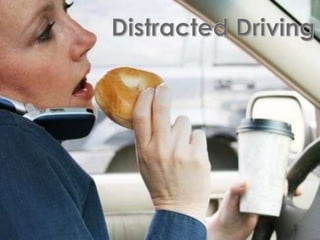
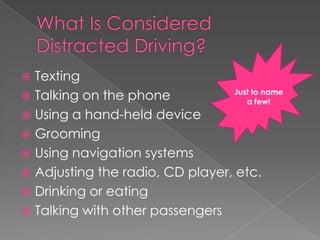
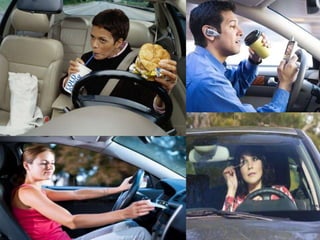
 Distracted driving is any activity that
takes the drivers attention away from the
task of driving.
 Texting
 Talking on the phone
 Using a hand-held device
 Grooming
 Using navigation systems
 Adjusting the radio, CD player, etc.
 Drinking or eating
 Talking with other passengers
Just to name
a few!
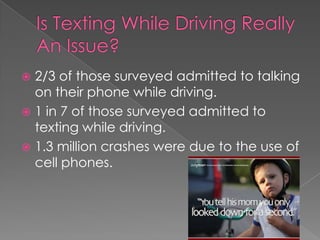
 2/3 of those surveyed admitted to talking
on their phone while driving.
 1 in 7 of those surveyed admitted to
texting while driving.
 1.3 million crashes were due to the use of
cell phones.
 Out of sight, out of mind. Put your phone
where you cannot reach it.
 Turn your phone on silent. This does not
mean vibrate. If you can’t hear it, you
won’t check it.
 There is an app for that! There are apps
that can help you stop texting and
driving.
Find us at:
www.umkc.edu/studenthealth
Facebook: UMKC Student Health
Pinterest: Student Health

Distracted driving presentation

  • 3.
     Text messaging,both sending and receiving, creates a crash risk that is 23 times greater than those driving while not distracted.
  • 4.
     Drivers whouse a hand-held device are 4 times more likely to be involved in a serious or possibly fatal car crash.
  • 5.
     “Sending orreceiving a text takes a driver’s eyes from the road for an average of 4.6 seconds, the equivalent- at 55 mph-of driving the length of an entire football field, blind.” ~Official US Government Website for Distracted Driving
  • 6.
     Distracted drivingis any activity that takes the drivers attention away from the task of driving.
  • 7.
     Texting  Talkingon the phone  Using a hand-held device  Grooming  Using navigation systems  Adjusting the radio, CD player, etc.  Drinking or eating  Talking with other passengers Just to name a few!
  • 9.
     2/3 ofthose surveyed admitted to talking on their phone while driving.  1 in 7 of those surveyed admitted to texting while driving.  1.3 million crashes were due to the use of cell phones.
  • 11.
     Out ofsight, out of mind. Put your phone where you cannot reach it.  Turn your phone on silent. This does not mean vibrate. If you can’t hear it, you won’t check it.  There is an app for that! There are apps that can help you stop texting and driving.
  • 13.
    Find us at: www.umkc.edu/studenthealth Facebook:UMKC Student Health Pinterest: Student Health