Texting and Driving
By: Beau Bennett
English 2010
3/9/2012
Bennett1
All over the world drivers are more distracted then they have ever been before. In the
past, drivers have been distracted with more traditional distractions such as eating food, changing
the radio station and even talking to people in the car. Now with the ability of mobile
technologies, such as cell phones, and global positioning systems, also known as GPS, these
distractions are becoming more and more hazardous to not only the people driving the car but to
other drivers as well. This article is going to focus on one of those devices and that is the use of
cell phones. Cell phones have two primary functions, to text message and to call people. A vast
majority of people that are driving have the access of a cell phone, while they are driving. That is
why any driver that owns a cell phone and uses it while attempting to drive safely greatly
increases their risk of getting into a car accident.
A study done in 1997 by Redelmeier and Tibshirani evaluated that out of 699 individuals
who were involved in motor vehicle accidents in a 14-month time period stated, that almost a
quarter of them used their cell phones 10 minutes before their accident. They stated that having
used their cell phone increased their chances of getting into an accident by four times. (Violanti)
In Australia a similar survey was conducted by Telstra. He recorded that 30% of the participants
admitted to sending a text message while driving and almost 20% regularly send text messages
while driving. (Telstra) The popularity of having an instant conversation with your family,
friends, and co-workers has grown rapidly since the invention of the cellular device. In 1980,
owning a cell phone that didn’t weigh at least 2.0 lbs was very rare. Now, 20 years later, kids
everywhere are calling, playing games and sending countless number of text messages each day.
A study done by the CTIA (Cellular Telecommunications Industry Association) in 2005 stated,
“There were 81 billion text messages sent in the United States however, in 2008 the number of
sent text messages exceeded 1 trillion.” (CTIA)
Bennett2
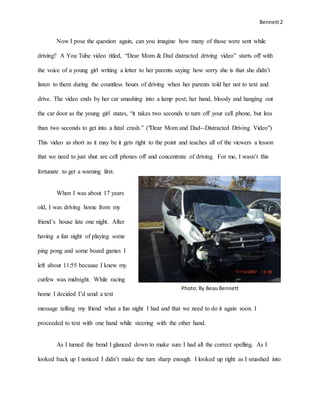
Photo: By Beau Bennett
Now I pose the question again, can you imagine how many of those were sent while
driving? A You Tube video titled, “Dear Mom & Dad distracted driving video” starts off with
the voice of a young girl writing a letter to her parents saying how sorry she is that she didn’t
listen to them during the countless hours of driving when her parents told her not to text and
drive. The video ends by her car smashing into a lamp post; her hand, bloody and hanging out
the car door as the young girl states, “it takes two seconds to turn off your cell phone, but less
than two seconds to get into a fatal crash.” ("Dear Mom and Dad--Distracted Driving Video")
This video as short as it may be it gets right to the point and teaches all of the viewers a lesson
that we need to just shut are cell phones off and concentrate of driving. For me, I wasn’t this
fortunate to get a warning first.
When I was about 17 years
old, I was driving home from my
friend’s house late one night. After
having a fun night of playing some
ping pong and some board games I
left about 11:55 because I knew my
curfew was midnight. While racing
home I decided I’d send a text
message telling my friend what a fun night I had and that we need to do it again soon. I
proceeded to text with one hand while steering with the other hand.
As I turned the bend I glanced down to make sure I had all the correct spelling. As I
looked back up I noticed I didn’t make the turn sharp enough. I looked up right as I smashed into
Bennett3
the backside of a truck that had an iron bumper. I put the pedal to the metal, thinking it was the
brakes, when in reality it was the gas. I moved the truck about 20 feet and caused it to hit the
passenger side of a parked van. With my heart pounding out of my chest I began to gain
composure of myself. I looked around to see what damage I had caused. Both the driver side and
the passenger side air bags went off, the front side of my parents van was crushed and the front
bumper had fallen to the asphalt. I went to go call my parents so they could come see what I had
done.
As my parents finally showed up a few minutes after the ambulance, they were just happy
to see me alive. The paramedics examined me and asked me countless questions of what
happened, most I don’t even remember because of the immense shock I was in. But one
statement I remember one of the EMTs telling me was, “you are very lucky to be so well after
such a crash like this one.” The next couple days I was sore because of the impact my body took.
But from that day I learned that being focused on the road was important. It would have taken
me less than 5 minutes to get home to send that text message; instead I chose that that important
conversation had to be taken care of right then. Is any conversation worth risking your life for?
A study was done by the University of Utah in 2009 where they had 40 participants
taking part in both single task driving, and double tasking driving; driving and text messaging.
Their main objective was to identify the impact text messaging has on driving performance in
either a positive or negative way. In the paper they wrote they had two main points of research
which stated,
“First, the study seeks to establish the impact of text messaging in simulated driving on
driving performance and safety, therefore replicating and extending the findings of
Bennett4
Hosking et al. (2009). Second, this research aims to estimate the impact of text messaging
during simulated driving on accident rates and, furthermore, the reason for any observed
impairments in driver performance” (Frank A. Drews)
In a questionnaire that was given to each participant of the research project, 90% said that
they send text messages more than three times a day on a regular basis. All participants
responded that they would either likely read a text message received while driving. Again 90%
of the participants said they send text messages while driving more than once a week. (Frank A.
Drews)
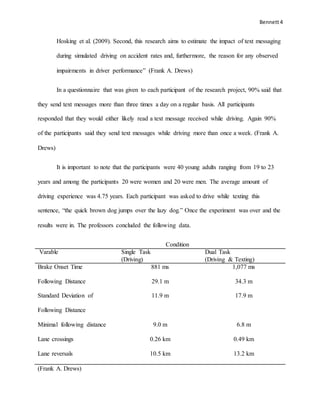
It is important to note that the participants were 40 young adults ranging from 19 to 23
years and among the participants 20 were women and 20 were men. The average amount of
driving experience was 4.75 years. Each participant was asked to drive while texting this
sentence, “the quick brown dog jumps over the lazy dog.” Once the experiment was over and the
results were in. The professors concluded the following data.
Condition
Varable Single Task
(Driving)
Dual Task
(Driving & Texting)
Brake Onset Time 881 ms 1,077 ms
Following Distance 29.1 m 34.3 m
Standard Deviation of
Following Distance
11.9 m 17.9 m
Minimal following distance 9.0 m 6.8 m
Lane crossings 0.26 km 0.49 km
Lane reversals 10.5 km 13.2 km
(Frank A. Drews)
Bennett5
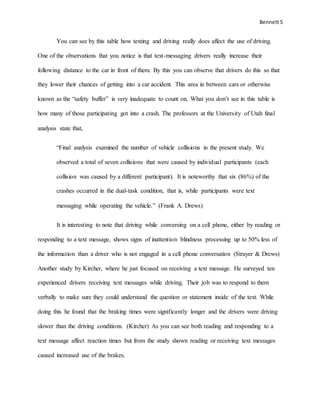
You can see by this table how texting and driving really does affect the use of driving.
One of the observations that you notice is that text-messaging drivers really increase their
following distance to the car in front of them. By this you can observe that drivers do this so that
they lower their chances of getting into a car accident. This area in between cars or otherwise
known as the “safety buffer” is very inadequate to count on. What you don’t see in this table is
how many of those participating got into a crash. The professors at the University of Utah final
analysis state that,
“Final analysis examined the number of vehicle collisions in the present study. We
observed a total of seven collisions that were caused by individual participants (each
collision was caused by a different participant). It is noteworthy that six (86%) of the
crashes occurred in the dual-task condition, that is, while participants were text
messaging while operating the vehicle.” (Frank A. Drews)
It is interesting to note that driving while conversing on a cell phone, either by reading or
responding to a text message, shows signs of inattention blindness processing up to 50% less of
the information than a driver who is not engaged in a cell phone conversation (Strayer & Drews)
Another study by Kircher, where he just focused on receiving a text message. He surveyed ten
experienced drivers receiving text messages while driving. Their job was to respond to them
verbally to make sure they could understand the question or statement inside of the text. While
doing this he found that the braking times were significantly longer and the drivers were driving
slower than the driving conditions. (Kircher) As you can see both reading and responding to a
text message affect reaction times but from the study shown reading or receiving text messages
caused increased use of the brakes.
Bennett6
As explained over this piece activities done in the car that require different tasks such as
text messaging are a much higher risk than that of a single task. Although people argue and say
that talking on a cell phone is a higher risk because you aren’t focused, it is without a doubt that
text messaging is a two step process, read and then respond, will increase your risk and the
drivers around you getting into a crash. It takes two seconds to turn off your cell phone, but less
than two seconds to get into a fatal crash. This problem needs to be fixed before more people get
hurt by distracted drivers who aren’t having their full attention on the road ahead of them.
Bennett7
Works Cited Page
“Wireless quick facts: Year end figures.” CTIA. March 9, 2009. Web. March 9, 2012.
“Dear Mom and Dad- Distracted Driving Video”. Youtube.com. August 10, 2010. Web. March
9, 2012.
Drew, F.A., & Strayer, D.L.. “Cellular phones and driver distraction”. Book. March 9, 2012
Drews, Frank A.. “Text messaging during Simulated Driving”. University of Utah. 2006. Web.
March 11, 2012.
Hosking, S.G., K.L. Young, and M.A. Regan. “The effects of text messaging on young novice
driver performance”. Human Factors. 2009. Book. March 9, 2012.
Kircher, A. (2004). Mobile telephone simulator study. Linkloping: Swedish National Road and
Transport Research Institute.
Strayer, D. L., & Drews, F. A. (2007). Cell-phone induced inattention blindness. Current
directions in Psychological Science, 16, 128–131.
Strayer, D. L., Drews, F. A., & Johnston, W. A. (2003). Cell phone induced failures of visual
attention during simulated driving. Journal of Experimental Psychology: Applied, 9, 23–
52.
Violanti, J. M. (1998). Cellular phones and fatal traffic collisions. Accident Analysis &
Prevention, 30, 519–524.

Texting and Driving

  • 1.
    Texting and Driving By:Beau Bennett English 2010 3/9/2012
  • 2.
    Bennett1 All over theworld drivers are more distracted then they have ever been before. In the past, drivers have been distracted with more traditional distractions such as eating food, changing the radio station and even talking to people in the car. Now with the ability of mobile technologies, such as cell phones, and global positioning systems, also known as GPS, these distractions are becoming more and more hazardous to not only the people driving the car but to other drivers as well. This article is going to focus on one of those devices and that is the use of cell phones. Cell phones have two primary functions, to text message and to call people. A vast majority of people that are driving have the access of a cell phone, while they are driving. That is why any driver that owns a cell phone and uses it while attempting to drive safely greatly increases their risk of getting into a car accident. A study done in 1997 by Redelmeier and Tibshirani evaluated that out of 699 individuals who were involved in motor vehicle accidents in a 14-month time period stated, that almost a quarter of them used their cell phones 10 minutes before their accident. They stated that having used their cell phone increased their chances of getting into an accident by four times. (Violanti) In Australia a similar survey was conducted by Telstra. He recorded that 30% of the participants admitted to sending a text message while driving and almost 20% regularly send text messages while driving. (Telstra) The popularity of having an instant conversation with your family, friends, and co-workers has grown rapidly since the invention of the cellular device. In 1980, owning a cell phone that didn’t weigh at least 2.0 lbs was very rare. Now, 20 years later, kids everywhere are calling, playing games and sending countless number of text messages each day. A study done by the CTIA (Cellular Telecommunications Industry Association) in 2005 stated, “There were 81 billion text messages sent in the United States however, in 2008 the number of sent text messages exceeded 1 trillion.” (CTIA)
  • 3.
    Bennett2 Photo: By BeauBennett Now I pose the question again, can you imagine how many of those were sent while driving? A You Tube video titled, “Dear Mom & Dad distracted driving video” starts off with the voice of a young girl writing a letter to her parents saying how sorry she is that she didn’t listen to them during the countless hours of driving when her parents told her not to text and drive. The video ends by her car smashing into a lamp post; her hand, bloody and hanging out the car door as the young girl states, “it takes two seconds to turn off your cell phone, but less than two seconds to get into a fatal crash.” ("Dear Mom and Dad--Distracted Driving Video") This video as short as it may be it gets right to the point and teaches all of the viewers a lesson that we need to just shut are cell phones off and concentrate of driving. For me, I wasn’t this fortunate to get a warning first. When I was about 17 years old, I was driving home from my friend’s house late one night. After having a fun night of playing some ping pong and some board games I left about 11:55 because I knew my curfew was midnight. While racing home I decided I’d send a text message telling my friend what a fun night I had and that we need to do it again soon. I proceeded to text with one hand while steering with the other hand. As I turned the bend I glanced down to make sure I had all the correct spelling. As I looked back up I noticed I didn’t make the turn sharp enough. I looked up right as I smashed into
  • 4.
    Bennett3 the backside ofa truck that had an iron bumper. I put the pedal to the metal, thinking it was the brakes, when in reality it was the gas. I moved the truck about 20 feet and caused it to hit the passenger side of a parked van. With my heart pounding out of my chest I began to gain composure of myself. I looked around to see what damage I had caused. Both the driver side and the passenger side air bags went off, the front side of my parents van was crushed and the front bumper had fallen to the asphalt. I went to go call my parents so they could come see what I had done. As my parents finally showed up a few minutes after the ambulance, they were just happy to see me alive. The paramedics examined me and asked me countless questions of what happened, most I don’t even remember because of the immense shock I was in. But one statement I remember one of the EMTs telling me was, “you are very lucky to be so well after such a crash like this one.” The next couple days I was sore because of the impact my body took. But from that day I learned that being focused on the road was important. It would have taken me less than 5 minutes to get home to send that text message; instead I chose that that important conversation had to be taken care of right then. Is any conversation worth risking your life for? A study was done by the University of Utah in 2009 where they had 40 participants taking part in both single task driving, and double tasking driving; driving and text messaging. Their main objective was to identify the impact text messaging has on driving performance in either a positive or negative way. In the paper they wrote they had two main points of research which stated, “First, the study seeks to establish the impact of text messaging in simulated driving on driving performance and safety, therefore replicating and extending the findings of
  • 5.
    Bennett4 Hosking et al.(2009). Second, this research aims to estimate the impact of text messaging during simulated driving on accident rates and, furthermore, the reason for any observed impairments in driver performance” (Frank A. Drews) In a questionnaire that was given to each participant of the research project, 90% said that they send text messages more than three times a day on a regular basis. All participants responded that they would either likely read a text message received while driving. Again 90% of the participants said they send text messages while driving more than once a week. (Frank A. Drews) It is important to note that the participants were 40 young adults ranging from 19 to 23 years and among the participants 20 were women and 20 were men. The average amount of driving experience was 4.75 years. Each participant was asked to drive while texting this sentence, “the quick brown dog jumps over the lazy dog.” Once the experiment was over and the results were in. The professors concluded the following data. Condition Varable Single Task (Driving) Dual Task (Driving & Texting) Brake Onset Time 881 ms 1,077 ms Following Distance 29.1 m 34.3 m Standard Deviation of Following Distance 11.9 m 17.9 m Minimal following distance 9.0 m 6.8 m Lane crossings 0.26 km 0.49 km Lane reversals 10.5 km 13.2 km (Frank A. Drews)
  • 6.
    Bennett5 You can seeby this table how texting and driving really does affect the use of driving. One of the observations that you notice is that text-messaging drivers really increase their following distance to the car in front of them. By this you can observe that drivers do this so that they lower their chances of getting into a car accident. This area in between cars or otherwise known as the “safety buffer” is very inadequate to count on. What you don’t see in this table is how many of those participating got into a crash. The professors at the University of Utah final analysis state that, “Final analysis examined the number of vehicle collisions in the present study. We observed a total of seven collisions that were caused by individual participants (each collision was caused by a different participant). It is noteworthy that six (86%) of the crashes occurred in the dual-task condition, that is, while participants were text messaging while operating the vehicle.” (Frank A. Drews) It is interesting to note that driving while conversing on a cell phone, either by reading or responding to a text message, shows signs of inattention blindness processing up to 50% less of the information than a driver who is not engaged in a cell phone conversation (Strayer & Drews) Another study by Kircher, where he just focused on receiving a text message. He surveyed ten experienced drivers receiving text messages while driving. Their job was to respond to them verbally to make sure they could understand the question or statement inside of the text. While doing this he found that the braking times were significantly longer and the drivers were driving slower than the driving conditions. (Kircher) As you can see both reading and responding to a text message affect reaction times but from the study shown reading or receiving text messages caused increased use of the brakes.
  • 7.
    Bennett6 As explained overthis piece activities done in the car that require different tasks such as text messaging are a much higher risk than that of a single task. Although people argue and say that talking on a cell phone is a higher risk because you aren’t focused, it is without a doubt that text messaging is a two step process, read and then respond, will increase your risk and the drivers around you getting into a crash. It takes two seconds to turn off your cell phone, but less than two seconds to get into a fatal crash. This problem needs to be fixed before more people get hurt by distracted drivers who aren’t having their full attention on the road ahead of them.
  • 8.
    Bennett7 Works Cited Page “Wirelessquick facts: Year end figures.” CTIA. March 9, 2009. Web. March 9, 2012. “Dear Mom and Dad- Distracted Driving Video”. Youtube.com. August 10, 2010. Web. March 9, 2012. Drew, F.A., & Strayer, D.L.. “Cellular phones and driver distraction”. Book. March 9, 2012 Drews, Frank A.. “Text messaging during Simulated Driving”. University of Utah. 2006. Web. March 11, 2012. Hosking, S.G., K.L. Young, and M.A. Regan. “The effects of text messaging on young novice driver performance”. Human Factors. 2009. Book. March 9, 2012. Kircher, A. (2004). Mobile telephone simulator study. Linkloping: Swedish National Road and Transport Research Institute. Strayer, D. L., & Drews, F. A. (2007). Cell-phone induced inattention blindness. Current directions in Psychological Science, 16, 128–131. Strayer, D. L., Drews, F. A., & Johnston, W. A. (2003). Cell phone induced failures of visual attention during simulated driving. Journal of Experimental Psychology: Applied, 9, 23– 52. Violanti, J. M. (1998). Cellular phones and fatal traffic collisions. Accident Analysis & Prevention, 30, 519–524.