Distance Learning Group Members: 1 – Salah Al-Belushi 2 – Ahmed Al-Senani
Content DEFINITION TECHNOLOGY USED IN DELIVERY TESTING AND EVALUATION ADVANTAGES DISADVANTAGES
Definition # - Distance Learning  is defined as an educational system in  which the student is formally enrolled in a school or  college , but receive instruction at some remote site .  # - According to  UNESCO  It means An educational process  in which there is no direct interaction between the student and his instructor. They contact  each other through electronic or printing methods .
Definition # - The term distance learning is restricted to teaching via satellite or other long distance telecommunication technologies. # - The two-way communication between teacher and student can take place through writing , telephone in programmes , two way video , or telephone.
Technology Used In Delivery Synchronous Technology  is used in a mode of online delivery where all the participants are present at the same time through : 1 - Telephone 2 -  Video Conferencing 3 -  Web Conferencing
Technology Used In Delivery Asynchronous  Technology  is a mode of online delivery where participants access course materials on their own schedule. Students are not  required to be together at the same time. 1 - Audio Cassettes   2 -  E – mail 3 -  Social learning Websites   4 -  Voice Mail 5 -  Fax 6 -  Video Cassettes
Testing & Evaluation # -  Assignments are large , long , and more through so as to test for knowledge by forcing the student to research the subject and prove that they have done the work. # -  Quizzes are time limited and worth very little of the overall mark. # -  Midterm and Final examinations are held at a common location so that professors can supervise directly.
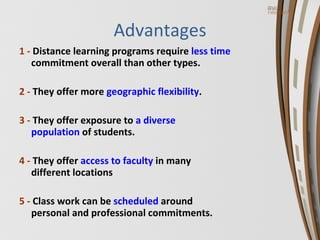
Advantages 1 -  Distance learning programs require  less time   commitment overall than other types. 2 -  They offer more  geographic flexibility . 3 -  They offer exposure to  a diverse  population  of students. 4 -  They offer  access to faculty  in many  different locations 5 -  Class work can be  scheduled  around  personal and professional commitments.
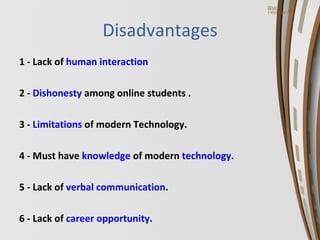
Disadvantages 1 - Lack of  human interaction 2 -  Dishonesty  among online students . 3 -  Limitations  of modern Technology. 4 - Must have  knowledge  of modern  technology . 5 - Lack of  verbal communication . 6 - Lack of  career opportunity .
THE END

Distance Learning

  • 1.
    Distance Learning GroupMembers: 1 – Salah Al-Belushi 2 – Ahmed Al-Senani
  • 2.
    Content DEFINITION TECHNOLOGYUSED IN DELIVERY TESTING AND EVALUATION ADVANTAGES DISADVANTAGES
  • 3.
    Definition # -Distance Learning is defined as an educational system in which the student is formally enrolled in a school or college , but receive instruction at some remote site . # - According to UNESCO It means An educational process in which there is no direct interaction between the student and his instructor. They contact each other through electronic or printing methods .
  • 4.
    Definition # -The term distance learning is restricted to teaching via satellite or other long distance telecommunication technologies. # - The two-way communication between teacher and student can take place through writing , telephone in programmes , two way video , or telephone.
  • 5.
    Technology Used InDelivery Synchronous Technology is used in a mode of online delivery where all the participants are present at the same time through : 1 - Telephone 2 - Video Conferencing 3 - Web Conferencing
  • 6.
    Technology Used InDelivery Asynchronous Technology is a mode of online delivery where participants access course materials on their own schedule. Students are not required to be together at the same time. 1 - Audio Cassettes 2 - E – mail 3 - Social learning Websites 4 - Voice Mail 5 - Fax 6 - Video Cassettes
  • 7.
    Testing & Evaluation# - Assignments are large , long , and more through so as to test for knowledge by forcing the student to research the subject and prove that they have done the work. # - Quizzes are time limited and worth very little of the overall mark. # - Midterm and Final examinations are held at a common location so that professors can supervise directly.
  • 8.
    Advantages 1 - Distance learning programs require less time commitment overall than other types. 2 - They offer more geographic flexibility . 3 - They offer exposure to a diverse population of students. 4 - They offer access to faculty in many different locations 5 - Class work can be scheduled around personal and professional commitments.
  • 9.
    Disadvantages 1 -Lack of human interaction 2 - Dishonesty among online students . 3 - Limitations of modern Technology. 4 - Must have knowledge of modern technology . 5 - Lack of verbal communication . 6 - Lack of career opportunity .
  • 10.