A prospective study
on functional outcome of volar plating
distal end radius.
presenter: Dr. Raghvendra Singh R.
PG dept. orthopaedics.
1. Fracture distal radius is the most
common fracture treated;
10 to 25%;1/6.
2. The goal of the treatment for fracture
distal radius should be to restore
function of the affected wrist at the
best, to limit pain and to reach full
functional ability .
 In case of intra-articular fractures anatomical
reconstruction is of utmost importance to obtain
good functional results. An
intra-articular step of more than 2 mm inevitably
leads to osteoarthritis and functional deficit.
 Conservative treatment often leads to radial
shortening which leads to poor functional
outcome.
 volar plate fixation is a valuable method because of the
decreased risk of inducing dorsal soft-tissue
complications.
 Because there is more space between the volar cortex
and the flexor tendons in the volar approach, the volar
anatomy of the wrist presents an advantage over the
dorsal aspect.
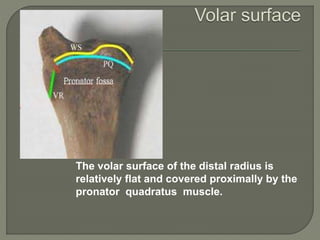
The volar surface of the distal radius is
relatively flat and covered proximally by the
pronator quadratus muscle.
To evaluate the functional outcome of volar
fixed angle plate fixation for distal radius
fractures and to assess its benefits in
terms of amount of pain, finger motion ,
wrist motion , grip strength ,DASH score,
Modified Green and Obrien score ,
deformity and ranges of motions in
affected wrist after surgery.
.
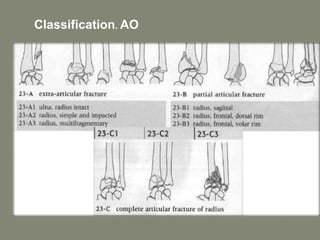
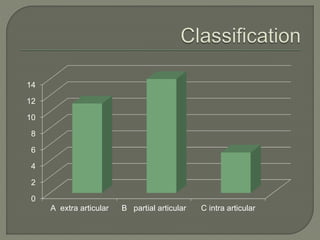
Classification. AO
Place of study : Department of
Orthopaedic Surgery, Regional Institute of
Medical Sciences (RIMS), Imphal, Manipur
Duration : from September 2011 to August
2013.
Type of study : prospective .
 Follow up : for a period of 12 months.
Inclusion criteria:
1.Fractures of the distal end of radius.
2.Age between 20 to 70 years .
Exclusion criteria:
1. Patients with mental and physical
inability to co-operate.
2. Distal radius fracture extending to
shaft of radius .
3. Concomitant fracture in the same limb.
 The fractures will be assessed by antero-
posterior and lateral view X-rays.
 All routine Investigations .
PRE-OPERATIVE PREPARATION
 A closed reduction will be performed, both to
assess fracture fragment stability and to
make open reduction easier.
Positioning
supine position with hand supported on hand
table. Tourniquet was applied for every case .
Anesthesia.
every case taken under general anesthesia.
Skin incision
An incision is made using the flexor carpi
radialis (FCR) approach, over the volar aspect;with
distal extension as necessary. The skin incision
should be centered over the FCR tendon and of
approximately 10 cm length.
 Internal fixation
The fracture line and distal fragments will be exposed. The
distal fragment positions adjusted and appropriate volar
plate will be positioned to assess its optimum fitting.
Optimal length screws will be selected and fixed. It is
important that any discontinuity in the articular surface of
the distal radius be minimised and the drill holes/screws
chosen with their length appropriate to the location to avoid
dorsal screw penetration through the far cortex and extensor
tensor tendon rupture .
After Closure of the skin, a final check will be performed for
plate prominence and distal radio ulnar joint instability
subjective and objective parametres
Radiological parametres
 Modified Green and Obrien score
DASH score
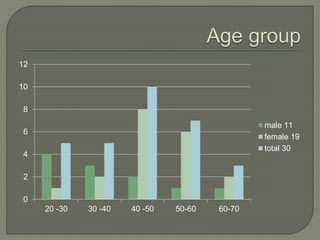
0
2
4
6
8
10
12
20 -30 30 -40 40 -50 50-60 60-70
male 11
female 19
total 30
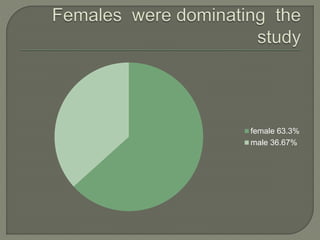
female 63.3%
male 36.67%
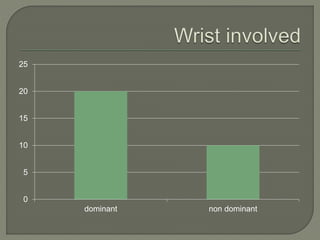
0
5
10
15
20
25
dominant non dominant
0
2
4
6
8
10
12
14
A extra articular B partial articular C intra articular
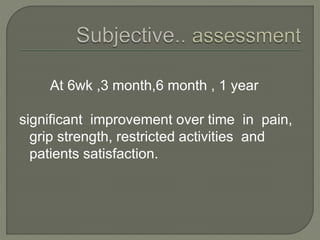
At 6wk ,3 month,6 month , 1 year
significant improvement over time in pain,
grip strength, restricted activities and
patients satisfaction.
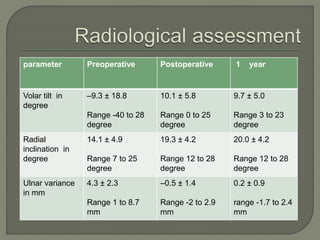
parameter Preoperative Postoperative 1 year
Volar tilt in
degree
–9.3 ± 18.8
Range -40 to 28
degree
10.1 ± 5.8
Range 0 to 25
degree
9.7 ± 5.0
Range 3 to 23
degree
Radial
inclination in
degree
14.1 ± 4.9
Range 7 to 25
degree
19.3 ± 4.2
Range 12 to 28
degree
20.0 ± 4.2
Range 12 to 28
degree
Ulnar variance
in mm
4.3 ± 2.3
Range 1 to 8.7
mm
–0.5 ± 1.4
Range -2 to 2.9
mm
0.2 ± 0.9
range -1.7 to 2.4
mm
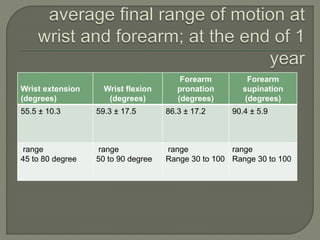
Wrist extension
(degrees)
Wrist flexion
(degrees)
Forearm
pronation
(degrees)
Forearm
supination
(degrees)
55.5 ± 10.3 59.3 ± 17.5 86.3 ± 17.2 90.4 ± 5.9
range
45 to 80 degree
range
50 to 90 degree
range
Range 30 to 100
range
Range 30 to 100
0%
10%
20%
30%
40%
50%
60%
70%
80%
90%
100%
Excellent Good Fair Poor
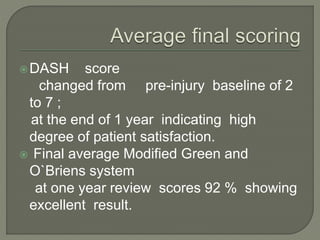
DASH score
changed from pre-injury baseline of 2
to 7 ;
at the end of 1 year indicating high
degree of patient satisfaction.
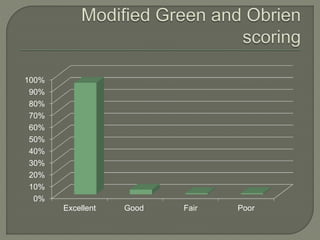
 Final average Modified Green and
O`Briens system
at one year review scores 92 % showing
excellent result.
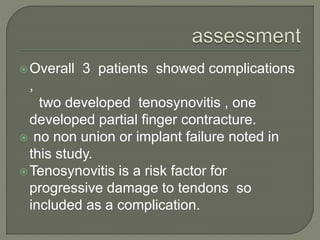
Overall 3 patients showed complications
,
two developed tenosynovitis , one
developed partial finger contracture.
 no non union or implant failure noted in
this study.
Tenosynovitis is a risk factor for
progressive damage to tendons so
included as a complication.
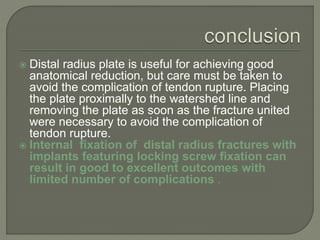
 Distal radius plate is useful for achieving good
anatomical reduction, but care must be taken to
avoid the complication of tendon rupture. Placing
the plate proximally to the watershed line and
removing the plate as soon as the fracture united
were necessary to avoid the complication of
tendon rupture.
 Internal fixation of distal radius fractures with
implants featuring locking screw fixation can
result in good to excellent outcomes with
limited number of complications .
.

Distal radius fracture fixed angle volar plate

  • 1.
    A prospective study onfunctional outcome of volar plating distal end radius. presenter: Dr. Raghvendra Singh R. PG dept. orthopaedics.
  • 2.
    1. Fracture distalradius is the most common fracture treated; 10 to 25%;1/6. 2. The goal of the treatment for fracture distal radius should be to restore function of the affected wrist at the best, to limit pain and to reach full functional ability .
  • 3.
     In caseof intra-articular fractures anatomical reconstruction is of utmost importance to obtain good functional results. An intra-articular step of more than 2 mm inevitably leads to osteoarthritis and functional deficit.  Conservative treatment often leads to radial shortening which leads to poor functional outcome.
  • 4.
     volar platefixation is a valuable method because of the decreased risk of inducing dorsal soft-tissue complications.  Because there is more space between the volar cortex and the flexor tendons in the volar approach, the volar anatomy of the wrist presents an advantage over the dorsal aspect.
  • 5.
    The volar surfaceof the distal radius is relatively flat and covered proximally by the pronator quadratus muscle.
  • 6.
    To evaluate thefunctional outcome of volar fixed angle plate fixation for distal radius fractures and to assess its benefits in terms of amount of pain, finger motion , wrist motion , grip strength ,DASH score, Modified Green and Obrien score , deformity and ranges of motions in affected wrist after surgery.
  • 7.
  • 8.
    Place of study: Department of Orthopaedic Surgery, Regional Institute of Medical Sciences (RIMS), Imphal, Manipur Duration : from September 2011 to August 2013. Type of study : prospective .  Follow up : for a period of 12 months.
  • 9.
    Inclusion criteria: 1.Fractures ofthe distal end of radius. 2.Age between 20 to 70 years . Exclusion criteria: 1. Patients with mental and physical inability to co-operate. 2. Distal radius fracture extending to shaft of radius . 3. Concomitant fracture in the same limb.
  • 10.
     The fractureswill be assessed by antero- posterior and lateral view X-rays.  All routine Investigations . PRE-OPERATIVE PREPARATION  A closed reduction will be performed, both to assess fracture fragment stability and to make open reduction easier.
  • 11.
    Positioning supine position withhand supported on hand table. Tourniquet was applied for every case . Anesthesia. every case taken under general anesthesia. Skin incision An incision is made using the flexor carpi radialis (FCR) approach, over the volar aspect;with distal extension as necessary. The skin incision should be centered over the FCR tendon and of approximately 10 cm length.
  • 12.
     Internal fixation Thefracture line and distal fragments will be exposed. The distal fragment positions adjusted and appropriate volar plate will be positioned to assess its optimum fitting. Optimal length screws will be selected and fixed. It is important that any discontinuity in the articular surface of the distal radius be minimised and the drill holes/screws chosen with their length appropriate to the location to avoid dorsal screw penetration through the far cortex and extensor tensor tendon rupture . After Closure of the skin, a final check will be performed for plate prominence and distal radio ulnar joint instability
  • 13.
    subjective and objectiveparametres Radiological parametres  Modified Green and Obrien score DASH score
  • 14.
    0 2 4 6 8 10 12 20 -30 30-40 40 -50 50-60 60-70 male 11 female 19 total 30
  • 15.
  • 16.
  • 17.
    0 2 4 6 8 10 12 14 A extra articularB partial articular C intra articular
  • 18.
    At 6wk ,3month,6 month , 1 year significant improvement over time in pain, grip strength, restricted activities and patients satisfaction.
  • 19.
    parameter Preoperative Postoperative1 year Volar tilt in degree –9.3 ± 18.8 Range -40 to 28 degree 10.1 ± 5.8 Range 0 to 25 degree 9.7 ± 5.0 Range 3 to 23 degree Radial inclination in degree 14.1 ± 4.9 Range 7 to 25 degree 19.3 ± 4.2 Range 12 to 28 degree 20.0 ± 4.2 Range 12 to 28 degree Ulnar variance in mm 4.3 ± 2.3 Range 1 to 8.7 mm –0.5 ± 1.4 Range -2 to 2.9 mm 0.2 ± 0.9 range -1.7 to 2.4 mm
  • 20.
    Wrist extension (degrees) Wrist flexion (degrees) Forearm pronation (degrees) Forearm supination (degrees) 55.5± 10.3 59.3 ± 17.5 86.3 ± 17.2 90.4 ± 5.9 range 45 to 80 degree range 50 to 90 degree range Range 30 to 100 range Range 30 to 100
  • 21.
  • 22.
    DASH score changed frompre-injury baseline of 2 to 7 ; at the end of 1 year indicating high degree of patient satisfaction.  Final average Modified Green and O`Briens system at one year review scores 92 % showing excellent result.
  • 23.
    Overall 3 patientsshowed complications , two developed tenosynovitis , one developed partial finger contracture.  no non union or implant failure noted in this study. Tenosynovitis is a risk factor for progressive damage to tendons so included as a complication.
  • 24.
     Distal radiusplate is useful for achieving good anatomical reduction, but care must be taken to avoid the complication of tendon rupture. Placing the plate proximally to the watershed line and removing the plate as soon as the fracture united were necessary to avoid the complication of tendon rupture.  Internal fixation of distal radius fractures with implants featuring locking screw fixation can result in good to excellent outcomes with limited number of complications .
  • 25.