MANAGEMENT OF DORSALLY DISPLACED
INTRAARTICULAR FRACTURE OF THE
DISTAL RADIUS WITH DORSAL LOCKING
PLATE
PRESENTER: DR PRAVIN TODEKAR 3RD
YEAR PGT
PROF SANJIB WAIKHOM
HOD DEPT OF ORTHOPAEDICS
RIMS, IMPHAL
Distal radius fractures account for 17% of all fractures treated by
orthopedic trauma surgeons, with 60% being intra-articular and unstable.
The primary goal of treatment is precise reduction and stable fixation.
Treatment options include casting, percutaneous pinning, ligamentotaxis
and open reduction and fixation with volar or dorsal plating.
INTRODUCTION
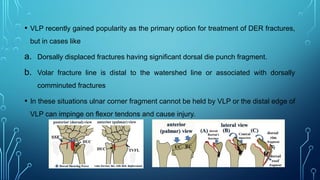
• VLP recently gained popularity as the primary option for treatment of DER fractures,
but in cases like
a. Dorsally displaced fractures having significant dorsal die punch fragment.
b. Volar fracture line is distal to the watershed line or associated with dorsally
comminuted fractures
• In these situations ulnar corner fragment cannot be held by VLP or the distal edge of
VLP can impinge on flexor tendons and cause injury.
• Advantages of dorsal plating
a. Direct visualization of articular surface.
b. Provides a buttress against dorsal collapse.
c. Lowers the risk of neurovascular structure damage.
• Dorsal plate has higher incidence of tendon complications but the newer
generation low profile plates overcome these complications.
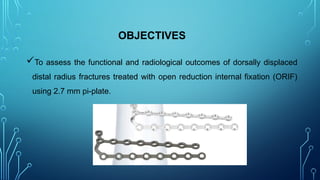
OBJECTIVES
To assess the functional and radiological outcomes of dorsally displaced
distal radius fractures treated with open reduction internal fixation (ORIF)
using 2.7 mm pi-plate.
Study place & duration
RIMS Imphal Manipur
April 2023 to January 2025
Study design
Prospective cohort study
Sample size
40
Study tools
Structured proforma
Plain X ray of the wrist
NCCT of wrist
Instruments for dorsal plating
Outcome measures
Modified green o Brien score
Q Dash score
METHODOLOGY
INCLUSION CRITERIA
Patients with radiologically
confirmed dorsally displaced
intra-articular fractures of the
distal radius
Medically fit
Willing for the procedure
Injuries not older than 2 weeks
Age group more than 18 years
EXCLUSION CRITERIA
Open fracture
Polytrauma patients
Previous fracture in the same
limb
Patient lost to follow up
 Non-cooperative patient
Bilateral fractures
AIM OF SURGERY
• To restore radiological
parameters
1. Radial height
2. Radial inclination
3. Palmar tilt
4. Ulnar variance
5. Articular step-off
• To restore functional status
1. Wrist flexion
2. Wrist extension
3. Supination
4. Pronation
5. Ulnar deviation
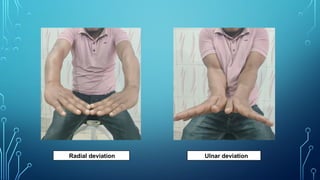
6. Radial deviation
7. Grip strength
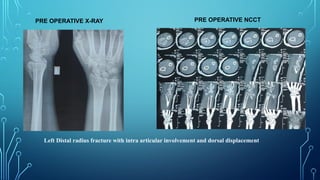
PRE OPERATIVE X-RAY PRE OPERATIVE NCCT
Left Distal radius fracture with intra articular involvement and dorsal displacement
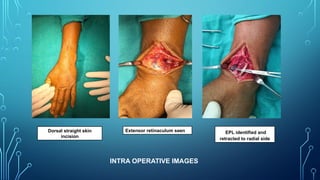
Dorsal straight skin
incision
Extensor retinaculum seen EPL identified and
retracted to radial side
INTRA OPERATIVE IMAGES
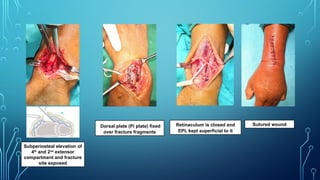
Subperiosteal elevation of
4th
and 2nd
extensor
compartment and fracture
site exposed
Dorsal plate (Pi plate) fixed
over fracture fragments
Retinaculum is closed and
EPL kept superficial to it
Sutured wound
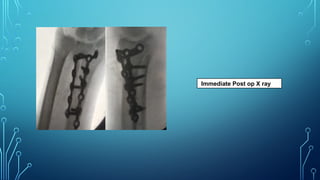
Immediate Post op X ray
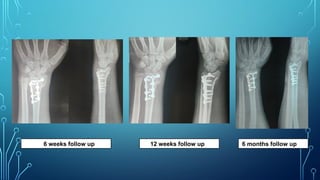
6 months follow up
6 weeks follow up 12 weeks follow up
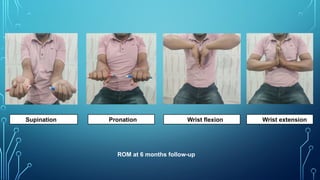
Wrist flexion Wrist extension
Supination Pronation
ROM at 6 months follow-up
Radial deviation Ulnar deviation
POSTOPERATIVE FOLLOW-UP
Rom exercise started on the 3rd
post-op day.
Patients were followed up on 12th
day, at 6 weeks, 12 weeks, 24 weeks and after
1 year.
Sutures removed on 12th
day.
During each visit radiographic parameters and functional outcome (Q DASH &
Modified green O’Brien score) were assessed.
RESULTS
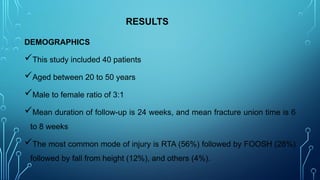
DEMOGRAPHICS
This study included 40 patients
Aged between 20 to 50 years
Male to female ratio of 3:1
Mean duration of follow-up is 24 weeks, and mean fracture union time is 6
to 8 weeks
The most common mode of injury is RTA (56%) followed by FOOSH (28%)
followed by fall from height (12%), and others (4%).
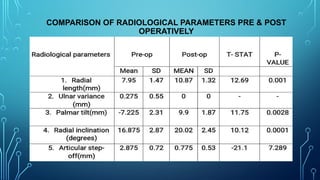
COMPARISON OF RADIOLOGICAL PARAMETERS PRE & POST
OPERATIVELY
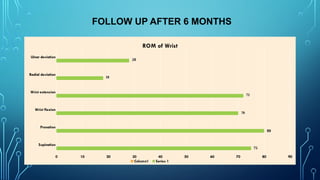
FOLLOW UP AFTER 6 MONTHS
Supination
Pronation
Wrist flexion
Wrist extension
Radial deviation
Ulnar deviation
0 10 20 30 40 50 60 70 80 90
ROM of Wrist
Column1 Series 1
75
80
70
72
18
28
The functional outcome of participants was assessed using Q DASH
score and Modified Green O’Briens score at various follow-up intervals
According to the Q DASH score 32 patients had an excellent outcome, 7
patients had a good outcome and 1 patient had a fair outcome.
According to Modified Green O’Briens score 29 patients had an excellent
outcome, 10 patients had good outcome and 1 patient had poor outcome.
COMPLICATIONS
There were no plate breakage, infections, tendon rupture, or
compression neuropathy during the study period
Tendon irritation was observed in one patient for which plate removal
was done after 6 months.
CONCLUSION
Dorsal locking plate is a useful technique for the treatment of selected
cases of dorsally displaced, comminuted intra-articular fractures of the
distal radius.
Tendon complications can be avoided by careful subperiosteal elevation
of 2nd
and 4th
compartment and avoiding direct contact of plate with a
tendon.
THANK YOU

Dr Pravin Paper-1,,,,,,,,,,,,,,,,,,,,,,,,,,,,,,

  • 1.
    MANAGEMENT OF DORSALLYDISPLACED INTRAARTICULAR FRACTURE OF THE DISTAL RADIUS WITH DORSAL LOCKING PLATE PRESENTER: DR PRAVIN TODEKAR 3RD YEAR PGT PROF SANJIB WAIKHOM HOD DEPT OF ORTHOPAEDICS RIMS, IMPHAL
  • 2.
    Distal radius fracturesaccount for 17% of all fractures treated by orthopedic trauma surgeons, with 60% being intra-articular and unstable. The primary goal of treatment is precise reduction and stable fixation. Treatment options include casting, percutaneous pinning, ligamentotaxis and open reduction and fixation with volar or dorsal plating. INTRODUCTION
  • 3.
    • VLP recentlygained popularity as the primary option for treatment of DER fractures, but in cases like a. Dorsally displaced fractures having significant dorsal die punch fragment. b. Volar fracture line is distal to the watershed line or associated with dorsally comminuted fractures • In these situations ulnar corner fragment cannot be held by VLP or the distal edge of VLP can impinge on flexor tendons and cause injury.
  • 4.
    • Advantages ofdorsal plating a. Direct visualization of articular surface. b. Provides a buttress against dorsal collapse. c. Lowers the risk of neurovascular structure damage. • Dorsal plate has higher incidence of tendon complications but the newer generation low profile plates overcome these complications.
  • 5.
    OBJECTIVES To assess thefunctional and radiological outcomes of dorsally displaced distal radius fractures treated with open reduction internal fixation (ORIF) using 2.7 mm pi-plate.
  • 6.
    Study place &duration RIMS Imphal Manipur April 2023 to January 2025 Study design Prospective cohort study Sample size 40 Study tools Structured proforma Plain X ray of the wrist NCCT of wrist Instruments for dorsal plating Outcome measures Modified green o Brien score Q Dash score METHODOLOGY
  • 7.
    INCLUSION CRITERIA Patients withradiologically confirmed dorsally displaced intra-articular fractures of the distal radius Medically fit Willing for the procedure Injuries not older than 2 weeks Age group more than 18 years EXCLUSION CRITERIA Open fracture Polytrauma patients Previous fracture in the same limb Patient lost to follow up  Non-cooperative patient Bilateral fractures
  • 8.
    AIM OF SURGERY •To restore radiological parameters 1. Radial height 2. Radial inclination 3. Palmar tilt 4. Ulnar variance 5. Articular step-off • To restore functional status 1. Wrist flexion 2. Wrist extension 3. Supination 4. Pronation 5. Ulnar deviation 6. Radial deviation 7. Grip strength
  • 9.
    PRE OPERATIVE X-RAYPRE OPERATIVE NCCT Left Distal radius fracture with intra articular involvement and dorsal displacement
  • 10.
    Dorsal straight skin incision Extensorretinaculum seen EPL identified and retracted to radial side INTRA OPERATIVE IMAGES
  • 11.
    Subperiosteal elevation of 4th and2nd extensor compartment and fracture site exposed Dorsal plate (Pi plate) fixed over fracture fragments Retinaculum is closed and EPL kept superficial to it Sutured wound
  • 12.
  • 13.
    6 months followup 6 weeks follow up 12 weeks follow up
  • 14.
    Wrist flexion Wristextension Supination Pronation ROM at 6 months follow-up
  • 15.
  • 16.
    POSTOPERATIVE FOLLOW-UP Rom exercisestarted on the 3rd post-op day. Patients were followed up on 12th day, at 6 weeks, 12 weeks, 24 weeks and after 1 year. Sutures removed on 12th day. During each visit radiographic parameters and functional outcome (Q DASH & Modified green O’Brien score) were assessed.
  • 17.
    RESULTS DEMOGRAPHICS This study included40 patients Aged between 20 to 50 years Male to female ratio of 3:1 Mean duration of follow-up is 24 weeks, and mean fracture union time is 6 to 8 weeks The most common mode of injury is RTA (56%) followed by FOOSH (28%) followed by fall from height (12%), and others (4%).
  • 18.
    COMPARISON OF RADIOLOGICALPARAMETERS PRE & POST OPERATIVELY
  • 19.
    FOLLOW UP AFTER6 MONTHS Supination Pronation Wrist flexion Wrist extension Radial deviation Ulnar deviation 0 10 20 30 40 50 60 70 80 90 ROM of Wrist Column1 Series 1 75 80 70 72 18 28
  • 20.
    The functional outcomeof participants was assessed using Q DASH score and Modified Green O’Briens score at various follow-up intervals According to the Q DASH score 32 patients had an excellent outcome, 7 patients had a good outcome and 1 patient had a fair outcome. According to Modified Green O’Briens score 29 patients had an excellent outcome, 10 patients had good outcome and 1 patient had poor outcome.
  • 21.
    COMPLICATIONS There were noplate breakage, infections, tendon rupture, or compression neuropathy during the study period Tendon irritation was observed in one patient for which plate removal was done after 6 months.
  • 22.
    CONCLUSION Dorsal locking plateis a useful technique for the treatment of selected cases of dorsally displaced, comminuted intra-articular fractures of the distal radius. Tendon complications can be avoided by careful subperiosteal elevation of 2nd and 4th compartment and avoiding direct contact of plate with a tendon.
  • 23.