Downloaded 19 times

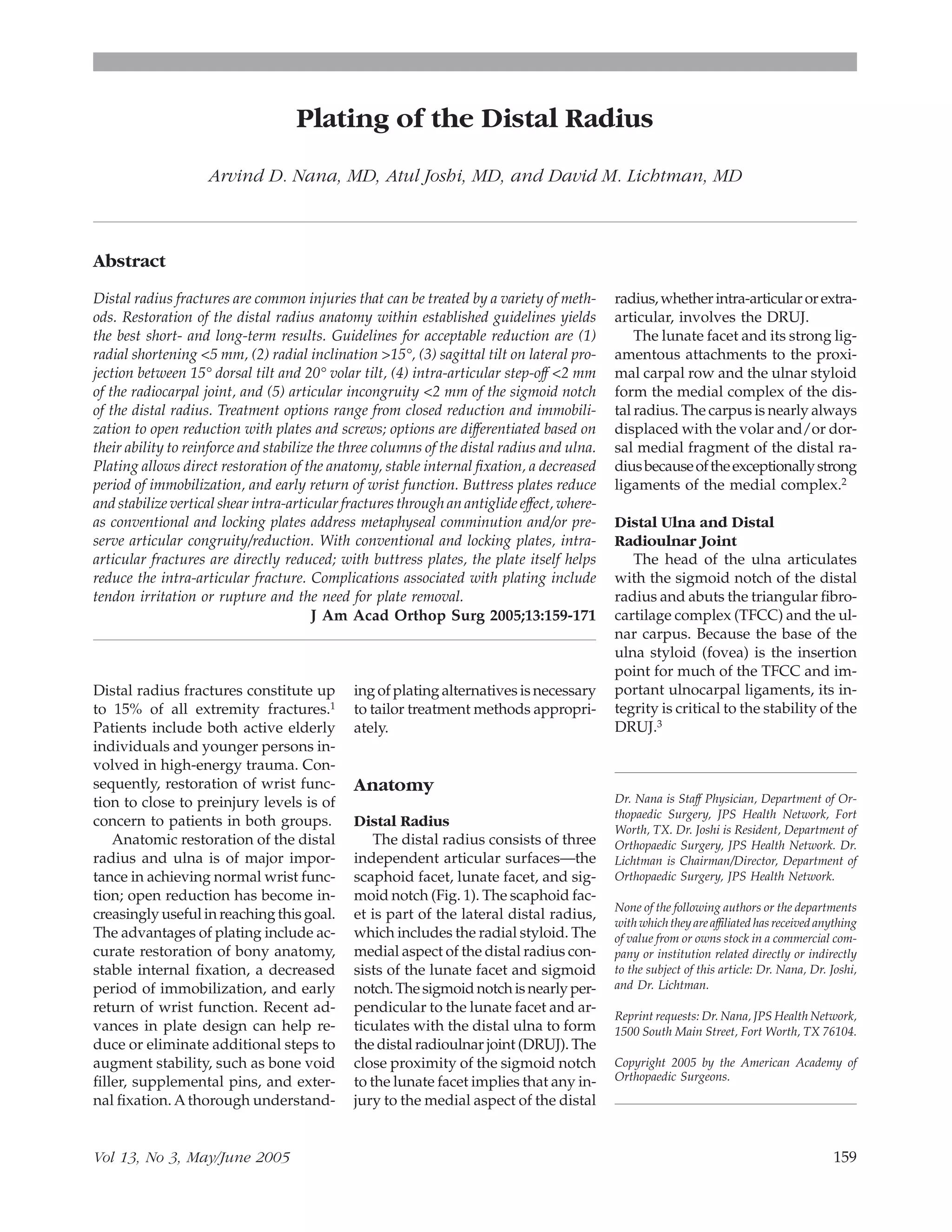
![Restoration of volar stability has
important radiocarpal implications
because the stronger and more impor-
tant radiocarpal ligaments are at-
tached to the volar surface. Volar in-
tegrity therefore is critical because it
facilitates adequate reduction of dor-
sal metaphyseal fragments against a
stable volar buttress and because it
prevents possible volar radiocarpal
instability.8
Plate Fixation
Plate fixation is primarily indicat-
ed for unstable fractures of the volar
medial column of the distal radius;
it is also helpful for combined volar
and dorsal medial column injuries.
Although some authors recommend
dorsal plates for isolated dorsal me-
dial column injuries of the distal ra-
dius, other methods of treatment are
available for these injuries. Volar
plates with locking screws or pegs
may be effective for extensive dorsal
comminution.
Distal radius plates are categorized
by location of use and type of plate.
Plates categorized by location may be
used on the dorsal medial, volar me-
dial, and radial styloid aspects of the
distal radius. Certain plate designs
address two areas simultaneously (ie,
dorsal medial distal radius and radi-
al styloid, or volar medial distal ra-
dius and radial styloid). Smaller im-
plants are also available to stabilize
each area separately.
The two principal types of distal
radius plates are buttress plates and
plates that can span metaphyseal
comminution and/or maintain artic-
ular congruity and reduction. Only
the buttress plate, with its antiglide
effect,reducesintra-articularfractures
(eg, volar Smith or Barton fractures
[Fig. 4] or dorsal Barton fracture). All
other distal radius plates require di-
rect reduction of intra-articular frac-
tures; the plating serves to maintain
the alignment.
Plates that maintain alignment can
be further subdivided into two types:
conventional and locking. In conven-
tional plate design, stability of the
construct is ultimately achieved
through apposition of the bone and
plate by screw purchase in the bone.
Conventional plates can be used dor-
sally or volarly. The use of dual small
conventional plates on the dorsal dis-
tal radius also has been described.17
When cortical or cancellous screws
are used in the distal holes of the but-
tress plate, they are most effective if
the opposite cortex is not comminut-
ed. If the opposite cortex is commi-
nuted, the surface could collapse be-
cause of both axial forces across the
wrist joint and toggle of the screws
in the plate, which may result in loos-
ening of the distal screws.18
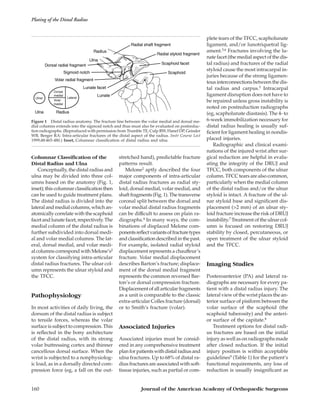
Plates with locking distal screws
or pegs support the subchondral bone
and resist forces across the articula-
tion that may displace the articular
fragments (Figs. 5, 6, and 7). Locking
screws or pegs offer numerous advan-
tagesoverregularscrewsbecausetheir
stability is achieved through plate de-
sign. The screws or pegs become fixed-
angle devices via threaded heads that
engage the threaded distal screw holes
of the plate for stability. New plate de-
signs allow locking screw insertion in
the most distal screw holes as well as
in the proximal screw holes. Of his-
torical note, the dorsal plate used by
Gesensway et al19 employed a blade
plate construct with multiple tines to
achieve fixed-angle fixation.
Locking screws or pegs support
the subchondral bone without rely-
ing on the purchase of the screws or
pegs in bone, and they are indepen-
dent of opposite cortex comminution.
Accordingly, no bone void filler is re-
quired to prevent collapse at the site
of comminution. The distal screws or
pegs—whethercortical,cancellous,or
fixed-angle—serve to maintain reduc-
tion of articular fragments, but they
do not directly reduce the articular
fracture.
Distal Radius Plating
Plating offers direct restoration of
the distal radius through stable fix-
ation. The stability of the construct en-
sures more predictable healing of the
fracture and thus shortens the peri-
od of immobilization of the wrist. The
principal advantage of distal radius
platingistheearlyreturnofwristfunc-
tion,animportantcriterionforpatients
who expect wrist function after inju-
rytoreturntopreinjurylevels.Conven-
tional plates can be used for buttress
and/or neutralization support of a
distal radius fracture. Plates with lock-
ing screws or pegs do not rely on an-
atomic contour of the plate to obtain
stability. Stabilization of the opposite
cortex through locking screws or pegs
significantly decreases or eliminates
the need for further stabilization of
the opposite cortex fragmentation.
Figure 4 The antiglide effect of a buttress
plate helps reduce a volar vertical shear frac-
ture (volar Barton fracture) of the distal ra-
dius. The most proximal screw is placed first;
the penultimate distal screw (A) reduces the
fracture (arrows) (B) before placement of the
final distal screw (C). (Reproduced with per-
mission from Jupiter JB: Complex articular
fractures of the distal radius: Classification
and management. J Am Acad Orthop Surg 1997;
5:119-129.)
Arvind D. Nana, MD, et al
Vol 13, No 3, May/June 2005 163](https://image.slidesharecdn.com/platingofthedistalradiusjaaos-150814171802-lva1-app6892/85/Plating-of-the-distal-radius-5-320.jpg)
![Surgical Treatment
Extra-articular Distal Radius
Fractures
These injuries are transverse or
short oblique fractures proximal to the
DRUJ and are usually amenable to
closed treatment methods with sup-
plementary percutaneous pin stabi-
lization. For an unstable distal shaft
fracture with minimal or no commi-
nution that is either dorsally or vo-
larly displaced, a volar plate is suf-
ficient to achieve stable fixation. A
locking volar plate does not offer any
specific advantage over convention-
al volar plating systems for this type
of fracture. However, for an extra-
articular fracture with dorsal or volar
comminution, a locking volar plate
may offer stability; it also restores
length without the mobilization of
extensor tendons that is required for
dorsal plating. A dorsal plate for an
extra-articular fracture with dorsal
comminution is considered excessive
treatmentwithoutsufficientbenefitbe-
cause these fractures can be routine-
ly pinned and stabilized in a closed
fashion. Bone void filler and external
fixation may be used for severely com-
minuted extra-articular fractures.
Intra-articular Distal Radius
Fractures
The concept of four-part displace-
ment is useful in conceptualizing a
treatment algorithm, especially with
regard to the indications for distal ra-
dius plating. When evaluating a pa-
tient with a distal radius fracture,
three distinct areas (columns) are as-
sessed (Fig. 1, inset). The medial col-
umn of the distal radius represents
Melone’s dorsal and volar die-punch
radius fragments; plates and/or bone
void filler are particularly applicable
for restoration of this column. The ra-
dial styloid component—the lateral
distal radius column—is then re-
viewed to determine whether local-
ized treatment is sufficient (eg, per-
cutaneous pins or screws for the
displaced radial styloid) or whether
treatment should be combined with
fixation of the medial column of the
distal radius (eg, a volar or dorsal
plate that also fixes the styloid). Fi-
nally, the ulnar column, representing
the TFCC and the ulnar styloid com-
ponents, is addressed.
Intra-articular Fractures of the
Lateral Column
The radial styloid fracture and its
corresponding scaphoid facet are
usually displaced proximally by ax-
ial compression forces. Often the frag-
ment is rotated in pronation, but this
is not easily appreciated on routine
radiographs. CT scan and dynamic
fluoroscopy can help delineate this
Figure 5 A, With conventional screws, stability is achieved through friction between the
plate undersurface and the underlying bone (arrows) resulting from screw compression at
the interface. This stability is augmented by bicortical screw purchase, which also decreases
toggle between the screw and plate hole (represented by the rectangles). Friction at the in-
terface must be higher than the axial forces to ensure absolute stability. Thus, anatomic con-
touring of the conventional screw/plate system is needed to obtain a stable construct. B, In
a locking screw system, the threaded screw head locks in the threaded screw hole of the plate
to attain stability. Consequently, axial forces in the bone are transmitted to the plate rather
than the screw, and no screw toggle can occur (arrows). Because stability with a locking screw
does not require compression between the bone and the plate (rectangles), the periosteal blood
supply under the plate is preserved. (Adapted with permission from Appenzeller A, Chris-
tensen R, Frenk A, Gilbert S, Schavan R: The development of the distal femur LISS. Injury
2001;32[suppl 3]:5-25.)
Figure 6 In the distal radius, the principal advantage of a plate with locking screws is sta-
bility of the construct, even in the presence of segmental bone defect or comminution of cor-
tex opposite the plate. Because the screws lock into the plate, the axial forces are transmitted
to the plate. This diagram shows locking screws along the entire plate. F = axial force in the
direction of the arrow. (Adapted courtesy of Synthes [USA], Paoli, PA.)
Plating of the Distal Radius
164 Journal of the American Academy of Orthopaedic Surgeons](https://image.slidesharecdn.com/platingofthedistalradiusjaaos-150814171802-lva1-app6892/85/Plating-of-the-distal-radius-6-320.jpg)
![dial volar to ulnar dorsal. Other op-
tions for styloid fixation include
percutaneous lag screw fixation or a
small buttress plate and pins.20
Plate fixation of the radial styloid
is usually done in combination with
stabilization of medial column inju-
ries of the distal radius. Volar or dor-
sal distal radius plates include radial
styloid stabilization in their construct
and therefore do not need separate ra-
dial styloid plating or pinning. Cer-
tain smaller implant designs are avail-
able for separate plating of radial
styloid fractures, but this is almost al-
ways in combination with medial col-
umn stabilization (whether dorsal or
volar). Separate lateral and medial
column plating of the distal radius is
most mechanically stable when the
plates are angled 50° to 90° to each
other.11,17,20,21 Separate radial styloid
plates are placed on the dorsal radial
or most radial aspect of the distal ra-
dius; this placement requires a low-
profile design to avoid irritation of the
brachioradialis tendon or dorsal ex-
tensor tendons.
Intra-articular Fractures of the
Medial Column
Unstable volar fractures are ame-
nable to volar plate stabilization. If the
fracture is isolated (ie, there is no dor-
sal fragment instability), then a sim-
ple buttress plate may be used to re-
constitute the volar cortex. If the volar
metaphysis is comminuted, bone
void filler may be used to fill in the
gap and also to support the distal ar-
ticular surface. The integrity of the
joint should not be violated by dis-
secting the volar radiocarpal liga-
ments. When necessary, the volar cor-
tex can be hinged open like a book
to inspect and realign volar intra-
articular injuries.
When dorsal fragment instability
also is present, several options are
available. If a volar buttress plate has
been applied, then the dorsal frag-
ment must be stabilized from a dor-
sal approach. If the dorsal fragment
is large, it can be fixed by one or (pref-
erably) two percutaneous cross pins
entering the dorsal medial fragment
distally and aimed proximally and ra-
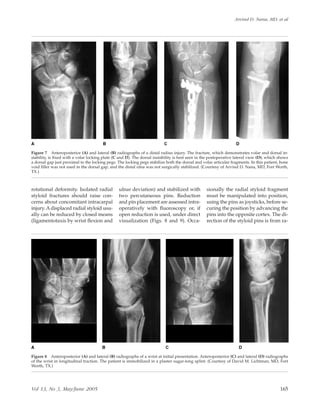
dially (Figs. 8 and 9). As with the ra-
dial styloid fragment, percutaneous
pins can be used as joysticks to ma-
nipulate the dorsal fragment into po-
sition. The pins also may be placed
into the fracture line (intrafocal Ka-
pandji pinning [Fig. 10]), starting
more perpendicular to the dorsal cor-
tex, and then used to reduce the dor-
sal fragment by moving the pins more
nearly parallel to the dorsal cortex,
with subsequent fixation into the
volar cortex.
If the dorsal medial fragment is
comminuted, reducing and holding
the area with pin fixation may be dif-
ficult. The fracture can be opened dor-
sally, usually through a longitudinal
approach between the third and
fourth dorsal extensor compartments.
An approach ulnar to the fourth com-
partment also may be used if the com-
minution is limited to the dorsal ul-
nar corner and semilunar notch. The
floor of the third extensor compart-
ment is incised longitudinally; then
the fourth extensor compartment
(sheath and tendons) is sharply ele-
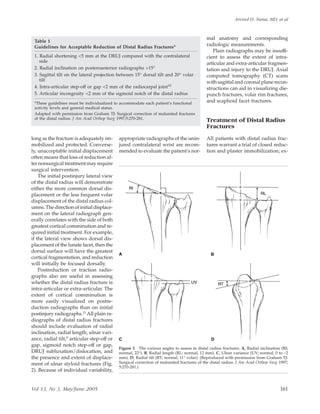
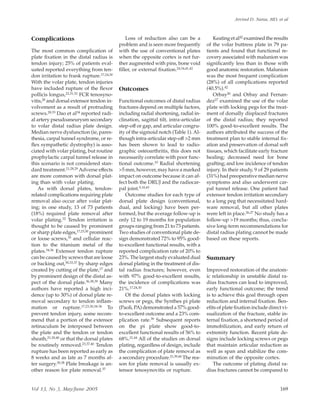
Figure 9 Same patient as in Figure 8. Anteroposterior (A) and lateral (B) radiographs made 1 week after injury. The laterally displaced
radial styloid fragment and volarly displaced volar medial fragment (arrows) are evident. Instability of these fragments is easily demon-
strated by their inability to maintain initial closed reduction. Anteroposterior (C) and lateral (D) postoperative radiographs show that the
volar medial fragment is stabilized with a volar plate. The radial styloid is fixed with two percutaneous pins; the dorsal cortex with its large
dorsal fragments is stabilized with a dorsal percutaneous pin. The ulnar styloid also was stabilized because of the fracture through its base,
marked displacement (>2 mm), and clinical instability of the DRUJ after stabilization of the distal radius. (Courtesy of David M. Lichtman,
MD, Fort Worth, TX.)
Plating of the Distal Radius
166 Journal of the American Academy of Orthopaedic Surgeons](https://image.slidesharecdn.com/platingofthedistalradiusjaaos-150814171802-lva1-app6892/85/Plating-of-the-distal-radius-8-320.jpg)
![vated off the dorsal distal radius.
Bone grafting of the dorsal metaphy-
sis is now possible. If the joint needs
to be viewed, the dorsal capsule can
be incised transversely. Reduction un-
der direct visualization usually can be
done, and bone void filler is often
used to stabilize and buttress the dor-
sal cortex. If necessary, a transverse
capsular incision may be used to ex-
plore the radiocarpal joint and reduce
intra-articular or intracarpal injuries.
Some surgeons use low-profile dor-
sal plates at this point to maintain ar-
ticular reduction and stability; others
apply an external fixator for 3 to 4
weeks to avoid use of a dorsal plate.
An alternative for treating both
dorsal and volar instability is to use
a plate with locking screws or pegs
to transfix both volar and dorsal cor-
tices of the medial column of the dis-
tal radius (Fig. 7). Satisfactory results
have also been achieved using lock-
ing screw–plate combinations from
the dorsal side.22-24
Although dorsal plates do permit
adequate healing of the fracture, their
secondary effects—particularly on
surrounding soft-tissue structures—
render them a less appealing option.
Disadvantages of dorsal plates in-
clude the need for mobilization of ex-
tensor tendons to achieve proper
plate placement, possible tendon ir-
ritation or rupture because of a prom-
inent plate or screws, and the possi-
bility of additional surgery to remove
the symptomatic dorsal plate.
In isolated unstable fractures of the
dorsal medial column, the decision to
treat with pin fixation or with open
bone grafting plus neutralization ex-
ternal fixation depends on the size of
the fragments. Treatment is the same
as when combined with volar insta-
bility: percutaneous pins for large
fragments or open reduction, bone
void filler, and external fixation for
comminuted fractures (small frag-
ments). Once again, low-profile dor-
sal plates can be applied instead of
an external fixator, but locking screws
or pegs are not necessary in this in-
stance.
A lateral column injury of the dis-
tal radius is usually treated concom-
itantly or after stabilization of the me-
dial column. As noted, if the fracture
pattern permits, the styloid can be
fixed with either a volar or dorsal
plate. In most instances, the radial sty-
loid can be fixed separately using two
percutaneous pins, as described for
isolatedradialstyloidfractures.Aper-
cutaneous lag screw or a small dorsal
radial buttress plate are also options.
Surgical Approach
Volar Radial Approach
The volar radial (Henry) approach
is utilitarian; it can expose the entire
volar radial surface up to the DRUJ
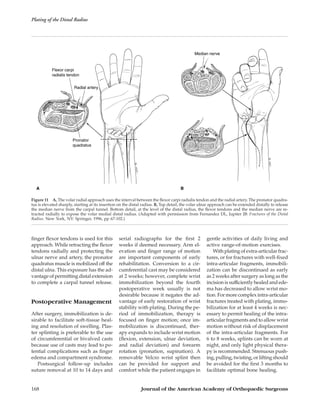
(Fig. 11, A). This exposure uses the in-
terval between the flexor carpi radi-
alis (FCR) and the radial artery or
goes through the floor of the FCR ten-
don sheath. The pronator quadratus
muscle is elevated in a subperiosteal
fashion to visualize the volar distal
radius.25 Orbay26 and Orbay and
Fernandez27 also describe the release
of the first extensor compartment and
the insertion of the brachioradialis off
the lateral distal radius to permit ac-
cess to the dorsal surface and to fa-
cilitate the reduction of the lateral col-
umn of the distal radius (radial
styloid). Release of the volar capsule
or the ligamentous attachments on
the volar rim may lead to volar ra-
diocarpal instability and should be
avoided.
Carpal tunnel release through the
distal extension of this approach is not
recommended because of potential
injury to the volar cutaneous branch
of the median nerve. If carpal tunnel
release is indicated, a separate stan-
dard or a mini carpal tunnel incision
is recommended. Prophylactic carpal
tunnel release is not routinely per-
formed21,28,29 unless acute carpal tun-
nel symptoms are present or unless
the distal fragment is significantly
dorsally displaced for a prolonged
period of time.
Volar Ulnar Approach
The volar ulnar approach offers
limited exposure to the radial column
and is indicated for injuries to the vo-
lar aspect of the medial column and
the DRUJ (Fig. 11, B). The interval be-
tween the flexor carpi ulnaris and the
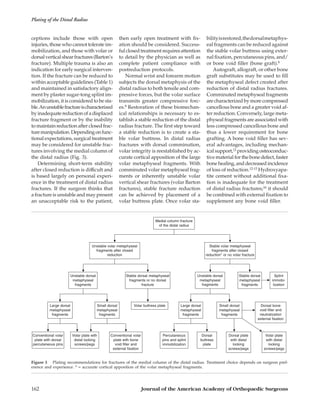
Figure 10 With intrafocal Kapandji pinning, the pin is placed through the fracture site and
maneuvered to elevate the fragment. Once adequate reduction is achieved, the pin is then
driven through the opposite cortex to achieve stability. This technique can be used to restore
radial inclination (A) or volar tilt (B). (Adapted with permission from Palmer AK: Fractures
of the distal radius, in Green DP [ed]: Operative Hand Surgery. New York, NY: Churchill Liv-
ingstone, 1993, pp 929-971.)
Arvind D. Nana, MD, et al
Vol 13, No 3, May/June 2005 167](https://image.slidesharecdn.com/platingofthedistalradiusjaaos-150814171802-lva1-app6892/85/Plating-of-the-distal-radius-9-320.jpg)
![other surgical options because of a
lack of long-term follow-up and the
wide variation of indications for plat-
ing in published studies. The three-
column system for distal radius and
ulna fractures is a simple and prac-
tical approach to understanding and
treating these common, yet some-
times complex, injuries. The risks and
benefits of plating must be balanced
for each patient and weighed with
complete understanding of the patho-
logic anatomy and physiology of each
specific fracture pattern.
The OKO video ″Intra-
articular Distal Radius Fractures,″ by
Christopher H. Allan, MD, is avail-
able at http://www5.aaos.org/oko/
jaaos/main.cfm.
References
1. Sanders WE: Distal radius fractures, in
Manske PR (ed): Hand Surgery Update.
Rosemont, IL:AmericanAcademy of Or-
thopaedic Surgeons, 1996, pp 117-123.
2. Melone CP Jr: Articular fractures of the
distal radius. Orthop Clin North Am
1984;15:217-236.
3. Palmer AK: The distal radioulnar joint.
Orthop Clin North Am 1984;15:321-335.
4. Andersen DJ, Blair WF, Steyers CM,
Adams BD, El-Khouri GY, Brandser
EA: Classification of distal radius frac-
tures: An analysis of interobserver reli-
ability and intraobserver reproducibil-
ity. J Hand Surg [Am] 1996;21:574-582.
5. Geissler WB, Freeland AE, Savoie FH,
McIntyre LW, Whipple TL: Intracarpal
soft-tissue lesions associated with an
intra-articular fracture of the distal end
of the radius. J Bone Joint Surg Am 1996;
78:357-365.
6. Richards RS, Bennett JD, Roth JH,
Milne K Jr: Arthroscopic diagnosis of
intra-articular soft tissue injuries asso-
ciated with distal radius fractures.
J Hand Surg [Am] 1997;22:772-776.
7. May NM, Lawton JN, Blazar PE: Ulnar
styloid fractures associated with distal
radius fractures: Incidence and implica-
tions for distal radioulnar joint instabil-
ity. J Hand Surg [Am] 2002;27:965-971.
8. Nana AD, Lichtman DM: Distal-third
forearm fractures. Available at http://
www.emedicine.com/orthoped/topic
79.htm. Accessed April 27, 2005.
9. Graham TJ: Surgical correction of
malunited fractures of the distal radius.
J Am Acad Orthop Surg 1997;5:270-281.
10. Knirk JL, Jupiter JB: Intra-articular frac-
tures of the distal end of the radius in
young adults. J Bone Joint Surg Am 1986;
68:647-659.
11. Rikli DA, Regazzoni P: Fractures of the
distal end of the radius treated by inter-
nal fixation and early function. J Bone
Joint Surg Br 1996;78:588-592.
12. Fernandez DL, Geissler WB: Treatment
of displaced articular fractures of the ra-
dius. J Hand Surg [Am] 1999;24:102-107.
13. Leung KS, Shen WY, Leung PC, Kinnin-
month AWG, Chang JCW, Chan GPY:
Ligamentotaxis and bone grafting for
comminuted fractures of the distal ra-
dius. J Bone Joint Surg Br 1989;71:838-842.
14. Putnam MD, Fischer MD: Treatment of
unstable distal radius fractures: Meth-
ods and comparison of external distrac-
tion and ORIF versus external distrac-
tion-ORIF neutralization. J Hand Surg
[Am] 1997;22:238-251.
15. Trumble TE, Schmitt SR, Vedder NB: Fac-
tors affecting functional outcome of dis-
placed intra-articular distal radius frac-
tures. J Hand Surg [Am] 1994;19:325-340.
16. Jeyam M,Andrew JG, Muir LT, McGov-
ern A: Controlled trial of distal radial
fractures treated with a resorbable bone
mineral substitute. J Hand Surg [Br]
2002;27:146-149.
17. Jakob M, Rikli DA, Regazzoni P: Frac-
tures of the distal radius treated by in-
ternal fixation and early function. J Bone
Joint Surg Br 2000;82:340-344.
18. Small Fragment Locking Compression
Plate (LCP): Technique Guide. Paoli, PA:
Synthes (USA), 2002, pp 1-20.
19. Gesensway D, Putnam MD, Mente PL,
Lewis JL: Design and biomechanics of
a plate for the distal radius. J Hand Surg
[Am] 1995;20:1021-1027.
20. Swigart CR, Wolfe SW: Limited incision
open techniques for distal radius frac-
ture management. Orthop Clin North
Am 2001;32:317-327.
21. Hahnloser D, Platz A, Amgwerd M,
Trentz O: Internal fixation of distal ra-
dius fractures with dorsal dislocation:
π-plate or two ¼ tube plates?Aprospec-
tive randomized study. J Trauma 1999;
47:760-765.
22. Fuller DJ: The Ellis plate operation for
Smith’s fracture. J Bone Joint Surg Br
1973;55:173-178.
23. Fitoussi F, Ip WY, Chow SP: Treatment
of displaced intra-articular fractures of
the distal end of the radius with plates.
J Bone Joint Surg Am 1997;79:1303-1312.
24. Finsen V, Aasheim T: Initial experience
with the Forte plate for dorsally dis-
placed distal radius fractures. Injury
2000;31:445-448.
25. Trumble TE, Culp RW, Hanel DP, Gei-
ssler WB, Berger RA: Intra-articular
fractures of the distal aspect of the ra-
dius. Instr Course Lect 1999;48:465-480.
26. Orbay JL: The treatment of unstable
distal radius fractures with volar fixa-
tion. Hand Surg 2000;5:103-112.
27. Orbay JL, Fernandez DL: Volar fixation
for dorsally displaced fractures of the
distal radius: A preliminary report.
J Hand Surg [Am] 2002;27:205-215.
28. Jupiter JB, Fernandez DL, Toh C-L, Fell-
man T, Ring D: Operative treatment of
volar intra-articular fractures of the dis-
tal end of the radius. J Bone Joint Surg
Am 1996;78:1817-1828.
29. Schneeberger AG, Ip WY, Poon TL,
Chow SP: Open reduction and plate fix-
ation of displaced AO type C3 fractures
of the distal radius: Restoration of artic-
ular congruity in eighteen cases.
J Orthop Trauma 2001;15:350-357.
30. CarterPR,FrederickHA,LaseterGF:Open
reduction and internal fixation of unsta-
bledistalradiusfractureswithalow-profile
plate:Amulticenter study of 73 fractures.
J Hand Surg [Am] 1998;23:300-307.
31. Bell JSP, Wollstein R, Citron ND: Rup-
ture of flexor pollicis longus tendon.
J Bone Joint Surg Br 1998;80:225-226.
32. Nunley JA, Rowan PR: Delayed rupture
of the flexor pollicis longus tendon af-
ter inappropriate placement of the π plate
on the volar surface of the distal radius.
J Hand Surg [Am] 1999;24:1279-1280.
33. Wong-Chung J, Quinlan W: Rupture of
extensor pollicis longus following fixa-
tion of a distal radius fracture. Injury
1989;20:375-376.
34. Dao KD, Venn-Watson E, Shin AY: Ra-
dial artery pseudoaneurysm complica-
tion from use of AO/ASIF volar distal
radius plate: A case report. J Hand Surg
[Am] 2001;26:448-453.
35. Schnur DP, Chang B: Extensor tendon
rupture after internal fixation of a dis-
tal radius fracture using a dorsally
placed AO/ASIF titanium Pi plate. Ann
Plast Surg 2000;44:564-566.
36. Lowry KJ, Gainor BJ, Hoskins JS: Exten-
sor tendon rupture secondary to the
AO/ASIF titanium distal radius plate
Plating of the Distal Radius
170 Journal of the American Academy of Orthopaedic Surgeons](https://image.slidesharecdn.com/platingofthedistalradiusjaaos-150814171802-lva1-app6892/85/Plating-of-the-distal-radius-12-320.jpg)
![without associated plate failure: A case
report. Am J Orthop 2000;29:789-791.
37. Kambouroglou GK, Axelrod TS: Com-
plications of the AO/ASIF titanium dis-
tal radius plate system (π plate) in in-
ternal fixation of the distal radius:Abrief
report. J Hand Surg [Am] 1998;23:737-741.
38. Lucas GL, Fejfar ST: Complication in
internal fixation of the distal radius.
J Hand Surg [Am] 1998;23:1117.
39. Ring D, Jupiter JB, Brennwald J,
Buchler U, Hastings H: Prospective
multicenter trial of a plate for dorsal fix-
ation of distal radius fractures. J Hand
Surg [Am] 1997;22:777-784.
40. Peine R, Rikli DA, Hoffmann R, Duda
G, Regazzoni P: Comparison of three dif-
ferent plating techniques for the dorsum
of the distal radius: A biomechanical
study. J Hand Surg [Am] 2000;25:29-33.
41. Hove LM, Nilsen PT, Furnes O, Oulie
HE, Solheim E, MolsterAO: Open reduc-
tion and internal fixation of displaced in-
traarticular fractures of the distal radi-
us. Acta Orthop Scand 1997;68:59-63.
42. Keating JF, Court-Brown CM, Mc-
Queen MM: Internal fixation of volar-
displaced distal radial fractures. J Bone
Joint Surg Br 1994;76:401-405.
43. Catalono LW III, Cole RJ, Gelberman
RH, Evanoff BA, Gilula LA, Borelli J Jr:
Displaced intra-articular fractures of
the distal aspect of the radius. J Bone
Joint Surg Am 1997;79:1290-1302.
44. Campbell DA: Open reduction and in-
ternal fixation of intra-articular and un-
stable fractures of the distal radius us-
ing the AO distal radius plate. J Hand
Surg [Br] 2000;25:528-534.
Arvind D. Nana, MD, et al
Vol 13, No 3, May/June 2005 171](https://image.slidesharecdn.com/platingofthedistalradiusjaaos-150814171802-lva1-app6892/85/Plating-of-the-distal-radius-13-320.jpg)

This document discusses the treatment of distal radius fractures through plating. It begins with an overview of distal radius anatomy and the columnar classification system used to guide treatment. It then discusses the pathophysiology of distal radius fractures and associated injuries. Treatment options range from closed reduction to open reduction with plating or other internal fixation. Plating allows for anatomic restoration and stable fixation, enabling early return of wrist function. Factors such as fracture pattern, displacement, and patient needs help determine the appropriate treatment. Complications of plating include tendon issues and potential need for plate removal.


![PERI-PROSTHETIC FRACTURE NAIL-PLATE CONSTRUCT [NPC].pptx](https://cdn.slidesharecdn.com/ss_thumbnails/drarunkumardrmohamedashrafperiprostheticfrasturenail-plateconstructnpc-260209164459-7e9d15a1-thumbnail.jpg?width=640&height=640&fit=bounds)


![ONFH[AVN HIP] -TRIPLE REGIME -A NOVAL SURGICAL CONCEPT .pptx](https://cdn.slidesharecdn.com/ss_thumbnails/onfhavnhip2026koaconcalicutdrgokuldevdrmashraf-260210064517-213ec005-thumbnail.jpg?width=640&height=640&fit=bounds)


![CTEV [ clubfoot] DR ARUN LAL ,DR MOHAMED ASHRAF travancore medical college k...](https://cdn.slidesharecdn.com/ss_thumbnails/ctevclubfootdrarunlaldrmohamedashraftravancoremedicalcollegekollamkeralaindia-260208063247-18fc466c-thumbnail.jpg?width=640&height=640&fit=bounds)


