Economics:Meaning,scopeandsubjectmatter,definitions,activities,
approachestoeconomicanalysis;microandmacroeconomics,positive
andnormativeanalysis.
Natureofeconomictheory;rationalityassumption,conceptof
equilibrium,economiclawsasgeneralizationofhumanbehavior.
Basicconcepts:Goodsandservices,desire,want,demand,utility,cost
andprice,wealth,capital,incomeandwelfare.
Contents
Economics is popularly known as the “Queen of Social
Sciences”.
It studies economic activities of a man living in a society.
Economic activities are those activities, which are concerned
with the efficient use of scarce means that can satisfy the
wants of man.
After the basic needs viz., food, shelter and clothing have been
satisfied, the priorities shift towards other wants.
Human wants are unlimited, in the sense, that as soon as one
want is satisfied another cops up.
 Resources being scarce in nature ought to be utilized
productively within the available means to derive maximum
satisfaction.
 The knowledge of economics guides us in making effective
decisions.
 Economics deals with decisions regarding the commodities
and services to be produced in the economy, how to produce
them most economically and how to provide for the growth
of the economy
Definitions
• The word ECONOMICS has been derived from the Greek Word
“OIKONOMICAS” with “OIKOS” meaning a household and
“NOMOS” meaning management.
• The concept on which various definitions of economics given are
Wealth, Welfare, Scarcity & Growth.
1. Wealth:
• Adam smith defined Economics as “An enquiry into the nature
and causes of wealth of nations” in his book, entitled ‘Wealth of
Nations’.
• He is regarded as the “Father of Economics”.
2. Welfare:
Alfred Marshall in his book “Principles of Economics” defined
“Economics as a study of mankind in the ordinary business of
life, it examines that part of individual and social action which
is most closely connected with the attainment and with the use
of the material requisites of well- being”.
3. Scarcity:
Lionel Robbins formulated his conception of economics based on
the scarcity concept.
“Economics is the science which studies human behavior as a
relationship between ends and scarce means which have
alternative uses.
4. GROWTH:
• J. M. Keynes is known as the Father of Modern Economics.
• He defined economics as “the study of the administration of
scarce resources and of the determinants of employment and
income”.
• In the words of Nobel prize winner Prof. Samuelson, “Economics
is the study of how people and society end up choosing with
or without the use of money, to employ scarce productive
resources that could have alternative uses, it produces
various commodities over time and distributes them for
consumption, now or in the future, among various persons
and groups in society. It analyses costs and benefits of
improving patterns of resources allocation.”
Scope
 Economics is a social science.
 Economics is a science or an art.
 If economics is a science, whether it is a POSITIVE
science or a NORMATIVE science.
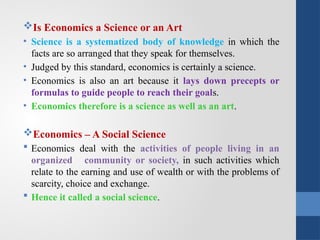
Is Economics a Science or an Art
• Science is a systematized body of knowledge in which the
facts are so arranged that they speak for themselves.
• Judged by this standard, economics is certainly a science.
• Economics is also an art because it lays down precepts or
formulas to guide people to reach their goals.
• Economics therefore is a science as well as an art.
Economics – A Social Science
 Economics deal with the activities of people living in an
organized community or society, in such activities which
relate to the earning and use of wealth or with the problems of
scarcity, choice and exchange.
 Hence it called a social science.
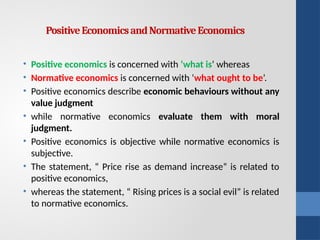
PositiveEconomicsandNormativeEconomics
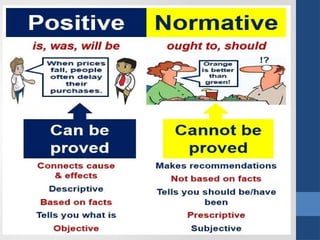
• Positive economics is concerned with ‘what is’ whereas
• Normative economics is concerned with ‘what ought to be’.
• Positive economics describe economic behaviours without any
value judgment
• while normative economics evaluate them with moral
judgment.
• Positive economics is objective while normative economics is
subjective.
• The statement, “ Price rise as demand increase” is related to
positive economics,
• whereas the statement, “ Rising prices is a social evil” is related
to normative economics.
SubjectMatter
• Economics tells how a man utilizes his limited resources
for the satisfaction of unlimited wants.
• Man has limited amount of time and money. He should
spend time and money in such away that he derives
maximum satisfaction.
• A man wants food, clothing and shelter.
• To get these things he must have money. For getting money he
must make an effort.
• Effort leads to satisfaction.
• Thus, wants- efforts- satisfaction sums up the subject
matter of economics, initially in a primitive society where the
connection between wants efforts and satisfaction is direct .
Wants
Efforts
Satisfaction
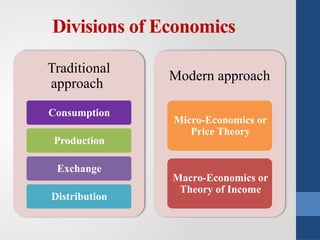
Divisions of Economics
Traditional
approach
Consumption
Production
Exchange
Distribution
Modern approach
Micro-Economics or
Price Theory
Macro-Economics or
Theory of Income
TraditionalApproach
• Consumption:
It means the use of wealth to satisfy human wants. It
also means the destruction of utility or use of commodities and
services to satisfy human wants.
• Production:
It is defined as the creation of utility. It involves the
processes and methods employed in transformation of Tangible
inputs (raw materials semi-finished goods, or subassemblies) and
intangible inputs (ideas, information , know-how) into goods or
services.
Exchange:
It implies the transfer of goods from one person to the
other. It may occur among individuals or countries. The exchange
of goods leads to an increase in the welfare of the individuals
through creation of higher utilities for goods and services.
Distribution:
Distribution refers to sharing of wealth that is produced
among the different factors of production.
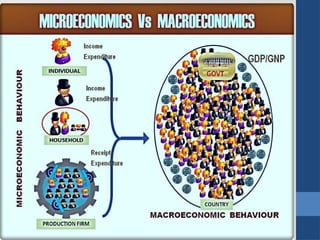
Micro economics
 It is otherwise known as price theory.
 It focuses on price determination.
 Micro economics fundamentally deals with economic behavior of
individual economic units such as consumer, resource
owners and business firms it is concerned with the flow of
goods and services from business firms to consumer and also
the flow of resources or their services from resource owners
to business firms.
 Micro economics covers theory of consumer behavior, theory of
value (product pricing and factor pricing) and theory of
economic welfare.
Modern approach
Macro economics
 Also refereed as income theory.
 It treats the economic system as a whole, rather them
treating the individual economic units of which it is
composed.
 Macro economics is concerned with the value of the overall
flow of goods and the value of the overall flow of
resources. Thus, it covers theory of income and
employment, theory of money and prices, banking,
theory of economic growth, theory of distribution,
general equilibrium analysis, policy formulation and
analysis etc.
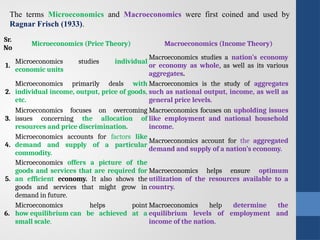
The terms Microeconomics and Macroeconomics were first coined and used by
Ragnar Frisch (1933).
Sr.
No
Microeconomics (Price Theory) Macroeconomics (Income Theory)
1.
Microeconomics studies individual
economic units
Macroeconomics studies a nation’s economy
or economy as whole, as well as its various
aggregates.
2.
Microeconomics primarily deals with
individual income, output, price of goods,
etc.
Macroeconomics is the study of aggregates
such as national output, income, as well as
general price levels.
3.
Microeconomics focuses on overcoming
issues concerning the allocation of
resources and price discrimination.
Macroeconomics focuses on upholding issues
like employment and national household
income.
4.
Microeconomics accounts for factors like
demand and supply of a particular
commodity.
Macroeconomics account for the aggregated
demand and supply of a nation’s economy.
5.
Microeconomics offers a picture of the
goods and services that are required for
an efficient economy. It also shows the
goods and services that might grow in
demand in future.
Macroeconomics helps ensure optimum
utilization of the resources available to a
country.
6.
Microeconomics helps point
how equilibrium can be achieved at a
small scale.
Macroeconomics help determine the
equilibrium levels of employment and
income of the nation.
Methods of Economics Investigation
Therearetwomethodsofeconomicinvestigationthatareusedin
economictheoryi.e.,
1)Deductivemethod 2)InductiveMethod
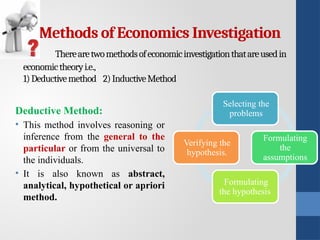
Deductive Method:
• This method involves reasoning or
inference from the general to the
particular or from the universal to
the individuals.
• It is also known as abstract,
analytical, hypothetical or apriori
method.
Selecting the
problems
Formulating
the
assumptions
Formulating
the hypothesis
Verifying the
hypothesis.
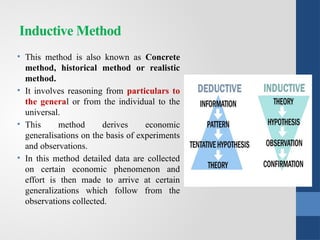
Inductive Method
• This method is also known as Concrete
method, historical method or realistic
method.
• It involves reasoning from particulars to
the general or from the individual to the
universal.
• This method derives economic
generalisations on the basis of experiments
and observations.
• In this method detailed data are collected
on certain economic phenomenon and
effort is then made to arrive at certain
generalizations which follow from the
observations collected.
Rationality assumptions
It is also known as Economics rationality Or Psychological
rationality.
Human are classified into two types
A. Consumer:
1. It is assume that consumer behave rationally that is in
sensible and practical manner (It means the consumer is
aware of what is want and in what quantity). If consumer
want to buy tomato, he will buy tomato and not potato even
if they are cheap.
2. Consumer taste and preference remain same
(If boy loves T-shirt he will buy T-shirt not shirt)
3. Consumer tries to get maximum satisfaction for money spent
The consumer will spend his money only if he gets satisfaction
(A smoker will buy cigarette he get satisfaction and non smoker
will not buy because he will not get satisfaction)
B. Producer
1. Every business behave rationally, they try to get maximum
profit.
A business if given a option of
a) Low sales & low profit (reject)
b) How sales & low profit (reject)
c) High sales & high profit (accept)
This way both consumer and producer behaves rationally.
Concept of Equilibrium
A English historian Thomas Carlyle once said, “Teach any parrot
the words demands and supply you’ve got an economist.
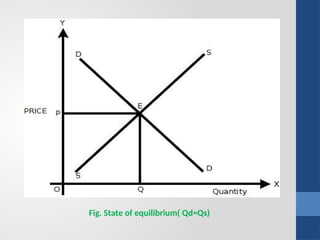
Equilibrium: The force of demand supply interact to determine
equilibrium quantity and prices.
 Equilibrium price
When the quantity of supply of goods matches the demand
for goods, it is called the equilibrium price.
 Equilibrium quantity
The equilibrium quantity is the quantity of a good or service
bought at the equilibrium price.
Fig. State of equilibrium( Qd=Qs)
The Nature of Economic Laws and Generalizations
 Economic laws e also known as generalizations, principles and
uniformities.
 The economic laws describe how a in behaves as a producer and
a consumer.
 The economic laws are also concerned with how the economic
system works and operate. Man in his economic life produces
wealth, consumes wealth, changes it with others.
 There are important laws of economics, LoD, LDMU, Keynesian
Psychological Law of Consump­
tion, Principles of Multiplier and
Accelerator,
 “Economic laws are these social laws which relate to branches of
con­
duct in which the strength of the motives chiefly concerned
can be measured by money price (Marshall).”
Economic Laws as Statements of Tendencies
 Economic laws are statements of tendencies which govern human
behavior concerning the utilization of scarce resources for the
achievement of un­
limited wants (Robbins).
 In other words, when resources are scarce and wants are unlimited
and therefore the problem of choice arises, economists have to frame
the laws of choice.
Scientific Nature of Economic Laws
 Economic laws are related to economic life of man. It needs observation
of behavior of several people to established certain generalizations
or general prin­
ciples which are called economic laws.
Economic laws are less exact than laws of physical sciences
 Economics are less exact and definite than the laws of physical
sciences.
 Law of gravitation which is so exact and definite that we can
calculate and measure exactly the movements of the solar system
and we can predict their exact position at a particular time.
 But this is not TRUE in case of economic laws because we cannot say
with certainty how a man would behave under certain conditions
and, therefore, cannot exactly predict his behavior.
Basic concepts
Goods: the commodities that an individual use. Goods or
commodities are almost always concrete material and tangible
items i.e.. house, furniture.
Services: The work that a person may do viz. carpentry, tailoring,
insurance agent etc.
Free Goods: Are those goods that exist in such plenty that you can
have as much of them as you like without any payments e.g. Air, Sun
shine
Economic Goods: Those goods which are scarce and can be had
only on payments.
Consumption Goods: Those goods which are used the consumers
to satisfy their wants directly e.g.:- food and clothing.
Capital Goods: Those goods which help use to produce other
goods e.g.:- Machines, tools etc. They are also called producer’s
goods.
Private Goods: The property of private individuals e.g. Land or
buildings owned by them exclusively and not shared with others.
Public Goods: Those which is common to all and are owned by
society collectively e.g. - a hospital, a college, a stadium etc.
Desire: is whatever an individual wish to have or something want, but
don’t have sufficient money or income to afford it.
Example – X is having Rs. 8000 and wants to buy a phase of worth Rs.
10000. This is called desire want something but can’t buy.
Want: s that desire which is backed by & willingness to satisfy called
wants.
Demand: “It means that the person is willing and able to pay for the
object he desires”. “Demand means desire backed by willingness and
ability to pay.” “Demands are the quantitative expression of preferences.”
(Chapman).
Utility: The power of satisfying human wants are called utility.” Utility is
that quality of a commodity by virtue of which it is capable of satisfying
a human wants.
Cost: “Cost is value scarified are called cost”. This scarified is either
called as opportunity cost or Alternative cost. e.g.- Fixed cost, variable
cost.
Price: When value is expressed in terms of money it is called price”.
The price of a commodity today means its money value i.e. the price it
commands in the market.
Wealth: “ Anything which has value is called wealth” there three
attributes of wealth as in case of value, utility, scarcity and
transferability or marketability.
i. It should a human wants or it posses’ utility.
ii. ii. It must be both scarce & useful.
iii. iii. It must also be transferable.
THANK
YOU

Agri Ginance- meaning, need and types, importance

  • 1.
  • 2.
    Economics is popularlyknown as the “Queen of Social Sciences”. It studies economic activities of a man living in a society. Economic activities are those activities, which are concerned with the efficient use of scarce means that can satisfy the wants of man. After the basic needs viz., food, shelter and clothing have been satisfied, the priorities shift towards other wants. Human wants are unlimited, in the sense, that as soon as one want is satisfied another cops up.
  • 3.
     Resources beingscarce in nature ought to be utilized productively within the available means to derive maximum satisfaction.  The knowledge of economics guides us in making effective decisions.  Economics deals with decisions regarding the commodities and services to be produced in the economy, how to produce them most economically and how to provide for the growth of the economy
  • 4.
    Definitions • The wordECONOMICS has been derived from the Greek Word “OIKONOMICAS” with “OIKOS” meaning a household and “NOMOS” meaning management. • The concept on which various definitions of economics given are Wealth, Welfare, Scarcity & Growth. 1. Wealth: • Adam smith defined Economics as “An enquiry into the nature and causes of wealth of nations” in his book, entitled ‘Wealth of Nations’. • He is regarded as the “Father of Economics”.
  • 5.
    2. Welfare: Alfred Marshallin his book “Principles of Economics” defined “Economics as a study of mankind in the ordinary business of life, it examines that part of individual and social action which is most closely connected with the attainment and with the use of the material requisites of well- being”. 3. Scarcity: Lionel Robbins formulated his conception of economics based on the scarcity concept. “Economics is the science which studies human behavior as a relationship between ends and scarce means which have alternative uses.
  • 6.
    4. GROWTH: • J.M. Keynes is known as the Father of Modern Economics. • He defined economics as “the study of the administration of scarce resources and of the determinants of employment and income”. • In the words of Nobel prize winner Prof. Samuelson, “Economics is the study of how people and society end up choosing with or without the use of money, to employ scarce productive resources that could have alternative uses, it produces various commodities over time and distributes them for consumption, now or in the future, among various persons and groups in society. It analyses costs and benefits of improving patterns of resources allocation.”
  • 7.
    Scope  Economics isa social science.  Economics is a science or an art.  If economics is a science, whether it is a POSITIVE science or a NORMATIVE science.
  • 8.
    Is Economics aScience or an Art • Science is a systematized body of knowledge in which the facts are so arranged that they speak for themselves. • Judged by this standard, economics is certainly a science. • Economics is also an art because it lays down precepts or formulas to guide people to reach their goals. • Economics therefore is a science as well as an art. Economics – A Social Science  Economics deal with the activities of people living in an organized community or society, in such activities which relate to the earning and use of wealth or with the problems of scarcity, choice and exchange.  Hence it called a social science.
  • 9.
    PositiveEconomicsandNormativeEconomics • Positive economicsis concerned with ‘what is’ whereas • Normative economics is concerned with ‘what ought to be’. • Positive economics describe economic behaviours without any value judgment • while normative economics evaluate them with moral judgment. • Positive economics is objective while normative economics is subjective. • The statement, “ Price rise as demand increase” is related to positive economics, • whereas the statement, “ Rising prices is a social evil” is related to normative economics.
  • 11.
    SubjectMatter • Economics tellshow a man utilizes his limited resources for the satisfaction of unlimited wants. • Man has limited amount of time and money. He should spend time and money in such away that he derives maximum satisfaction. • A man wants food, clothing and shelter. • To get these things he must have money. For getting money he must make an effort. • Effort leads to satisfaction. • Thus, wants- efforts- satisfaction sums up the subject matter of economics, initially in a primitive society where the connection between wants efforts and satisfaction is direct . Wants Efforts Satisfaction
  • 12.
    Divisions of Economics Traditional approach Consumption Production Exchange Distribution Modernapproach Micro-Economics or Price Theory Macro-Economics or Theory of Income
  • 13.
    TraditionalApproach • Consumption: It meansthe use of wealth to satisfy human wants. It also means the destruction of utility or use of commodities and services to satisfy human wants. • Production: It is defined as the creation of utility. It involves the processes and methods employed in transformation of Tangible inputs (raw materials semi-finished goods, or subassemblies) and intangible inputs (ideas, information , know-how) into goods or services.
  • 14.
    Exchange: It implies thetransfer of goods from one person to the other. It may occur among individuals or countries. The exchange of goods leads to an increase in the welfare of the individuals through creation of higher utilities for goods and services. Distribution: Distribution refers to sharing of wealth that is produced among the different factors of production.
  • 15.
    Micro economics  Itis otherwise known as price theory.  It focuses on price determination.  Micro economics fundamentally deals with economic behavior of individual economic units such as consumer, resource owners and business firms it is concerned with the flow of goods and services from business firms to consumer and also the flow of resources or their services from resource owners to business firms.  Micro economics covers theory of consumer behavior, theory of value (product pricing and factor pricing) and theory of economic welfare. Modern approach
  • 16.
    Macro economics  Alsorefereed as income theory.  It treats the economic system as a whole, rather them treating the individual economic units of which it is composed.  Macro economics is concerned with the value of the overall flow of goods and the value of the overall flow of resources. Thus, it covers theory of income and employment, theory of money and prices, banking, theory of economic growth, theory of distribution, general equilibrium analysis, policy formulation and analysis etc.
  • 17.
    The terms Microeconomicsand Macroeconomics were first coined and used by Ragnar Frisch (1933). Sr. No Microeconomics (Price Theory) Macroeconomics (Income Theory) 1. Microeconomics studies individual economic units Macroeconomics studies a nation’s economy or economy as whole, as well as its various aggregates. 2. Microeconomics primarily deals with individual income, output, price of goods, etc. Macroeconomics is the study of aggregates such as national output, income, as well as general price levels. 3. Microeconomics focuses on overcoming issues concerning the allocation of resources and price discrimination. Macroeconomics focuses on upholding issues like employment and national household income. 4. Microeconomics accounts for factors like demand and supply of a particular commodity. Macroeconomics account for the aggregated demand and supply of a nation’s economy. 5. Microeconomics offers a picture of the goods and services that are required for an efficient economy. It also shows the goods and services that might grow in demand in future. Macroeconomics helps ensure optimum utilization of the resources available to a country. 6. Microeconomics helps point how equilibrium can be achieved at a small scale. Macroeconomics help determine the equilibrium levels of employment and income of the nation.
  • 19.
    Methods of EconomicsInvestigation Therearetwomethodsofeconomicinvestigationthatareusedin economictheoryi.e., 1)Deductivemethod 2)InductiveMethod Deductive Method: • This method involves reasoning or inference from the general to the particular or from the universal to the individuals. • It is also known as abstract, analytical, hypothetical or apriori method. Selecting the problems Formulating the assumptions Formulating the hypothesis Verifying the hypothesis.
  • 20.
    Inductive Method • Thismethod is also known as Concrete method, historical method or realistic method. • It involves reasoning from particulars to the general or from the individual to the universal. • This method derives economic generalisations on the basis of experiments and observations. • In this method detailed data are collected on certain economic phenomenon and effort is then made to arrive at certain generalizations which follow from the observations collected.
  • 21.
    Rationality assumptions It isalso known as Economics rationality Or Psychological rationality. Human are classified into two types A. Consumer: 1. It is assume that consumer behave rationally that is in sensible and practical manner (It means the consumer is aware of what is want and in what quantity). If consumer want to buy tomato, he will buy tomato and not potato even if they are cheap. 2. Consumer taste and preference remain same (If boy loves T-shirt he will buy T-shirt not shirt)
  • 22.
    3. Consumer triesto get maximum satisfaction for money spent The consumer will spend his money only if he gets satisfaction (A smoker will buy cigarette he get satisfaction and non smoker will not buy because he will not get satisfaction) B. Producer 1. Every business behave rationally, they try to get maximum profit. A business if given a option of a) Low sales & low profit (reject) b) How sales & low profit (reject) c) High sales & high profit (accept) This way both consumer and producer behaves rationally.
  • 23.
    Concept of Equilibrium AEnglish historian Thomas Carlyle once said, “Teach any parrot the words demands and supply you’ve got an economist. Equilibrium: The force of demand supply interact to determine equilibrium quantity and prices.  Equilibrium price When the quantity of supply of goods matches the demand for goods, it is called the equilibrium price.  Equilibrium quantity The equilibrium quantity is the quantity of a good or service bought at the equilibrium price.
  • 24.
    Fig. State ofequilibrium( Qd=Qs)
  • 25.
    The Nature ofEconomic Laws and Generalizations  Economic laws e also known as generalizations, principles and uniformities.  The economic laws describe how a in behaves as a producer and a consumer.  The economic laws are also concerned with how the economic system works and operate. Man in his economic life produces wealth, consumes wealth, changes it with others.  There are important laws of economics, LoD, LDMU, Keynesian Psychological Law of Consump­ tion, Principles of Multiplier and Accelerator,  “Economic laws are these social laws which relate to branches of con­ duct in which the strength of the motives chiefly concerned can be measured by money price (Marshall).”
  • 26.
    Economic Laws asStatements of Tendencies  Economic laws are statements of tendencies which govern human behavior concerning the utilization of scarce resources for the achievement of un­ limited wants (Robbins).  In other words, when resources are scarce and wants are unlimited and therefore the problem of choice arises, economists have to frame the laws of choice. Scientific Nature of Economic Laws  Economic laws are related to economic life of man. It needs observation of behavior of several people to established certain generalizations or general prin­ ciples which are called economic laws.
  • 27.
    Economic laws areless exact than laws of physical sciences  Economics are less exact and definite than the laws of physical sciences.  Law of gravitation which is so exact and definite that we can calculate and measure exactly the movements of the solar system and we can predict their exact position at a particular time.  But this is not TRUE in case of economic laws because we cannot say with certainty how a man would behave under certain conditions and, therefore, cannot exactly predict his behavior.
  • 28.
    Basic concepts Goods: thecommodities that an individual use. Goods or commodities are almost always concrete material and tangible items i.e.. house, furniture. Services: The work that a person may do viz. carpentry, tailoring, insurance agent etc. Free Goods: Are those goods that exist in such plenty that you can have as much of them as you like without any payments e.g. Air, Sun shine Economic Goods: Those goods which are scarce and can be had only on payments.
  • 29.
    Consumption Goods: Thosegoods which are used the consumers to satisfy their wants directly e.g.:- food and clothing. Capital Goods: Those goods which help use to produce other goods e.g.:- Machines, tools etc. They are also called producer’s goods. Private Goods: The property of private individuals e.g. Land or buildings owned by them exclusively and not shared with others. Public Goods: Those which is common to all and are owned by society collectively e.g. - a hospital, a college, a stadium etc.
  • 30.
    Desire: is whateveran individual wish to have or something want, but don’t have sufficient money or income to afford it. Example – X is having Rs. 8000 and wants to buy a phase of worth Rs. 10000. This is called desire want something but can’t buy. Want: s that desire which is backed by & willingness to satisfy called wants. Demand: “It means that the person is willing and able to pay for the object he desires”. “Demand means desire backed by willingness and ability to pay.” “Demands are the quantitative expression of preferences.” (Chapman). Utility: The power of satisfying human wants are called utility.” Utility is that quality of a commodity by virtue of which it is capable of satisfying a human wants.
  • 31.
    Cost: “Cost isvalue scarified are called cost”. This scarified is either called as opportunity cost or Alternative cost. e.g.- Fixed cost, variable cost. Price: When value is expressed in terms of money it is called price”. The price of a commodity today means its money value i.e. the price it commands in the market. Wealth: “ Anything which has value is called wealth” there three attributes of wealth as in case of value, utility, scarcity and transferability or marketability. i. It should a human wants or it posses’ utility. ii. ii. It must be both scarce & useful. iii. iii. It must also be transferable.
  • 32.