ASPHYXIANTS
Dr. Ayushi Gera
• Asphyxiants are gases that deprive body tissues of oxygen.
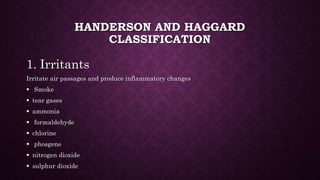
HANDERSON AND HAGGARD
CLASSIFICATION
1. Irritants
Irritate air passages and produce inflammatory changes
 Smoke
 tear gases
 ammonia
 formaldehyde
 chlorine
 phosgene
 nitrogen dioxide
 sulphur dioxide
2. Chemical asphyxiants
Inrerrupt with either delivery or utilization of oxygen
 Carbon monoxide
 Cyanide
 hydrogen sulphide etc.
3 . Simple asphyxiant
Inert gases
When breathed in hight concentration displaces oxygen in alveoli .
Clinical effect due to hypoxia
 carbon dioxide,
 methane,
 helium,
 nitrogen,
 nitrous oxide
4. Volatile -
act after getting absorbed in blood either as anaesthetic or agent toxic to liver , kidney
or other organ.
 Aliphatic hydrocarbon
 halogenated hydrocarbon
 aromatic htdrocarbon .
5. Systemic –
These are insecticide,arsine, stibine .
CARBON MONOXIDE
PROPERTIES –
• Colorless
• Tasteless
• Non-irritating gas
• Lighter than air
• burns with blue flame
• Produced due to incomplete combustion of carbon
• Mostly accidental poisoning
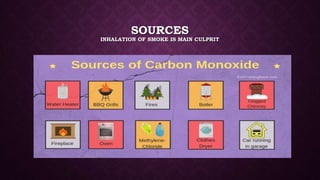
SOURCES
INHALATION OF SMOKE IS MAIN CULPRIT
MECHANISM OF ACTION
 Hemoglobin – it has 240 times more affinity for haemoglobin as compared to oxygen
 It binds with haemoglobin to form CARBOXYHAEMOGLOBIN .
 Reduce total oxygen carrying capacity of blood .
 Myoglobin – it has 40 times more affinity than oxygen (decreasing its oxygen
storage capacity)
 Mitochondrial –inhibit cytochrome a3 oxidase & cytochrome p 450 thereby
inhibiting cellular respiration.
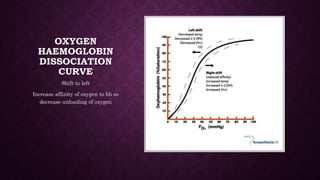
OXYGEN
HAEMOGLOBIN
DISSOCIATION
CURVE
Shift to left
Increase affinity of oxygen to hb so
decrease unloading of oxygen
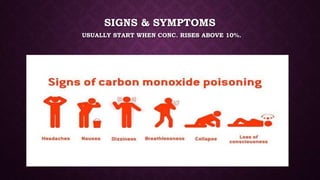
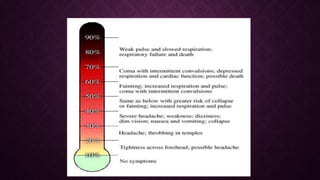
SIGNS & SYMPTOMS
USUALLY START WHEN CONC. RISES ABOVE 10%.
LATE COMPLICATIONS
• Personality disorder
• Short term memory loss
• Parkinsonism
• depression
TREATMENT
1. First aid is to immediately remove the victim from the exposure
2. CPR if needed.

3. Firstline of treatmentis100% Oxygen immediately, till the COHb level returns to normal.
4. Hyperbaric Oxygen
• Half life with
1. 21% oxygen=4 – 5 hours
2. 100% oxygen=80 – 90 min
3. Hyperbaric oxygen=30 min
Indications for hyperbaric oxygen
1) If COHb is more than 40 gm/100gm of Hb
2) If he is unconscious
3) If Cyanosed
4) If female is pregnant,because clearance of CO in Foetal Carboxy Hb is slower than adult Hb
5) If suffering from some other illness
OTHER IMPORTANT POINTS
• Saturation required to cause the death varies with age and the health. Death usually
occurs when 80% of Hb is saturated with CO.
• Senility / co-existing respiratory or circulatory diseases / anaemia / in association with
CNS depressant drugs like barbiturates, alcohol result in significant decrease in the
lethal saturation of the COHb & death can occur from as little as 30% saturation.
• CO can cross the maternal blood to foetal blood & may cause IUD of the foetus.
• Physical activity increases the rate of saturation.
• Children saturate their blood more rapidly than adults because of their rapid rate of
respiratory exchange.
POST MORTEM CHANGES
External
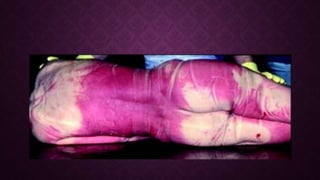
1. Cherry red color of skin, mucous membrane , comjunctiva , nail beds, hypostasis .
2. Cutaneous bullae
Internal
1.Cherry red color of blood n tissues
2. Pulmonary n cerebral edema
3. Necrosis n cavitation of basal ganglia, globus pallidus
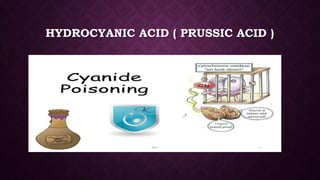
HYDROCYANIC ACID ( PRUSSIC ACID )
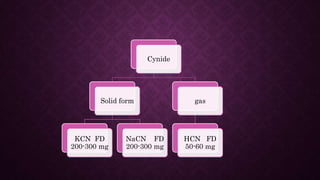
Cynide
Solid form
KCN FD
200-300 mg
NaCN FD
200-300 mg
gas
HCN FD
50-60 mg
PROPERTIES
• vegetable acid (distributed in many fruits n leaves) in the form of harmless glucoside
amygdalin
• colorless gas or pale blue, highly volatile liquid
• has a faint, bitter almond-like odor
• Other names - Hydrocyanic acid ,Prussic acid, Formonitrile,Formic anammonide
Carbon hydride nitride, Cyanane,Cyclon
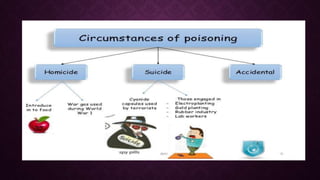
ROUTE OF POISONING
• Inhalation – cyanide gas
• Ingestion – KCN, NaCN – in acidic ph of stomach get concerted to HOCL & and
become poisonous
• Skin absorption
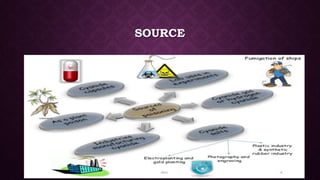
SOURCE
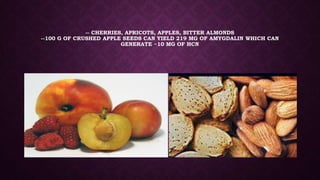
-- CHERRIES, APRICOTS, APPLES, BITTER ALMONDS
--100 G OF CRUSHED APPLE SEEDS CAN YIELD 219 MG OF AMYGDALIN WHICH CAN
GENERATE ~10 MG OF HCN
MECHANISM OF ACTION
• HCN has no affinity for Oxygen. Thus at in the lungs HbO2 is formed as usual.
• Both HbO2 and HCN reaches at tissue level.
• HCN has strong affinity for Cytochrome Oxidase. So at tissue level it forms
cytochrome Oxidase Cyanide complex.
• Cellular transport of oxygen is blocked causing tissue hypoxia, causing cell death.
HISTOTOXIC ANOXIA
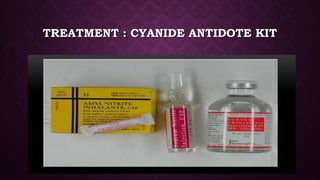
TREATMENT : CYANIDE ANTIDOTE KIT
• First Aid
• Immediate Amyl Nitrate inhalation:- Amyl nitrate capsule is broken & spread over
the handkerchief and patient is given the inhalation for 15 -30 seconds. This process
must be repeated after every 2-3 minutes, until the capsule is exhausted.
• Amyl nitrite converts Hb to Meth hemoglobin.
• Meth Hb has more affinity to CN than Cytochrome Oxidase. So Cyn- meth-
Hemoglobin complex is formed and cytochrome oxidase is released, and cellular
oxygenation will start again.
• Cyn-Meth-Haemoglobin is toxic.
• Sodium Thiosulphate is given IV. Sodium Thiosulphate is a Sulpher Donor,
combines with Cyn-Meth-Haemoglobin to form Thiocyanate, which is nontoxic and
is excreted through urine.
• VIT B12 iv infusion – hydroxycobalamine contain cobalt which binds with cyanide
with more affinity than cytochrome oxidase to form cynocobalamine which is less
toxic and get excreted in urine .
• EDTA chelating agent
POST MORTEM CHANGES
External
• Odor of bitter almonds
• Brick red color of skin and mucous membranes
• Cyanosis of extremities
• Froth at mouth and nostrils
Internal
• stomach mucosa red &congested
• Pulmonary and cerebral edema
• Disseminated petechiae in brain, meninges, pleura, lungs, and pericardium
HYDROGEN SULPHIDE
Properties –
• Colourless
• heavy
• flammable gas
• Rotten egg odour
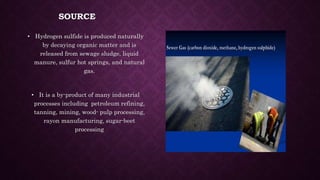
SOURCE
• Hydrogen sulfide is produced naturally
by decaying organic matter and is
released from sewage sludge, liquid
manure, sulfur hot springs, and natural
gas.
• It is a by-product of many industrial
processes including petroleum refining,
tanning, mining, wood- pulp processing,
rayon manufacturing, sugar-beet
processing
MECHANISM OF ACTION
• Exposure of hydrogen sulphide is mainly by inhalation .
• Inhibit cytochrome oxidase thereby inhibiting oxidative phosphorylation
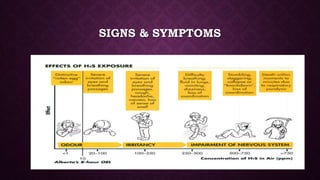
SIGNS & SYMPTOMS
TREATMENT
• Remove patient from site of exposure and take him to fresh air
• Artificial respiration & 100 % oxygen given
• Amyl nitrate and sodium nitrate given to form less toxic sulphahaemoglobin .
Which is less toxic & can easily be excreted through kidney .
POST MORTEM CHANGES
• Rotten egg smell
• Signs of asphyxia
• Viscera – greenish purple
CARBON DIOXIDE
• Heavy colorless gas with a faintly sweet odour
• Act as simple asphyxiant by preventing the tissue from obtaining oxygen
• SOURCES- produced by complete combustion of carbon containing compounds
decomposition of organic matter
manholes, wells
mine explosions
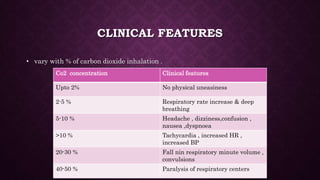
CLINICAL FEATURES
• vary with % of carbon dioxide inhalation .
Co2 concentration Clinical features
Upto 2% No physical uneasiness
2-5 % Respiratory rate increase & deep
breathing
5-10 % Headache , dizziness,confusion ,
nausea ,dyspnoea
>10 % Tachycardia , increased HR ,
increased BP
20-30 % Fall nin respiratory minute volume ,
convulsions
40-50 % Paralysis of respiratory centers
TREATMENT
• Administer oxygen
• Supportive treatment
POST MORTEM FINDINGS
• Cyanosis
• Froth at mouth or nostrils
• Congestion
• Petechial haemorrhages
METHYL ISOCYNATE
• Stable liquid below 27c, gaseous at 31c
• Highly volatile n inflammable
• Used in manufacture of carbamate pesticides, adhesives n plastic
• The Bhopal disaster was an industrial disaster that occurred in the city of Bhopal
(1984)A pesticide plant released 40 tones of methyl isocyanate (MIC) gas.
MECHANISM OF ACTION
• Causes carbamylation at biochemical level
• Irritant action on skin , eyes & mucous membrane
CLINICAL FEATURES
• Lacrimation chest pain
• Irritation of eyes hemoptysis
• Blurring of vision pulmonary edema
• Photophobia convulsions
• Corneal ulceration coma
• Cough death
• Dyspnea
• Dermal- erythema, rashes
MANAGEMENT
• Decontamination of skin & eyes
• Oxygen administration
• Bronchodilators & steroids
• Supportive treatment
POST MORTEM FINDINGS
• Signs of asphyxia
• Pulmonary edema ( increased weight of lung 2-3 times normal )
• Cerebral edema
• Visceral congestion
PHOSGENE
• colourless gas,
• heavier than air,
• odour of freshly-cut hay.
• it is hydrolysed in the body to hydrochloric acid which produces a systemic
inflammatory response .
• Also stimulates the synthesis of lipoxygenase-derived leukotrienes causing pulmonary
oedema.
• it increases pulmonary vascular permeability, leading to increased fluid accumulation in
the interstitial and alveolar compartments
Asphyxiants

Asphyxiants

  • 1.
  • 2.
    • Asphyxiants aregases that deprive body tissues of oxygen.
  • 3.
    HANDERSON AND HAGGARD CLASSIFICATION 1.Irritants Irritate air passages and produce inflammatory changes  Smoke  tear gases  ammonia  formaldehyde  chlorine  phosgene  nitrogen dioxide  sulphur dioxide
  • 4.
    2. Chemical asphyxiants Inrerruptwith either delivery or utilization of oxygen  Carbon monoxide  Cyanide  hydrogen sulphide etc.
  • 5.
    3 . Simpleasphyxiant Inert gases When breathed in hight concentration displaces oxygen in alveoli . Clinical effect due to hypoxia  carbon dioxide,  methane,  helium,  nitrogen,  nitrous oxide
  • 6.
    4. Volatile - actafter getting absorbed in blood either as anaesthetic or agent toxic to liver , kidney or other organ.  Aliphatic hydrocarbon  halogenated hydrocarbon  aromatic htdrocarbon . 5. Systemic – These are insecticide,arsine, stibine .
  • 7.
    CARBON MONOXIDE PROPERTIES – •Colorless • Tasteless • Non-irritating gas • Lighter than air • burns with blue flame • Produced due to incomplete combustion of carbon • Mostly accidental poisoning
  • 8.
  • 9.
    MECHANISM OF ACTION Hemoglobin – it has 240 times more affinity for haemoglobin as compared to oxygen  It binds with haemoglobin to form CARBOXYHAEMOGLOBIN .  Reduce total oxygen carrying capacity of blood .  Myoglobin – it has 40 times more affinity than oxygen (decreasing its oxygen storage capacity)  Mitochondrial –inhibit cytochrome a3 oxidase & cytochrome p 450 thereby inhibiting cellular respiration.
  • 10.
    OXYGEN HAEMOGLOBIN DISSOCIATION CURVE Shift to left Increaseaffinity of oxygen to hb so decrease unloading of oxygen
  • 11.
    SIGNS & SYMPTOMS USUALLYSTART WHEN CONC. RISES ABOVE 10%.
  • 13.
    LATE COMPLICATIONS • Personalitydisorder • Short term memory loss • Parkinsonism • depression
  • 14.
    TREATMENT 1. First aidis to immediately remove the victim from the exposure 2. CPR if needed. 3. Firstline of treatmentis100% Oxygen immediately, till the COHb level returns to normal. 4. Hyperbaric Oxygen • Half life with 1. 21% oxygen=4 – 5 hours 2. 100% oxygen=80 – 90 min 3. Hyperbaric oxygen=30 min Indications for hyperbaric oxygen 1) If COHb is more than 40 gm/100gm of Hb 2) If he is unconscious 3) If Cyanosed 4) If female is pregnant,because clearance of CO in Foetal Carboxy Hb is slower than adult Hb 5) If suffering from some other illness
  • 15.
    OTHER IMPORTANT POINTS •Saturation required to cause the death varies with age and the health. Death usually occurs when 80% of Hb is saturated with CO. • Senility / co-existing respiratory or circulatory diseases / anaemia / in association with CNS depressant drugs like barbiturates, alcohol result in significant decrease in the lethal saturation of the COHb & death can occur from as little as 30% saturation. • CO can cross the maternal blood to foetal blood & may cause IUD of the foetus. • Physical activity increases the rate of saturation. • Children saturate their blood more rapidly than adults because of their rapid rate of respiratory exchange.
  • 16.
    POST MORTEM CHANGES External 1.Cherry red color of skin, mucous membrane , comjunctiva , nail beds, hypostasis . 2. Cutaneous bullae Internal 1.Cherry red color of blood n tissues 2. Pulmonary n cerebral edema 3. Necrosis n cavitation of basal ganglia, globus pallidus
  • 18.
    HYDROCYANIC ACID (PRUSSIC ACID )
  • 19.
    Cynide Solid form KCN FD 200-300mg NaCN FD 200-300 mg gas HCN FD 50-60 mg
  • 20.
    PROPERTIES • vegetable acid(distributed in many fruits n leaves) in the form of harmless glucoside amygdalin • colorless gas or pale blue, highly volatile liquid • has a faint, bitter almond-like odor • Other names - Hydrocyanic acid ,Prussic acid, Formonitrile,Formic anammonide Carbon hydride nitride, Cyanane,Cyclon
  • 21.
    ROUTE OF POISONING •Inhalation – cyanide gas • Ingestion – KCN, NaCN – in acidic ph of stomach get concerted to HOCL & and become poisonous • Skin absorption
  • 22.
  • 23.
    -- CHERRIES, APRICOTS,APPLES, BITTER ALMONDS --100 G OF CRUSHED APPLE SEEDS CAN YIELD 219 MG OF AMYGDALIN WHICH CAN GENERATE ~10 MG OF HCN
  • 25.
    MECHANISM OF ACTION •HCN has no affinity for Oxygen. Thus at in the lungs HbO2 is formed as usual. • Both HbO2 and HCN reaches at tissue level. • HCN has strong affinity for Cytochrome Oxidase. So at tissue level it forms cytochrome Oxidase Cyanide complex. • Cellular transport of oxygen is blocked causing tissue hypoxia, causing cell death. HISTOTOXIC ANOXIA
  • 27.
    TREATMENT : CYANIDEANTIDOTE KIT
  • 28.
    • First Aid •Immediate Amyl Nitrate inhalation:- Amyl nitrate capsule is broken & spread over the handkerchief and patient is given the inhalation for 15 -30 seconds. This process must be repeated after every 2-3 minutes, until the capsule is exhausted. • Amyl nitrite converts Hb to Meth hemoglobin. • Meth Hb has more affinity to CN than Cytochrome Oxidase. So Cyn- meth- Hemoglobin complex is formed and cytochrome oxidase is released, and cellular oxygenation will start again.
  • 29.
    • Cyn-Meth-Haemoglobin istoxic. • Sodium Thiosulphate is given IV. Sodium Thiosulphate is a Sulpher Donor, combines with Cyn-Meth-Haemoglobin to form Thiocyanate, which is nontoxic and is excreted through urine. • VIT B12 iv infusion – hydroxycobalamine contain cobalt which binds with cyanide with more affinity than cytochrome oxidase to form cynocobalamine which is less toxic and get excreted in urine . • EDTA chelating agent
  • 30.
    POST MORTEM CHANGES External •Odor of bitter almonds • Brick red color of skin and mucous membranes • Cyanosis of extremities • Froth at mouth and nostrils Internal • stomach mucosa red &congested • Pulmonary and cerebral edema • Disseminated petechiae in brain, meninges, pleura, lungs, and pericardium
  • 31.
    HYDROGEN SULPHIDE Properties – •Colourless • heavy • flammable gas • Rotten egg odour
  • 32.
    SOURCE • Hydrogen sulfideis produced naturally by decaying organic matter and is released from sewage sludge, liquid manure, sulfur hot springs, and natural gas. • It is a by-product of many industrial processes including petroleum refining, tanning, mining, wood- pulp processing, rayon manufacturing, sugar-beet processing
  • 33.
    MECHANISM OF ACTION •Exposure of hydrogen sulphide is mainly by inhalation . • Inhibit cytochrome oxidase thereby inhibiting oxidative phosphorylation
  • 34.
  • 35.
    TREATMENT • Remove patientfrom site of exposure and take him to fresh air • Artificial respiration & 100 % oxygen given • Amyl nitrate and sodium nitrate given to form less toxic sulphahaemoglobin . Which is less toxic & can easily be excreted through kidney .
  • 36.
    POST MORTEM CHANGES •Rotten egg smell • Signs of asphyxia • Viscera – greenish purple
  • 37.
    CARBON DIOXIDE • Heavycolorless gas with a faintly sweet odour • Act as simple asphyxiant by preventing the tissue from obtaining oxygen • SOURCES- produced by complete combustion of carbon containing compounds decomposition of organic matter manholes, wells mine explosions
  • 38.
    CLINICAL FEATURES • varywith % of carbon dioxide inhalation . Co2 concentration Clinical features Upto 2% No physical uneasiness 2-5 % Respiratory rate increase & deep breathing 5-10 % Headache , dizziness,confusion , nausea ,dyspnoea >10 % Tachycardia , increased HR , increased BP 20-30 % Fall nin respiratory minute volume , convulsions 40-50 % Paralysis of respiratory centers
  • 39.
  • 40.
    POST MORTEM FINDINGS •Cyanosis • Froth at mouth or nostrils • Congestion • Petechial haemorrhages
  • 41.
    METHYL ISOCYNATE • Stableliquid below 27c, gaseous at 31c • Highly volatile n inflammable • Used in manufacture of carbamate pesticides, adhesives n plastic • The Bhopal disaster was an industrial disaster that occurred in the city of Bhopal (1984)A pesticide plant released 40 tones of methyl isocyanate (MIC) gas.
  • 42.
    MECHANISM OF ACTION •Causes carbamylation at biochemical level • Irritant action on skin , eyes & mucous membrane
  • 43.
    CLINICAL FEATURES • Lacrimationchest pain • Irritation of eyes hemoptysis • Blurring of vision pulmonary edema • Photophobia convulsions • Corneal ulceration coma • Cough death • Dyspnea • Dermal- erythema, rashes
  • 44.
    MANAGEMENT • Decontamination ofskin & eyes • Oxygen administration • Bronchodilators & steroids • Supportive treatment
  • 45.
    POST MORTEM FINDINGS •Signs of asphyxia • Pulmonary edema ( increased weight of lung 2-3 times normal ) • Cerebral edema • Visceral congestion
  • 46.
    PHOSGENE • colourless gas, •heavier than air, • odour of freshly-cut hay. • it is hydrolysed in the body to hydrochloric acid which produces a systemic inflammatory response . • Also stimulates the synthesis of lipoxygenase-derived leukotrienes causing pulmonary oedema. • it increases pulmonary vascular permeability, leading to increased fluid accumulation in the interstitial and alveolar compartments