Facebook & Blackboard Comparison of learner perspectives 29 May 2009
Introduction The team: Patrick Parslow, Shirley Williams, Michael Evans, Karsten  Ø ster Lundqvist, Edwin Porter-Daniels, Robert Ashton Contact details: [email_address] Domain : All surveys conducted at University of Reading
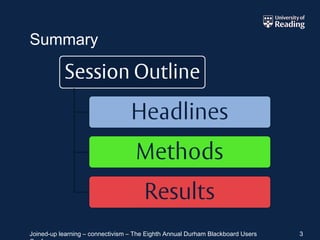
Summary
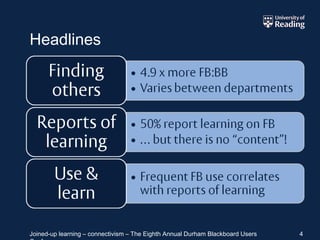
Headlines
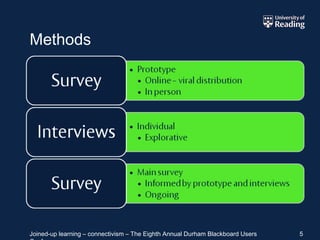
Methods
Results “ What do you think would make a good eLearning environment?” “ Something that doesn't detract from a physical learning environment.” “ An education into how to use and what e-learning is attempting to achieve” “ Fun and easy to use” “ accurate information”
Results “ What do you think would make a good eLearning environment?” “ E-mail” “ An easily accessible website, for students doing the same course(s), not necessarily from the same institution.” “ I think blackboard is ideal really.” “ nothing, teaching is best done in the classroom, face to face. eLearning is silly.”
Results More from the comments and interviews: eLearning environment needs to be widely used to be useful Consistency between modules and interfaces More discussion groups Privacy, within group and sometimes excluding lecturer Trust is an issue Separation of academia and social matters
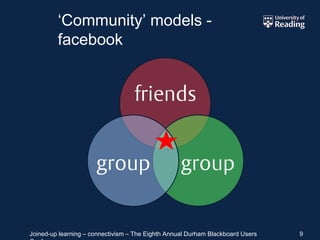
‘ Community’ models - facebook
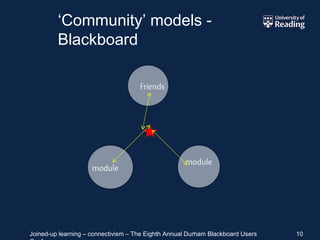
‘ Community’ models - Blackboard
Results – connecting to people Students 5 times more likely to find peers on Facebook than on UoR Blackboard Marked gender difference found in prototype survey  not  supported by results of full survey so far Strongest correlations with departments (for FB) Chemistry and Human & Environmental Science -ve correlation with Health & Social care, and Biological Science Appears unrelated to gender May be related to active social groups in departments
Why is connecting important? Connectivism Rapidly changing knowledge landscape Short half-life of information Important to have a network of information sources Collaboration Many heads are better than one Synergy Inter-disciplinary cross fertilization Constructivism Learn better if creating things others will see/use
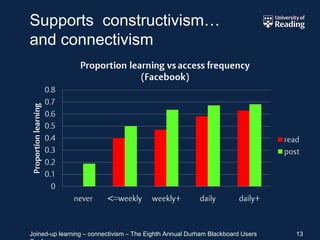
Supports  constructivism… and connectivism
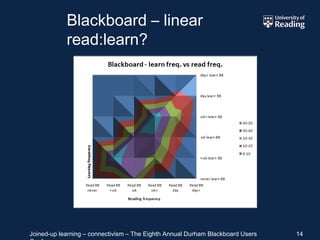
Blackboard – linear read:learn?
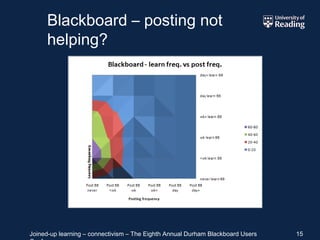
Blackboard – posting not helping?
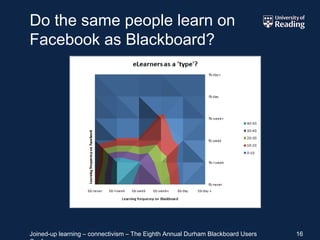
Do the same people learn on  Facebook as Blackboard?
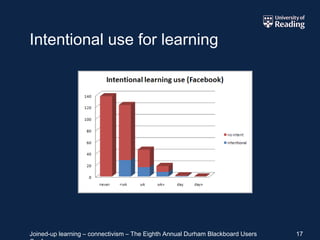
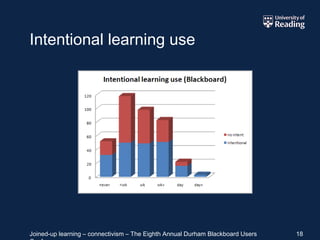
Intentional use for learning
Intentional learning use
Conclusions Learners will learn through social networking Even in the absence of course materials There may be a eLearner  role Those who learn both through the VLE and other tools Intentional use of tools improves outcomes At least in terms of frequency Something about UoR use of Blackboard seems to inhibit 1 in 6 intending to learn by using it never do
Thank you Any Questions?

Facebook Blackboard

  • 1.
    Facebook & BlackboardComparison of learner perspectives 29 May 2009
  • 2.
    Introduction The team:Patrick Parslow, Shirley Williams, Michael Evans, Karsten Ø ster Lundqvist, Edwin Porter-Daniels, Robert Ashton Contact details: [email_address] Domain : All surveys conducted at University of Reading
  • 3.
  • 4.
  • 5.
  • 6.
    Results “ Whatdo you think would make a good eLearning environment?” “ Something that doesn't detract from a physical learning environment.” “ An education into how to use and what e-learning is attempting to achieve” “ Fun and easy to use” “ accurate information”
  • 7.
    Results “ Whatdo you think would make a good eLearning environment?” “ E-mail” “ An easily accessible website, for students doing the same course(s), not necessarily from the same institution.” “ I think blackboard is ideal really.” “ nothing, teaching is best done in the classroom, face to face. eLearning is silly.”
  • 8.
    Results More fromthe comments and interviews: eLearning environment needs to be widely used to be useful Consistency between modules and interfaces More discussion groups Privacy, within group and sometimes excluding lecturer Trust is an issue Separation of academia and social matters
  • 9.
  • 10.
  • 11.
    Results – connectingto people Students 5 times more likely to find peers on Facebook than on UoR Blackboard Marked gender difference found in prototype survey not supported by results of full survey so far Strongest correlations with departments (for FB) Chemistry and Human & Environmental Science -ve correlation with Health & Social care, and Biological Science Appears unrelated to gender May be related to active social groups in departments
  • 12.
    Why is connectingimportant? Connectivism Rapidly changing knowledge landscape Short half-life of information Important to have a network of information sources Collaboration Many heads are better than one Synergy Inter-disciplinary cross fertilization Constructivism Learn better if creating things others will see/use
  • 13.
  • 14.
  • 15.
  • 16.
    Do the samepeople learn on Facebook as Blackboard?
  • 17.
  • 18.
  • 19.
    Conclusions Learners willlearn through social networking Even in the absence of course materials There may be a eLearner role Those who learn both through the VLE and other tools Intentional use of tools improves outcomes At least in terms of frequency Something about UoR use of Blackboard seems to inhibit 1 in 6 intending to learn by using it never do
  • 20.
    Thank you AnyQuestions?