Activity theory applied to a connectivist environment for second language
acquisition in a social networking site.
____________________________________________________________________
Vera Leier
German Programme
XVIth International CALL Research Conference RESEARCH CHALLENGES IN CALL, Antwerp 2014
• Facebook use in a foreign language classroom: examples
and observations
• Activity theory as a descriptive and analytical tool
• Activity system’s constraints identified & implications
Outline
• How do students perceive the integration of FB into their curriculum?
• How do students perceive the integration of FB into their assessment?
• How is FB best used in the German language classroom?
• How do students respond to teacher participation?
• What level of feedback do students expect and approve of?
Research questions:
• Context: intermediate German language class (Grmn251):
24 students, mostly English native speakers. Use of a
Facebook group.
• Goal: to develop a closer community and more cultural
awareness of the target language (L2). Use of newly
introduced vocabulary.
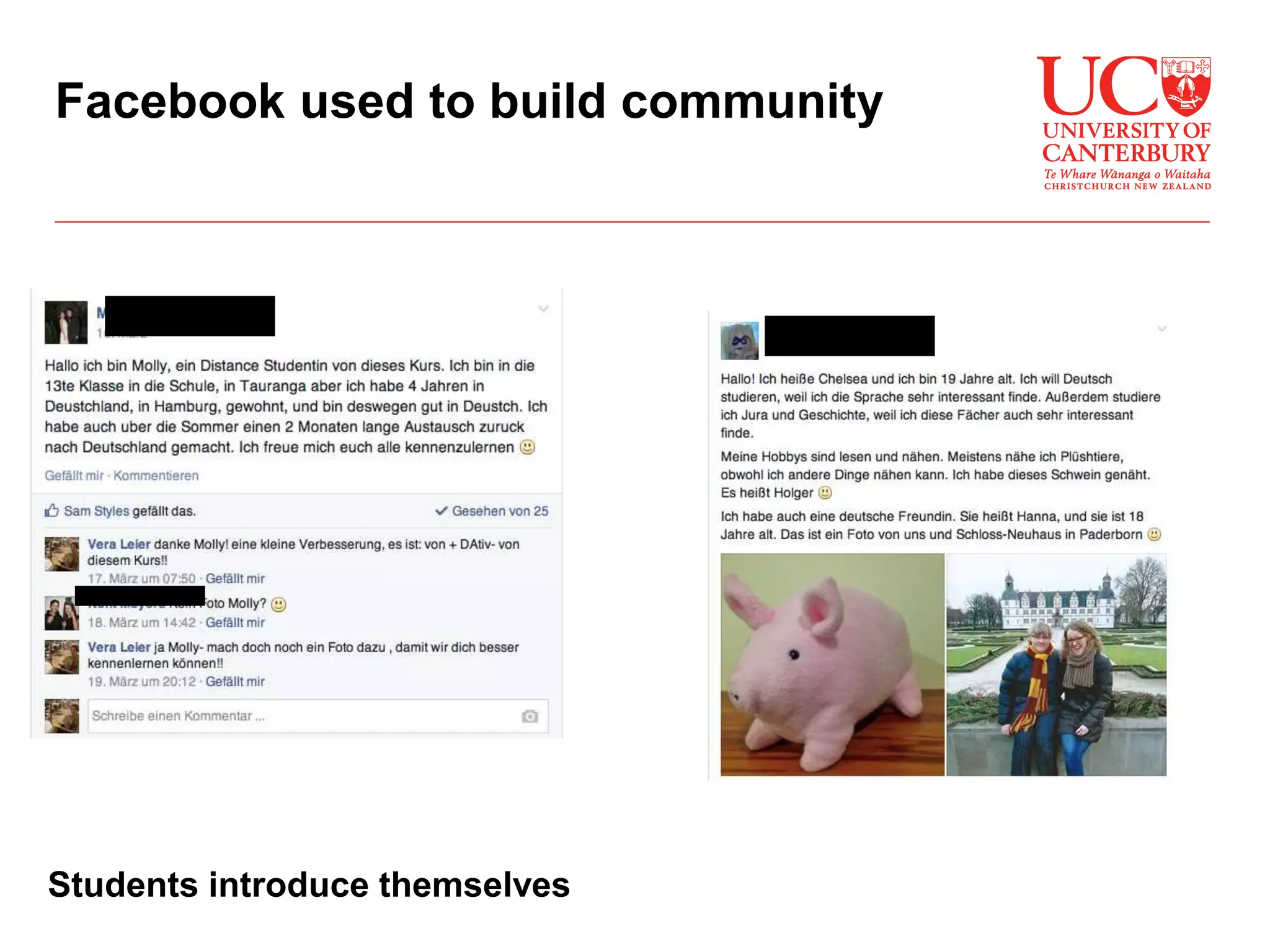
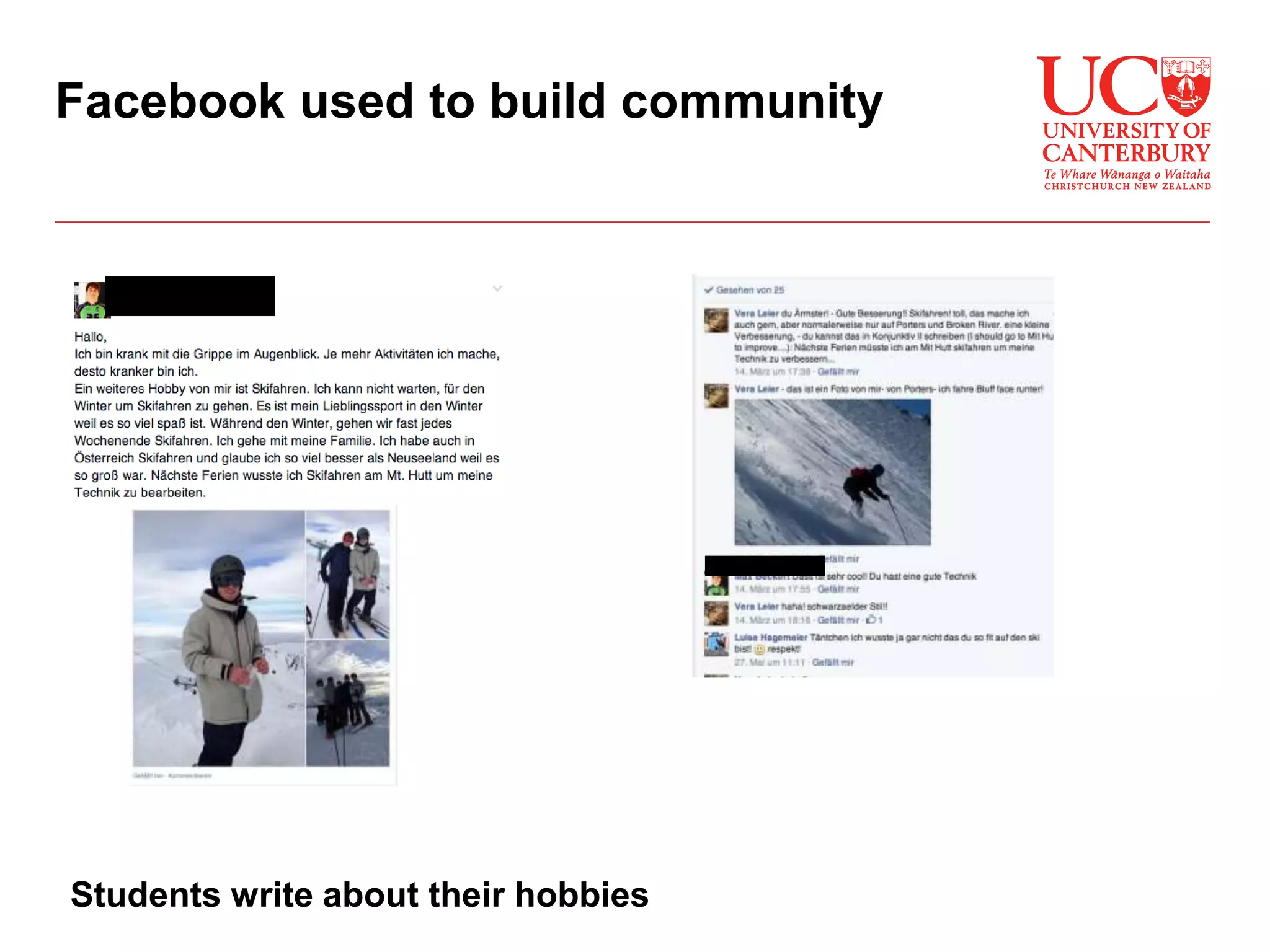
• Activities : 8% of course assessment: 8 posts: students’
personal introductions, posts about their hobbies, about
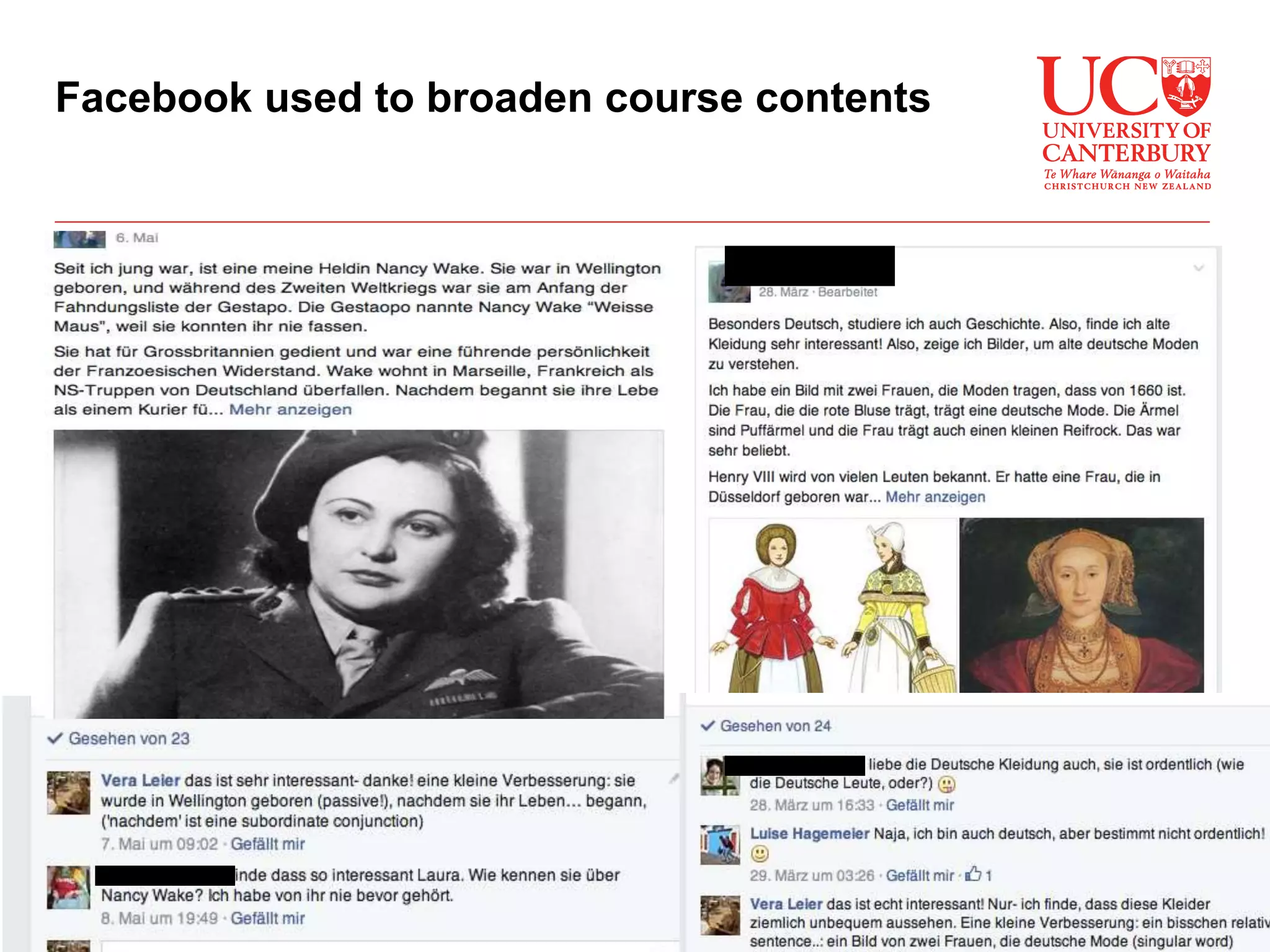
films and music in Germany, information about course
related topics (new- 2014)
My research and Facebook use (2013-2014)
Facebook used to build community
Students introduce themselves
Facebook used to build community
Students write about their hobbies
Facebook used to broaden course contents
• All students contributed with presentations.
• Language use was sometimes not accurate but
production was more than expected.
Implications:
• Learners can learn new discourse types and registers (eg.
everyday conversation) not usually accessible in the
language classroom.
• Authentic language use in a sheltered environment.
Observations
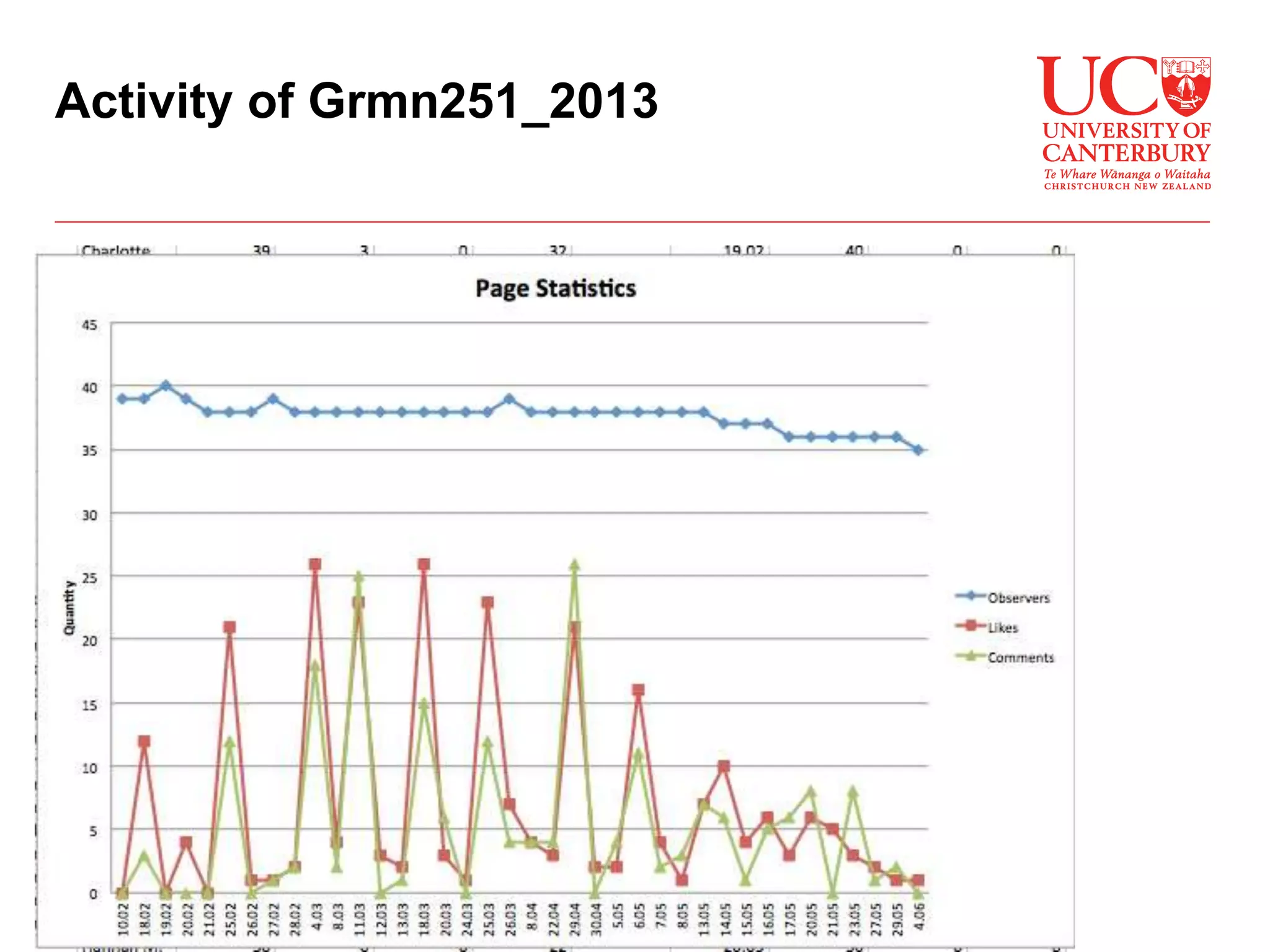
Activity of Grmn251_2013
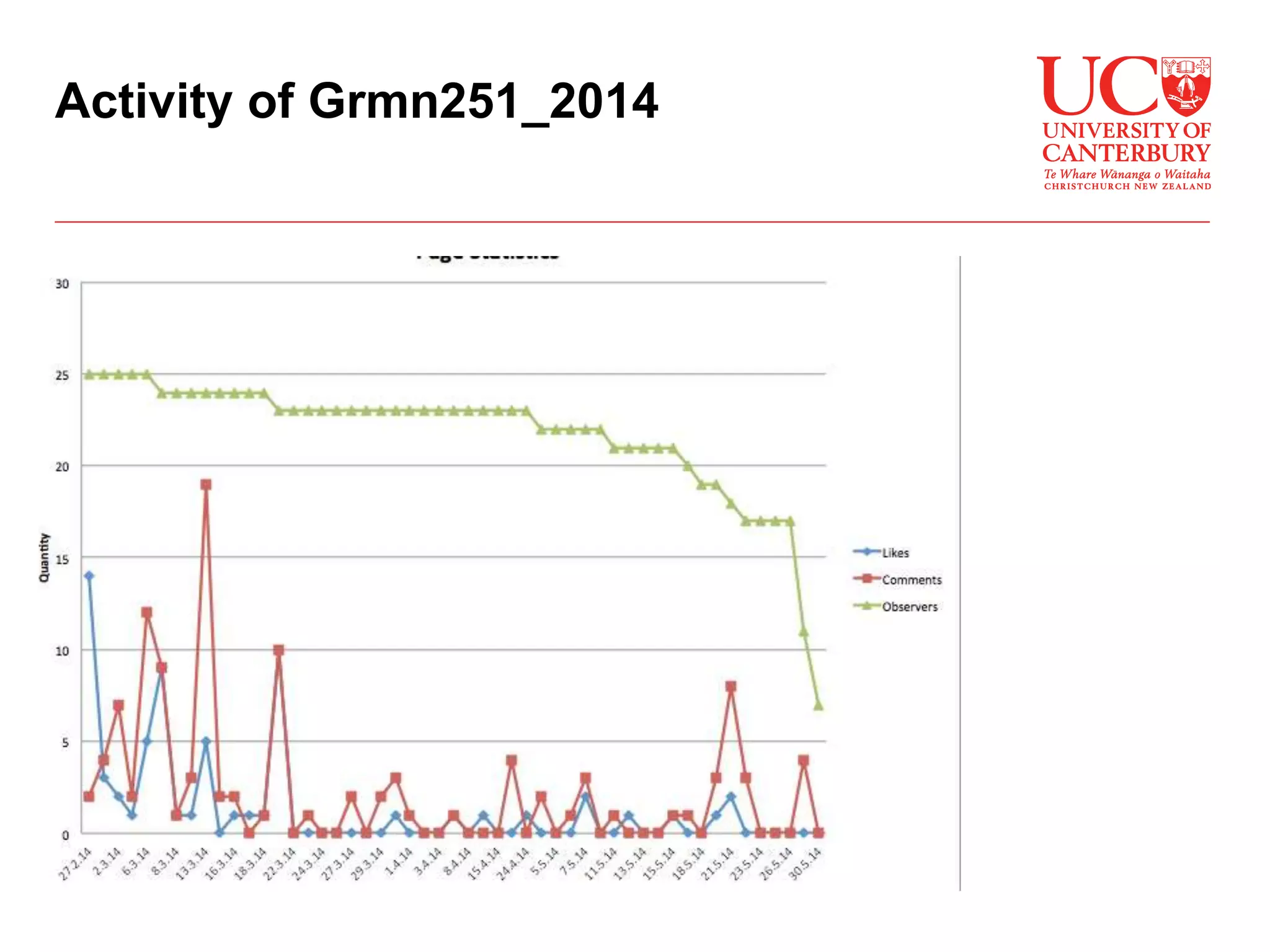
Activity of Grmn251_2014
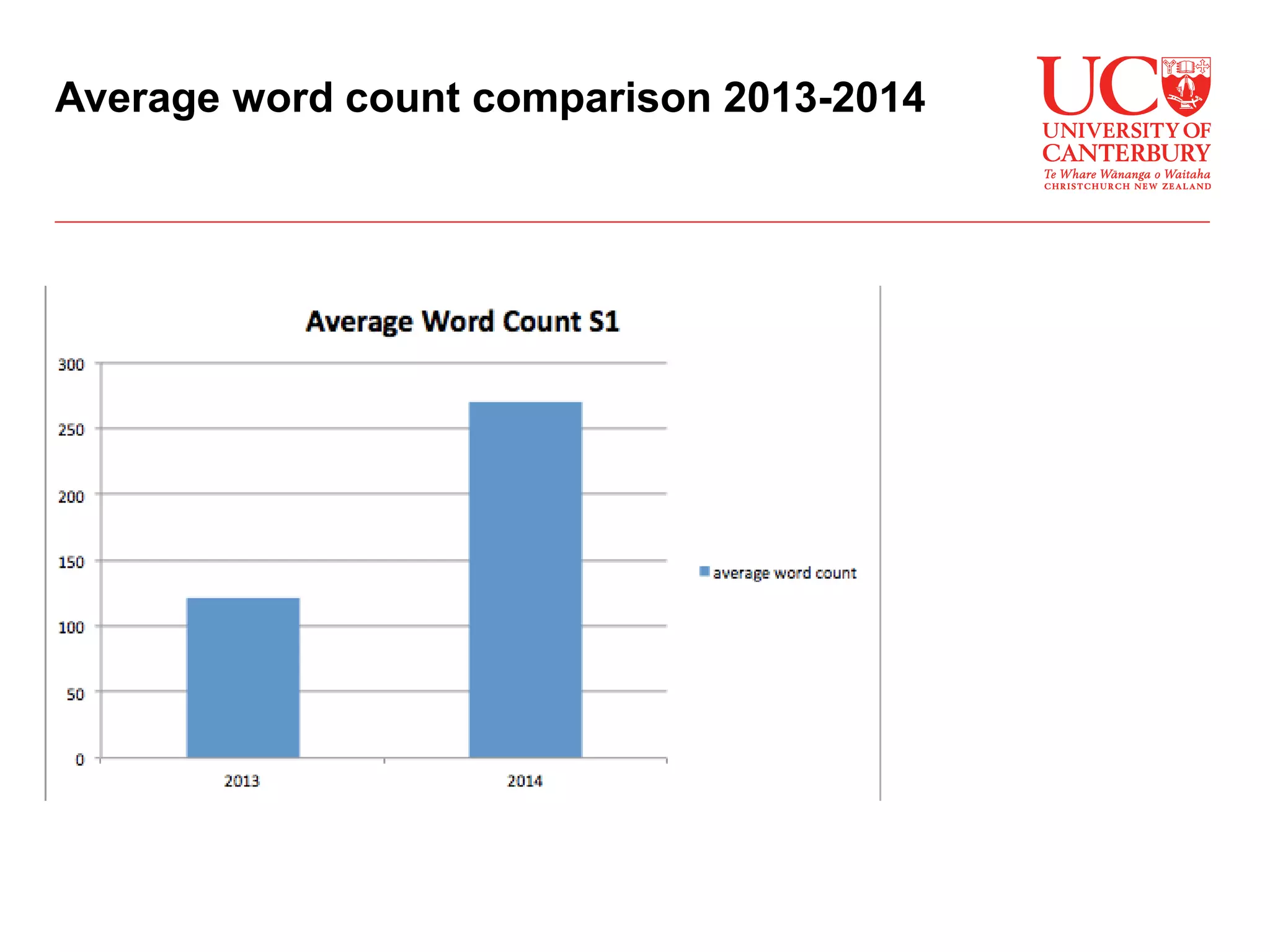
Average word count comparison 2013-2014
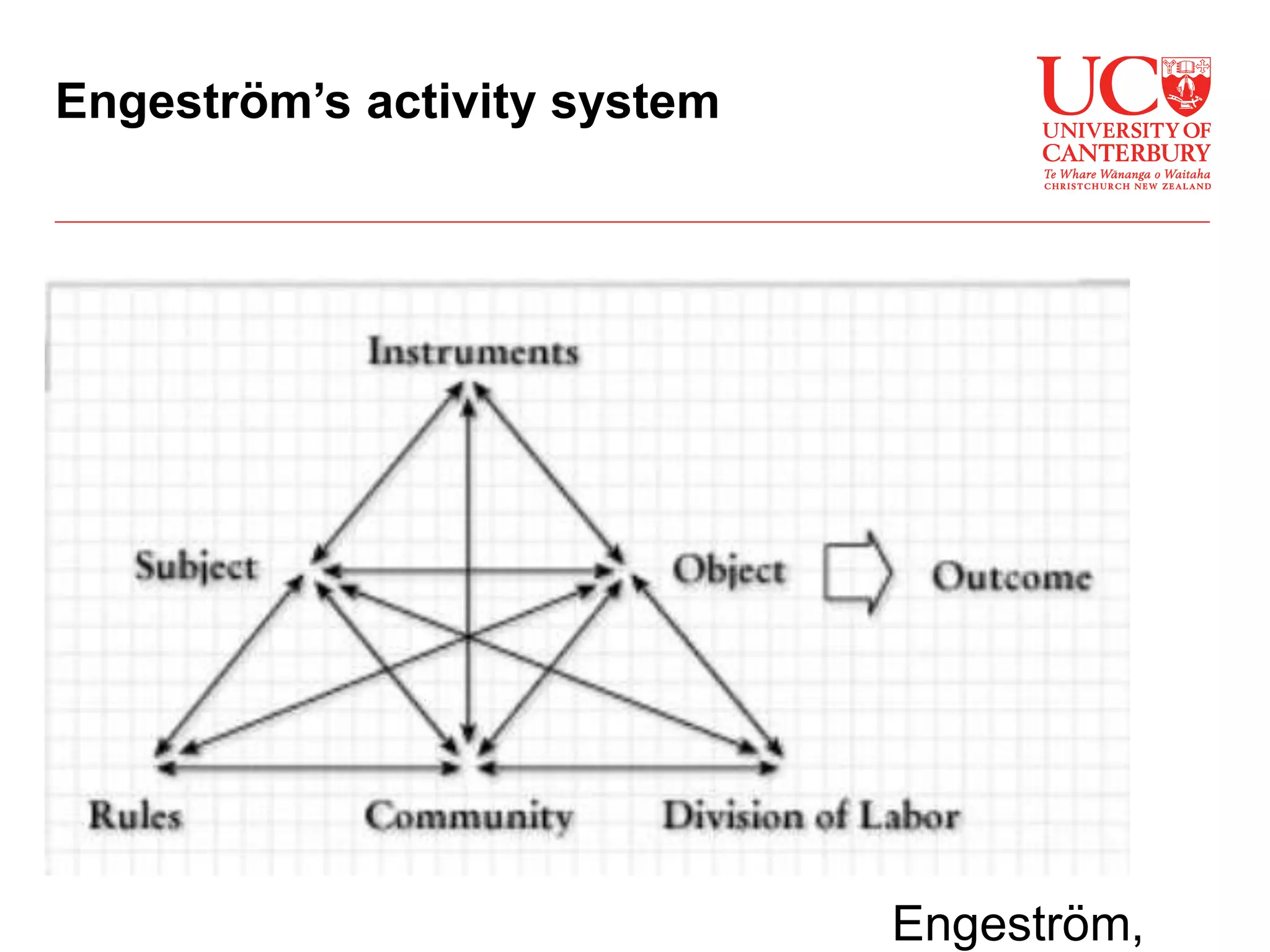
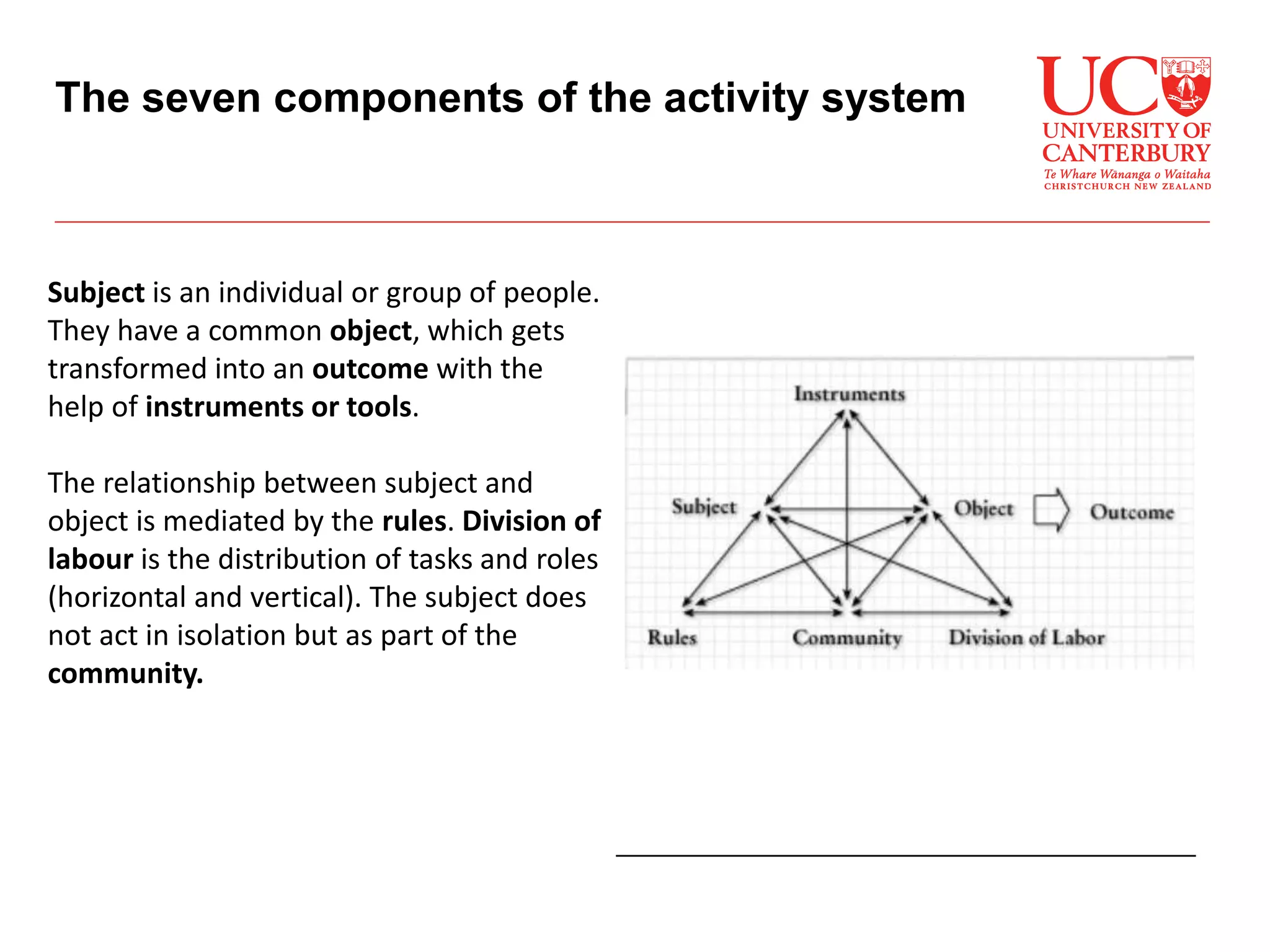
Engeström’s activity system
Engeström,
The seven components of the activity system
Subject is an individual or group of people.
They have a common object, which gets
transformed into an outcome with the
help of instruments or tools.
The relationship between subject and
object is mediated by the rules. Division of
labour is the distribution of tasks and roles
(horizontal and vertical). The subject does
not act in isolation but as part of the
community.
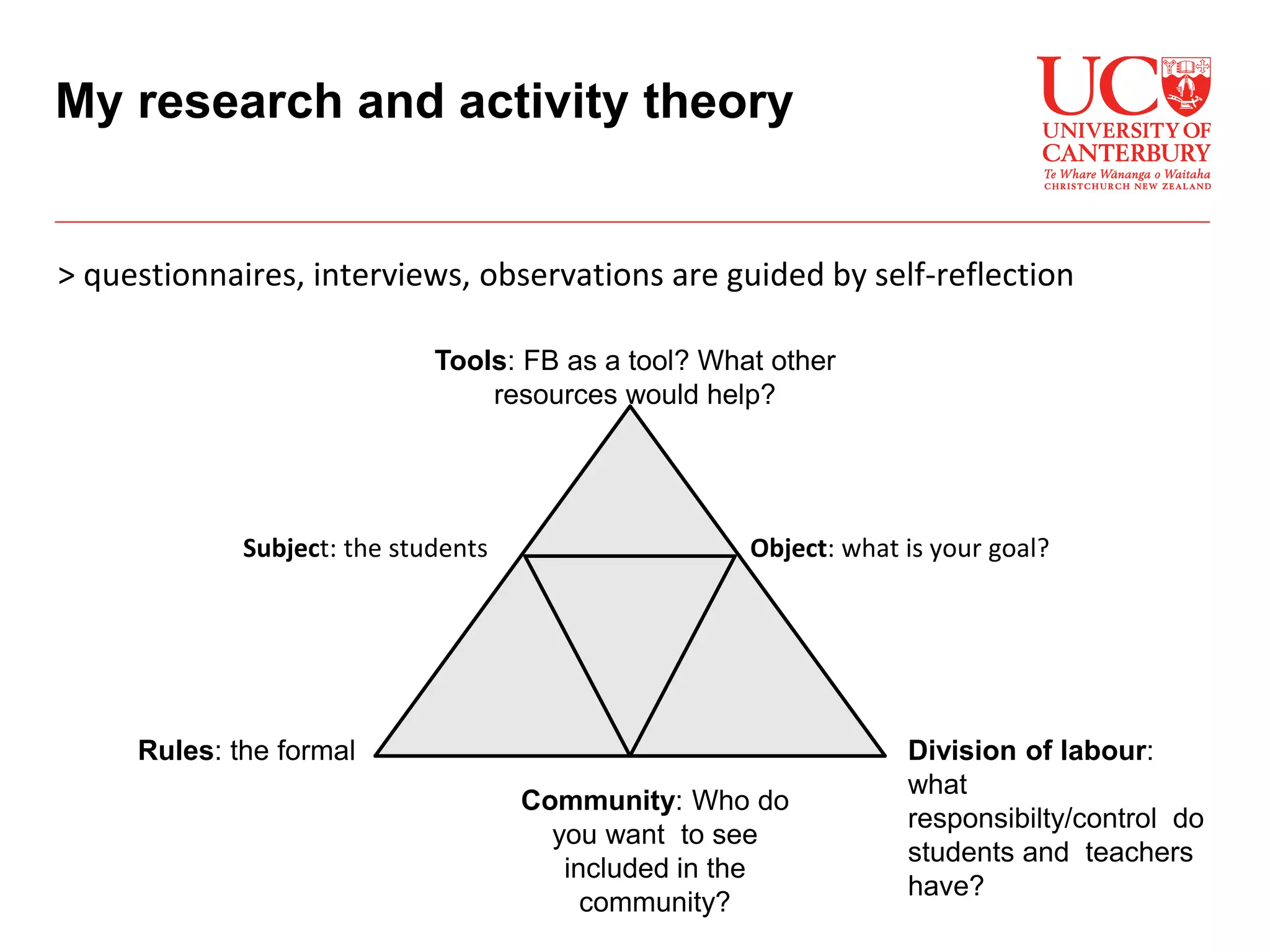
> questionnaires, interviews, observations are guided by self-reflection
Subject: the students Object: what is your goal?
My research and activity theory
Tools: FB as a tool? What other
resources would help?
Rules: the formal
Community: Who do
you want to see
included in the
community?
Division of labour:
what
responsibilty/control do
students and teachers
have?
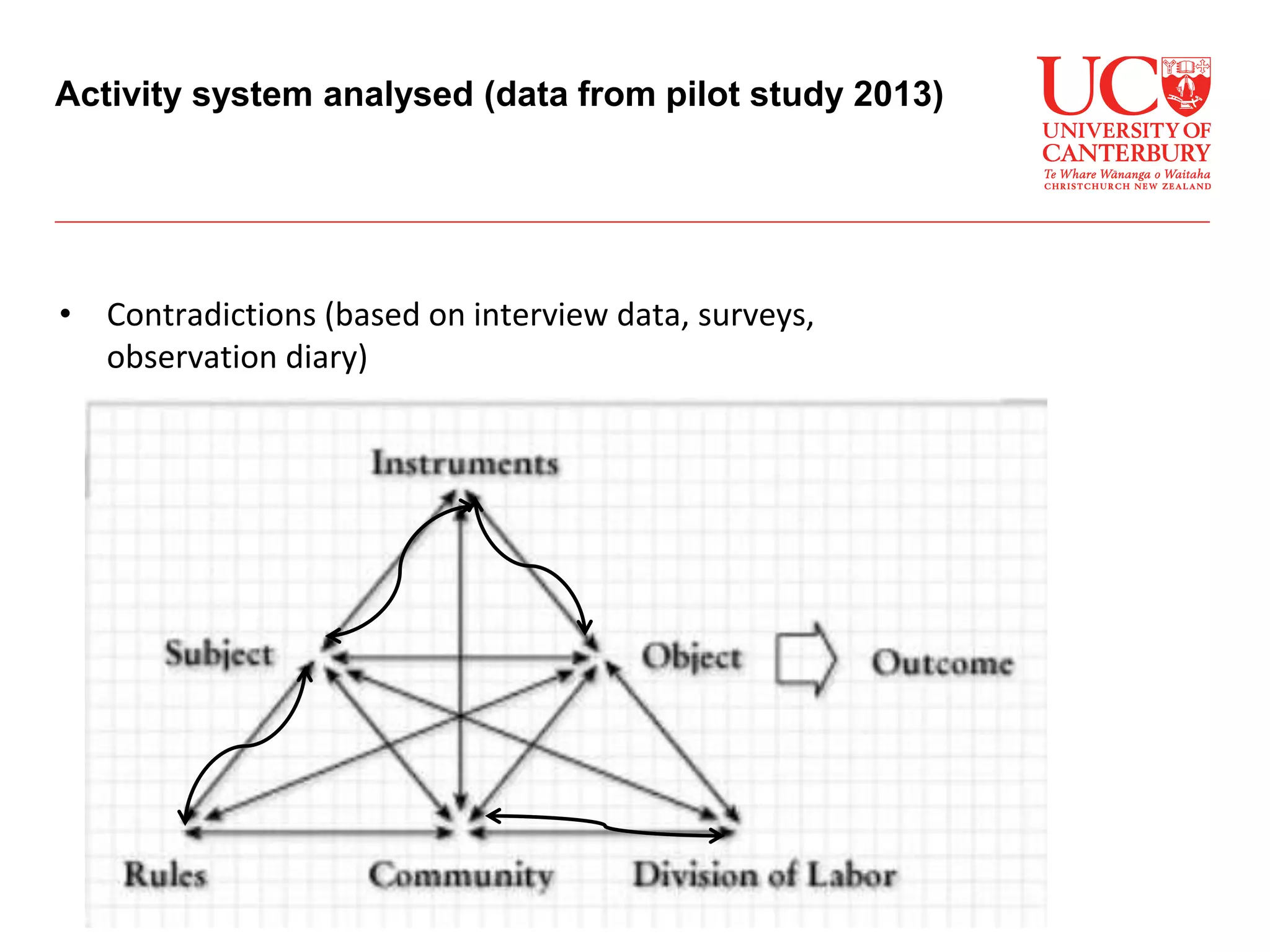
• Contradictions (based on interview data, surveys,
observation diary)
Activity system analysed (data from pilot study 2013)
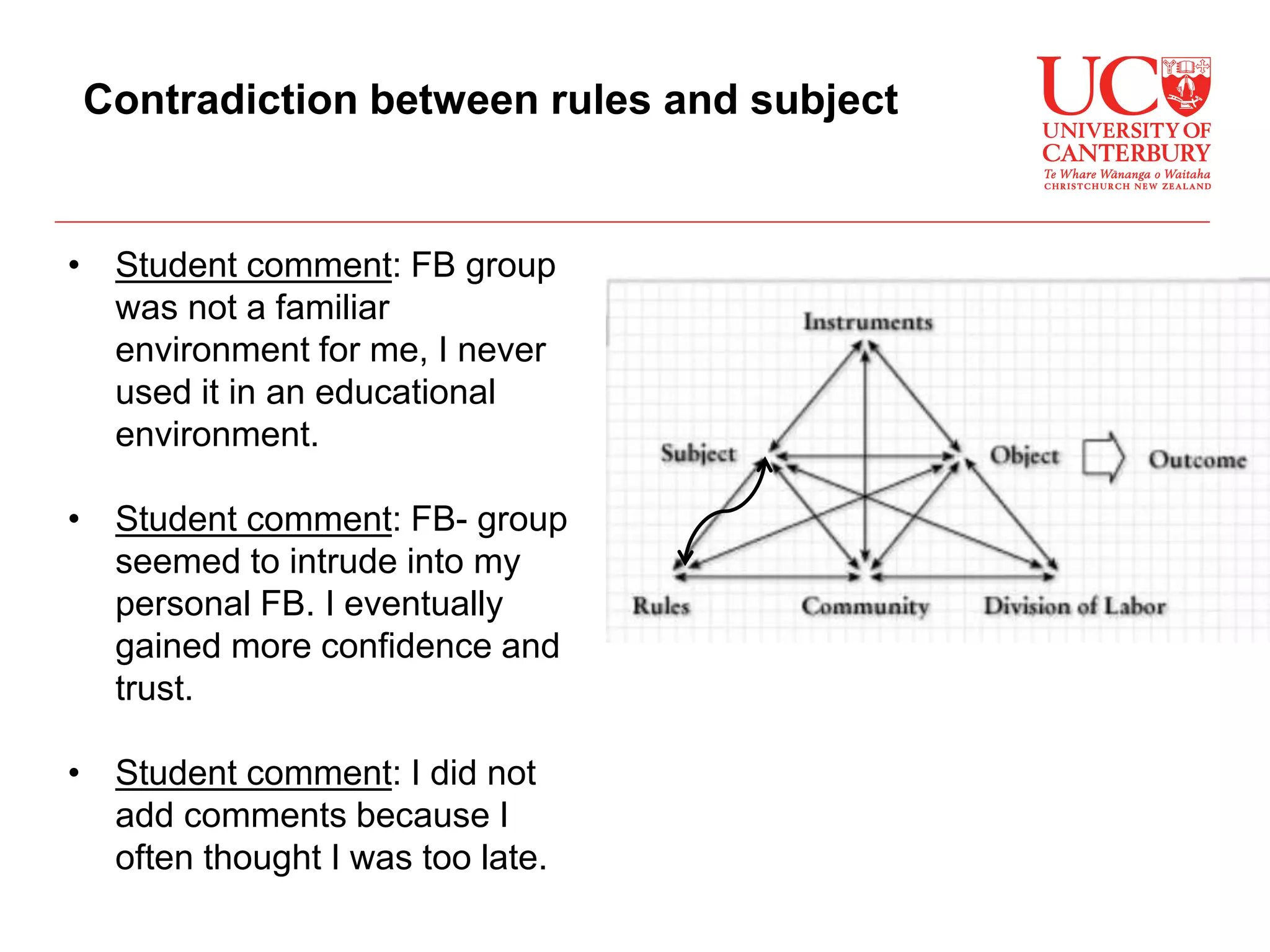
• Student comment: FB group
was not a familiar
environment for me, I never
used it in an educational
environment.
• Student comment: FB- group
seemed to intrude into my
personal FB. I eventually
gained more confidence and
trust.
• Student comment: I did not
add comments because I
often thought I was too late.
Contradiction between rules and subject
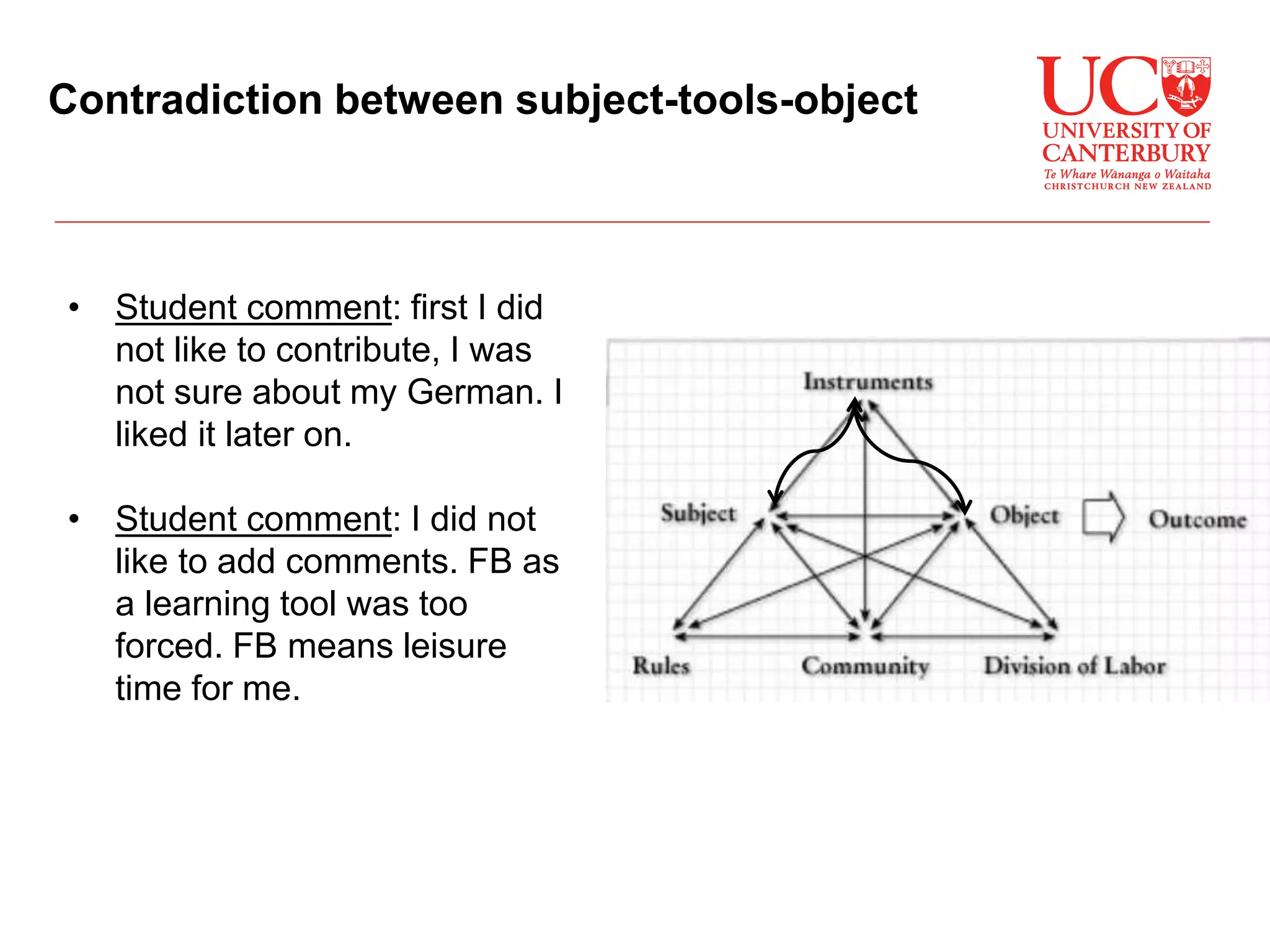
• Student comment: first I did
not like to contribute, I was
not sure about my German. I
liked it later on.
• Student comment: I did not
like to add comments. FB as
a learning tool was too
forced. FB means leisure
time for me.
Contradiction between subject-tools-object
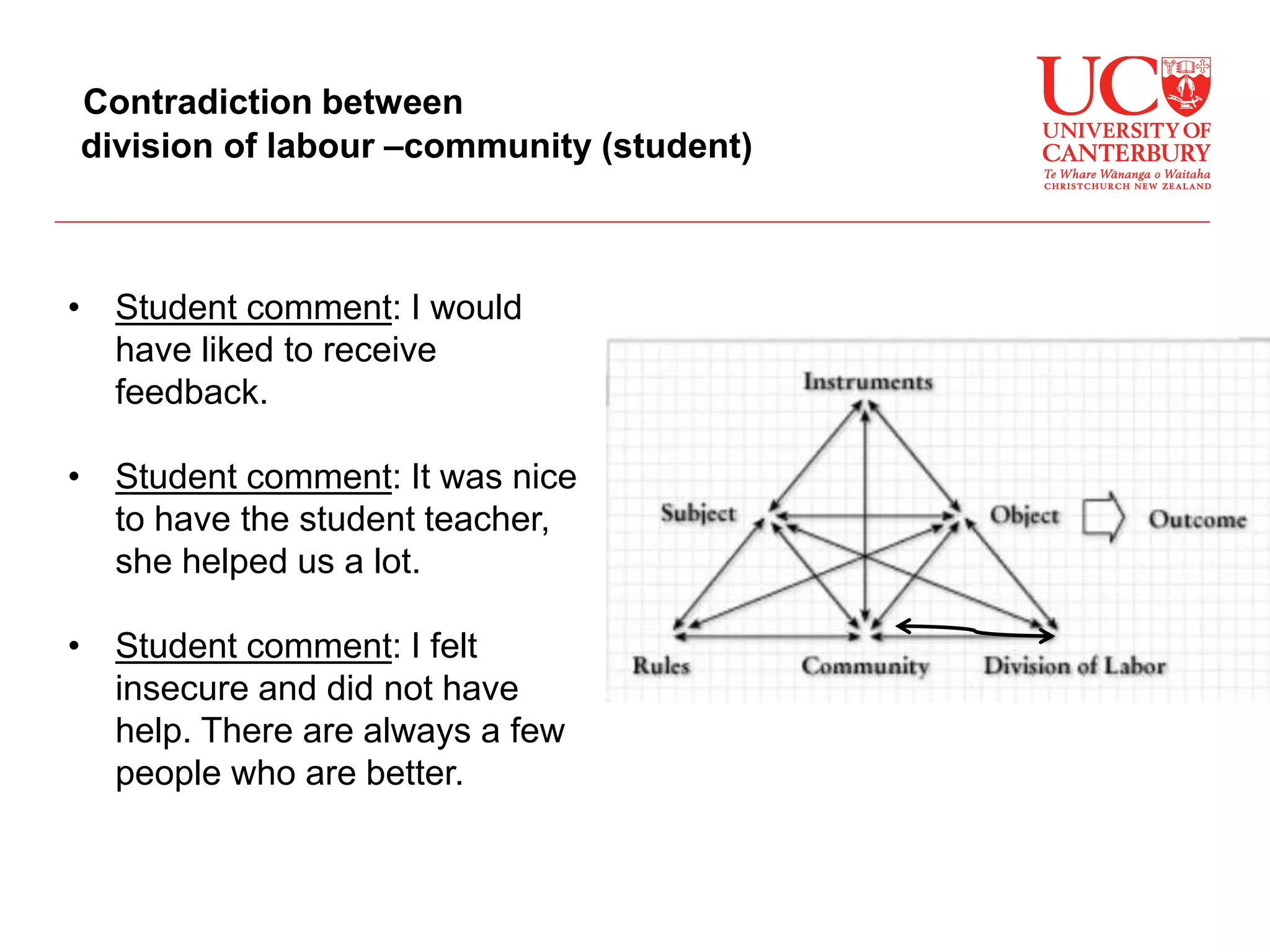
• Student comment: I would
have liked to receive
feedback.
• Student comment: It was nice
to have the student teacher,
she helped us a lot.
• Student comment: I felt
insecure and did not have
help. There are always a few
people who are better.
Contradiction between
division of labour –community (student)
• How can you extend the German community?
• What would be appropriate topics to discuss on FB?
(rules)
• Who should give feedback and to what extent? (division
of labour)
General discussion
• Although SN has got contradictions to resolve it has
unique interactional and discursive. As such, it has great
learning potential.
• Facebook involves online presentation, students might
prefer to be in a more sheltered group.
• Analysis and solving constraints leads to improved digital
literacy skills.
• The goal is the autonomous foreign language use in
digital media.
Conclusion
“In a statistical sense, we may one day communicate with
each other far more via computer mediation than in direct
interaction. The effects on what counts as ‘normal’ language
acquisition could be similarly profound.” (Crystal, 2001:241)
Thank you
vera.leier@canterbury.ac.nz

Presentation antwerp latest

  • 1.
    Activity theory appliedto a connectivist environment for second language acquisition in a social networking site. ____________________________________________________________________ Vera Leier German Programme XVIth International CALL Research Conference RESEARCH CHALLENGES IN CALL, Antwerp 2014
  • 2.
    • Facebook usein a foreign language classroom: examples and observations • Activity theory as a descriptive and analytical tool • Activity system’s constraints identified & implications Outline
  • 3.
    • How dostudents perceive the integration of FB into their curriculum? • How do students perceive the integration of FB into their assessment? • How is FB best used in the German language classroom? • How do students respond to teacher participation? • What level of feedback do students expect and approve of? Research questions:
  • 4.
    • Context: intermediateGerman language class (Grmn251): 24 students, mostly English native speakers. Use of a Facebook group. • Goal: to develop a closer community and more cultural awareness of the target language (L2). Use of newly introduced vocabulary. • Activities : 8% of course assessment: 8 posts: students’ personal introductions, posts about their hobbies, about films and music in Germany, information about course related topics (new- 2014) My research and Facebook use (2013-2014)
  • 5.
    Facebook used tobuild community Students introduce themselves
  • 6.
    Facebook used tobuild community Students write about their hobbies
  • 7.
    Facebook used tobroaden course contents
  • 8.
    • All studentscontributed with presentations. • Language use was sometimes not accurate but production was more than expected. Implications: • Learners can learn new discourse types and registers (eg. everyday conversation) not usually accessible in the language classroom. • Authentic language use in a sheltered environment. Observations
  • 9.
  • 10.
  • 11.
    Average word countcomparison 2013-2014
  • 12.
  • 13.
    The seven componentsof the activity system Subject is an individual or group of people. They have a common object, which gets transformed into an outcome with the help of instruments or tools. The relationship between subject and object is mediated by the rules. Division of labour is the distribution of tasks and roles (horizontal and vertical). The subject does not act in isolation but as part of the community.
  • 14.
    > questionnaires, interviews,observations are guided by self-reflection Subject: the students Object: what is your goal? My research and activity theory Tools: FB as a tool? What other resources would help? Rules: the formal Community: Who do you want to see included in the community? Division of labour: what responsibilty/control do students and teachers have?
  • 15.
    • Contradictions (basedon interview data, surveys, observation diary) Activity system analysed (data from pilot study 2013)
  • 16.
    • Student comment:FB group was not a familiar environment for me, I never used it in an educational environment. • Student comment: FB- group seemed to intrude into my personal FB. I eventually gained more confidence and trust. • Student comment: I did not add comments because I often thought I was too late. Contradiction between rules and subject
  • 17.
    • Student comment:first I did not like to contribute, I was not sure about my German. I liked it later on. • Student comment: I did not like to add comments. FB as a learning tool was too forced. FB means leisure time for me. Contradiction between subject-tools-object
  • 18.
    • Student comment:I would have liked to receive feedback. • Student comment: It was nice to have the student teacher, she helped us a lot. • Student comment: I felt insecure and did not have help. There are always a few people who are better. Contradiction between division of labour –community (student)
  • 19.
    • How canyou extend the German community? • What would be appropriate topics to discuss on FB? (rules) • Who should give feedback and to what extent? (division of labour) General discussion
  • 20.
    • Although SNhas got contradictions to resolve it has unique interactional and discursive. As such, it has great learning potential. • Facebook involves online presentation, students might prefer to be in a more sheltered group. • Analysis and solving constraints leads to improved digital literacy skills. • The goal is the autonomous foreign language use in digital media. Conclusion
  • 21.
    “In a statisticalsense, we may one day communicate with each other far more via computer mediation than in direct interaction. The effects on what counts as ‘normal’ language acquisition could be similarly profound.” (Crystal, 2001:241) Thank you vera.leier@canterbury.ac.nz

Editor's Notes

  • #3 I have ben working with FB in my German language classes for the last three years. Last year in connection with my PhD, I started to analyse the use of the social media. 2013 in a pilot study I looked at the overall activity of the FB use and again in semester 2014 and try to compare the outcome. Activity theory serves as my descriptive and analytical too , framework in this study.
  • #13 Explain contradicitons/tensions