Discourse vs. Text
Is it discourse analysis
Or Text analysis?
• There has been some confusion in the
literature regarding the distinction
between ‘discourse analysis’ and ‘text
analysis’.
• It is a result of the confusion in the terms
‘discourse’ and ‘text’.
Introduction
The Confusion
• Some researchers label their analysis
‘discourse analysis’, while others claim
they are doing ‘text analysis’, but the
difference is often inconsistent.
• Some claim to make clear distinctions
between ‘discourse’ and ‘text’, but a closer
look reveals that their distinctions do not
hold.
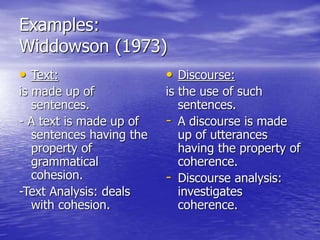
Examples:
Widdowson (1973)
• Text:
is made up of
sentences.
- A text is made up of
sentences having the
property of
grammatical
cohesion.
-Text Analysis: deals
with cohesion.
• Discourse:
is the use of such
sentences.
- A discourse is made
up of utterances
having the property of
coherence.
- Discourse analysis:
investigates
coherence.
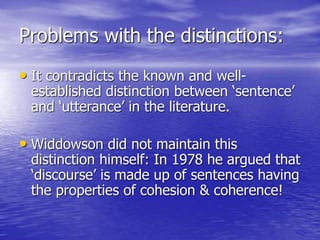
Problems with the distinctions:
• It contradicts the known and well-
established distinction between ‘sentence’
and ‘utterance’ in the literature.
• Widdowson did not maintain this
distinction himself: In 1978 he argued that
‘discourse’ is made up of sentences having
the properties of cohesion & coherence!
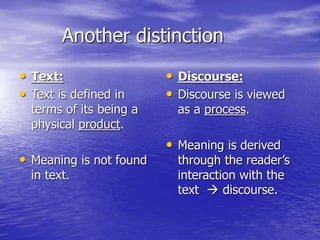
Another distinction
• Text:
• Text is defined in
terms of its being a
physical product.
• Meaning is not found
in text.
• Discourse:
• Discourse is viewed
as a process.
• Meaning is derived
through the reader’s
interaction with the
text  discourse.
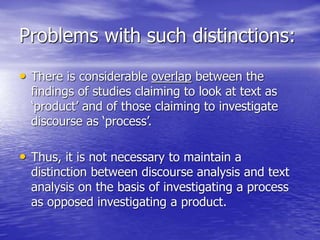
Problems with such distinctions:
• There is considerable overlap between the
findings of studies claiming to look at text as
‘product’ and of those claiming to investigate
discourse as ‘process’.
• Thus, it is not necessary to maintain a
distinction between discourse analysis and text
analysis on the basis of investigating a process
as opposed investigating a product.
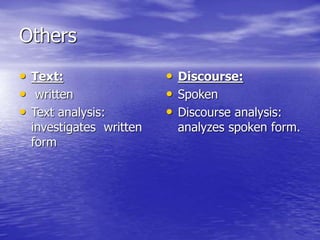
Others
• Text:
• written
• Text analysis:
investigates written
form
• Discourse:
• Spoken
• Discourse analysis:
analyzes spoken form.
Problems:
• Many studies have used models originally
developed for studying spoken form to
investigate written form (Tadros 1981),
and vice versa (Hoey 1983).
• Thus, such a distinction is not necessary.
Conclusion
• Many researchers have come to this
conclusion:
• Discourse analysis includes all studies
investigating the supra-sentential structure
of any stretch of language, spoken or
written.
What about text analysis?
• The terms ‘text’ / ‘text analysis’ lead to
confusion.
• Therefore, the term ‘text’ should be
abandoned unless it is used to refer to the
physical arrangement of linguistic signals
on paper (Tadros, 1981).

Discourse vs.Text.ppt

  • 1.
    Discourse vs. Text Isit discourse analysis Or Text analysis?
  • 2.
    • There hasbeen some confusion in the literature regarding the distinction between ‘discourse analysis’ and ‘text analysis’. • It is a result of the confusion in the terms ‘discourse’ and ‘text’. Introduction
  • 3.
    The Confusion • Someresearchers label their analysis ‘discourse analysis’, while others claim they are doing ‘text analysis’, but the difference is often inconsistent. • Some claim to make clear distinctions between ‘discourse’ and ‘text’, but a closer look reveals that their distinctions do not hold.
  • 4.
    Examples: Widdowson (1973) • Text: ismade up of sentences. - A text is made up of sentences having the property of grammatical cohesion. -Text Analysis: deals with cohesion. • Discourse: is the use of such sentences. - A discourse is made up of utterances having the property of coherence. - Discourse analysis: investigates coherence.
  • 5.
    Problems with thedistinctions: • It contradicts the known and well- established distinction between ‘sentence’ and ‘utterance’ in the literature. • Widdowson did not maintain this distinction himself: In 1978 he argued that ‘discourse’ is made up of sentences having the properties of cohesion & coherence!
  • 6.
    Another distinction • Text: •Text is defined in terms of its being a physical product. • Meaning is not found in text. • Discourse: • Discourse is viewed as a process. • Meaning is derived through the reader’s interaction with the text  discourse.
  • 7.
    Problems with suchdistinctions: • There is considerable overlap between the findings of studies claiming to look at text as ‘product’ and of those claiming to investigate discourse as ‘process’. • Thus, it is not necessary to maintain a distinction between discourse analysis and text analysis on the basis of investigating a process as opposed investigating a product.
  • 8.
    Others • Text: • written •Text analysis: investigates written form • Discourse: • Spoken • Discourse analysis: analyzes spoken form.
  • 9.
    Problems: • Many studieshave used models originally developed for studying spoken form to investigate written form (Tadros 1981), and vice versa (Hoey 1983). • Thus, such a distinction is not necessary.
  • 10.
    Conclusion • Many researchershave come to this conclusion: • Discourse analysis includes all studies investigating the supra-sentential structure of any stretch of language, spoken or written.
  • 11.
    What about textanalysis? • The terms ‘text’ / ‘text analysis’ lead to confusion. • Therefore, the term ‘text’ should be abandoned unless it is used to refer to the physical arrangement of linguistic signals on paper (Tadros, 1981).