Introduction to
Discourse Analysis
Maria Cristhel A. Ledesma
PhD-ELS
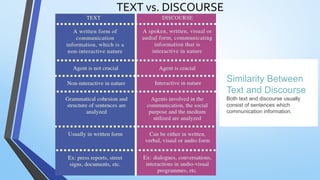
TEXT vs. DISCOURSE
Similarity Between
Text and Discourse
Both text and discourse usually
consist of sentences which
communication information.
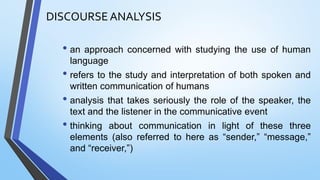
DISCOURSE ANALYSIS
• an approach concerned with studying the use of human
language
• refers to the study and interpretation of both spoken and
written communication of humans
• analysis that takes seriously the role of the speaker, the
text and the listener in the communicative event
• thinking about communication in light of these three
elements (also referred to here as “sender,” “message,”
and “receiver,”)
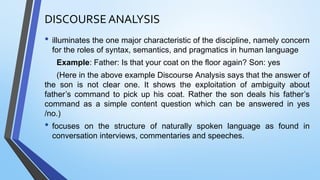
DISCOURSE ANALYSIS
• illuminates the one major characteristic of the discipline, namely concern
for the roles of syntax, semantics, and pragmatics in human language
Example: Father: Is that your coat on the floor again? Son: yes
(Here in the above example Discourse Analysis says that the answer of
the son is not clear one. It shows the exploitation of ambiguity about
father’s command to pick up his coat. Rather the son deals his father’s
command as a simple content question which can be answered in yes
/no.)
• focuses on the structure of naturally spoken language as found in
conversation interviews, commentaries and speeches.
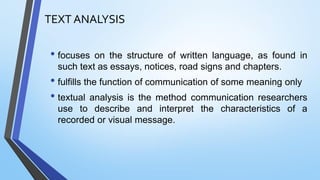
TEXT ANALYSIS
• focuses on the structure of written language, as found in
such text as essays, notices, road signs and chapters.
• fulfills the function of communication of some meaning only
• textual analysis is the method communication researchers
use to describe and interpret the characteristics of a
recorded or visual message.
TEXT ANALYSIS
• the important considerations in textual analysis include
selecting the types of texts to be studied, acquiring
appropriate texts, and determining which particular approach
to employ in analyzing them.
• there are two general categories of texts: a. Transcripts of
communication (verbatim recordings) b. Outputs of
communication (messages produced by communicators)
• in terms of acquiring texts, outputs of communication are
more readily available than transcripts.
TEXT ANALYSIS vs. DISCOURSE ANALYSIS
an effort to interpret what the writer
or speaker intended to convey with
in a sensitive social context
a methodology that involves
understanding language,
symbols, and/or pictures present
in texts to gain information
regarding how people make
sense of and communicate life
and life experiences.
GENRE
• Genre is a directional, patterned, continuous, and purpose-oriented
activity.
• Genre is a distinctive part of culture that has purpose and steps, as well
as language features which has relationship to the purpose, steps, and
the distinctive culture that the definitions should be interpreted by
referring to the social and cultural context in which the context exists
• a process, emphasizing a series of phases of meaning making that are
designed to accomplish something through interactions with others.
GENRE ANALYSIS
• Genre analysis is an area of discourse analysis that studies
written and spoken discourse, mainly in nonliterary
communication and especially in domain‐specific
communication (academic, corporate, legal)
• A genre analysis is the study of how language is used within a
particular context.
• Genre analysis makes a narrower discussion of a discourse
analysis.
DISCOURSE ANALYSIS and PRAGMATICS
• Pragmatics is the study of meaning of language use in context. It does
not take account of formal properties of language construction which
determine its grammaticality, but meaning derived from how utterance is
used and its relation to the social context in which it is used
• Pragmatics looks at the aspect of meaning and language use that is
dependent on the speaker and the listener. Anyone using pragmatic
approach to discourse intends to investigate meaning of language
beyond the literal meaning.
PRAGMATICS is looking at the meaning in the context of discourse between the
participants, that is, communicative meaning. Pragmatics has some basic principles that is
considered in a discourse analysis.
These are…..
utterance and context: Utterance is a unit of discourse or speech. It is made in a
context. Context is all physical, social and cultural situations that surround discourse.
Utterance must be considered within its context before meaning can be derived.
Implicature: This is meaning or something implied in conversational context which is
distinct from what is said.
Entailment: It is logical implication. Entailments are deductions or inferences made from
utterances to help us interpret them successfully.
Presupposition: It is the background knowledge or belief shared by the participants in
discourse which makes them to understand the appropriate context of discourse.
Deixis: It is the use of reference items in utterances, and such items depend on the
context of the utterance
Pragmatics can be considered as a sub-system of discourse analysis
DISCOURSE ANALYSIS and PRAGMATICS
CDA
Critical Discourse Analysis
Fairclough (1993) says that CDA is a kind of analysis of
discourse which brings forth odd relationships among different
social and ethnic groups. He focuses text and sequential
events and then relates them with broader socio-cultural
perspective of the discourse of people which reveals uneven
and ideology shaped power relations. He explores how power
is exercised in a society through hegemonic attitude and
ideological text of the elite.
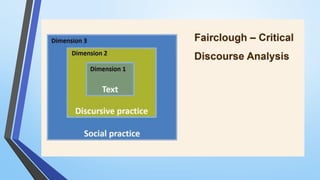
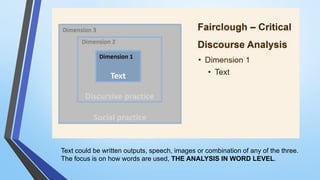
Text could be written outputs, speech, images or combination of any of the three.
The focus is on how words are used, THE ANALYSIS IN WORD LEVEL.
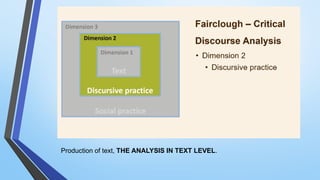
Production of text, THE ANALYSIS IN TEXT LEVEL.
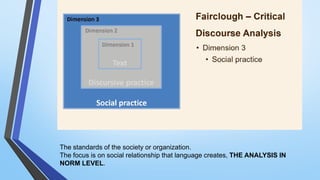
The standards of the society or organization.
The focus is on social relationship that language creates, THE ANALYSIS IN
NORM LEVEL.
In CDA, Fairclough believes that language
can create change, change behaviour and
can be used as a powerful tool.
CDA
Critical Discourse Analysis
Critical discourse analysis (CDA) is a qualitative analytical
approach for critically describing, interpreting, and explaining
the ways in which discourses construct, maintain, and
legitimize social inequalities. CDA rests on the notion that the
way we use language is purposeful, regardless of whether
discursive choices are conscious or unconscious. CDA takes
a number of different approaches and incorporates a variety
of methods that depend on research goals and theoretical
perspectives.
Stylistic Syntax of the English Language
as Foundation for Discourse Analysis
Discourse Analysis attempts to analyze actual human language in terms of
whole discourses. It understands human language in terms of syntax, semantics, and
pragmatics. In addition to the focus on syntax, semantics, and pragmatics, the concern
with human communication leads to a second, narrower characteristic of the discipline,
namely that above all, the emphasis of discourse analysis is upon language as it is
used, in contrast with traditional grammar study which is largely prescriptive and
concerned with “correct usage” of language, discourse analysis is concerned with the
descriptive analysis of actual human communications. Furthermore, language is
characterized at every level by cohesion, coherence, and prominence. Such an
understanding of language has the potential to help those who study scripture better
understand how language works, and thereby make them more sensitive, accurate
interpreters.
DISCOURSE ANALYSIS
• Two main definitions:
- As social action and interaction between human agents
- As social construction of reality that creates a knowledge
system; influences our social practice and relations
• Discourse Analysis is a process in which the reader and
listener’s mind is working up on the linguistic features of the
utterance to grasp the intended meaning of the writer or
speaker. Even if the utterances or sentences are
ungrammatical the Discourse Analysis makes us grasp the
intended meaning.

discourse analysis in language - report.pdf

  • 1.
    Introduction to Discourse Analysis MariaCristhel A. Ledesma PhD-ELS
  • 2.
    TEXT vs. DISCOURSE SimilarityBetween Text and Discourse Both text and discourse usually consist of sentences which communication information.
  • 3.
    DISCOURSE ANALYSIS • anapproach concerned with studying the use of human language • refers to the study and interpretation of both spoken and written communication of humans • analysis that takes seriously the role of the speaker, the text and the listener in the communicative event • thinking about communication in light of these three elements (also referred to here as “sender,” “message,” and “receiver,”)
  • 4.
    DISCOURSE ANALYSIS • illuminatesthe one major characteristic of the discipline, namely concern for the roles of syntax, semantics, and pragmatics in human language Example: Father: Is that your coat on the floor again? Son: yes (Here in the above example Discourse Analysis says that the answer of the son is not clear one. It shows the exploitation of ambiguity about father’s command to pick up his coat. Rather the son deals his father’s command as a simple content question which can be answered in yes /no.) • focuses on the structure of naturally spoken language as found in conversation interviews, commentaries and speeches.
  • 5.
    TEXT ANALYSIS • focuseson the structure of written language, as found in such text as essays, notices, road signs and chapters. • fulfills the function of communication of some meaning only • textual analysis is the method communication researchers use to describe and interpret the characteristics of a recorded or visual message.
  • 6.
    TEXT ANALYSIS • theimportant considerations in textual analysis include selecting the types of texts to be studied, acquiring appropriate texts, and determining which particular approach to employ in analyzing them. • there are two general categories of texts: a. Transcripts of communication (verbatim recordings) b. Outputs of communication (messages produced by communicators) • in terms of acquiring texts, outputs of communication are more readily available than transcripts.
  • 7.
    TEXT ANALYSIS vs.DISCOURSE ANALYSIS an effort to interpret what the writer or speaker intended to convey with in a sensitive social context a methodology that involves understanding language, symbols, and/or pictures present in texts to gain information regarding how people make sense of and communicate life and life experiences.
  • 8.
    GENRE • Genre isa directional, patterned, continuous, and purpose-oriented activity. • Genre is a distinctive part of culture that has purpose and steps, as well as language features which has relationship to the purpose, steps, and the distinctive culture that the definitions should be interpreted by referring to the social and cultural context in which the context exists • a process, emphasizing a series of phases of meaning making that are designed to accomplish something through interactions with others.
  • 9.
    GENRE ANALYSIS • Genreanalysis is an area of discourse analysis that studies written and spoken discourse, mainly in nonliterary communication and especially in domain‐specific communication (academic, corporate, legal) • A genre analysis is the study of how language is used within a particular context. • Genre analysis makes a narrower discussion of a discourse analysis.
  • 10.
    DISCOURSE ANALYSIS andPRAGMATICS • Pragmatics is the study of meaning of language use in context. It does not take account of formal properties of language construction which determine its grammaticality, but meaning derived from how utterance is used and its relation to the social context in which it is used • Pragmatics looks at the aspect of meaning and language use that is dependent on the speaker and the listener. Anyone using pragmatic approach to discourse intends to investigate meaning of language beyond the literal meaning.
  • 11.
    PRAGMATICS is lookingat the meaning in the context of discourse between the participants, that is, communicative meaning. Pragmatics has some basic principles that is considered in a discourse analysis. These are….. utterance and context: Utterance is a unit of discourse or speech. It is made in a context. Context is all physical, social and cultural situations that surround discourse. Utterance must be considered within its context before meaning can be derived. Implicature: This is meaning or something implied in conversational context which is distinct from what is said. Entailment: It is logical implication. Entailments are deductions or inferences made from utterances to help us interpret them successfully. Presupposition: It is the background knowledge or belief shared by the participants in discourse which makes them to understand the appropriate context of discourse. Deixis: It is the use of reference items in utterances, and such items depend on the context of the utterance Pragmatics can be considered as a sub-system of discourse analysis DISCOURSE ANALYSIS and PRAGMATICS
  • 12.
    CDA Critical Discourse Analysis Fairclough(1993) says that CDA is a kind of analysis of discourse which brings forth odd relationships among different social and ethnic groups. He focuses text and sequential events and then relates them with broader socio-cultural perspective of the discourse of people which reveals uneven and ideology shaped power relations. He explores how power is exercised in a society through hegemonic attitude and ideological text of the elite.
  • 14.
    Text could bewritten outputs, speech, images or combination of any of the three. The focus is on how words are used, THE ANALYSIS IN WORD LEVEL.
  • 15.
    Production of text,THE ANALYSIS IN TEXT LEVEL.
  • 16.
    The standards ofthe society or organization. The focus is on social relationship that language creates, THE ANALYSIS IN NORM LEVEL.
  • 17.
    In CDA, Faircloughbelieves that language can create change, change behaviour and can be used as a powerful tool.
  • 18.
    CDA Critical Discourse Analysis Criticaldiscourse analysis (CDA) is a qualitative analytical approach for critically describing, interpreting, and explaining the ways in which discourses construct, maintain, and legitimize social inequalities. CDA rests on the notion that the way we use language is purposeful, regardless of whether discursive choices are conscious or unconscious. CDA takes a number of different approaches and incorporates a variety of methods that depend on research goals and theoretical perspectives.
  • 19.
    Stylistic Syntax ofthe English Language as Foundation for Discourse Analysis Discourse Analysis attempts to analyze actual human language in terms of whole discourses. It understands human language in terms of syntax, semantics, and pragmatics. In addition to the focus on syntax, semantics, and pragmatics, the concern with human communication leads to a second, narrower characteristic of the discipline, namely that above all, the emphasis of discourse analysis is upon language as it is used, in contrast with traditional grammar study which is largely prescriptive and concerned with “correct usage” of language, discourse analysis is concerned with the descriptive analysis of actual human communications. Furthermore, language is characterized at every level by cohesion, coherence, and prominence. Such an understanding of language has the potential to help those who study scripture better understand how language works, and thereby make them more sensitive, accurate interpreters.
  • 20.
    DISCOURSE ANALYSIS • Twomain definitions: - As social action and interaction between human agents - As social construction of reality that creates a knowledge system; influences our social practice and relations • Discourse Analysis is a process in which the reader and listener’s mind is working up on the linguistic features of the utterance to grasp the intended meaning of the writer or speaker. Even if the utterances or sentences are ungrammatical the Discourse Analysis makes us grasp the intended meaning.