Practical Tasks for Mastering the
Mechanics of Writing and Going
Just Beyond
Presenter: Melika Rajabi
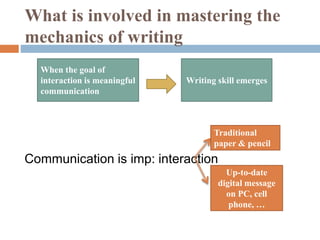
What is involved in mastering the
mechanics of writing
Communication is imp: interaction
When the goal of
interaction is meaningful
communication
Writing skill emerges
Up-to-date
digital message
on PC, cell
phone, …
Traditional
paper & pencil
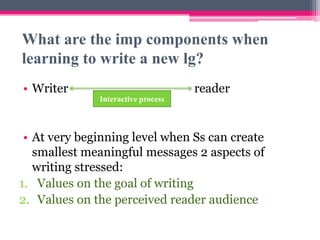
What are the imp components when
learning to write a new lg?
• Writer reader
• At very beginning level when Ss can create
smallest meaningful messages 2 aspects of
writing stressed:
1. Values on the goal of writing
2. Values on the perceived reader audience
Interactive process
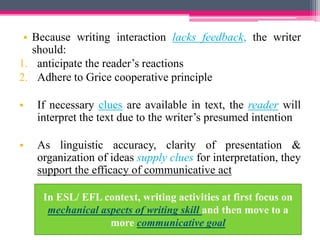
• Because writing interaction lacks feedback, the writer
should:
1. anticipate the reader’s reactions
2. Adhere to Grice cooperative principle
• If necessary clues are available in text, the reader will
interpret the text due to the writer’s presumed intention
• As linguistic accuracy, clarity of presentation &
organization of ideas supply clues for interpretation, they
support the efficacy of communicative act
In ESL/ EFL context, writing activities at first focus on
mechanical aspects of writing skill and then move to a
more communicative goal
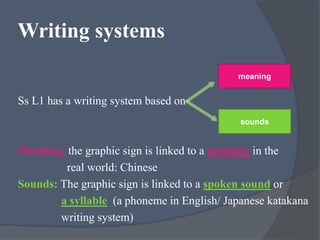
Writing systems
Ss L1 has a writing system based on
Meaning: the graphic sign is linked to a meaning in the
real world: Chinese
Sounds: The graphic sign is linked to a spoken sound or
a syllable (a phoneme in English/ Japanese katakana
writing system)
meaning
sounds
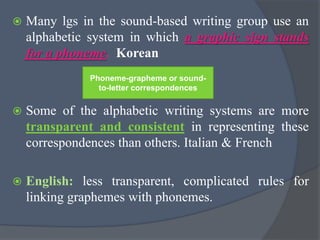
 Many lgs in the sound-based writing group use an
alphabetic system in which a graphic sign stands
for a phoneme. Korean
 Some of the alphabetic writing systems are more
transparent and consistent in representing these
correspondences than others. Italian & French
 English: less transparent, complicated rules for
linking graphemes with phonemes.
Phoneme-grapheme or sound-
to-letter correspondences
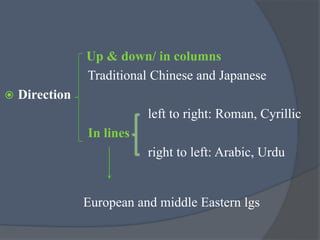
Up & down/ in columns
Traditional Chinese and Japanese
 Direction
left to right: Roman, Cyrillic
In lines
right to left: Arabic, Urdu
European and middle Eastern lgs
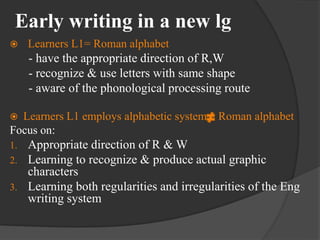
Early writing in a new lg
 Learners L1= Roman alphabet
- have the appropriate direction of R,W
- recognize & use letters with same shape
- aware of the phonological processing route
 Learners L1 employs alphabetic system Roman alphabet
Focus on:
1. Appropriate direction of R & W
2. Learning to recognize & produce actual graphic
characters
3. Learning both regularities and irregularities of the Eng
writing system
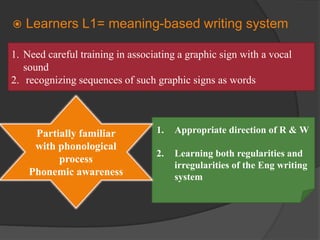
 Learners L1= meaning-based writing system
1. Need careful training in associating a graphic sign with a vocal
sound
2. recognizing sequences of such graphic signs as words
1. Appropriate direction of R & W
2. Learning both regularities and
irregularities of the Eng writing
system
Partially familiar
with phonological
process
Phonemic awareness
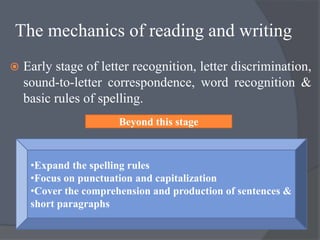
The mechanics of reading and writing
 Early stage of letter recognition, letter discrimination,
sound-to-letter correspondence, word recognition &
basic rules of spelling.
Beyond this stage
•Expand the spelling rules
•Focus on punctuation and capitalization
•Cover the comprehension and production of sentences &
short paragraphs
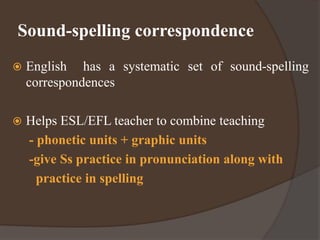
Sound-spelling correspondence
 English has a systematic set of sound-spelling
correspondences
 Helps ESL/EFL teacher to combine teaching
- phonetic units + graphic units
-give Ss practice in pronunciation along with
practice in spelling
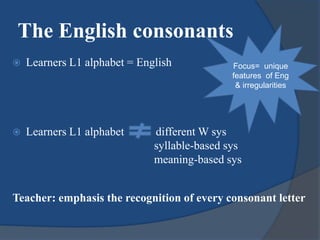
 Learners L1 alphabet = English
 Learners L1 alphabet different W sys
syllable-based sys
meaning-based sys
Teacher: emphasis the recognition of every consonant letter
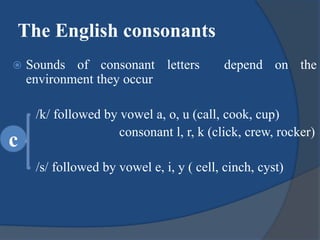
The English consonants
Focus= unique
features of Eng
& irregularities
The English consonants
 Sounds of consonant letters depend on the
environment they occur
/k/ followed by vowel a, o, u (call, cook, cup)
consonant l, r, k (click, crew, rocker)
/s/ followed by vowel e, i, y ( cell, cinch, cyst)
c
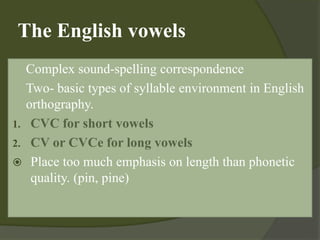
The English vowels
 Complex sound-spelling correspondence
 Two- basic types of syllable environment in English
orthography.
1. CVC for short vowels
2. CV or CVCe for long vowels
 Place too much emphasis on length than phonetic
quality. (pin, pine)
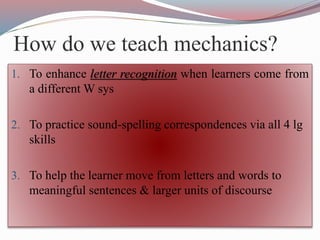
How do we teach mechanics?
1. To enhance letter recognition when learners come from
a different W sys
2. To practice sound-spelling correspondences via all 4 lg
skills
3. To help the learner move from letters and words to
meaningful sentences & larger units of discourse
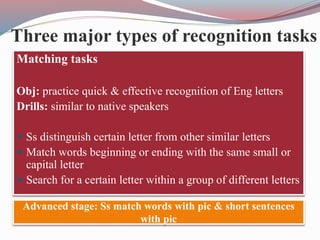
Three major types of recognition tasks
Matching tasks
Obj: practice quick & effective recognition of Eng letters
Drills: similar to native speakers
 Ss distinguish certain letter from other similar letters
 Match words beginning or ending with the same small or
capital letter
 Search for a certain letter within a group of different letters
Advanced stage: Ss match words with pic & short sentences
with pic
Writing tasks
Obj: allow Ss to produce the shapes of the letters both
as a recognition and a production task
•Tracing letters
•Ss focus on detailed characteristics of the letters
Only for Ss with
different
writing sys
Meaningful sound-spelling
correspondence
Obj: Ss match individual sounds or sequences of sounds
& words with their written form
Focus: listening & recognizing the sound corresponding
to the relevant written form
Teachers= give opportunities for copying
Challenging: create sent. for new context
Imp feature: accustom learners to using the appropriate
capitalization rule in Eng and some basic rules of punctuation
More advanced writing tasks
 Focus: accuracy and content with communicative goal
 Three types of writing tasks
1. Practical writing tasks
2. Emotive writing tasks
3. School-oriented tasks
 The task description
 The content description
 The audience description
 Format cues
 Linguistic cues
 Spelling and punctuation cues
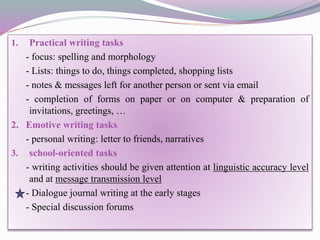
1. Practical writing tasks
- focus: spelling and morphology
- Lists: things to do, things completed, shopping lists
- notes & messages left for another person or sent via email
- completion of forms on paper or on computer & preparation of
invitations, greetings, …
2. Emotive writing tasks
- personal writing: letter to friends, narratives
3. school-oriented tasks
- writing activities should be given attention at linguistic accuracy level
and at message transmission level
- Dialogue journal writing at the early stages
- Special discussion forums
Presentation

Presentation

  • 1.
    Practical Tasks forMastering the Mechanics of Writing and Going Just Beyond Presenter: Melika Rajabi
  • 2.
    What is involvedin mastering the mechanics of writing Communication is imp: interaction When the goal of interaction is meaningful communication Writing skill emerges Up-to-date digital message on PC, cell phone, … Traditional paper & pencil
  • 3.
    What are theimp components when learning to write a new lg? • Writer reader • At very beginning level when Ss can create smallest meaningful messages 2 aspects of writing stressed: 1. Values on the goal of writing 2. Values on the perceived reader audience Interactive process
  • 4.
    • Because writinginteraction lacks feedback, the writer should: 1. anticipate the reader’s reactions 2. Adhere to Grice cooperative principle • If necessary clues are available in text, the reader will interpret the text due to the writer’s presumed intention • As linguistic accuracy, clarity of presentation & organization of ideas supply clues for interpretation, they support the efficacy of communicative act In ESL/ EFL context, writing activities at first focus on mechanical aspects of writing skill and then move to a more communicative goal
  • 5.
    Writing systems Ss L1has a writing system based on Meaning: the graphic sign is linked to a meaning in the real world: Chinese Sounds: The graphic sign is linked to a spoken sound or a syllable (a phoneme in English/ Japanese katakana writing system) meaning sounds
  • 6.
     Many lgsin the sound-based writing group use an alphabetic system in which a graphic sign stands for a phoneme. Korean  Some of the alphabetic writing systems are more transparent and consistent in representing these correspondences than others. Italian & French  English: less transparent, complicated rules for linking graphemes with phonemes. Phoneme-grapheme or sound- to-letter correspondences
  • 7.
    Up & down/in columns Traditional Chinese and Japanese  Direction left to right: Roman, Cyrillic In lines right to left: Arabic, Urdu European and middle Eastern lgs
  • 8.
    Early writing ina new lg  Learners L1= Roman alphabet - have the appropriate direction of R,W - recognize & use letters with same shape - aware of the phonological processing route  Learners L1 employs alphabetic system Roman alphabet Focus on: 1. Appropriate direction of R & W 2. Learning to recognize & produce actual graphic characters 3. Learning both regularities and irregularities of the Eng writing system
  • 9.
     Learners L1=meaning-based writing system 1. Need careful training in associating a graphic sign with a vocal sound 2. recognizing sequences of such graphic signs as words 1. Appropriate direction of R & W 2. Learning both regularities and irregularities of the Eng writing system Partially familiar with phonological process Phonemic awareness
  • 10.
    The mechanics ofreading and writing  Early stage of letter recognition, letter discrimination, sound-to-letter correspondence, word recognition & basic rules of spelling. Beyond this stage •Expand the spelling rules •Focus on punctuation and capitalization •Cover the comprehension and production of sentences & short paragraphs
  • 11.
    Sound-spelling correspondence  Englishhas a systematic set of sound-spelling correspondences  Helps ESL/EFL teacher to combine teaching - phonetic units + graphic units -give Ss practice in pronunciation along with practice in spelling
  • 12.
     Learners L1alphabet = English  Learners L1 alphabet different W sys syllable-based sys meaning-based sys Teacher: emphasis the recognition of every consonant letter The English consonants Focus= unique features of Eng & irregularities
  • 13.
    The English consonants Sounds of consonant letters depend on the environment they occur /k/ followed by vowel a, o, u (call, cook, cup) consonant l, r, k (click, crew, rocker) /s/ followed by vowel e, i, y ( cell, cinch, cyst) c
  • 14.
    The English vowels Complex sound-spelling correspondence  Two- basic types of syllable environment in English orthography. 1. CVC for short vowels 2. CV or CVCe for long vowels  Place too much emphasis on length than phonetic quality. (pin, pine)
  • 15.
    How do weteach mechanics? 1. To enhance letter recognition when learners come from a different W sys 2. To practice sound-spelling correspondences via all 4 lg skills 3. To help the learner move from letters and words to meaningful sentences & larger units of discourse
  • 16.
    Three major typesof recognition tasks Matching tasks Obj: practice quick & effective recognition of Eng letters Drills: similar to native speakers  Ss distinguish certain letter from other similar letters  Match words beginning or ending with the same small or capital letter  Search for a certain letter within a group of different letters Advanced stage: Ss match words with pic & short sentences with pic
  • 17.
    Writing tasks Obj: allowSs to produce the shapes of the letters both as a recognition and a production task •Tracing letters •Ss focus on detailed characteristics of the letters Only for Ss with different writing sys
  • 18.
    Meaningful sound-spelling correspondence Obj: Ssmatch individual sounds or sequences of sounds & words with their written form Focus: listening & recognizing the sound corresponding to the relevant written form Teachers= give opportunities for copying Challenging: create sent. for new context Imp feature: accustom learners to using the appropriate capitalization rule in Eng and some basic rules of punctuation
  • 19.
    More advanced writingtasks  Focus: accuracy and content with communicative goal  Three types of writing tasks 1. Practical writing tasks 2. Emotive writing tasks 3. School-oriented tasks
  • 20.
     The taskdescription  The content description  The audience description  Format cues  Linguistic cues  Spelling and punctuation cues
  • 21.
    1. Practical writingtasks - focus: spelling and morphology - Lists: things to do, things completed, shopping lists - notes & messages left for another person or sent via email - completion of forms on paper or on computer & preparation of invitations, greetings, … 2. Emotive writing tasks - personal writing: letter to friends, narratives 3. school-oriented tasks - writing activities should be given attention at linguistic accuracy level and at message transmission level - Dialogue journal writing at the early stages - Special discussion forums