AN INTRODUCTION TO
SOCIAL SCIENCE
1
INTRODUCTION
2
 The scientific study of organized human groups is
a relatively recent development, but a vast
amount of information has been accumulated
concerning the social life of human beings.
 This information has been used in building a
system of knowledge (called social sciences) about
the nature, growth and functioning of human
societies.
 Scientific knowledge is a knowledge that
has been systematically gathered,
classified, related and interpreted.
3
 Social science – is taught in diverse ways.
some courses take a global perspective
some an anthropological perspective
some a psychological perspective
some a sociological perspective, and
some a historical perspective
4
Definition
5
Social Sciences are the fields of human
knowledge that deal with all aspects of the
group life of human beings.
They are closely related to humanities (deals
with literature, music, art, and philosophy)
because both deal with humans and their
culture.
 However, Social Sciences are most concerned
with those basic elements of culture that
determine the general patterns of human
behavior.
6
Components of Social Sciences:
7
Anthropology – is the study of relationship
between biological traits and socially acquired
characteristics. Sometimes called the study of
human.
1. Physical anthropology
2. Cultural anthropology
Sociology – is the systematic study of
8
relationship
among people. Sociologists assume that behavior is
influenced by people’s social, political, occupational
and by the particular
themselves atone time
and intellectual groupings
settings in which they find
or another.
3 major choices are:
1. Functionalism
2. Conflict
3. Interactionalism
Geography – is the study of the natural environment
and how it influence social and cultural
development.
Concerns of geography are:
1. Ecology
2. Climate
3. Resources
4. Accessibility
5. Demography
9
 History – is the study of past events. It is a social
science in the sense that it is a systematic attempt to
learn about and verify past events and relate them to
one another and to the present.
 The study of history involves:
 1. Identifying
 2. Classifying
 3. Arranging
10
 Economics – is the study of the ways in which men
and women make a living, the most pressing problem
most human beings face.
 Its subject matter is often summarized as:
 1. Production
 2. Distribution
 3. Consumption
11
 Some of the topics includes are:
 1. Supply and demand
 2. Monetary and fiscal policy
 3. Costs
 4. Inflation
 5. Unemployment
 Economics seeks to explain, guide and predict social
arrangements by which we satisfy economic wants.
12
 Political Science – is the study of social arrangments
to maintain peace and order within a given society.
 It deals with government, and its interest are:
 1. Politics
 2. Laws
 3. Adminsitration
 4.International Relations
 5.Theory of the nature and functions of the state
13
 Psychology – deals with the mind and personality of
the individual. It is a social science because humans
are social creatures. It focuses on the individual and
physical processes such as:
 1. Biological structure
 2. Development and maturation
14
 To understand society is to learn not only the
conditions that limit ourselves, but also the
opportunities open to us for improving the
human condition.
15
The humanities deal special aspects of human culture
and primarily concerned with our attempts to express
spiritual and aesthetic values and discover the
meaning of life.
Whereas the social sciences study issues in a
systematic, scientific way, the focus of the humanities
is more on the emotions and feeling themselves than
on the system employed to sharpen that focus.
16
Increasing our knowledge of human society is as
important as learning more about mathematics,
physics, chemistry or engineering, for unless we can
develop societies in which human beings can live
happy, meaningful and satisfying lives (incomparable
to benefits from learning how make better
automobiles etc).
Albert Einstein said that “Politics is more difficult
than physics and the world is more likely to die from
bad politics than from bad physics.
17
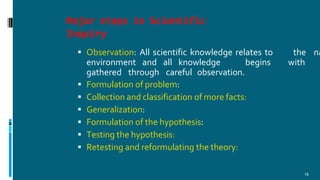
Major steps in Scientific
Inquiry
18
 Observation: All scientific knowledge relates to the na
environment and all knowledge begins with
gathered through careful observation.
 Formulation of problem:
 Collection and classification of more facts:
 Generalization:
 Formulation of the hypothesis:
 Testing the hypothesis:
 Retesting and reformulating the theory:
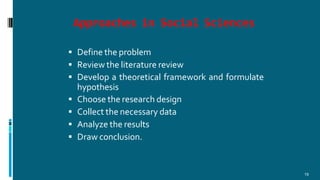
Approaches in Social Sciences
19
 Define the problem
 Review the literature review
 Develop a theoretical framework and formulate
hypothesis
 Choose the research design
 Collect the necessary data
 Analyze the results
 Draw conclusion.
1. Define the Problem
20
this one is probably the most important. If you
have carefully defined your terms, you can save
an enormous amount of energy. Put simply, if
you do not know what you are doing, no matter
how well you do it then everything is useless.
2.Literature Review
21
knowledge of the relevant literature is
because it provides background,
essential
suggests
approaches, indicates what has already been covered
and what hasn’t, and saves you from redoing what has
already been done. It is a way of using other people’s
observation.
3. Develop aTheoretical Framework
22
make a statement predicting your results and
them clarify what each of the terms in the
statement means within the framework of your
research.
4.Choose a research design
23
pick a means of gathering data, a survey, an
experiment, an observational study,
secondary materials or a combination. Weigh
this choice carefully because your plan is the
crux of your research process.
5.Collecting the necessary data
24
Data are what one collects from careful observation.
Your conclusion will be only as good as your data, so
take great care in collecting and especially in
recording your data. If you don’t document what you
have done, youmight as well not have done it.
7. Drawing conclusions
25
Now you can prepare a report, summarizing the steps
you have followed and discussing what you have
found. A good findings will relate your conclusions to
the existing body of research, suggest where current
assumptions may be modified because of nee
evidence and possibly identify unanswered questions
for further study.
6.Analyzing the results
26
when all data are in classify facts, identify trends,
recognize relationships and tabulate the information
so that it can be accurately analyzed and interpreted.
Typical Method in Social Science
27
 The historical method relies heavily on a study of
their (subjects) historical background. It traces the
principal past developments that seem to have
been directly significant in bringing a social
situation about.
 The case method involves making a more detailed
examination and analysis of a particular issue or
problem situation.
 The comparative and cross-cultural methods
was formerly often employed in the hope of
discovering evolutionary sequence in the
development of human institutions that is
patterns of social development or progress
that would be universal.
28
Difference betweenTheories and
Concepts
29
 Concepts
a generalized idea about people, objects or processes
that are related to one another, an abstract ways of
classifying things that are similar.
 They are ways of classifying things that are in the
same categories
 Concepts
30
are used to simply the way people think and
communicate.
 Concepts are used by social scientists to generalize
about some aspects of human interaction.
 They are guidelines that direct the interpretation and
analysis of reality.
 Concepts are the technical vocabulary of the social
sciences, and they have precise meanings that may
differ considerably from the generally understood
versions.
31
 Theories
32
- a set of principles or concepts and generalizations so
arranged that they explain and predict possible
relationships among phenomena.
 In social science, theories are formulation of
principles of behavior through which scientists try to
increase their knowledge of human interaction.
 Theories
33
using
- founded on observation and analysis
the vocabulary of concepts
-intent to explain the connections between
and among occurrences in human
interaction.
- without theories the accumulation of knowledge would be
impossible, just as the formulation of theories would
be impossible without concepts
- Always open to change and even to total rejection if new
evidence is presented to challenge them.
- In scientific terminology, a theory carries much more weight
because it is based on supporting evidence.
34
Theories of Social sciences
35
 The Theory of Evolution assumes that the
changes in any society are uniform based on
fixed rules.
 Idea of Evolution is often associated with
great personalities like Charles Darwin,
Auguste Comte, Herbert Spencer and Karl
Marx
Theory of Evolution
36
 Darwin’s Theory of Evolution – is based on 5 key
observation and inferences.
1. Species have great fertility. They make more
offspring than can grow to adulthood.
2.Populations remain roughly the same size with
modest fluctuations
3. Food resources are limited but are relatively
constant most of the time.
4. In sexually reproducing species, generally no two
individuals are identical.Variations is rampant.
5. Much of this variation is heritable.
37
 From this it may be inferred. In a world of
stable populations where each individual
must struggle to survive, those with the best
characteristics will be more likely to survive,
and those desirable traits will be passed to
their offspring.
 These advantageous are inherited by
following generations, becoming dominant
among population through time. This is
natural selection.
38
Darwin’sTheory of Evolution
39
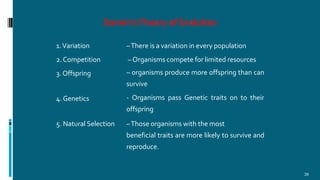
1.Variation –There is a variation in every population
2. Competition – Organisms compete for limited resources
3. Offspring – organisms produce more offspring than can
survive
4.Genetics - Organisms pass Genetic traits on to their
offspring
5. Natural Selection –Those organisms with the most
beneficial traits are more likely to survive and
reproduce.
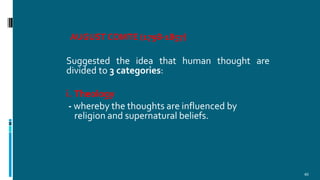
AUGUST COMTE (1798-1857)
40
Suggested the idea that human thought are
divided to 3 categories:
i. Theology
- whereby the thoughts are influenced by
religion and supernatural beliefs.
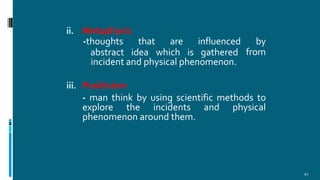
ii. Metaphysic
41
abstract idea which is gathered
-thoughts that are influenced by
from
incident and physical phenomenon.
iii. Positivism
- man think by using scientific methods to
explore the incidents and physical
phenomenon around them.
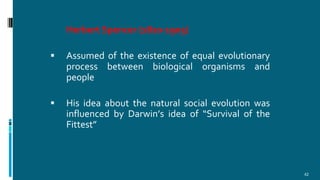
Herbert Spencer (1820-1903)
 Assumed of the existence of equal evolutionary
process between biological organisms and
people
 His idea about the natural social evolution was
influenced by Darwin’s idea of “Survival of the
Fittest”
42
 The fittest will survive in the process while
the weak will be eliminated naturally
according to the law of nature
 Hence, his idea refuses the element of force
in human social system
43
Lewis Henry Morgan (1818- 1881)
44
 popularized Cultural EvolutionTheory
 Made assumptions that any society can be divided
according to 3 levels of survival
 Savagery - society which lives as nomads and
indulge in hunting and food gathering
 Barbarisme - society which lives on a particular
place and plants for survival
 Civilization - society which lives on a particular
place and starts to use technology
45
Karl Marx (1818-1883) &
Frederick Engels (1820-1895)
46
 Influenced by Morgan’s ideas but more focused
on material changes aspect
 Evolution happens in the contacts of resource
production and mode of production
CONCLUSION
47
 Man kind need to understand and observe the import
of social sciences
 Knowledge based society will be better equipped t
socializing process
 A well balanced knowledge about social sciences w
ensure the humans existence.
WHAT THE “NEW” SOCIAL STUDIES HOPE TO ACHIEVE?
Objectives:
a. enumerate and discuss what the “New”
Social Studies hopes to achieve;
b. describe the cognitive, affective and
psychomotor taxonomies; and
▶ explain the behavioral objectives in the
social sciences.
National Objective of Education (Elementary
and Secondary Level)
▶ Filipinos have deep regard to for education. Education occupies a
central place in Philippine political, economic social and cultural life. It has
always been strongly viewed as a pillar of national development and a
primary avenue for social and economic mobility..
▶ Consistent with the provisions of the Constitution, the education sector shall continue
to receive the largest portion of the national budget to the tune of PhP751.7
billion, or 16.7 percent of the FY 2021 budget. The Department of Public Works
and Highways (DPWH) and the Department of Interior and Local Government (DILG)
will follow suit with PhP695.7 billion (15.4 percent) and PhP249.3 billion (5.5
percent), respectively. The Department of Health (DOH), being the primary
government arm in responding to the COVID-19 pandemic, will receive PhP210.2
billion which is 19.6 percent higher than its FY 2020 budget. This is followed by the
Department of National Defense (DND) with PhP205.8 billion, Department of Social
Welfare and Development (DSWD) with PhP176.9 billion, Department of
Transportation (DOTr) with PhP87.9 billion, Department of Agriculture (DA) with
PhP71.0 billion, The Judiciary with PhP45.3 billion, and the Department of Labor and
Employment (DOLE) with PhP37.1 billion.
(National Objective of Education (Elementary and
Secondary Level)
▶ The 1987 Constitution likewise guarantees the right to education of every
Filipino. It provided that, “The State shall protect and promote the right of all
citizens to quality education at all levels and shall take appropriate steps to
make education accessible to all.”
▶ The right of every Filipino to quality basic education is further emphasized
in Republic Act 9155 or the Governance of Basic Education Act of 2001.
Along with Republic Act 6655 or the Free Secondary Education Act, these
laws reaffirm the policy of the State to protect and promote the rights of all
Filipinos by providing children free and compulsory education in the
elementary and high school level. This pertains to six years of free tuition
fees for children aged 6 to 11, and free four years of secondary schooling for
those aged 12 to 15.
(National Objective of Education (Elementary and
Secondary Level)
▶ Along with “Education for All”, the Philippines is also committed
to pursue eight timebound and specific targets under the
Millennium Declaration which it signed on September 2000.
▶ With the adoption of the Declaration, the Philippines likewise
affirmed its commitment to the Millennium Development Goals
(MDG) geared towards reducing poverty, hunger, diseases,
illiteracy, environmental degradation and discrimination against
women.
(National Objective of Education (Elementary and
Secondary Level)
▶ Among the issues that needs to be resolved but have
improved lately include the high dropout rates, high
number of repeaters, low passing grades, lack of
particular language skills, failure to adequately respond
and address the needs of people with special needs,
overcrowded classrooms and poor teacher performances.
These problems in turn resulted to a considerable number
of illiterate Filipinos and out of school youths and
graduates who are not prepared for work.
▶
Philippine Education Structure
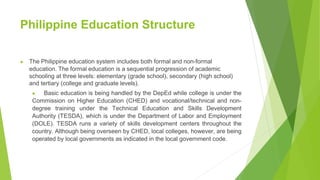
▶ The Philippine education system includes both formal and non-formal
education. The formal education is a sequential progression of academic
schooling at three levels: elementary (grade school), secondary (high school)
and tertiary (college and graduate levels).
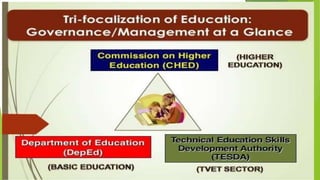
▶ Basic education is being handled by the DepEd while college is under the
Commission on Higher Education (CHED) and vocational/technical and non-
degree training under the Technical Education and Skills Development
Authority (TESDA), which is under the Department of Labor and Employment
(DOLE). TESDA runs a variety of skills development centers throughout the
country. Although being overseen by CHED, local colleges, however, are being
operated by local governments as indicated in the local government code.
. Overview on EFA
▶ In 1990, there was a World Declaration on Education
for All (EFA) in Jomtiem, Thailand, which prescribed
that Basic Learning Needs shall be met for all by
various means. As a response, the Philippines crafted
and implemented the 10-year EFA Philippine Plan of
Action covering 1991-2000.
EFA THRUST
▶ Early Childhood Development
▶ • Expansion of self-sustaining community based ECCD
▶ • Use of innovative approaches to parent education
▶ • Promotion of preparatory education
▶ • Accreditation of private pre-school programs and institutions
▶ • Differentiated approaches for special categories of children
▶ • Strengthening of health, nutrition and other allied services
▶ • Socio-cultural adaptation of curriculum, materials and approaches
▶ • Single agency to coordinate programs for ECCD
Universalization of Quality Primary
Education
▶ Enhancing the holding power or student retention of
schools
▶ • Using alternative teaching-learning delivery modes(
Give examples for this)
▶ • Strengthening home-school partnership
▶ • Emphasis on higher-level thinking skills
▶ • Upgrading teacher competencies(Why is it
necessary to upgrade the skills and competencies of
teachers?)
Alternative Learning Systems
▶Eradication of illiteracy in selected areas
▶• Promotion of continuing education and
development
▶• Implementation of integrated programs
Alternative Learning Systems
▶ Goal 1: Expand and improve comprehensive early childhood
care and education, especially for the most vulnerable and
disadvantaged children;
▶ Goal 2: Ensure that by 2015, all children, particularly girls,
children in difficult
circumstances and those belonging to ethnic minorities, have
access to complete free and compulsory primary education of
good quality;
▶ Goal 3: Ensure that the learning needs of all young people
and adults are met through equitable access to appropriate
learning and life skills programs
Alternative Learning Systems
Goal 4: Achieve a 50 percent improvement in levels of adult literacy by 2015,
especially for women and equitable access to basic and continuing education
for all
adults;
Goal 5: Eliminate gender disparities in primary and secondary education by
2015,
with focus on ensuring girls full and equal access to and achievement in basic
education of good quality; and
Goal 6: Improve every aspect of the quality of education, and ensure their
excellence so that recognized and measurable learning outcomes are achieved
by
all, especially in literacy, numeracy and essential life skills.
To attain the above goals, nine urgent and critical
tasks were formulated. The six production tasks will
hopefully yield the desired educational outcomes
while the three enabling tasks will be necessary to
sustain effective implementation of the production
aspects. These tasks are enumerated below:
Production Tasks
▶ a. Better Schools: Make every school continuously perform better.
▶ b. Early Childhood Care and Development: Make expansion of coverage yield
▶ more EFA benefits;
▶ c. Alternative Learning System: Transform non-formal and informal interventions into
an alternative learning system yielding more EFA benefits.
▶ d. Teachers: Promote practice of high-quality teaching;
▶ e. Longer Cycle: Adopt a 12-year program for formal basic education – Two more
years added, one each for elementary and high school, to the existing
▶ 10-year basic education schooling;
▶ f. Accelerate articulation, enrichment, and development of the basic education
curriculum in the context of the pillars of new functional literacy.
Enabling Task
▶ g. Funding: Provide adequate and stable public funding for country-wide
attainment of EFA goals. Adoption of funding framework for basic
education that combines the national and local government funding to
support the most cost-effective local efforts to attain quality outcomes in
every locality across the whole country.
▶ h. Governance: Create a network of community-based groups for local
attainment of EFA goals. A knowledge-based movement which reach,
engage and organize persons in each locality to form a nationwide
network of multi-sectoral groups advocating and supporting attainment of
EFA goals in their respective localities; and i. Monitor progress in efforts
towards attainment of EFA goals. Of particular importance is the
development and implementation of indicators of “quality education”.
Early Childhood Education
▶ The increasing gross enrolment rate in early childhood
education programs by both public and private schools in
recent years can be attributed to the implementation of the
Early Childhood Care and Development Act or Republic Act
No. 8980. Signed on December 5, 2000, the law is considered
a landmark in the country’s education history as it provides the
national policy that institutionalizes an integrated and
comprehensive system of early childhood care and
development.
Formal Basic Education
To increase access to quality, relevant and efficient formal
primary education, the country has introduced and
implemented innovations and reforms in the curriculum, testing
and assessment, teacher development, school improvement
and alternative delivery modes.
Formal Basic Education
▶ The number of learning areas in both levels was reduced to five,
focusing on those that facilitate lifelong learning skills. The
implementation of the curriculum included training of teachers and
administrators, development of modules and training materials, and
close monitoring and assessment of program implementation. The
policy of indigenization of the curriculum led to development of
localized curriculum materials that took into account local culture. In
school year 2005-2006, the Standard Curriculum for Elementary Public
Schools and Private Madras was implemented.
Formal Basic Education
▶ (1) establishing a smooth transfer of
pupils/students from public to private Madrasah
or vice versa;
▶ (2) unifying the long history of dichotomy among
Muslims; and
▶ (3) promoting the Filipino national identity and at
the same time preserving the Muslim’s cultural
heritage.
Formal Basic Education
▶ Quality Assurance Strategies through Testing and Assessment.
A new student assessment scheme was introduced in school
year 2002-2003. It included a diagnostic test administered to
Grade IV pupils at the start of the school year to determine
learning gaps.
Performance-Based Grading System.
▶ The new grading system designed to truly reflect student performance
raised the passing mark and mastery level to 75 from 70 and redesigned
the content of the examination. Distribution of test items categorized as
easy, medium-level difficulty and difficult is 60, 30 and 10 percent,
respectively.
▶At the high school level, incoming first year students are given the
High School Readiness Test to assess whether or not they have
mastered the basic competencies of the elementary curriculum. The
results have not been encouraging.
• In a democratic state like the Philippines, it is
essential that the citizens are literate,
socially responsible, useful and law-abiding.
• A very significant factor in education in our
country is the assignment of the ultimate
responsibility for the education of the citizens
to the government.
AGlimpseatHistory…
What are the
Constitutional provisions
on education in the
previous Constitutions?
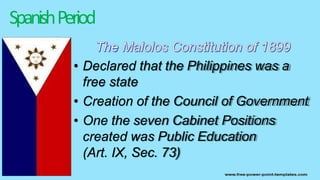
SpanishPeriod
• Declared that the Philippines was a
free state
• Creation of the Council of Government
• One the seven Cabinet Positions
created was Public Education
(Art. IX, Sec. 73)
PHILIPPINE CONSTITUTION
OF 1935
• Reaffirmed the existence of Public Educational
Department as legal (Art. VII, Sec. 11, Sub-sec. 1)
• Provide aid and support to parents in rearing the
youth for civil efficiency (Art. II, Sec. 4)
• Exemption from taxation of buildings and
improvements used exclusively for educational
purposes (Art. VI, Sec. 22, Sub-sec. 3)
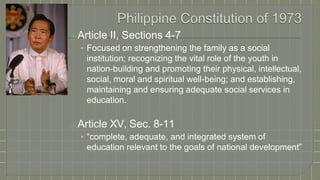
⦿Article II, Sections 4-7
• Focused on strengthening the family as a social
institution; recognizing the vital role of the youth in
nation-building and promoting their physical, intellectual,
social, moral and spiritual well-being; and establishing,
maintaining and ensuring adequate social services in
education.
⦿Article XV, Sec. 8-11
• “complete, adequate, and integrated system of
education relevant to the goals of national development”
THE 1987
CONSTITUTION
• The Constitution provides what the
nature of educational system in the
Philippines shall be.
• The educational system as
envisioned in the Constitution is a
system that is national in scope with
public and private schools as
subsystems.
Constitutional Basis of
Philippine Education
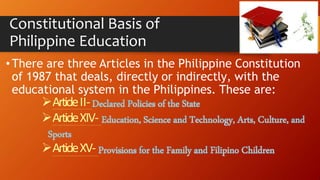
• There are three Articles in the Philippine Constitution
of 1987 that deals, directly or indirectly, with the
educational system in the Philippines. These are:
ArticleII-
ArticleXIV-
ArticleXV-
ARTICLE II,
SECTIONS 11, 12, 13,and 17
• The State declares that:
1. it values the dignity of every human person and
guarantees full respect for human rights;
2. it shall strengthen the family as a basic, self-
governing social unit and protect the life of the
mother and the life of the unborn from
conception;
3. it shall provide support to parents in the rearing of
their children for civic efficiency and the
ARTICLE II,
SECTIONS 11, 12, 13,and 17
•The State declares that: (cont.)
4. it recognizes the vital role of the youth in the
country's development;
5. it shall promote and protect the physical, moral,
spiritual, intellectual and social well-being of the
youth;
6. it makes education, science and technology, arts,
culture and sports a priority of the State.
With these declared
policies, the State is
mandated to provide
a system of
education for the
Filipino children and
the youth.
What kind of
education is
envisioned in the
Constitution?
The kind of education that is envisioned in the
Constitution is "quality education," a "complete,
adequate, and integrated system of education
education relevant to the needs of the people and
people and society," and the State must ensure that
ensure that all citizens can access this envisioned
system of education.
To achieve these goals, the Constitution
provides the following legal bases under
ARTICLE XIV
EDUCATION, SCIENCE AND
TECHNOLOGY, ARTS,
CULTURE AND SPORTS
ARTICLE XIV EDUCATION, SCIENCE AND
TECHNOLOGY, ARTS, CULTURE AND SPORTS
🠶Section 1
The State shall protect and promote
the right of all citizens to quality
education at all levels, and shall take
appropriate steps to make such
education accessible to all.
 Complete, adequate, and integrated system of
education relevant to the needs of the society (2.1)
 Free public education in the elementary and high
school without limiting the natural right and duty of
the parents to rear their children for civic efficiency
and development of moral
character. Elementary education
is compulsory for all children
of school age. (2.2)
Section 2 stipulates the following:
Scholarship grants, loans, subsidies and other
incentives to deserving students in both private
and public schools. (2.3);
Non-formal, formal, and indigenous learning systems
as well as self-learning, independent, and out-of-
school study programs, especially those that
respond to community needs (2.4); and
Civic, vocational and other skills training for adults,
disabled citizens, and out- of -school youth (2.5)
Section 2 stipulates the following: (cont.)
All educational institutions shall include the study
of the Constitution as part of the curricula (3.1).
Inculcation of values (3.2).
Patriotism
Nationalism
Love of humanity
Respect of human rights
Appreciation of the role of the national heroes
Strengthen ethical and spiritual values
Moral character and personal discipline
Critical and creative thinking
Scientific and technological knowledge
Vocational efficiency
Optional religious
instruction in public
schools (3.3)
Section 4- Supervision and Regulation of Schools
• The State recognizes the complementary roles of public and
private institutions in the educational system and shall exercise
reasonable supervision and regulation of all educational
institutions (4.1).
• Educational institutions, other than those established by
religious groups and mission boards, shall be owned solely by
citizens of the Philippines or corporations or associations of
which at least sixty percent of the capital is owned by such
citizen (4.2a)
Section 4- Supervision and Regulation of Schools
• The control and administration of educational institutions shall
be vested in citizens of the Philippines. (4.2b)
• No educational institution shall be established exclusively for
aliens and no group of aliens shall comprise more than one-
third of the enrollment in any school. The provisions of this
subsection shall not apply to schools established for foreign
diplomatic personnel and their dependents and, unless
otherwise provided by law, for other foreign temporary
residents. (4.2c)
Section 4- Supervision and Regulation of Schools
• All revenues and assets of non- stock, non- profit educational
institutions used actually, directly and exclusively for
educational purposes shall be exempt from taxes and duties.
Proprietary educational institutions, including those
cooperatively owned, may likewise be entitled to such
exemptions subject to the limitations provided by law including
restrictions on dividends and provisions for reinvestment. (4.3)
• Subject to conditions prescribed by law, all grants
endowments, donations or contributions used actually, directly
and exclusively for educational purposes shall
be exempt from tax. (4.4)
• Take into account regional and sectoral needs and conditions;
encourage local planning in the development of educational
policies and programs. (5.1)
• Academic freedom shall be enjoyed in all institutions of higher
learning. (5.2)
• Every citizen has a right to select a profession or course of
study, subject to fair, reasonable and equitable admission and
academic requirements. (5.3)
• Enhance the right of teachers to professional advancement.
Non- teaching academic and non-academic personnel shall
enjoy the protection of the State.
• The State shall assign the highest budgetary priority to
education and ensure that teaching will attract and retain its
rightful share of the best available talents through adequate
remuneration and other means of job satisfaction and
fulfillment.
LANGUAGE (Sec. 6-9)
🞇Filipino is the national language of the state and subject
to provisions of law and as the Congress may deem
appropriate, the Government shall take steps to initiate
and sustain the use of Filipino as the medium of
communication and language of instruction in the
educational system (Sec. 6).
🞇For purposes of communication and instruction, the
official languages of the Philippines are Filipino, and,
until otherwise provided by law, English;
🞇Regional languages are auxiliary official languages and
shall serve as auxiliary media of instruction therein. (Sec.
7)
• The State shall give priority to research and development,
invention, innovation, and their utilization; and to science and
technology education, training, and services. It shall support
indigenous, appropriate, and self-reliant scientific and
technological capabilities, and their application to the country’s
productive systems and national life. (Sec. 10)
• Scholarships, grants-in-aid, or other
forms of incentives shall be provided
to deserving science students,
researchers, scientists, inventors,
technologists, and specially gifted
citizens. (Sec. 11)
• The State shall protect and secure the exclusive
rights of scientists, inventors, artists, and other gifted
citizens to their intellectual property and creations,
particularly when beneficial to the people, for such
period as may be provided by law. (Sec. 13)