BARTENDING
 
Bartending began as a trade thousands of years ago.  Historical accounts from the time of  Julius Caesar  show that inns situated along the major transportations routes served wine and provisions to travelers. HISTORY OF BARTENDING
In Rome, neighborhood taverns were meeting places for locals to enjoy drinking and gossip. There is evidence that even earlier the ancient Greeks had such places of entertainment and refreshments for travelers.
It dates back to ancient times and can be found in  Roman ,  Greek , and even  Asian  societies. Public drinking houses (now called  PUB s in England), served as a  place for people to socialize. In  15 th  century , the majority of bartenders were house owners and female innkeepers who brewed and produced their own liquor.
Bartenders and bar owners were considered  members of the economic and social elite .  They owned property and were recognized as part of one of the wealthiest traders of all time.  This social status of bartending was then passed on to the New World
Today people still gather in a variety of public and private establishments for  drinking, meeting friends, relaxation , and  entertainment. Tending bar involves much more than just serving drinks.  In fact, some bartenders leave the “serving” to others.  The job may include  preparing the drinks, customer service, management, security,  and sometimes  psychiatrist!
 
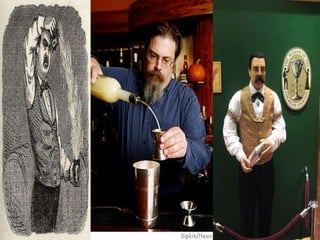
Jeremiah “Jerry” Thomas (1830-1885) An American bartender  “ Father of the American Mixology” born in 1830 in Sackets Harbor, New York He learned bartending in New Haven, Connecticut before sailing for California where he worked as bartender, gold prospector, and show manager
He toured Europe, carrying along his  flashy techniques  of mixing cocktails, sometimes while juggling bottles, cups and mixers.  At the  Hotel in San Francisco , Thomas was earning $100 a week– more than the Vice President of the United States In  1862 , he finished the Bar-Tender’s Guide or the book entitled as  “How to Mix Drinks” – the first drink book ever published in United States
Upon returning to New York City, he became head bartender at the Metropolitan Hotel before opening his most famous bar on Broadway in 1866. By middle age he was married and had two daughters.
Towards the end of his life, Thomas tried speculating on Wall Street, but bad judgments rendered him broke. He had to sell his successful saloon and auction off his considerable art collection; he tried opening a new bar but was unable to maintain the level of popularity as his more famous location.
He died in New York City of  apoplexy  (stroke)  in 1885 at the age of  55 In  December, 2005  a bar opened in the East Village of New York City name  Professor Thom’s , in reference to Thomas.
BARTENDING There are two important people who are responsible for quick service in a restaurant or bar-  the bartender and the wine steward. Some people dine without drinking alcoholic beverages.  The most commonly served beverages are water, sodas, and coffee.  For an elegant or leisurely meal, however, wine is increasingly being ordered.
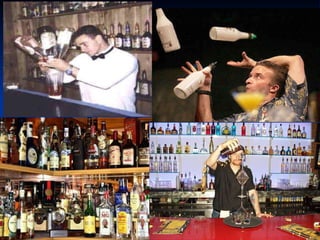
Flair Bartending  It is the  practice of  bartenders  entertaining guests , or audiences with the manipulation of bar tools (ex. cocktail shakers) and liquor bottles in  tricky, dazzling ways.   used occasionally in cocktail bars, the action requires  skills  commonly  associated with jugglers.
It has become a sought-after talent among venue owners and marketers to help  advertise a liquor product  or the  opening of a bar establishment .  Competitions have been sponsored by liquor brands to attract flair bartenders, and some hospitality training  companies hold courses to teach flair techniques.
Sometimes referred to as  “extreme bartending”  The word flair refers to  any trickery  used by a bartender in order  to entertain guests while mixing a drink .  Flair  can include juggling, flipping (bottles, shakers), manipulating flammable liquors or even performing close-up magic tricks ( “bar-magic” )
Flair  is showmanship added to bartending that enhances the overall guest experience.  The ideas behind mixology and drink-oriented  or service-minded bartending can still be upheld with the correct application of working flair.
IMPORTANCE & OBJECTIVES OF BARTENDING The service staff should be knowledgeable in all aspects of wine service.  Professional wine service demand skill.  The more a person knows about wines- how each kind tastes, which wine “flavors” complement which foods- the easier it is to sell wines to guests.
Guest who want wine with their meal but cannot decide which wine, or are afraid to choose one, will be pleased if a knowledgeable server can make an appropriate suggestion.  Having a service staff knowledgeable in wine and how to recommend them-how to pair wines with food and how to provide “flairs” while opening and serving them, can make a real difference.
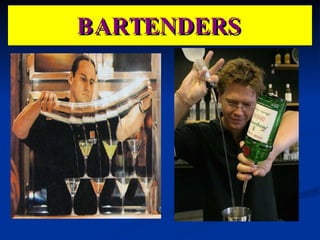
BARTENDERS
Bartender Also called as barman, barkeeper, barmaid, mixologist, tavern keeper, whiskey slinger One who mixes and serves alcoholic drinks at a bar, lounge, or tavern or similar establishment A bartender may own a bar they tend or be simply an employee Barkeeper carries a stronger connotation of being the purveyor (ownership)
Bartending basics start with the  lingo.   It’s also essential to  recognize the glassware.  The next thing a bartender needs are proper tools to make the cocktail: ice, alcohol, mixers, and the crowning touch, the garnish
Bartenders also usually serve as the  public image  of the bar they tend, contributing to as well as  reflecting the atmosphere of the bar . Some establishments make the bartender  part of the entertainment , expected perhaps to engage in flair bartending.
Good bartenders help  provide a steady client  by  remembering the favored drinks  of regulars.  They are sometimes called upon for  answers to a wide variety of questions  on topics such as sports, trivia, directions, or the marital status of other patrons.
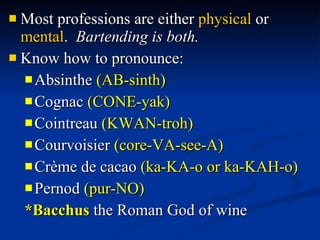
Most professions are either  physical  or  mental .  Bartending is both. Know how to pronounce:  Absinthe  (AB-sinth) Cognac  (CONE-yak) Cointreau  (KWAN-troh) Courvoisier  (core-VA-see-A) Crème de cacao  (ka-KA-o or ka-KAH-o) Pernod  (pur-NO) *Bacchus  the Roman God of wine
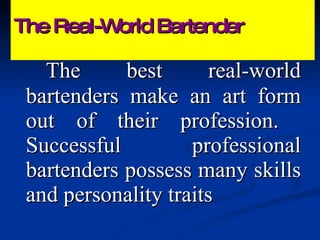
The Real-World Bartender The best real-world bartenders make an art form out of their profession.  Successful professional bartenders possess many skills and personality traits
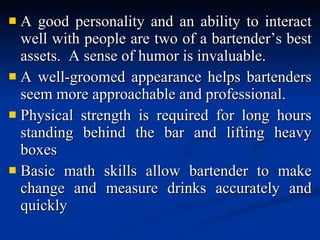
A good personality and an ability to interact well with people are two of a bartender’s best assets.  A sense of humor is invaluable. A well-groomed appearance helps bartenders seem more approachable and professional. Physical strength is required for long hours standing behind the bar and lifting heavy boxes Basic math skills allow bartender to make change and measure drinks accurately and quickly
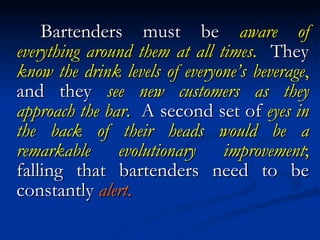
Bartenders must be  aware of everything around them at all times .   They  know the drink levels of everyone’s beverage ,  and they  see new customers as they approach the bar .   A second set of  eyes in the back of their heads would be a remarkable evolutionary improvement ;  falling that bartenders need to be constantly  alert .
The bartender can literally make or break a party.  Since cocktails are complimentary, private-party bartenders must be  very organized with plenty of backup .  Overall, they can  relax and just be the life of the party  because the hassle of running tabs and dealing with credit cards is nonexistent.  The home-party bartender’s main job is  to smile, be happy, and set the tone for the party. THE HOME-PARTY BARTENDER
There are thousands of tips a bartender can learn through the years to help make her job easier and more efficient.  There are far too many to list, but a few will illuminate the way. SERVICE TIPS
When a guest sits at the bar,  always greet him with eye contact  and  a smile  as you lay down a cocktail napkin.  If you cannot get to him right away, let him know that you’ll be right with him.  Guest don’t mind waiting if they are recognized .
Keep the  bar top clean   for customers. Always think of  sanitation.   Don’t let your fingers touch  drinking surfaces – the top of the straw, the rim of a glass, the ice, and the tip of beer bottles. Service Tips
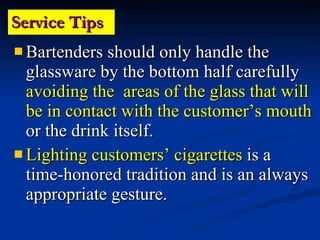
Service Tips Bartenders should only handle the glassware by the bottom half carefully  avoiding the  areas of the glass that will be in contact with the customer’s mouth  or the drink itself. Lighting customers’ cigarettes  is a time-honored tradition and is an always appropriate gesture.
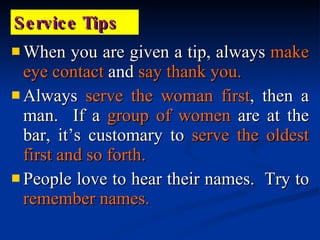
When you are given a tip, always  make eye contact  and  say thank you. Always  serve the woman first , then a man.  If a  group of women  are at the bar, it’s customary to  serve the oldest first and so forth. People love to hear their names.  Try to  remember names. Service Tips

Bartending(History)

  • 1.
  • 2.
  • 3.
    Bartending began asa trade thousands of years ago. Historical accounts from the time of Julius Caesar show that inns situated along the major transportations routes served wine and provisions to travelers. HISTORY OF BARTENDING
  • 4.
    In Rome, neighborhoodtaverns were meeting places for locals to enjoy drinking and gossip. There is evidence that even earlier the ancient Greeks had such places of entertainment and refreshments for travelers.
  • 5.
    It dates backto ancient times and can be found in Roman , Greek , and even Asian societies. Public drinking houses (now called PUB s in England), served as a place for people to socialize. In 15 th century , the majority of bartenders were house owners and female innkeepers who brewed and produced their own liquor.
  • 6.
    Bartenders and barowners were considered members of the economic and social elite . They owned property and were recognized as part of one of the wealthiest traders of all time. This social status of bartending was then passed on to the New World
  • 7.
    Today people stillgather in a variety of public and private establishments for drinking, meeting friends, relaxation , and entertainment. Tending bar involves much more than just serving drinks. In fact, some bartenders leave the “serving” to others. The job may include preparing the drinks, customer service, management, security, and sometimes psychiatrist!
  • 8.
  • 9.
    Jeremiah “Jerry” Thomas(1830-1885) An American bartender “ Father of the American Mixology” born in 1830 in Sackets Harbor, New York He learned bartending in New Haven, Connecticut before sailing for California where he worked as bartender, gold prospector, and show manager
  • 10.
    He toured Europe,carrying along his flashy techniques of mixing cocktails, sometimes while juggling bottles, cups and mixers. At the Hotel in San Francisco , Thomas was earning $100 a week– more than the Vice President of the United States In 1862 , he finished the Bar-Tender’s Guide or the book entitled as “How to Mix Drinks” – the first drink book ever published in United States
  • 11.
    Upon returning toNew York City, he became head bartender at the Metropolitan Hotel before opening his most famous bar on Broadway in 1866. By middle age he was married and had two daughters.
  • 12.
    Towards the endof his life, Thomas tried speculating on Wall Street, but bad judgments rendered him broke. He had to sell his successful saloon and auction off his considerable art collection; he tried opening a new bar but was unable to maintain the level of popularity as his more famous location.
  • 13.
    He died inNew York City of apoplexy (stroke) in 1885 at the age of 55 In December, 2005 a bar opened in the East Village of New York City name Professor Thom’s , in reference to Thomas.
  • 14.
    BARTENDING There aretwo important people who are responsible for quick service in a restaurant or bar- the bartender and the wine steward. Some people dine without drinking alcoholic beverages. The most commonly served beverages are water, sodas, and coffee. For an elegant or leisurely meal, however, wine is increasingly being ordered.
  • 15.
    Flair Bartending It is the practice of bartenders entertaining guests , or audiences with the manipulation of bar tools (ex. cocktail shakers) and liquor bottles in tricky, dazzling ways. used occasionally in cocktail bars, the action requires skills commonly associated with jugglers.
  • 16.
    It has becomea sought-after talent among venue owners and marketers to help advertise a liquor product or the opening of a bar establishment . Competitions have been sponsored by liquor brands to attract flair bartenders, and some hospitality training companies hold courses to teach flair techniques.
  • 17.
    Sometimes referred toas “extreme bartending” The word flair refers to any trickery used by a bartender in order to entertain guests while mixing a drink . Flair can include juggling, flipping (bottles, shakers), manipulating flammable liquors or even performing close-up magic tricks ( “bar-magic” )
  • 18.
    Flair isshowmanship added to bartending that enhances the overall guest experience. The ideas behind mixology and drink-oriented or service-minded bartending can still be upheld with the correct application of working flair.
  • 19.
    IMPORTANCE & OBJECTIVESOF BARTENDING The service staff should be knowledgeable in all aspects of wine service. Professional wine service demand skill. The more a person knows about wines- how each kind tastes, which wine “flavors” complement which foods- the easier it is to sell wines to guests.
  • 20.
    Guest who wantwine with their meal but cannot decide which wine, or are afraid to choose one, will be pleased if a knowledgeable server can make an appropriate suggestion. Having a service staff knowledgeable in wine and how to recommend them-how to pair wines with food and how to provide “flairs” while opening and serving them, can make a real difference.
  • 21.
  • 22.
    Bartender Also calledas barman, barkeeper, barmaid, mixologist, tavern keeper, whiskey slinger One who mixes and serves alcoholic drinks at a bar, lounge, or tavern or similar establishment A bartender may own a bar they tend or be simply an employee Barkeeper carries a stronger connotation of being the purveyor (ownership)
  • 23.
    Bartending basics startwith the lingo. It’s also essential to recognize the glassware. The next thing a bartender needs are proper tools to make the cocktail: ice, alcohol, mixers, and the crowning touch, the garnish
  • 24.
    Bartenders also usuallyserve as the public image of the bar they tend, contributing to as well as reflecting the atmosphere of the bar . Some establishments make the bartender part of the entertainment , expected perhaps to engage in flair bartending.
  • 25.
    Good bartenders help provide a steady client by remembering the favored drinks of regulars. They are sometimes called upon for answers to a wide variety of questions on topics such as sports, trivia, directions, or the marital status of other patrons.
  • 26.
    Most professions areeither physical or mental . Bartending is both. Know how to pronounce: Absinthe (AB-sinth) Cognac (CONE-yak) Cointreau (KWAN-troh) Courvoisier (core-VA-see-A) Crème de cacao (ka-KA-o or ka-KAH-o) Pernod (pur-NO) *Bacchus the Roman God of wine
  • 27.
    The Real-World BartenderThe best real-world bartenders make an art form out of their profession. Successful professional bartenders possess many skills and personality traits
  • 28.
    A good personalityand an ability to interact well with people are two of a bartender’s best assets. A sense of humor is invaluable. A well-groomed appearance helps bartenders seem more approachable and professional. Physical strength is required for long hours standing behind the bar and lifting heavy boxes Basic math skills allow bartender to make change and measure drinks accurately and quickly
  • 29.
    Bartenders must be aware of everything around them at all times . They know the drink levels of everyone’s beverage , and they see new customers as they approach the bar . A second set of eyes in the back of their heads would be a remarkable evolutionary improvement ; falling that bartenders need to be constantly alert .
  • 30.
    The bartender canliterally make or break a party. Since cocktails are complimentary, private-party bartenders must be very organized with plenty of backup . Overall, they can relax and just be the life of the party because the hassle of running tabs and dealing with credit cards is nonexistent. The home-party bartender’s main job is to smile, be happy, and set the tone for the party. THE HOME-PARTY BARTENDER
  • 31.
    There are thousandsof tips a bartender can learn through the years to help make her job easier and more efficient. There are far too many to list, but a few will illuminate the way. SERVICE TIPS
  • 32.
    When a guestsits at the bar, always greet him with eye contact and a smile as you lay down a cocktail napkin. If you cannot get to him right away, let him know that you’ll be right with him. Guest don’t mind waiting if they are recognized .
  • 33.
    Keep the bar top clean for customers. Always think of sanitation. Don’t let your fingers touch drinking surfaces – the top of the straw, the rim of a glass, the ice, and the tip of beer bottles. Service Tips
  • 34.
    Service Tips Bartendersshould only handle the glassware by the bottom half carefully avoiding the areas of the glass that will be in contact with the customer’s mouth or the drink itself. Lighting customers’ cigarettes is a time-honored tradition and is an always appropriate gesture.
  • 35.
    When you aregiven a tip, always make eye contact and say thank you. Always serve the woman first , then a man. If a group of women are at the bar, it’s customary to serve the oldest first and so forth. People love to hear their names. Try to remember names. Service Tips