CLASSROOM RULES
Turn Off Cell Phones and Electronic Devices: When class is in
session.
Use Polite Speech and Body Language: Always behave in a way
that is respectful to your teacher and fellow students.
Speak When Permitted: Most of the time, you must raise your
hand in class and wait to be called on before speaking.
If You Have a Question, Ask for Help: If something is confusing
ask your teacher or your colleagues for help.
- CJ
CHAPEL JUN M. PACIENTE
Republic of the Philippines
DEPARTMENT OF EDUCATION
Region X – Northern Mindanao
Division of Lanao del Norte
Pagayawan Integrated School
Pagayawan, Bacolod, Lanao del Norte
Disaster Readiness
and
Risk Reduction
REVIEW/RECAP
WHAT ARE THE THREE IMPORTANT ELEMENTS OF THE FIRE
TRIANGLE
-
FUEL
-
OXYGEN
-
HEAT
REVIEW/RECAP
FIRE INCIDENTS CAN BE CAUSE BY:
- NATURAL PHEOMENA
- MAN-
MADE
REVIEW/RECAP
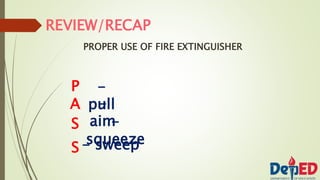
PROPER USE OF FIRE EXTINGUISHER
P -
pull
A
S
S
-
aim
-
squeeze
- sweep
REVIEW/RECAP
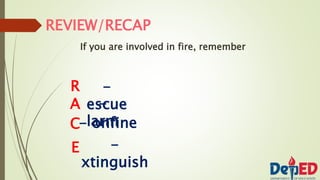
If you are involved in fire, remember
R -
escue
A
C
E
-
larm
- onfine
-
xtinguish
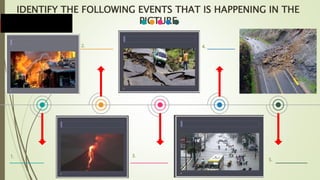
1.
2.
3.
4.
5.
IDENTIFY THE FOLLOWING EVENTS THAT IS HAPPENING IN THE
PICTURE
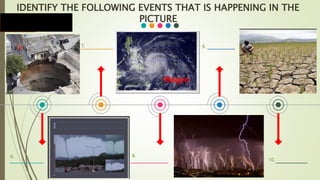
6.
7.
8.
9.
10.
IDENTIFY THE FOLLOWING EVENTS THAT IS HAPPENING IN THE
PICTURE
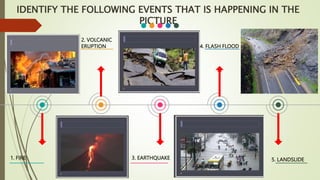
1. FIRE
2. VOLCANIC
ERUPTION
3. EARTHQUAKE
4. FLASH FLOOD
5. LANDSLIDE
IDENTIFY THE FOLLOWING EVENTS THAT IS HAPPENING IN THE
PICTURE
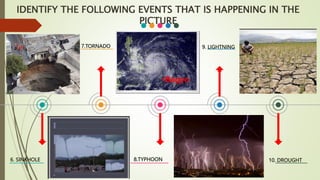
6. SINKHOLE
7.TORNADO
8.TYPHOON
9. LIGHTNING
10. DROUGHT
IDENTIFY THE FOLLOWING EVENTS THAT IS HAPPENING IN THE
PICTURE
DEFINITION OF
DISASTER
LESSON 1
At the end of the class, you are
expected to:
LEARNING
COMPETENCY
EXPLAIN THE MEANING OF
DISASTER
DRR11/12-Ia-b-1
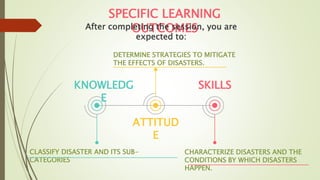
KNOWLEDG
E
CLASSIFY DISASTER AND ITS SUB-
CATEGORIES
ATTITUD
E
DETERMINE STRATEGIES TO MITIGATE
THE EFFECTS OF DISASTERS.
SKILLS
CHARACTERIZE DISASTERS AND THE
CONDITIONS BY WHICH DISASTERS
HAPPEN.
SPECIFIC LEARNING
OUTCOMES
After completing the session, you are
expected to:
INTRODUCTIO
N
Every year, millions of people around the world are
affected by either human-cause or natural disasters.
Disasters take different forms like volcanic eruptions,
earthquakes, floods, tornadoes, fires. etc.
In a disaster, people face the danger of death or
physical injury.
They may also loss their homes, possessions, and
community where they live in.
DEFINITION OF TERMS
What is it?
DISASTE
R
- is "a natural or man-made, sudden,
progressive, calamitous occurrence that
causes great harm, injury, destruction, and
devastation to life and property”.
- A serious disruption of functioning of
society, causing widespread human, material
or environmental losses.
DISASTER
HERE ARE SOME EXAMPLES OF DISASTER
2009
3
2006
2
2013
1
TYPHOON
YOLANDA
- STRENGTH 290
KM/HR
- MORE THAN 7,000
PEOPLE DIED
- THE ENTIRE CITY OF
TACLOBAN WAS
FLATTENED
- THE STORM SURGE IT
BROUGHT WAS
SUDDEN AND
UNEXPECTED
WOWOWEE
STAMPEDE
- Became so popular that
thousands of fans flock to
ULTRA to watch this noon
time show. That turned
out to disastrous tragedy
when there was a human-
induced disturbance
among the crowd that
cause the stampede.
TYPHOON
ONDOY
- HEAVY RAINS THAT
LASTED SEVERAL DAYS
CAUSING FLOOD AND
FLASH FLOODS IN
METRO MANILA.
- THOUSANDS OF HOUSES
WERE SUMERGED IN
FLOOD WATER.
- POWER AND WATER
SUPPLIES WERE CUT OFF.
- HUNDREDS OF LIVES
PERSIHED
DEFINITION OF TERMS
STORM
SURGE
- Is a rise in sea level that occurs
during intense storms like typhoons.
- The storms produce strong winds
that push the water into shore,
which can lead to flooding.
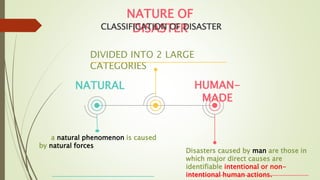
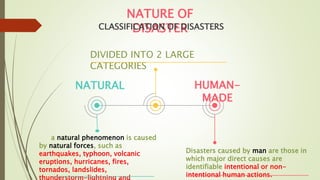
NATURAL
a natural phenomenon is caused
by natural forces
DIVIDED INTO 2 LARGE
CATEGORIES
HUMAN-
MADE
Disasters caused by man are those in
which major direct causes are
identifiable intentional or non-
intentional human actions.
NATURE OF
DISASTER
CLASSIFICATION OF DISASTER
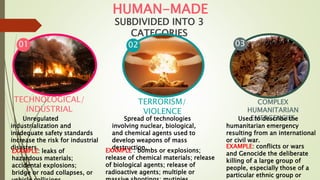
NATURAL
a natural phenomenon is caused
by natural forces, such as
earthquakes, typhoon, volcanic
eruptions, hurricanes, fires,
tornados, landslides,
thunderstorm-lightning and
DIVIDED INTO 2 LARGE
CATEGORIES
HUMAN-
MADE
Disasters caused by man are those in
which major direct causes are
identifiable intentional or non-
intentional human actions.
NATURE OF
DISASTER
CLASSIFICATION OF DISASTERS
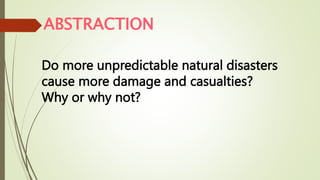
HUMAN-MADE
SUBDIVIDED INTO 3
CATEGORIES
01 02 03
TECHNOLOGICAL/
INDUSTRIAL
Unregulated
industrialization and
inadequate safety standards
increase the risk for industrial
disasters.
EXAMPLE: leaks of
hazardous materials;
accidental explosions;
bridge or road collapses, or
TERRORISM/
VIOLENCE
Spread of technologies
involving nuclear, biological,
and chemical agents used to
develop weapons of mass
destruction.
EXAMPLE : bombs or explosions;
release of chemical materials; release
of biological agents; release of
radioactive agents; multiple or
COMPLEX
HUMANITARIAN
EMERGENCIES
Used to describe the
humanitarian emergency
resulting from an international
or civil war.
EXAMPLE: conflicts or wars
and Genocide the deliberate
killing of a large group of
people, especially those of a
particular ethnic group or
GROUP
ACTIVITY
RUBRICS
TIME ALLOTTED: 10 MINS
RELEVANCE OF THE TOPIC - 10 POINTS
PRESENTATION - 15 POINTS
TEAMWORK - 15 POINTS
TOTAL = 40 POINTS
ABSTRACTION
Do more unpredictable natural disasters
cause more damage and casualties?
Why or why not?
APPLICATION/VALUING
Do you think you are relatively well prepared
when a disaster might affect your community
either natural or man-made as well as to its
effects?
List down five (5) strategies that you need to
prepare in order to mitigate the effects of disaster.
REFLECTION (values
formation)
“I would probably panic and run anywhere might
cause other people panic too.”
Also.. “I might be in a position where it is
vulnerable for me to be get hit by debris from
above”
POST-
TEST
INSTRUCTION:
- Choose the letter of the best answer. Write the chosen letter
on a separate sheet of paper.
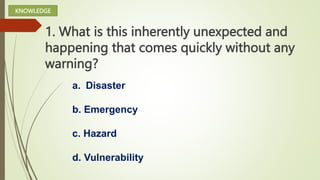
1. What is this inherently unexpected and
happening that comes quickly without any
warning?
a. Disaster
b. Emergency
c. Hazard
d. Vulnerability
KNOWLEDGE
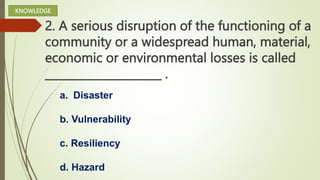
2. A serious disruption of the functioning of a
community or a widespread human, material,
economic or environmental losses is called
_____________________ .
a. Disaster
b. Vulnerability
c. Resiliency
d. Hazard
KNOWLEDGE
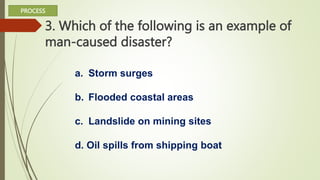
3. Which of the following is an example of
man-caused disaster?
a. Storm surges
b. Flooded coastal areas
c. Landslide on mining sites
d. Oil spills from shipping boat
PROCESS
4.Disaster frequently result in all of the
following EXCEPT
UNDERSTANDING
a. Displacement of populations
b. Damage to the ecological environment
c. Destruction of a population’s homeland
d. Adequate supply of goods and services
5. It is the product of the possible damage
caused by a hazard due to the vulnerability
within a community.
a. Vulnerability
b. Disaster
c. Disaster Risk
d. Hazard
KNOWLEDGE
6. Which of the following is NOT a type of
natural hazard that causes disaster?
a. Tornado
b. Typhoon
c. Earthquake
d. Car accident
PROCESS
7. All of the following are TRUE about
disasters EXCEPT
a. A disaster may be domestic or international
b. A disaster may be caused by nature or human origins
c. A disaster always receives widespread media coverage
d. A disaster may have a known and gradual onset
UNDERSTANDING
8. Which is possible cause of earthquake?
a. Tsunami
b. Volcanic Eruption
c. Landslide
d. Typhoon
PROCESS
9. Which of the following is an example of
natural hazards?
a. Factories
b. Fault lines
c. Mining Sites
d. Chemical Plants
PROCESS
10. Disaster is frequently described as a
result of various condition except
__________________________________.
a. exposure to hazard
b. having enough physical, social, and attitudinal capabilities
c. conditions of vulnerability at present
d. insufficient capacity or measures to cope with disasters
UNDERSTANDING
ASSIGNMENT
Conduct a Research of some events in the
Philippines that turned to a disaster. Classify such
event whether they are natural or human-made.
Thanks for
Listening with
great patience
- FIN

DEMONSTRATION LEARNING ACTION CELL FINAL

  • 2.
    CLASSROOM RULES Turn OffCell Phones and Electronic Devices: When class is in session. Use Polite Speech and Body Language: Always behave in a way that is respectful to your teacher and fellow students. Speak When Permitted: Most of the time, you must raise your hand in class and wait to be called on before speaking. If You Have a Question, Ask for Help: If something is confusing ask your teacher or your colleagues for help. - CJ
  • 4.
    CHAPEL JUN M.PACIENTE Republic of the Philippines DEPARTMENT OF EDUCATION Region X – Northern Mindanao Division of Lanao del Norte Pagayawan Integrated School Pagayawan, Bacolod, Lanao del Norte Disaster Readiness and Risk Reduction
  • 5.
    REVIEW/RECAP WHAT ARE THETHREE IMPORTANT ELEMENTS OF THE FIRE TRIANGLE - FUEL - OXYGEN - HEAT
  • 6.
    REVIEW/RECAP FIRE INCIDENTS CANBE CAUSE BY: - NATURAL PHEOMENA - MAN- MADE
  • 7.
    REVIEW/RECAP PROPER USE OFFIRE EXTINGUISHER P - pull A S S - aim - squeeze - sweep
  • 8.
    REVIEW/RECAP If you areinvolved in fire, remember R - escue A C E - larm - onfine - xtinguish
  • 9.
    1. 2. 3. 4. 5. IDENTIFY THE FOLLOWINGEVENTS THAT IS HAPPENING IN THE PICTURE
  • 10.
    6. 7. 8. 9. 10. IDENTIFY THE FOLLOWINGEVENTS THAT IS HAPPENING IN THE PICTURE
  • 11.
    1. FIRE 2. VOLCANIC ERUPTION 3.EARTHQUAKE 4. FLASH FLOOD 5. LANDSLIDE IDENTIFY THE FOLLOWING EVENTS THAT IS HAPPENING IN THE PICTURE
  • 12.
    6. SINKHOLE 7.TORNADO 8.TYPHOON 9. LIGHTNING 10.DROUGHT IDENTIFY THE FOLLOWING EVENTS THAT IS HAPPENING IN THE PICTURE
  • 13.
  • 14.
    At the endof the class, you are expected to: LEARNING COMPETENCY EXPLAIN THE MEANING OF DISASTER DRR11/12-Ia-b-1
  • 15.
    KNOWLEDG E CLASSIFY DISASTER ANDITS SUB- CATEGORIES ATTITUD E DETERMINE STRATEGIES TO MITIGATE THE EFFECTS OF DISASTERS. SKILLS CHARACTERIZE DISASTERS AND THE CONDITIONS BY WHICH DISASTERS HAPPEN. SPECIFIC LEARNING OUTCOMES After completing the session, you are expected to:
  • 16.
    INTRODUCTIO N Every year, millionsof people around the world are affected by either human-cause or natural disasters. Disasters take different forms like volcanic eruptions, earthquakes, floods, tornadoes, fires. etc. In a disaster, people face the danger of death or physical injury. They may also loss their homes, possessions, and community where they live in.
  • 17.
    DEFINITION OF TERMS Whatis it? DISASTE R - is "a natural or man-made, sudden, progressive, calamitous occurrence that causes great harm, injury, destruction, and devastation to life and property”. - A serious disruption of functioning of society, causing widespread human, material or environmental losses.
  • 18.
    DISASTER HERE ARE SOMEEXAMPLES OF DISASTER 2009 3 2006 2 2013 1 TYPHOON YOLANDA - STRENGTH 290 KM/HR - MORE THAN 7,000 PEOPLE DIED - THE ENTIRE CITY OF TACLOBAN WAS FLATTENED - THE STORM SURGE IT BROUGHT WAS SUDDEN AND UNEXPECTED WOWOWEE STAMPEDE - Became so popular that thousands of fans flock to ULTRA to watch this noon time show. That turned out to disastrous tragedy when there was a human- induced disturbance among the crowd that cause the stampede. TYPHOON ONDOY - HEAVY RAINS THAT LASTED SEVERAL DAYS CAUSING FLOOD AND FLASH FLOODS IN METRO MANILA. - THOUSANDS OF HOUSES WERE SUMERGED IN FLOOD WATER. - POWER AND WATER SUPPLIES WERE CUT OFF. - HUNDREDS OF LIVES PERSIHED
  • 19.
    DEFINITION OF TERMS STORM SURGE -Is a rise in sea level that occurs during intense storms like typhoons. - The storms produce strong winds that push the water into shore, which can lead to flooding.
  • 20.
    NATURAL a natural phenomenonis caused by natural forces DIVIDED INTO 2 LARGE CATEGORIES HUMAN- MADE Disasters caused by man are those in which major direct causes are identifiable intentional or non- intentional human actions. NATURE OF DISASTER CLASSIFICATION OF DISASTER
  • 21.
    NATURAL a natural phenomenonis caused by natural forces, such as earthquakes, typhoon, volcanic eruptions, hurricanes, fires, tornados, landslides, thunderstorm-lightning and DIVIDED INTO 2 LARGE CATEGORIES HUMAN- MADE Disasters caused by man are those in which major direct causes are identifiable intentional or non- intentional human actions. NATURE OF DISASTER CLASSIFICATION OF DISASTERS
  • 22.
    HUMAN-MADE SUBDIVIDED INTO 3 CATEGORIES 0102 03 TECHNOLOGICAL/ INDUSTRIAL Unregulated industrialization and inadequate safety standards increase the risk for industrial disasters. EXAMPLE: leaks of hazardous materials; accidental explosions; bridge or road collapses, or TERRORISM/ VIOLENCE Spread of technologies involving nuclear, biological, and chemical agents used to develop weapons of mass destruction. EXAMPLE : bombs or explosions; release of chemical materials; release of biological agents; release of radioactive agents; multiple or COMPLEX HUMANITARIAN EMERGENCIES Used to describe the humanitarian emergency resulting from an international or civil war. EXAMPLE: conflicts or wars and Genocide the deliberate killing of a large group of people, especially those of a particular ethnic group or
  • 23.
    GROUP ACTIVITY RUBRICS TIME ALLOTTED: 10MINS RELEVANCE OF THE TOPIC - 10 POINTS PRESENTATION - 15 POINTS TEAMWORK - 15 POINTS TOTAL = 40 POINTS
  • 24.
    ABSTRACTION Do more unpredictablenatural disasters cause more damage and casualties? Why or why not?
  • 25.
    APPLICATION/VALUING Do you thinkyou are relatively well prepared when a disaster might affect your community either natural or man-made as well as to its effects? List down five (5) strategies that you need to prepare in order to mitigate the effects of disaster.
  • 26.
    REFLECTION (values formation) “I wouldprobably panic and run anywhere might cause other people panic too.” Also.. “I might be in a position where it is vulnerable for me to be get hit by debris from above”
  • 27.
    POST- TEST INSTRUCTION: - Choose theletter of the best answer. Write the chosen letter on a separate sheet of paper.
  • 28.
    1. What isthis inherently unexpected and happening that comes quickly without any warning? a. Disaster b. Emergency c. Hazard d. Vulnerability KNOWLEDGE
  • 29.
    2. A seriousdisruption of the functioning of a community or a widespread human, material, economic or environmental losses is called _____________________ . a. Disaster b. Vulnerability c. Resiliency d. Hazard KNOWLEDGE
  • 30.
    3. Which ofthe following is an example of man-caused disaster? a. Storm surges b. Flooded coastal areas c. Landslide on mining sites d. Oil spills from shipping boat PROCESS
  • 31.
    4.Disaster frequently resultin all of the following EXCEPT UNDERSTANDING a. Displacement of populations b. Damage to the ecological environment c. Destruction of a population’s homeland d. Adequate supply of goods and services
  • 32.
    5. It isthe product of the possible damage caused by a hazard due to the vulnerability within a community. a. Vulnerability b. Disaster c. Disaster Risk d. Hazard KNOWLEDGE
  • 33.
    6. Which ofthe following is NOT a type of natural hazard that causes disaster? a. Tornado b. Typhoon c. Earthquake d. Car accident PROCESS
  • 34.
    7. All ofthe following are TRUE about disasters EXCEPT a. A disaster may be domestic or international b. A disaster may be caused by nature or human origins c. A disaster always receives widespread media coverage d. A disaster may have a known and gradual onset UNDERSTANDING
  • 35.
    8. Which ispossible cause of earthquake? a. Tsunami b. Volcanic Eruption c. Landslide d. Typhoon PROCESS
  • 36.
    9. Which ofthe following is an example of natural hazards? a. Factories b. Fault lines c. Mining Sites d. Chemical Plants PROCESS
  • 37.
    10. Disaster isfrequently described as a result of various condition except __________________________________. a. exposure to hazard b. having enough physical, social, and attitudinal capabilities c. conditions of vulnerability at present d. insufficient capacity or measures to cope with disasters UNDERSTANDING
  • 38.
    ASSIGNMENT Conduct a Researchof some events in the Philippines that turned to a disaster. Classify such event whether they are natural or human-made.
  • 39.