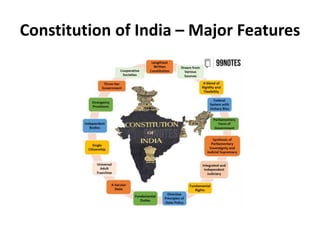
Constitution of India – Major Features
• 1. Lengthiest constitution
• It is the lengthiest and the longest constitution
in the world. It has 395 Articles and 12
Schedules. Also, about 90 Articles have been
added since 1951 and there have been more
than 100 Amendments.
• But, as the Articles are not separately added
but as a part of an existing Article, the total
number of Articles remain the same.
• 2. Drawn from Different Sources
• The basis of the basic structure such as
Federal scheme, Judiciary, Governors,
Emergency powers, Public Service
Commissions, Administrative details, etc. are
from the Government of India Act,1935.
• 3. Federal System and Unitary Features
• The federal features of governance are a dual system of
government i.e. center and states, the division of powers
between the executive, judiciary and legislature which are
the three organs of the state, Supremacy of the
Constitution, independent Judiciary and bicameralism.
• The Indian constitution contains all these features. Thus, it
is a federal system.
• But, it also contains many unitary features such as a strong
center, All India Services common to the center and the
states, emergency provisions that can modify the
Constitution into a unitary one, the appointment of
Governors by the President on the advice of the center, etc.
• 4. Parliamentary Form of Government
• The Indian Constitution chose the Parliamentary
form of government. In a Parliamentary form of
government executive is part of the legislature
and there is a collective responsibility of the
council of ministers to the legislature.
• Also, there exists majority party rule and the
Prime Minister is the leader of the country and
the Chief Minister is the leader in the state.
• 5. Parliamentary Sovereignty and Judicial
Supremacy
• The Indian Constitution has a proper balance
between Parliamentary sovereignty and Judicial
Supremacy. The Supreme Court has the power of
judicial review vide Articles 13, 32 and 136.
• Thus, it can cancel any Parliamentary law as
unconstitutional. On the other hand, the
Parliament has the authority to make laws and
also amend the major portion of the Constitution
vide Article 368.
• 6. Independent and Integrated Judicial
System
• As per the Indian constitution, a single
system of judiciary prevails in India. The
Supreme Court is at the top, the High Courts
at the state level and district and other
subordinate courts are below and are subject
to the supervision of the High Courts.
• Also, all the levels of courts have a duty of
enforcing central as well as state laws.
• 7. Directive Principles
• The Directive Principles of State Policies in
Part IV of the Constitution intends to make
India a welfare state. The Directive Principles
are not enforceable by the courts for their
violation.
• However, it is a moral obligation of the state
to apply these principles in making laws.
• 8. Rigid and Flexible
• The Indian Constitution is a combination or
a blend of rigidity and flexibility.
• As per Article 368, some provisions can be
amended by a special majority of
the Parliament i.e. a 2/3rd majority of the
members of each House present and voting
and majority which is more than 50 percent of
the total membership of each House.
• 9. Fundamental Rights
• Part III of the Indian Constitution guarantees
six fundamental rights to all Citizens.
• Fundamental Rights are one of the important
features of the Indian Constitution.
• 10. Directive Principles of State Policy
• According to Dr B R Ambedkar, the Directive
Principles of State Policy is a ‘novel feature’ of
the Indian Constitution.
• They are enumerated in Part IV of the
Constitution.
• 11. Fundamental Duties
• The original constitution did not provide for
the fundamental duties of the citizens.
• Fundamental Duties were added to our
Constitution by the 42nd Amendment Act of
1976 on the recommendation of the Swaran
Singh Committee.
• 12. Indian Secularism
• The Constitution of India stands for a secular
state.
• Hence, it does not uphold any particular
religion as the official religion of the Indian
State.
• 13. Universal Adult Franchise
• Indian democracy functions on the basis of
‘one person one vote’.
• Every citizen of India who is 18 years of age or
above is entitled to vote in the elections
irrespective of caste, sex, race, religion or
status.
• 14. Single Citizenship
• In a federal state usually, the citizens enjoy
double citizenship as is the case in the USA.
• In India, there is only single citizenship.
• It means that every Indian is a citizen of India,
irrespective of the place of his/her residence
or place of birth.
• 15. Independent Bodies
• The Indian Constitution not only provides
for the legislative, executive and judicial
organs of the government (Central and
state) but also establishes certain
independent bodies.
• They are envisaged by the Constitution as
the bulwarks of the democratic system of
Government in India.
• 16. Emergency Provisions
• The Constitution makers also foresaw that
there could be situations when the
government could not be run as in ordinary
times.
• 17. Three-tier Government
• Originally, the Indian Constitution provided for
a dual polity and contained provisions with
regard to the organisation and powers of the
Centre and the States.
• 18. Co-operative Societies
• The 97th Constitutional Amendment Act of
2011 gave constitutional status and protection
of cooperative societies.
Thank you

coi2.pptx

  • 1.
    Constitution of India– Major Features
  • 2.
    • 1. Lengthiestconstitution • It is the lengthiest and the longest constitution in the world. It has 395 Articles and 12 Schedules. Also, about 90 Articles have been added since 1951 and there have been more than 100 Amendments. • But, as the Articles are not separately added but as a part of an existing Article, the total number of Articles remain the same.
  • 3.
    • 2. Drawnfrom Different Sources • The basis of the basic structure such as Federal scheme, Judiciary, Governors, Emergency powers, Public Service Commissions, Administrative details, etc. are from the Government of India Act,1935.
  • 4.
    • 3. FederalSystem and Unitary Features • The federal features of governance are a dual system of government i.e. center and states, the division of powers between the executive, judiciary and legislature which are the three organs of the state, Supremacy of the Constitution, independent Judiciary and bicameralism. • The Indian constitution contains all these features. Thus, it is a federal system. • But, it also contains many unitary features such as a strong center, All India Services common to the center and the states, emergency provisions that can modify the Constitution into a unitary one, the appointment of Governors by the President on the advice of the center, etc.
  • 5.
    • 4. ParliamentaryForm of Government • The Indian Constitution chose the Parliamentary form of government. In a Parliamentary form of government executive is part of the legislature and there is a collective responsibility of the council of ministers to the legislature. • Also, there exists majority party rule and the Prime Minister is the leader of the country and the Chief Minister is the leader in the state.
  • 6.
    • 5. ParliamentarySovereignty and Judicial Supremacy • The Indian Constitution has a proper balance between Parliamentary sovereignty and Judicial Supremacy. The Supreme Court has the power of judicial review vide Articles 13, 32 and 136. • Thus, it can cancel any Parliamentary law as unconstitutional. On the other hand, the Parliament has the authority to make laws and also amend the major portion of the Constitution vide Article 368.
  • 7.
    • 6. Independentand Integrated Judicial System • As per the Indian constitution, a single system of judiciary prevails in India. The Supreme Court is at the top, the High Courts at the state level and district and other subordinate courts are below and are subject to the supervision of the High Courts. • Also, all the levels of courts have a duty of enforcing central as well as state laws.
  • 8.
    • 7. DirectivePrinciples • The Directive Principles of State Policies in Part IV of the Constitution intends to make India a welfare state. The Directive Principles are not enforceable by the courts for their violation. • However, it is a moral obligation of the state to apply these principles in making laws.
  • 9.
    • 8. Rigidand Flexible • The Indian Constitution is a combination or a blend of rigidity and flexibility. • As per Article 368, some provisions can be amended by a special majority of the Parliament i.e. a 2/3rd majority of the members of each House present and voting and majority which is more than 50 percent of the total membership of each House.
  • 10.
    • 9. FundamentalRights • Part III of the Indian Constitution guarantees six fundamental rights to all Citizens. • Fundamental Rights are one of the important features of the Indian Constitution.
  • 11.
    • 10. DirectivePrinciples of State Policy • According to Dr B R Ambedkar, the Directive Principles of State Policy is a ‘novel feature’ of the Indian Constitution. • They are enumerated in Part IV of the Constitution.
  • 12.
    • 11. FundamentalDuties • The original constitution did not provide for the fundamental duties of the citizens. • Fundamental Duties were added to our Constitution by the 42nd Amendment Act of 1976 on the recommendation of the Swaran Singh Committee.
  • 13.
    • 12. IndianSecularism • The Constitution of India stands for a secular state. • Hence, it does not uphold any particular religion as the official religion of the Indian State.
  • 14.
    • 13. UniversalAdult Franchise • Indian democracy functions on the basis of ‘one person one vote’. • Every citizen of India who is 18 years of age or above is entitled to vote in the elections irrespective of caste, sex, race, religion or status.
  • 15.
    • 14. SingleCitizenship • In a federal state usually, the citizens enjoy double citizenship as is the case in the USA. • In India, there is only single citizenship. • It means that every Indian is a citizen of India, irrespective of the place of his/her residence or place of birth.
  • 16.
    • 15. IndependentBodies • The Indian Constitution not only provides for the legislative, executive and judicial organs of the government (Central and state) but also establishes certain independent bodies. • They are envisaged by the Constitution as the bulwarks of the democratic system of Government in India.
  • 17.
    • 16. EmergencyProvisions • The Constitution makers also foresaw that there could be situations when the government could not be run as in ordinary times.
  • 18.
    • 17. Three-tierGovernment • Originally, the Indian Constitution provided for a dual polity and contained provisions with regard to the organisation and powers of the Centre and the States.
  • 19.
    • 18. Co-operativeSocieties • The 97th Constitutional Amendment Act of 2011 gave constitutional status and protection of cooperative societies.
  • 20.