• Bamboo as Building Material
INTRODUCTION
Bamboo is a woody grass. It is the fastest-growing woody
plant in the world. Some species of bamboo grow so fast
you can almost see them grow.
Bamboos are some of the fastest growing plants in the
world. They are capable of growing 60 cm or more per day.
However, the growth rate is dependent on local soil and
climatic conditions.
Bamboo are found in diverse climates, from cold mountains
to hot tropical regions. They occur across East Asia, through
to Northern Australia, and west to India and the Himalayas.
• In bamboo, the inter nodal regions of the stem
are hollow and the vascular bundles in the
cross section are scattered throughout the
stem instead of in a cylindrical arrangement.
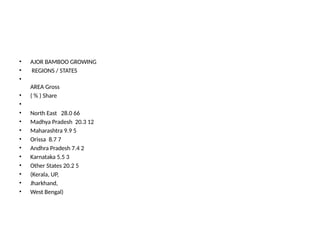
• AJOR BAMBOO GROWING
• REGIONS / STATES
•
AREA Gross
• ( % ) Share
•
• North East 28.0 66
• Madhya Pradesh 20.3 12
• Maharashtra 9.9 5
• Orissa 8.7 7
• Andhra Pradesh 7.4 2
• Karnataka 5.5 3
• Other States 20.2 5
• (Kerala, UP,
• Jharkhand,
• West Bengal)
ADVANTAGES
• Low-cost and environment friendly.
• Light weight compared to steel.
• Shock absorbing and thus earthquake resistant.
• It uses less fossil fuel to manufacture.
• Bamboo can prevent pollution by absorbing large
amounts of nitrogen from waste water and
reducing the amount of carbon dioxide in the air.
• Its abundance in tropical and subtropical regions
makes it an economically advantageous material.
Uses
• Scaffolding
•
Reinforcement
•
Roofing
•
Walling
•
Doors & Windows
TENSIL STRESS AND UNIT WEIGHT
• The common tensile stress in steel reinforcement
is 160 N/mm2
and in bamboo 370 N/mm2
.
•
The mass per volume of steel is 7850 kg/m3
and
of bamboo is about 500-600 kg/m3
.
•
Evidently bamboo will be cheaper because the
price of bamboo per weight will be less than half
that of steel.
MODULUS OF ELASTICITY
• The cellulose fibers in bamboo act as
reinforcement similar to reinforcing steel bars in
concrete. The distribution of these fibers
increases from the inside to the outside.
• The E-modulus for cellulose is 70 000 N/mm2
and about 50% of the cross-section of the fiber
is cellulose; the E of the fiber is 35 000 N/mm2
.
• In most bamboos, fibers constitute about 60%
on the outside and 10% on the inside.
• The density of the fibers in the cross-section of
a bamboo shell varies along its thickness.
• This presents a functionally gradient material,
evolved according to the state of stress
distribution in its natural environment.
• The fibers are concentrated in regions closer to
the outer skin. This is consistent with the state
of stress distribution when the Culm is
subjected to wind
Durability
• Bamboo with low humidity is less prone to mould
attacks especially when humidity content is less than
15%.
•
Physical and mechanical properties of bamboo
increase with a decrease in its humidity content.
•
Bamboo to be treated with a preservative needs to be
dry to facilitate penetration. Bamboo can be dried in
air, green house, and oven or by fire.
• The durability of bamboo depends strongly on the
preservative treatment methods in accordance
with basic requirements, its chemical composition
should not have any effect on the bamboo fiber
and once injected it must not be washed out by
rain or humidity.
• Many steel and concrete structures built in the
past 30years reveal serious deterioration caused
mainly by the corrosion of the steel reinforcement.
Disadvantages
• It is not that uniform, i.e., large varieties of bamboo
are found having different tensile strength.
• It has tendency to absorb water and also to release
water on drying.
• Bamboo wood is easily infected by wood-boring
insects and attracts living organisms, such as, fungi
and insects because of its high content of nutrients
unless treated with wood preservatives or kept very
dry.
• It is susceptible to catch fire as compared to steel.


PPT-March bamboo as building material.pptx

  • 1.
    • Bamboo asBuilding Material
  • 2.
    INTRODUCTION Bamboo is awoody grass. It is the fastest-growing woody plant in the world. Some species of bamboo grow so fast you can almost see them grow. Bamboos are some of the fastest growing plants in the world. They are capable of growing 60 cm or more per day. However, the growth rate is dependent on local soil and climatic conditions. Bamboo are found in diverse climates, from cold mountains to hot tropical regions. They occur across East Asia, through to Northern Australia, and west to India and the Himalayas.
  • 3.
    • In bamboo,the inter nodal regions of the stem are hollow and the vascular bundles in the cross section are scattered throughout the stem instead of in a cylindrical arrangement.
  • 4.
    • AJOR BAMBOOGROWING • REGIONS / STATES • AREA Gross • ( % ) Share • • North East 28.0 66 • Madhya Pradesh 20.3 12 • Maharashtra 9.9 5 • Orissa 8.7 7 • Andhra Pradesh 7.4 2 • Karnataka 5.5 3 • Other States 20.2 5 • (Kerala, UP, • Jharkhand, • West Bengal)
  • 5.
    ADVANTAGES • Low-cost andenvironment friendly. • Light weight compared to steel. • Shock absorbing and thus earthquake resistant. • It uses less fossil fuel to manufacture. • Bamboo can prevent pollution by absorbing large amounts of nitrogen from waste water and reducing the amount of carbon dioxide in the air. • Its abundance in tropical and subtropical regions makes it an economically advantageous material.
  • 6.
  • 7.
    TENSIL STRESS ANDUNIT WEIGHT • The common tensile stress in steel reinforcement is 160 N/mm2 and in bamboo 370 N/mm2 . • The mass per volume of steel is 7850 kg/m3 and of bamboo is about 500-600 kg/m3 . • Evidently bamboo will be cheaper because the price of bamboo per weight will be less than half that of steel.
  • 8.
    MODULUS OF ELASTICITY •The cellulose fibers in bamboo act as reinforcement similar to reinforcing steel bars in concrete. The distribution of these fibers increases from the inside to the outside. • The E-modulus for cellulose is 70 000 N/mm2 and about 50% of the cross-section of the fiber is cellulose; the E of the fiber is 35 000 N/mm2 . • In most bamboos, fibers constitute about 60% on the outside and 10% on the inside.
  • 9.
    • The densityof the fibers in the cross-section of a bamboo shell varies along its thickness. • This presents a functionally gradient material, evolved according to the state of stress distribution in its natural environment. • The fibers are concentrated in regions closer to the outer skin. This is consistent with the state of stress distribution when the Culm is subjected to wind
  • 10.
    Durability • Bamboo withlow humidity is less prone to mould attacks especially when humidity content is less than 15%. • Physical and mechanical properties of bamboo increase with a decrease in its humidity content. • Bamboo to be treated with a preservative needs to be dry to facilitate penetration. Bamboo can be dried in air, green house, and oven or by fire.
  • 11.
    • The durabilityof bamboo depends strongly on the preservative treatment methods in accordance with basic requirements, its chemical composition should not have any effect on the bamboo fiber and once injected it must not be washed out by rain or humidity. • Many steel and concrete structures built in the past 30years reveal serious deterioration caused mainly by the corrosion of the steel reinforcement.
  • 12.
    Disadvantages • It isnot that uniform, i.e., large varieties of bamboo are found having different tensile strength. • It has tendency to absorb water and also to release water on drying. • Bamboo wood is easily infected by wood-boring insects and attracts living organisms, such as, fungi and insects because of its high content of nutrients unless treated with wood preservatives or kept very dry. • It is susceptible to catch fire as compared to steel.