SEMINAR REPORT 
TITLED 
DISASTER ASSESSMENT 
SUBMITTED 
BY: 
SOHINI SHAH 
ANERI SAVANI 
RITUSHA SHAH 
ARVA CHUNAVALA 
Department of Computer Engineering
DISASTER ASSESSMENT 
WHAT IS DISASTER? 
A disaster can be defined as any occurrence that causes damage , ecological 
disruption, loss of human life, deterioration of health and health services on 
largescale. 
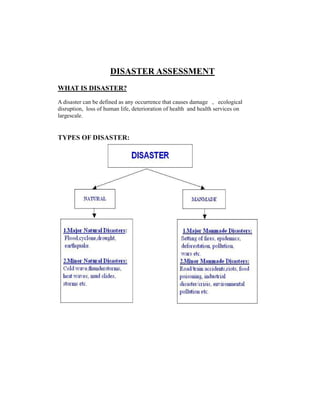
TYPES OF DISASTER:
TYPES OF NATURAL DISASTER: 
1.FLOOD 
A flood is an overflow of water, a deluge of water that submerges land which is 
normally dry. 
FACTORS CONTRIBUTING TO FLOODING: 
• Rainfall intensity 
• Rainfall duration 
• Topography 
• Soil conditions 
• Ground cover 
CAUSES OF FLOOD AND FLOOD DAMAGE: 
 Heavy rain 
 Spring snowmelt 
 Dam and levee failure 
 Low absorption or no soil percolation 
 Business and residential growth in flood areas. 
FLOOD PREPAREDNESS: 
 Know flood risk in area 
 Prepare flood evacuation plan 
 Obtain flood insurance if living in floodplain 
 Keep important documents in water-proof box 
 Check portable radio for current information and emergency messages 
AFTER FLOOD: 
 Stay out of flooded areas 
 Reserve telephone for emergencies 
 Avoid driving, except in emergencies 
 Wait for authorities to issue message that it is safe to return 
 Be aware that snakes and other animals may be in your house 
• Stay out of flooded 
areas 
• Reserve telephone for emergencies
2.DROUGHT 
 There are many definitions, but usually it is a period of time where there is 
much less than average rainfall. 
TYPES OF DROUGHT: 
 We can define drought in three main ways: 
 · Meteorological drought: related to rainfall amounts 
 · Hydrological drought: determined by water levels in reservoirs 
 · Agricultural drought: related to the availability of water for crops 
IMPACTS OF DROUGHT: 
 Humans are conditioned to live with the average rainfall conditions therefore 
in times of drought we suffer. 
 Evapotranspiration, run off and infiltration will help determine the impact of 
the drought. 
 A drought may occur within a few weeks without rain in a humid area but will 
take longer to occur without rain in a arid area. 
 We might define drought in Libya as occurring when annual rainfall is less 
than 180 mm, but in Bali, drought might be considered to occur after a period 
of only 6 days without rain 
FACTORS AFFECTING DROUGHT: 
 Wealth 
 Population 
 Temperature 
 Rainfall 
 Run-off rates 
 Land use 
CAUSES OF DROUGHT: 
 The initial cause of drought is associated with a change in atmospheric 
conditions brought about by: 
 Persistent high pressure 
 El Nino and a change in ocean temperatures 
 Changing depression tracks
3.CYCLONE 
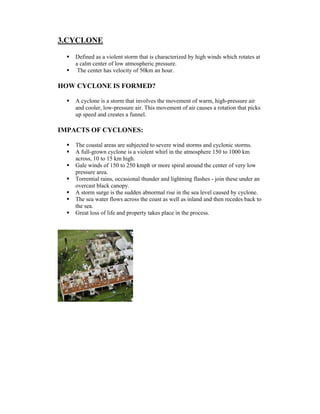
 Defined as a violent storm that is characterized by high winds which rotates at 
a calm center of low atmospheric pressure. 
 The center has velocity of 50km an hour. 
HOW CYCLONE IS FORMED? 
 A cyclone is a storm that involves the movement of warm, high-pressure air 
and cooler, low-pressure air. This movement of air causes a rotation that picks 
up speed and creates a funnel. 
IMPACTS OF CYCLONES: 
 The coastal areas are subjected to severe wind storms and cyclonic storms. 
 A full-grown cyclone is a violent whirl in the atmosphere 150 to 1000 km 
across, 10 to 15 km high. 
 Gale winds of 150 to 250 kmph or more spiral around the center of very low 
pressure area. 
 Torrential rains, occasional thunder and lightning flashes - join these under an 
overcast black canopy. 
 A storm surge is the sudden abnormal rise in the sea level caused by cyclone. 
 The sea water flows across the coast as well as inland and then recedes back to 
the sea. 
 Great loss of life and property takes place in the process.
4.EARTHQUAKE: 
 Earthquake are caused by abrupt release of strain that has build up in 
earth’s crust. 
CAUSES OF EARTHQUAKE: 
 primary cause of an earthquake is faults . 
 Surface causes 
 Volcanic causes 
 Tectonic causes 
EVIDENCE OF UPCOMING EARTHQUAKE ARE: 
FOLLOWING: 
 Unusual animal behaviour 
 Large scale of fluctuation of oil flow from oil wells 
 Temperature change 
 Change in seismic wave velocity 
EFFECTS OF EARTHQUAKE: 
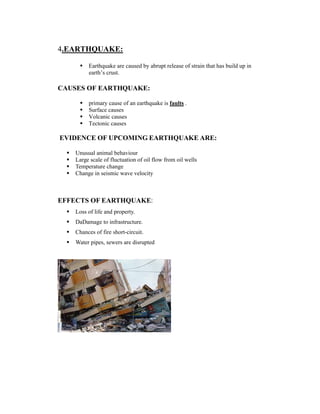
 Loss of life and property. 
 DaDamage to infrastructure. 
 Chances of fire short-circuit. 
 Water pipes, sewers are disrupted
5 .LANDSLIDES 
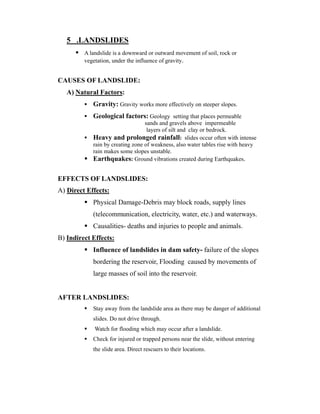
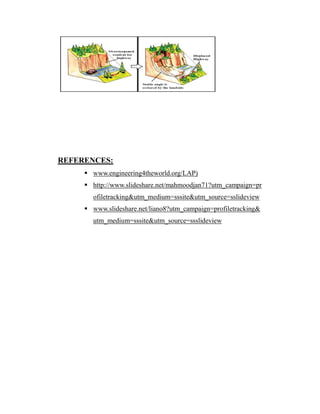
 A landslide is a downward or outward movement of soil, rock or 
vegetation, under the influence of gravity. 
CAUSES OF LANDSLIDE: 
A) Natural Factors: 
 Gravity: Gravity works more effectively on steeper slopes. 
 Geological factors: Geology setting that places permeable 
sands and gravels above impermeable 
layers of silt and clay or bedrock. 
 Heavy and prolonged rainfall: slides occur often with intense 
rain by creating zone of weakness, also water tables rise with heavy 
rain makes some slopes unstable. 
 Earthquakes: Ground vibrations created during Earthquakes. 
EFFECTS OF LANDSLIDES: 
A) Direct Effects: 
 Physical Damage-Debris may block roads, supply lines 
(telecommunication, electricity, water, etc.) and waterways. 
 Causalities- deaths and injuries to people and animals. 
B) Indirect Effects: 
 Influence of landslides in dam safety- failure of the slopes 
bordering the reservoir, Flooding caused by movements of 
large masses of soil into the reservoir. 
AFTER LANDSLIDES: 
 Stay away from the landslide area as there may be danger of additional 
slides. Do not drive through. 
 Watch for flooding which may occur after a landslide. 
 Check for injured or trapped persons near the slide, without entering 
the slide area. Direct rescuers to their locations.
REFERENCES: 
 www.engineering4theworld.org/LAP) 
 http://www.slideshare.net/mahmoodjan71?utm_campaign=pr 
ofiletracking&utm_medium=sssite&utm_source=sslideview 
 www.slideshare.net/liano8?utm_campaign=profiletracking& 
utm_medium=sssite&utm_source=ssslideview
 A landslide is a downward or outward movement of soil, rock 
or vegetation, under the influence of gravity. 
Economic activities like agricult 
• Avoid driving, except in emergencies 
• Wait for authorities to issue message that it is 
safe to return 
• Be aware that snakes and other animals may 
be in your house 
• Stay out of flooded areas 
• Reserve telephone for emergencies 
• Avoid driving, except in emergencies 
• Wait for authorities to issue message that it is 
safe to return 
• Be aware that snakes and other animals may 
be in your house
Disaster assessment pdf

Disaster assessment pdf

  • 1.
    SEMINAR REPORT TITLED DISASTER ASSESSMENT SUBMITTED BY: SOHINI SHAH ANERI SAVANI RITUSHA SHAH ARVA CHUNAVALA Department of Computer Engineering
  • 2.
    DISASTER ASSESSMENT WHATIS DISASTER? A disaster can be defined as any occurrence that causes damage , ecological disruption, loss of human life, deterioration of health and health services on largescale. TYPES OF DISASTER:
  • 3.
    TYPES OF NATURALDISASTER: 1.FLOOD A flood is an overflow of water, a deluge of water that submerges land which is normally dry. FACTORS CONTRIBUTING TO FLOODING: • Rainfall intensity • Rainfall duration • Topography • Soil conditions • Ground cover CAUSES OF FLOOD AND FLOOD DAMAGE:  Heavy rain  Spring snowmelt  Dam and levee failure  Low absorption or no soil percolation  Business and residential growth in flood areas. FLOOD PREPAREDNESS:  Know flood risk in area  Prepare flood evacuation plan  Obtain flood insurance if living in floodplain  Keep important documents in water-proof box  Check portable radio for current information and emergency messages AFTER FLOOD:  Stay out of flooded areas  Reserve telephone for emergencies  Avoid driving, except in emergencies  Wait for authorities to issue message that it is safe to return  Be aware that snakes and other animals may be in your house • Stay out of flooded areas • Reserve telephone for emergencies
  • 4.
    2.DROUGHT  Thereare many definitions, but usually it is a period of time where there is much less than average rainfall. TYPES OF DROUGHT:  We can define drought in three main ways:  · Meteorological drought: related to rainfall amounts  · Hydrological drought: determined by water levels in reservoirs  · Agricultural drought: related to the availability of water for crops IMPACTS OF DROUGHT:  Humans are conditioned to live with the average rainfall conditions therefore in times of drought we suffer.  Evapotranspiration, run off and infiltration will help determine the impact of the drought.  A drought may occur within a few weeks without rain in a humid area but will take longer to occur without rain in a arid area.  We might define drought in Libya as occurring when annual rainfall is less than 180 mm, but in Bali, drought might be considered to occur after a period of only 6 days without rain FACTORS AFFECTING DROUGHT:  Wealth  Population  Temperature  Rainfall  Run-off rates  Land use CAUSES OF DROUGHT:  The initial cause of drought is associated with a change in atmospheric conditions brought about by:  Persistent high pressure  El Nino and a change in ocean temperatures  Changing depression tracks
  • 5.
    3.CYCLONE  Definedas a violent storm that is characterized by high winds which rotates at a calm center of low atmospheric pressure.  The center has velocity of 50km an hour. HOW CYCLONE IS FORMED?  A cyclone is a storm that involves the movement of warm, high-pressure air and cooler, low-pressure air. This movement of air causes a rotation that picks up speed and creates a funnel. IMPACTS OF CYCLONES:  The coastal areas are subjected to severe wind storms and cyclonic storms.  A full-grown cyclone is a violent whirl in the atmosphere 150 to 1000 km across, 10 to 15 km high.  Gale winds of 150 to 250 kmph or more spiral around the center of very low pressure area.  Torrential rains, occasional thunder and lightning flashes - join these under an overcast black canopy.  A storm surge is the sudden abnormal rise in the sea level caused by cyclone.  The sea water flows across the coast as well as inland and then recedes back to the sea.  Great loss of life and property takes place in the process.
  • 6.
    4.EARTHQUAKE:  Earthquakeare caused by abrupt release of strain that has build up in earth’s crust. CAUSES OF EARTHQUAKE:  primary cause of an earthquake is faults .  Surface causes  Volcanic causes  Tectonic causes EVIDENCE OF UPCOMING EARTHQUAKE ARE: FOLLOWING:  Unusual animal behaviour  Large scale of fluctuation of oil flow from oil wells  Temperature change  Change in seismic wave velocity EFFECTS OF EARTHQUAKE:  Loss of life and property.  DaDamage to infrastructure.  Chances of fire short-circuit.  Water pipes, sewers are disrupted
  • 7.
    5 .LANDSLIDES A landslide is a downward or outward movement of soil, rock or vegetation, under the influence of gravity. CAUSES OF LANDSLIDE: A) Natural Factors:  Gravity: Gravity works more effectively on steeper slopes.  Geological factors: Geology setting that places permeable sands and gravels above impermeable layers of silt and clay or bedrock.  Heavy and prolonged rainfall: slides occur often with intense rain by creating zone of weakness, also water tables rise with heavy rain makes some slopes unstable.  Earthquakes: Ground vibrations created during Earthquakes. EFFECTS OF LANDSLIDES: A) Direct Effects:  Physical Damage-Debris may block roads, supply lines (telecommunication, electricity, water, etc.) and waterways.  Causalities- deaths and injuries to people and animals. B) Indirect Effects:  Influence of landslides in dam safety- failure of the slopes bordering the reservoir, Flooding caused by movements of large masses of soil into the reservoir. AFTER LANDSLIDES:  Stay away from the landslide area as there may be danger of additional slides. Do not drive through.  Watch for flooding which may occur after a landslide.  Check for injured or trapped persons near the slide, without entering the slide area. Direct rescuers to their locations.
  • 8.
    REFERENCES:  www.engineering4theworld.org/LAP)  http://www.slideshare.net/mahmoodjan71?utm_campaign=pr ofiletracking&utm_medium=sssite&utm_source=sslideview  www.slideshare.net/liano8?utm_campaign=profiletracking& utm_medium=sssite&utm_source=ssslideview
  • 9.
     A landslideis a downward or outward movement of soil, rock or vegetation, under the influence of gravity. Economic activities like agricult • Avoid driving, except in emergencies • Wait for authorities to issue message that it is safe to return • Be aware that snakes and other animals may be in your house • Stay out of flooded areas • Reserve telephone for emergencies • Avoid driving, except in emergencies • Wait for authorities to issue message that it is safe to return • Be aware that snakes and other animals may be in your house