Climate hazard
Classification
Lecturer
Department of Architecture
World University of Bangladesh
Submitted to
Md. Shamsul Arefin
Submitted by
Shoriful Islam
ID: wub12190106
Batch : 1st
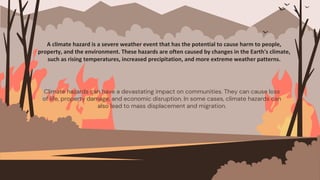
A climate hazard is a severe weather event that has the potential to cause harm to people,
property, and the environment. These hazards are often caused by changes in the Earth's climate,
such as rising temperatures, increased precipitation, and more extreme weather patterns.
Climate hazards can have a devastating impact on communities. They can cause loss
of life, property damage, and economic disruption. In some cases, climate hazards can
also lead to mass displacement and migration.
Types of Some Climate Hazard
Earthquake
Tornado
Drought
Flood
Riverbank
Erosion
02
03 05
04
01
Drought
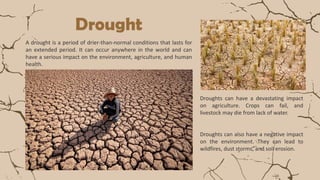
A drought is a period of drier-than-normal conditions that lasts for
an extended period. It can occur anywhere in the world and can
have a serious impact on the environment, agriculture, and human
health.
Droughts can have a devastating impact
on agriculture. Crops can fail, and
livestock may die from lack of water.
Droughts can also have a negative impact
on the environment. They can lead to
wildfires, dust storms, and soil erosion.
Flood
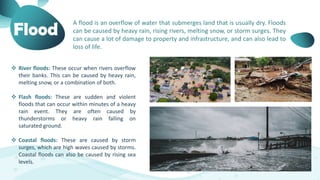
A flood is an overflow of water that submerges land that is usually dry. Floods
can be caused by heavy rain, rising rivers, melting snow, or storm surges. They
can cause a lot of damage to property and infrastructure, and can also lead to
loss of life.
❖ River floods: These occur when rivers overflow
their banks. This can be caused by heavy rain,
melting snow, or a combination of both.
❖ Flash floods: These are sudden and violent
floods that can occur within minutes of a heavy
rain event. They are often caused by
thunderstorms or heavy rain falling on
saturated ground.
❖ Coastal floods: These are caused by storm
surges, which are high waves caused by storms.
Coastal floods can also be caused by rising sea
levels.
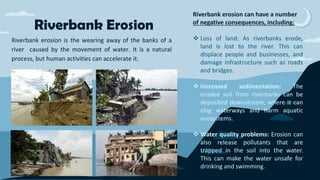
Riverbank erosion is the wearing away of the banks of a
river caused by the movement of water. It is a natural
process, but human activities can accelerate it.
Riverbank Erosion
Riverbank erosion can have a number
of negative consequences, including:
❖ Loss of land: As riverbanks erode,
land is lost to the river. This can
displace people and businesses, and
damage infrastructure such as roads
and bridges.
❖ Increased sedimentation: The
eroded soil from riverbanks can be
deposited downstream, where it can
clog waterways and harm aquatic
ecosystems.
❖ Water quality problems: Erosion can
also release pollutants that are
trapped in the soil into the water.
This can make the water unsafe for
drinking and swimming..
Earthquake
An earthquake is the shaking of the Earth's
surface caused by a sudden release of energy in
the Earth's crust. This energy release creates
seismic waves, which travel through the Earth's
rocks and cause the ground to shake. Earthquakes
can range in intensity from weak tremors that are
barely noticeable to violent shocks that can cause
widespread destruction.
Earthquakes can have a range of negative consequences, including ground
shaking, landslides, tsunamis, and fires. Ground shaking is the most typical result
of an earthquake, and it can cause buildings and other structures to collapse.
Earthquakes can cause landslides, which can obstruct highways and rivers.
Tsunamis are huge waves caused by underwater earthquakes. They may cover
huge areas and cause significant harm. Earthquakes can spark fires by breaking
electrical or gas lines.
Tornado
Tornadoes are extremely destructive storms, characterized by
a rotating column of air that forms during thunderstorms.
They can cause fatalities, destroy neighborhoods within
seconds, and reach wind speeds of up to 300 miles per hour,
with damage paths exceeding a mile wide and 50 miles long.
▪ Here are some of the dangers of tornadoes:
▪ High winds: Tornadoes can have wind speeds of up to 300 miles per
hour. These winds can cause severe damage to buildings and trees.
▪ Flying debris: Tornadoes can pick up debris from the ground and hurl
it through the air. This debris can cause serious injuries or death.
▪ Floods: Tornadoes can cause flooding by damaging dams and levees.

Climate hazard classification .

  • 1.
    Climate hazard Classification Lecturer Department ofArchitecture World University of Bangladesh Submitted to Md. Shamsul Arefin Submitted by Shoriful Islam ID: wub12190106 Batch : 1st
  • 2.
    A climate hazardis a severe weather event that has the potential to cause harm to people, property, and the environment. These hazards are often caused by changes in the Earth's climate, such as rising temperatures, increased precipitation, and more extreme weather patterns. Climate hazards can have a devastating impact on communities. They can cause loss of life, property damage, and economic disruption. In some cases, climate hazards can also lead to mass displacement and migration.
  • 3.
    Types of SomeClimate Hazard Earthquake Tornado Drought Flood Riverbank Erosion 02 03 05 04 01
  • 4.
    Drought A drought isa period of drier-than-normal conditions that lasts for an extended period. It can occur anywhere in the world and can have a serious impact on the environment, agriculture, and human health. Droughts can have a devastating impact on agriculture. Crops can fail, and livestock may die from lack of water. Droughts can also have a negative impact on the environment. They can lead to wildfires, dust storms, and soil erosion.
  • 5.
    Flood A flood isan overflow of water that submerges land that is usually dry. Floods can be caused by heavy rain, rising rivers, melting snow, or storm surges. They can cause a lot of damage to property and infrastructure, and can also lead to loss of life. ❖ River floods: These occur when rivers overflow their banks. This can be caused by heavy rain, melting snow, or a combination of both. ❖ Flash floods: These are sudden and violent floods that can occur within minutes of a heavy rain event. They are often caused by thunderstorms or heavy rain falling on saturated ground. ❖ Coastal floods: These are caused by storm surges, which are high waves caused by storms. Coastal floods can also be caused by rising sea levels.
  • 6.
    Riverbank erosion isthe wearing away of the banks of a river caused by the movement of water. It is a natural process, but human activities can accelerate it. Riverbank Erosion Riverbank erosion can have a number of negative consequences, including: ❖ Loss of land: As riverbanks erode, land is lost to the river. This can displace people and businesses, and damage infrastructure such as roads and bridges. ❖ Increased sedimentation: The eroded soil from riverbanks can be deposited downstream, where it can clog waterways and harm aquatic ecosystems. ❖ Water quality problems: Erosion can also release pollutants that are trapped in the soil into the water. This can make the water unsafe for drinking and swimming..
  • 7.
    Earthquake An earthquake isthe shaking of the Earth's surface caused by a sudden release of energy in the Earth's crust. This energy release creates seismic waves, which travel through the Earth's rocks and cause the ground to shake. Earthquakes can range in intensity from weak tremors that are barely noticeable to violent shocks that can cause widespread destruction. Earthquakes can have a range of negative consequences, including ground shaking, landslides, tsunamis, and fires. Ground shaking is the most typical result of an earthquake, and it can cause buildings and other structures to collapse. Earthquakes can cause landslides, which can obstruct highways and rivers. Tsunamis are huge waves caused by underwater earthquakes. They may cover huge areas and cause significant harm. Earthquakes can spark fires by breaking electrical or gas lines.
  • 8.
    Tornado Tornadoes are extremelydestructive storms, characterized by a rotating column of air that forms during thunderstorms. They can cause fatalities, destroy neighborhoods within seconds, and reach wind speeds of up to 300 miles per hour, with damage paths exceeding a mile wide and 50 miles long. ▪ Here are some of the dangers of tornadoes: ▪ High winds: Tornadoes can have wind speeds of up to 300 miles per hour. These winds can cause severe damage to buildings and trees. ▪ Flying debris: Tornadoes can pick up debris from the ground and hurl it through the air. This debris can cause serious injuries or death. ▪ Floods: Tornadoes can cause flooding by damaging dams and levees.