MUHIMBILI UNIVERSITY
    HEALTH AND ALLIED
         SCIENCE
SCHOOL OF NURSING

PAEDETRIC NURSING

PRESENTATION: DIARRHEA

DWASI MASUNGA(2009-04-01524)
INTRODUCTION
DEFINATION OF DIARRHOEA
 DIARRHOEA Is the passage of unusually
 loose or watery stools ,usually at least
 three times in 24hours period .
Frequent passing of formed stools is not
 diarrhea ,nor is the passing of
 loose, pasty stools by breastfed babies
cont
• Diarrhoea is usually a symptom of an infection
  in the intestinal infection which is caused by
  variety of bacteria,viral,parasitic organism.
  Infection is spread through contaminated food
  or drinking –water or from person –to- person
  as a result of a result of poor hygiene
• Diarrhoea disease is a leading cause of child
  mortality and morbidity .Diarrhoea disease kills
  1.5 million children every year . Globally, there
  are 2million cases disease every year. Diarrhoea
  is leading cause of malnutrition in children
  under five year five years old
• Loss of fluid and electrolytes via stools
  is net result of imbalance between
  secretory and absorptive processes in
  small & large intestine. Electrolytes
  have a critical role in the regulation of
  water absorption and secretion across
  the intestine
CLINICAL TYPES OF
      DIARRHOEAL DISEASES
 Four clinical types of diarrhoea can be recognize each
  reflecting the basic underlying pathology and altered
  pathology
 ACUTE WATERY DIARRHOEA(Including cholera) :which
  lasts several hours or day : the main danger is
  dehydration and malnutrion if feeding is not continued.
 COMMON CAUSES ARE:
 -Rotavirus,
 -Enterotoxigenic E.coli (ETEC),
 -Shigella,
 -Salmonella,
 -Vibrio cholerae
BLOOD DIARRHOEA
 BLOOD DIARRHOEA which is called
  Dysentery, the main dangers are
  damage of intestinal mucosa,sepsi, and
  malnutrion. Other complication including
  dehydration may also occur
 MAIN CAUSE OF ACUTE DYSENTERY
  – SHIGELLA, CAMPLYLOBACTER
  JEJUNI, Enteroinvasive E.coli
  (EIEC), SALMONELLA
cont
 PERSISTENT DIARRHOEA: last for 14
  days or longer ,the main danger is
  malnutrion and serious non-intestinal
  infections, dehydration may also occur
 DIRRHOEA AND SEVERE
  MANUTRITION(marasmus and
  kwashiorkor) : The main danger are severe
  systemic infection ,dehydration, heart
  failure, vitamin and mineral deficiency
CONT
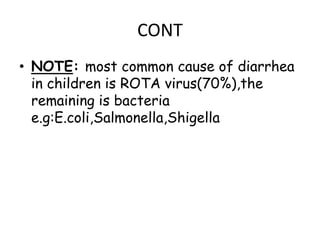
• NOTE: most common cause of diarrhea
  in children is ROTA virus(70%),the
  remaining is bacteria
  e.g:E.coli,Salmonella,Shigella
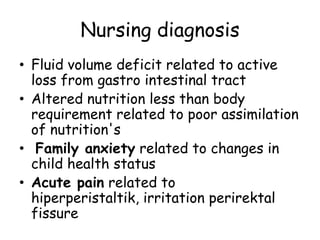
Nursing diagnosis
• Fluid volume deficit related to active
  loss from gastro intestinal tract
• Altered nutrition less than body
  requirement related to poor assimilation
  of nutrition's
• Family anxiety related to changes in
  child health status
• Acute pain related to
  hiperperistaltik, irritation perirektal
  fissure
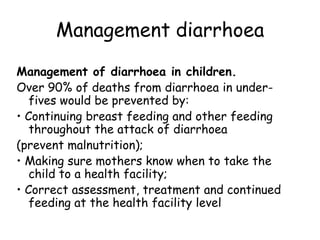
Management diarrhoea
Management of diarrhoea in children.
Over 90% of deaths from diarrhoea in under-
   fives would be prevented by:
• Continuing breast feeding and other feeding
   throughout the attack of diarrhoea
(prevent malnutrition);
• Making sure mothers know when to take the
   child to a health facility;
• Correct assessment, treatment and continued
   feeding at the health facility level
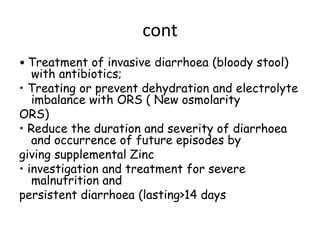
cont
• Treatment of invasive diarrhoea (bloody stool)
   with antibiotics;
• Treating or prevent dehydration and electrolyte
   imbalance with ORS ( New osmolarity
ORS)
• Reduce the duration and severity of diarrhoea
   and occurrence of future episodes by
giving supplemental Zinc
• investigation and treatment for severe
   malnutrition and
persistent diarrhoea (lasting>14 days
Nursing management
• Observation of complication by checking vital
  signs, behavior and consciousness
• Monitor fluid input and fluid out to know body
  fluid balance
• Weighing the child on admission.
• Isolation
• Maintain hydration by:-
  a-Increase oral feeding. b-giving fluid. c-check
  intake and out put.
CONT
• Assess progress of hydration (weighing
  the child daily).
• The nurse is responsible for collecting
  stool sample for laboratory examination.
  NOTE: avoid rectal thermometer
  because it stimulate the bowel.
Medical treatment
Zinc
The use of Zinc during diarrhoea has been
  shown to reduce frequency, stool volume
  and recurrence of diarrhoea episode. All
  children with diarrhoea should be
  given Zinc, 10-20mg every day for
  10-14 days. Zinc treatment should be
  continued even after diarrhoea has
  stopped
cont
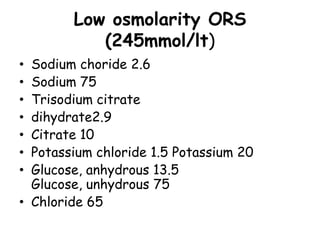
• Low osmolarity ORS (245mmol/lt) has
  been observed to be more effective
  than the Standard ORS in especially
  preventing dehydration
Low osmolarity ORS
           (245mmol/lt)
• Sodium choride 2.6
• Sodium 75
• Trisodium citrate
• dihydrate2.9
• Citrate 10
• Potassium chloride 1.5 Potassium 20
• Glucose, anhydrous 13.5
  Glucose, unhydrous 75
• Chloride 65
cont
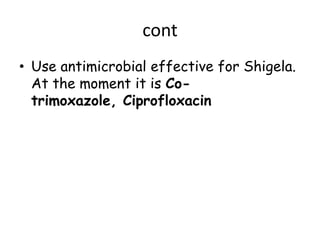
• Use antimicrobial effective for Shigela.
  At the moment it is Co-
  trimoxazole, Ciprofloxacin
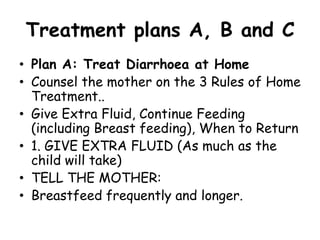
Treatment plans A, B and C
• Plan A: Treat Diarrhoea at Home
• Counsel the mother on the 3 Rules of Home
  Treatment..
• Give Extra Fluid, Continue Feeding
  (including Breast feeding), When to Return
• 1. GIVE EXTRA FLUID (As much as the
  child will take)
• TELL THE MOTHER:
• Breastfeed frequently and longer.
cont
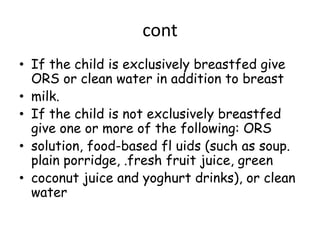
• If the child is exclusively breastfed give
  ORS or clean water in addition to breast
• milk.
• If the child is not exclusively breastfed
  give one or more of the following: ORS
• solution, food-based fl uids (such as soup.
  plain porridge, .fresh fruit juice, green
• coconut juice and yoghurt drinks), or clean
  water
cont
• TEACH THE MOTHER HOW TO MIX AND
  GIVE ORS. GIVE THE MOTHER
• 2 PACKETS OF ORS TO USE AT HOME,
• SHOW THE MOTHER HOW MUCH FLUI
  D TO GIVE IN ADDITION TO
• THE USUAL FUID INTAKE:
• Up to 2 years 50 to 100 ml after each
  loose stool
• 2 years or more 100 to 200 ml after each
  loose stool
PLAN B
• Give in clinic recommended amount of
  ORS over 4-hour period
• For infants under 6 months who are not
  breastfed, also give 100-200 ml clean
  water during this period
• Give Zinc, 10-20mg every day for 10-14
  days. Zinc treatment should be continued
  even after the diarrhoea has stopped
Plan C:
   Treat severe dehydration quickly

• Start with IV fluid immediately. If the
  child can drink, give ORS by mouth while
  the drip is set up. Give 100 ml/kg
  Ringer’s Lactate Solution (or, if not
  available, normal saline
• Infants (under 12 months) First give30
  ml/kg in hour Then give 70 ml/kg in: 5
  hours
REFERENCE
• Hockenberry M.J,Wilson D. Winkelstein
  M. L, Kline N.E. nursing care of infant
  and children
• Standard treatment guideline and then
  national medicine list for mainland
  Tanzania

Dirrhoea

  • 1.
    MUHIMBILI UNIVERSITY HEALTH AND ALLIED SCIENCE SCHOOL OF NURSING PAEDETRIC NURSING PRESENTATION: DIARRHEA DWASI MASUNGA(2009-04-01524)
  • 2.
    INTRODUCTION DEFINATION OF DIARRHOEA DIARRHOEA Is the passage of unusually loose or watery stools ,usually at least three times in 24hours period . Frequent passing of formed stools is not diarrhea ,nor is the passing of loose, pasty stools by breastfed babies
  • 3.
    cont • Diarrhoea isusually a symptom of an infection in the intestinal infection which is caused by variety of bacteria,viral,parasitic organism. Infection is spread through contaminated food or drinking –water or from person –to- person as a result of a result of poor hygiene • Diarrhoea disease is a leading cause of child mortality and morbidity .Diarrhoea disease kills 1.5 million children every year . Globally, there are 2million cases disease every year. Diarrhoea is leading cause of malnutrition in children under five year five years old
  • 4.
    • Loss offluid and electrolytes via stools is net result of imbalance between secretory and absorptive processes in small & large intestine. Electrolytes have a critical role in the regulation of water absorption and secretion across the intestine
  • 5.
    CLINICAL TYPES OF DIARRHOEAL DISEASES  Four clinical types of diarrhoea can be recognize each reflecting the basic underlying pathology and altered pathology  ACUTE WATERY DIARRHOEA(Including cholera) :which lasts several hours or day : the main danger is dehydration and malnutrion if feeding is not continued.  COMMON CAUSES ARE: -Rotavirus, -Enterotoxigenic E.coli (ETEC), -Shigella, -Salmonella, -Vibrio cholerae
  • 6.
    BLOOD DIARRHOEA  BLOODDIARRHOEA which is called Dysentery, the main dangers are damage of intestinal mucosa,sepsi, and malnutrion. Other complication including dehydration may also occur MAIN CAUSE OF ACUTE DYSENTERY – SHIGELLA, CAMPLYLOBACTER JEJUNI, Enteroinvasive E.coli (EIEC), SALMONELLA
  • 7.
    cont  PERSISTENT DIARRHOEA:last for 14 days or longer ,the main danger is malnutrion and serious non-intestinal infections, dehydration may also occur  DIRRHOEA AND SEVERE MANUTRITION(marasmus and kwashiorkor) : The main danger are severe systemic infection ,dehydration, heart failure, vitamin and mineral deficiency
  • 8.
    CONT • NOTE: mostcommon cause of diarrhea in children is ROTA virus(70%),the remaining is bacteria e.g:E.coli,Salmonella,Shigella
  • 9.
    Nursing diagnosis • Fluidvolume deficit related to active loss from gastro intestinal tract • Altered nutrition less than body requirement related to poor assimilation of nutrition's • Family anxiety related to changes in child health status • Acute pain related to hiperperistaltik, irritation perirektal fissure
  • 10.
    Management diarrhoea Management ofdiarrhoea in children. Over 90% of deaths from diarrhoea in under- fives would be prevented by: • Continuing breast feeding and other feeding throughout the attack of diarrhoea (prevent malnutrition); • Making sure mothers know when to take the child to a health facility; • Correct assessment, treatment and continued feeding at the health facility level
  • 11.
    cont • Treatment ofinvasive diarrhoea (bloody stool) with antibiotics; • Treating or prevent dehydration and electrolyte imbalance with ORS ( New osmolarity ORS) • Reduce the duration and severity of diarrhoea and occurrence of future episodes by giving supplemental Zinc • investigation and treatment for severe malnutrition and persistent diarrhoea (lasting>14 days
  • 12.
    Nursing management • Observationof complication by checking vital signs, behavior and consciousness • Monitor fluid input and fluid out to know body fluid balance • Weighing the child on admission. • Isolation • Maintain hydration by:- a-Increase oral feeding. b-giving fluid. c-check intake and out put.
  • 13.
    CONT • Assess progressof hydration (weighing the child daily). • The nurse is responsible for collecting stool sample for laboratory examination. NOTE: avoid rectal thermometer because it stimulate the bowel.
  • 14.
    Medical treatment Zinc The useof Zinc during diarrhoea has been shown to reduce frequency, stool volume and recurrence of diarrhoea episode. All children with diarrhoea should be given Zinc, 10-20mg every day for 10-14 days. Zinc treatment should be continued even after diarrhoea has stopped
  • 15.
    cont • Low osmolarityORS (245mmol/lt) has been observed to be more effective than the Standard ORS in especially preventing dehydration
  • 16.
    Low osmolarity ORS (245mmol/lt) • Sodium choride 2.6 • Sodium 75 • Trisodium citrate • dihydrate2.9 • Citrate 10 • Potassium chloride 1.5 Potassium 20 • Glucose, anhydrous 13.5 Glucose, unhydrous 75 • Chloride 65
  • 17.
    cont • Use antimicrobialeffective for Shigela. At the moment it is Co- trimoxazole, Ciprofloxacin
  • 18.
    Treatment plans A,B and C • Plan A: Treat Diarrhoea at Home • Counsel the mother on the 3 Rules of Home Treatment.. • Give Extra Fluid, Continue Feeding (including Breast feeding), When to Return • 1. GIVE EXTRA FLUID (As much as the child will take) • TELL THE MOTHER: • Breastfeed frequently and longer.
  • 19.
    cont • If thechild is exclusively breastfed give ORS or clean water in addition to breast • milk. • If the child is not exclusively breastfed give one or more of the following: ORS • solution, food-based fl uids (such as soup. plain porridge, .fresh fruit juice, green • coconut juice and yoghurt drinks), or clean water
  • 20.
    cont • TEACH THEMOTHER HOW TO MIX AND GIVE ORS. GIVE THE MOTHER • 2 PACKETS OF ORS TO USE AT HOME, • SHOW THE MOTHER HOW MUCH FLUI D TO GIVE IN ADDITION TO • THE USUAL FUID INTAKE: • Up to 2 years 50 to 100 ml after each loose stool • 2 years or more 100 to 200 ml after each loose stool
  • 21.
    PLAN B • Givein clinic recommended amount of ORS over 4-hour period • For infants under 6 months who are not breastfed, also give 100-200 ml clean water during this period • Give Zinc, 10-20mg every day for 10-14 days. Zinc treatment should be continued even after the diarrhoea has stopped
  • 22.
    Plan C: Treat severe dehydration quickly • Start with IV fluid immediately. If the child can drink, give ORS by mouth while the drip is set up. Give 100 ml/kg Ringer’s Lactate Solution (or, if not available, normal saline • Infants (under 12 months) First give30 ml/kg in hour Then give 70 ml/kg in: 5 hours
  • 23.
    REFERENCE • Hockenberry M.J,WilsonD. Winkelstein M. L, Kline N.E. nursing care of infant and children • Standard treatment guideline and then national medicine list for mainland Tanzania