Guided by : Presented by :
Mr.Daniel C.Ribu Akshay ss kumar
Asso. Prof. S7 ME-A
ME Dept. Roll no:33
LMCST Lourdes Matha College of
Science and Technology
kuttichal thiruvananthapuram
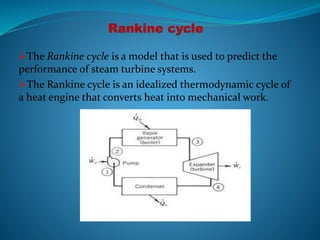
The Rankine cycle is a model that is used to predict the
performance of steam turbine systems.
The Rankine cycle is an idealized thermodynamic cycle of
a heat engine that converts heat into mechanical work.
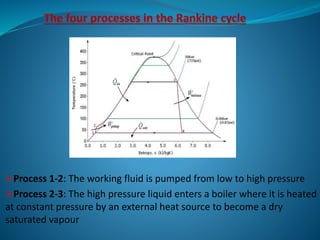
Process 1-2: The working fluid is pumped from low to high pressure
Process 2-3: The high pressure liquid enters a boiler where it is heated
at constant pressure by an external heat source to become a dry
saturated vapour
Process 3-4: The dry saturated vapour expands through a turbine
generating power. This decreases the temperature and pressure of
the vapour, and some condensation may occur
Process 4-1: The wet vapour then enters a condenser where it is
condensed at a constant pressure to become a saturated liquid.
THERMAL STORAGE SYSTEM
solar-thermal power plants are one of the key technologies for
production of electricity from renewable energy resource.
It is a system which helps to store thermal energy in excess for
later use.
Solar energy in summer can be stored for use in winter.
In parabolic trough collector row oil as a heat transfer fluid
is heated by concentrated solar irradiation.
.
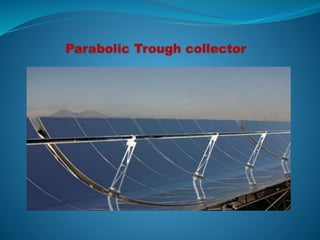
It is a type of solar thermal collector that is straight in
one dimension and curved as a parabola in other two,
lined with a polished metal mirror.
The solar energy which enters the mirror parallel to
its plane of symmetry is focused along the focal line
where object is positioned to heat.
Usually a parabolic trough collector generates thermal
energy which is consumed by a heat absorbing
medium(oil).
.
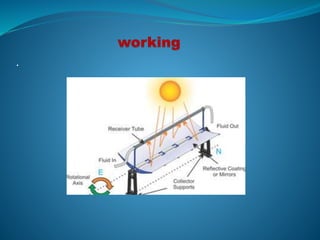
Figure shows the working principle of the TROUGH
collector at the Platform Solar. By tracking the sun from
sunrise to sunset, the parabolic Trough collectors
concentrate the sun’s radiation with their parabolic mirror
facets on the absorber tubes along their focal line.
Through these absorber tube circulates a heat transfer
fluid (HTF), usually synthetic oil, which is heated to a
temperature of nearly 395°C.
This heat absorbing oil transfer heat to water for producing
steam in a heat exchanger to accomplish power generation
from a steam cycle.
But these heat absorbing oil is only capable of
absorbing heat up to a temp of 395°C due to chemical
stability, therefore main steam temp is limited.
Since the performance of thermal cycle depends on
the steam parameters some alternatives should be
tested and a direct steam generation solar power
plant with a thermal storage is an example.
Basically salts are used as pcm
Molten salts can are used for storing heat at high
temp.
Potassium nitrate, calcium nitrate, etc are example
for such salts..
Sodium nirate is an interesting salt with a melting
point of 306°C .
A 10°C temp difference is assuming as a driving
force btw storage and steam.
Therefore the steam has to condense at 316°C during
charging and evaporate at 296°C discharging.
From steam tables, the pressure corresponding to the
saturation temp is 316°C is 107 bar and 296°C is 81 bar.
It reveals that higher operating pressure is required
during charging and then discharging.
Another pcm pottasium nitrate which result in a steam
pressure of 156bar for charging and 116bar for
discharging
.
Three section of heating takes places
1. Preheating
2.Evaporation
3.Superheating
For preheating and super heating, sensible heat storage
system is used and for evaporation, latent heat storage
system is used.
Both system uses a salt
During charging ,the salt has to melt to a constant
,material dependent temp and during discharging it will
back to freezed position.
For a solar thermal power plant a thermal storage
system allow a higher utilization of the power block and
to produce electricity on demand
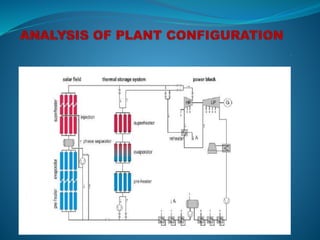
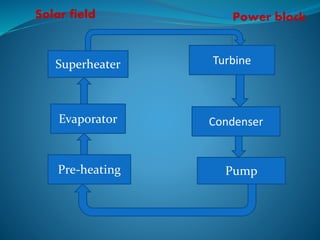
The solar field is operated in recirculation mode with a
phase separator between pre-heating, evaporation and
superheating sections.
An injection cooler is placed before the last collection of
each row to stabilize the steam temperature.
The steam feed the high- pressure turbine(HP),is re-
heated and directed through the low-pressure
turbine(LP).
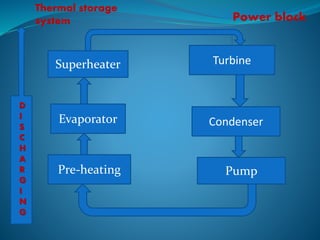
The thermal storage system is arranged similar to the
solar field with a sensible heat storage system for pre-
heating and superheating and a latent heat storage
system based on a pcm for evaporation and a sensible
heat storage system for superheating.
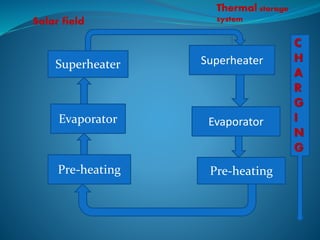
For charging ,steam from the solar field is directed
through the storage system in reverse direction.
The steam is cooled down in the superheating section,
condensed in the evaporation section and cooled down to
pre-heating section.
The condensate water is mixed with the feed water
from the power block and it feed in to the solar field.
The plant configuration cycle sub dived in to three
cycles
The plant configuration cycle sub dived in to three cycles
Evaporator
Pre-heating
Superheater Superheater
Evaporator
Pre-heating
Solar field
Thermal storage
system
C
H
A
R
G
I
N
G
.
Evaporator
Pre-heating
Superheater Turbine
Condenser
Pump
Thermal storage
system Power block
D
I
S
C
H
A
R
G
I
N
G
.
Evaporator
Pre-heating
Superheater Turbine
Condenser
Pump
Solar field Power block
Smaller environmental risks because oil is replaced by
water.
Higher steam temperature (maximum steam
temperature with oil = 395C)
The overall plant configuration is more simple
Lower investment and higher plant efficiency
 Solar field control under solar radiation transients.
Instability of the two-phase flow inside the receiver
tubes
The integration of a thermal storage system increases the
complexity of a direct steam generation solar power plant.
The usage of a pcm storage system for the evaporation of water
implies that the pressure for discharge is significantly lower than
the pressure level required for charging.
A reheat system is necessary to avoid high moisture content in
the low pressure turbine.
The work presented demonstrated that there are significant
differences in the plant layout of a parabolic trough power plant
with direct steam generation compared to a plant with indirect
steam generation.
1 Eck, M.; Hennecke, K.: Heat transfer fluids for future parabolic trough solar
thermal power plants. In:
Goswami, D. Yogi; Zhao, Yuwen [Ed.]: ISES Solar World Congress 2007, ISES Solar
World Congress, Beijing
(China), S. 1806 - 1812.
2 Benz N.: Next generation receivers, NREL Trough Work Shop, March 7-8,
Golden,
http://www.nrel.gov/csp/troughnet/wkshp_2007.html (2007).
3 Zarza, E.; Valenzuela, L.; León, J.; Hennecke, K.; Eck, M.; Weyers, H.-D.;
Eickhoff, M.: Direct Steam
Generation in Parabolic Troughs - Final Results and Conclusions of the DISS
Project, Energy, Vol. 29 (2004),
pp. 635-644.
4 Nava, P.; Hermann, U.: Trough Thermal Storage - Status Spring 2007, NREL
Trough Work Shop, March 7-8,
Golden, http://www.nrel.gov/csp/troughnet/wkshp_2007.html (2007).
5 Steinmann, W.-D.; Tamme, R.: Latent heat storage for solar steam systems, 13th
International Symposium on
Concentrated Solar Power and Chemical Energy Technologies, June 20-23 (2006)
Seville, Spain.
Direct steam generation from solar

Direct steam generation from solar

  • 1.
    Guided by :Presented by : Mr.Daniel C.Ribu Akshay ss kumar Asso. Prof. S7 ME-A ME Dept. Roll no:33 LMCST Lourdes Matha College of Science and Technology kuttichal thiruvananthapuram
  • 2.
    The Rankine cycleis a model that is used to predict the performance of steam turbine systems. The Rankine cycle is an idealized thermodynamic cycle of a heat engine that converts heat into mechanical work.
  • 3.
    Process 1-2: Theworking fluid is pumped from low to high pressure Process 2-3: The high pressure liquid enters a boiler where it is heated at constant pressure by an external heat source to become a dry saturated vapour
  • 4.
    Process 3-4: Thedry saturated vapour expands through a turbine generating power. This decreases the temperature and pressure of the vapour, and some condensation may occur Process 4-1: The wet vapour then enters a condenser where it is condensed at a constant pressure to become a saturated liquid.
  • 5.
    THERMAL STORAGE SYSTEM solar-thermalpower plants are one of the key technologies for production of electricity from renewable energy resource. It is a system which helps to store thermal energy in excess for later use. Solar energy in summer can be stored for use in winter. In parabolic trough collector row oil as a heat transfer fluid is heated by concentrated solar irradiation.
  • 6.
  • 7.
    It is atype of solar thermal collector that is straight in one dimension and curved as a parabola in other two, lined with a polished metal mirror. The solar energy which enters the mirror parallel to its plane of symmetry is focused along the focal line where object is positioned to heat. Usually a parabolic trough collector generates thermal energy which is consumed by a heat absorbing medium(oil).
  • 8.
  • 9.
    Figure shows theworking principle of the TROUGH collector at the Platform Solar. By tracking the sun from sunrise to sunset, the parabolic Trough collectors concentrate the sun’s radiation with their parabolic mirror facets on the absorber tubes along their focal line. Through these absorber tube circulates a heat transfer fluid (HTF), usually synthetic oil, which is heated to a temperature of nearly 395°C. This heat absorbing oil transfer heat to water for producing steam in a heat exchanger to accomplish power generation from a steam cycle.
  • 10.
    But these heatabsorbing oil is only capable of absorbing heat up to a temp of 395°C due to chemical stability, therefore main steam temp is limited. Since the performance of thermal cycle depends on the steam parameters some alternatives should be tested and a direct steam generation solar power plant with a thermal storage is an example.
  • 11.
    Basically salts areused as pcm Molten salts can are used for storing heat at high temp. Potassium nitrate, calcium nitrate, etc are example for such salts.. Sodium nirate is an interesting salt with a melting point of 306°C . A 10°C temp difference is assuming as a driving force btw storage and steam.
  • 12.
    Therefore the steamhas to condense at 316°C during charging and evaporate at 296°C discharging. From steam tables, the pressure corresponding to the saturation temp is 316°C is 107 bar and 296°C is 81 bar. It reveals that higher operating pressure is required during charging and then discharging. Another pcm pottasium nitrate which result in a steam pressure of 156bar for charging and 116bar for discharging
  • 13.
  • 14.
    Three section ofheating takes places 1. Preheating 2.Evaporation 3.Superheating
  • 15.
    For preheating andsuper heating, sensible heat storage system is used and for evaporation, latent heat storage system is used. Both system uses a salt During charging ,the salt has to melt to a constant ,material dependent temp and during discharging it will back to freezed position.
  • 16.
    For a solarthermal power plant a thermal storage system allow a higher utilization of the power block and to produce electricity on demand
  • 17.
    The solar fieldis operated in recirculation mode with a phase separator between pre-heating, evaporation and superheating sections. An injection cooler is placed before the last collection of each row to stabilize the steam temperature. The steam feed the high- pressure turbine(HP),is re- heated and directed through the low-pressure turbine(LP).
  • 18.
    The thermal storagesystem is arranged similar to the solar field with a sensible heat storage system for pre- heating and superheating and a latent heat storage system based on a pcm for evaporation and a sensible heat storage system for superheating. For charging ,steam from the solar field is directed through the storage system in reverse direction. The steam is cooled down in the superheating section, condensed in the evaporation section and cooled down to pre-heating section.
  • 19.
    The condensate wateris mixed with the feed water from the power block and it feed in to the solar field. The plant configuration cycle sub dived in to three cycles
  • 20.
    The plant configurationcycle sub dived in to three cycles
  • 21.
  • 22.
  • 23.
  • 24.
    Smaller environmental risksbecause oil is replaced by water. Higher steam temperature (maximum steam temperature with oil = 395C) The overall plant configuration is more simple Lower investment and higher plant efficiency
  • 25.
     Solar fieldcontrol under solar radiation transients. Instability of the two-phase flow inside the receiver tubes
  • 26.
    The integration ofa thermal storage system increases the complexity of a direct steam generation solar power plant. The usage of a pcm storage system for the evaporation of water implies that the pressure for discharge is significantly lower than the pressure level required for charging. A reheat system is necessary to avoid high moisture content in the low pressure turbine. The work presented demonstrated that there are significant differences in the plant layout of a parabolic trough power plant with direct steam generation compared to a plant with indirect steam generation.
  • 27.
    1 Eck, M.;Hennecke, K.: Heat transfer fluids for future parabolic trough solar thermal power plants. In: Goswami, D. Yogi; Zhao, Yuwen [Ed.]: ISES Solar World Congress 2007, ISES Solar World Congress, Beijing (China), S. 1806 - 1812. 2 Benz N.: Next generation receivers, NREL Trough Work Shop, March 7-8, Golden, http://www.nrel.gov/csp/troughnet/wkshp_2007.html (2007). 3 Zarza, E.; Valenzuela, L.; León, J.; Hennecke, K.; Eck, M.; Weyers, H.-D.; Eickhoff, M.: Direct Steam Generation in Parabolic Troughs - Final Results and Conclusions of the DISS Project, Energy, Vol. 29 (2004), pp. 635-644. 4 Nava, P.; Hermann, U.: Trough Thermal Storage - Status Spring 2007, NREL Trough Work Shop, March 7-8, Golden, http://www.nrel.gov/csp/troughnet/wkshp_2007.html (2007). 5 Steinmann, W.-D.; Tamme, R.: Latent heat storage for solar steam systems, 13th International Symposium on Concentrated Solar Power and Chemical Energy Technologies, June 20-23 (2006) Seville, Spain.