Slide 1
Manuel Romero
Instituto IMDEA Energía
Avda. Ramón de la Sagra 3
28935 Móstoles
Energía Solar Térmica de Alta Temperatura
Slide 2
• ensure the development, together with the SET Plan stakeholders, of an Integrated Roadmap around
the priorities identified in the EU Energy technology and innovation strategy by the end of 2013.
• define, together with the Member States, an Action Plan of joint and individual investments in
support of the Integrated Roadmap by mid 2014.
• invite, together with the Member States in the context of the Steering Group, the European Industrial
Initiatives and associated European Technology Platforms to adjust their mandate, structure and
participation to update their Technology Roadmaps and to contribute to the Integrated Roadmap.
• establish a coordination structure, under the Steering Group of the SET Plan, to promote investments
in research and innovation on energy efficiency
Slide 3
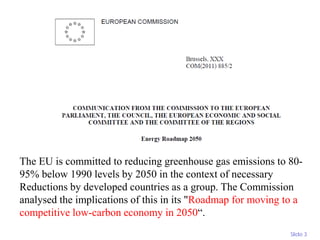
The EU is committed to reducing greenhouse gas emissions to 80-
95% below 1990 levels by 2050 in the context of necessary
Reductions by developed countries as a group. The Commission
analysed the implications of this in its "Roadmap for moving to a
competitive low-carbon economy in 2050“.
Slide 4
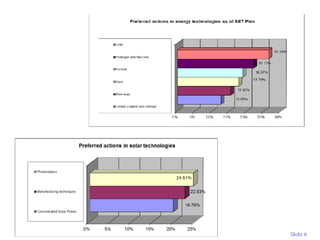
Slide 5
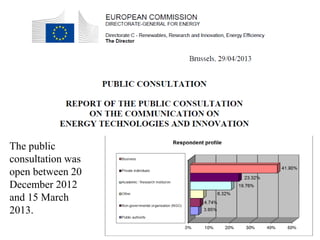
The public
consultation was
open between 20
December 2012
and 15 March
2013.
Slide 6
Slide 7
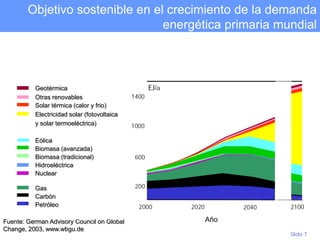
Objetivo sostenible en el crecimiento de la demanda
energética primaria mundial
AñoFuente: German Advisory Council on Global
Change, 2003, www.wbgu.de
Geotérmica
Otras renovables
Solar térmica (calor y frio)
Electricidad solar (fotovoltaica
y solar termoeléctrica)
Eólica
Biomasa (avanzada)
Biomasa (tradicional)
Hidroeléctrica
Nuclear
Gas
Carbón
Petróleo
Slide 8
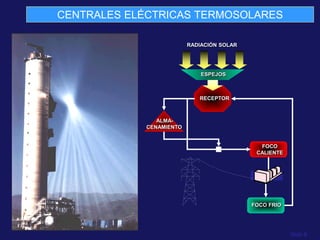
RADIACIÓN SOLAR
CENTRALES ELÉCTRICAS TERMOSOLARES
ESPEJOS
RECEPTOR
ALMA-
CENAMIENTO
FOCO FRIO
FOCO
CALIENTE
TURBINA
Slide 9
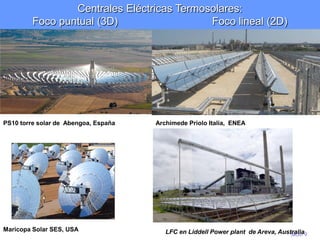
Maricopa Solar SES, USA
Archimede Priolo Italia, ENEA
LFC en Liddell Power plant de Areva, Australia
PS10 torre solar de Abengoa, España
Centrales Eléctricas Termosolares:
Foco puntual (3D) Foco lineal (2D)
Slide 10
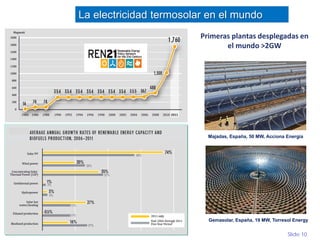
Majadas, España, 50 MW, Acciona Energía
Gemasolar, España, 19 MW, Torresol Energy
Primeras plantas desplegadas en
el mundo >2GW
La electricidad termosolar en el mundo
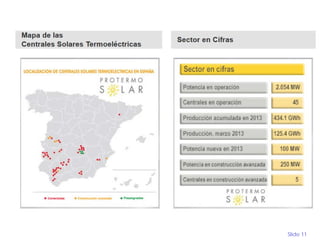
Slide 11
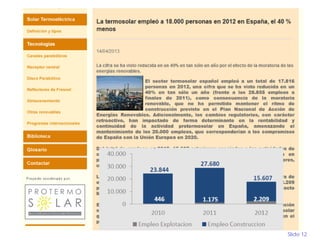
Slide 12
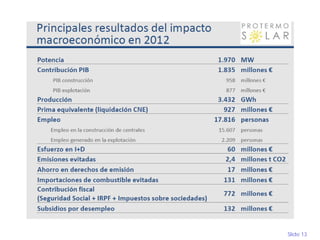
Slide 13
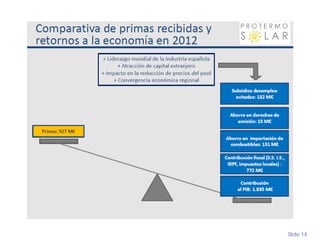
Slide 14
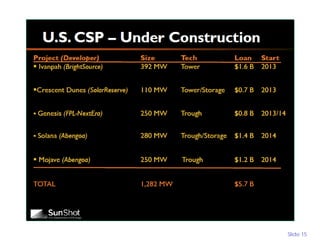
Slide 15
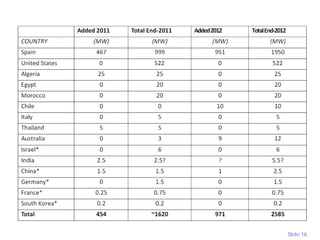
Slide 16
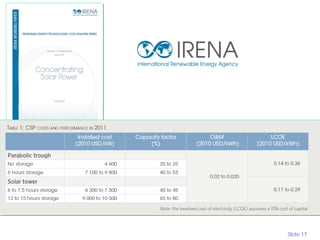
Slide 17
Slide 18
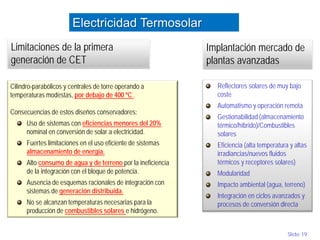
Slide 19
Cilindro-parabólicos y centrales de torre operando a
temperaturas modestas, por debajo de 400 ºC .
Consecuencias de estos diseños conservadores:
Uso de sistemas con eficiencias menores del 20%
nominal en conversión de solar a electricidad.
Fuertes limitaciones en el uso eficiente de sistemas
almacenamiento de energía.
Alto consumo de agua y de terreno por la ineficiencia
de la integración con el bloque de potencia.
Ausencia de esquemas racionales de integración con
sistemas de generación distribuida.
No se alcanzan temperaturas necesarias para la
producción de combustibles solares e hidrógeno.
Limitaciones de la primera
generación de CET
Implantación mercado de
plantas avanzadas
Electricidad Termosolar
Reflectores solares de muy bajo
coste
Automatismo y operación remota
Gestionabilidad (almacenamiento
térmico/híbrido)/Combustibles
solares
Eficiencia (alta temperatura y altas
irradiancias/nuevos fluidos
térmicos y receptores solares)
Modularidad
Impacto ambiental (agua, terreno)
Integración en ciclos avanzados y
procesos de conversión directa
Slide 20
Slide 21
Slide 22
• Steam heating
• Brayton cycle
• Air heating
• Air heating
• Dish Stirling
• Air heating
• Rankine cycle
• Steam heating
Oil
receivers
Water/Steam
receivers
Solarized Stirling
engines
Ceramic receivers
Low P, T
Temperature (thermal fluid)
PresentconceptsAdvancedconcepts
• Solar fuels and chemistry
• Brayton cycle
• Air heating
Ceramic receivers
High P, T
Sodium
Receivers
Molten salts
receivers
• Brayton cycle
• Air Pre-heating
500 ºC 1000 ºC 1500 ºC
• Rankine cycle
• Steam heating
Current
Source:IMDEAEnergía
Solid particles
receivers
Volumetric air
receivers (metallic)
… to Market Implementation
of Advanced Technologies
Solar Thermal Electricity
Efficiency (high-temperature /high-
flux/new HTF/solar receivers)
Integration in advanced cycles and
direct conversion systems
Slide 23
Receivers: More compact, durable and efficient
(Efficiency > 85%)
molten salt
receiver
(SENER)
0 1000 2000 3000
Current
Next
generation
Peak flux on aperture (kW/m2)
Volumetric
Molten salt
Water-steam
Direct Indirect
Particles Tubular Volumetric
Fluid - Water Liquid metals Molten Salts Air
Average flux (MW/m2)
Peak flux (MW/m2)
(0.9)
(2.5)
0.1-0.3
0.4-0.6
0.4-0.5
1.4-2.5
0.4-0.5
0.7-0.8
0.5-0.6
0.8-1.0
Fluid outlet temperature (ºC) (2,000) 490-525 540 540-565 (700-1,000)
Slide 24
Superheating steam with dual receivers
eSolar Double Cavity
B&W receiver
Slide 25
Volumetric air-cooled receiver
Heat transfer area: 255 m2/m3
Efficiency at 750°: 78%
Porosity: 50%
Target:
• Improve volumetricity
• Increase solar flux
Slide 26
Slide 27
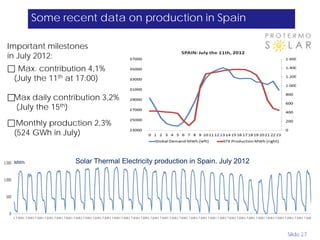
Some recent data on production in Spain
Source REE
Important milestones
in July 2012:
 Max. contribution 4,1%
(July the 11th at 17:00)
Max daily contribution 3,2%
(July the 15th)
Monthly production 2,3%
(524 GWh in July)
Solar Thermal Electricity production in Spain. July 2012MWh
Slide 28
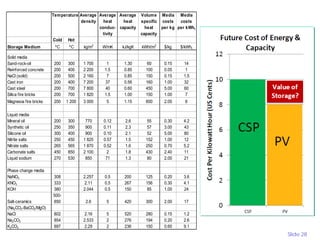
Average
density
Average
heat
conduc-
tivity
Average
heat
capacity
Volume
specific
heat
capacity
Media
costs
per kg
Media
costs
per kWht
Cold Hot
Storage Medium ºC ºC kg/m3
W/mK kJ/kgK kWht/m3
$/kg $/kWht
Solid media
Sand-rock-oil 200 300 1 700 1 1.30 60 0.15 14
Reinforced concrete 200 400 2 200 1.5 0.85 100 0.05 1
NaCl (solid) 200 500 2 160 7 0.85 150 0.15 1.5
Cast iron 200 400 7 200 37 0.56 160 1.00 32
Cast steel 200 700 7 800 40 0.60 450 5.00 60
Silica fire bricks 200 700 1 820 1.5 1.00 150 1.00 7
Magnesia fire bricks 200 1 200 3 000 5 1.15 600 2.00 6
Liquid media
Mineral oil 200 300 770 0.12 2.6 55 0.30 4.2
Synthetic oil 250 350 900 0.11 2.3 57 3.00 43
Silicone oil 300 400 900 0.10 2.1 52 5.00 80
Nitrite salts 250 450 1 825 0.57 1.5 152 1.00 12
Nitrate salts 265 565 1 870 0.52 1.6 250 0.70 5.2
Carbonate salts 450 850 2 100 2 1.8 430 2.40 11
Liquid sodium 270 530 850 71 1.3 80 2.00 21
Phase change media
NaNO3 308 2.257 0.5 200 125 0.20 3.6
KNO3 333 2.11 0.5 267 156 0.30 4.1
KOH 380 2.044 0.5 150 85 1.00 24
Salt-ceramics
500-
850 2.6 5 420 300 2.00 17
(Na2CO3-BaCO3/MgO)
NaCl 802 2.16 5 520 280 0.15 1.2
Na2CO3 854 2.533 2 276 194 0.20 2.6
K2CO3 897 2.29 2 236 150 0.60 9.1
Temperature
Slide 29
0
10000
20000
30000
40000
50000
60000
70000
80000
90000
1 5 9 13 17 21 1 5 9 13 17 21 1 5 9 13 17 21 1 5 9 13 17 21
Generation(MW)
CSP5 Wind15 PV10 PV
CSP
Wind
Hydro
PHS/CAES
Gas
Other
Biomass
Coal
Nuclear
Geothermal
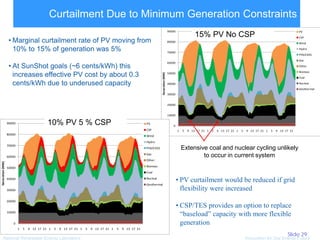
Curtailment Due to Minimum Generation Constraints
29National Renewable Energy Laboratory Innovation for Our Energy Future
Extensive coal and nuclear cycling unlikely
to occur in current system
• Marginal curtailment rate of PV moving from
10% to 15% of generation was 5%
• At SunShot goals (~6 cents/kWh) this
increases effective PV cost by about 0.3
cents/kWh due to underused capacity
0
10000
20000
30000
40000
50000
60000
70000
80000
90000
1 5 9 13 17 21 1 5 9 13 17 21 1 5 9 13 17 21 1 5 9 13 17 21
Generation(MW)
CSP5 Wind15 PV10 PV
CSP
Wind
Hydro
PHS/CAES
Gas
Other
Biomass
Coal
Nuclear
Geothermal
10% PV 5 % CSP
15% PV No CSP
• PV curtailment would be reduced if grid
flexibility were increased
• CSP/TES provides an option to replace
“baseload” capacity with more flexible
generation
Slide 30
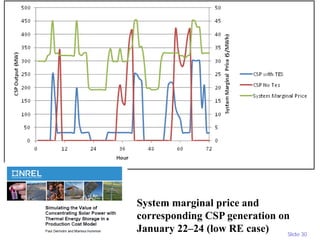
System marginal price and
corresponding CSP generation on
January 22–24 (low RE case)
Slide 31
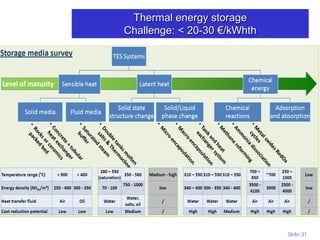
Thermal energy storage
Challenge: < 20-30 €/kWhth
Slide 32
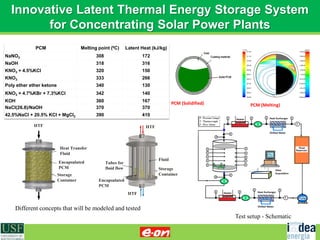
Innovative Latent Thermal Energy Storage System
for Concentrating Solar Power Plants
Heat Transfer
Fluid
HTF
Encapsulated
PCM
Storage
Container Encapsulated
PCM
Tubes for
fluid flow
HTF
Storage
Container
Fluid
HTF
Different concepts that will be modeled and tested
Test setup - Schematic
PCM (Solidified) PCM (Melting)
PCM Melting point (0C) Latent Heat (kJ/kg)
NaNO3 308 172
NaOH 318 316
KNO3 + 4.5%KCl 320 150
KNO3 333 266
Poly ether ether ketone 340 130
KNO3 + 4.7%KBr + 7.3%KCl 342 140
KOH 360 167
NaCl(26.8)/NaOH 370 370
42.5%NaCl + 20.5% KCl + MgCl2 390 410
Slide 33
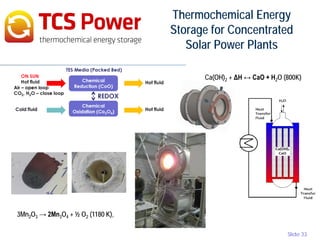
Ca(OH)2 + ΔH ↔ CaO + H2O (800K)
Thermochemical Energy
Storage for Concentrated
Solar Power Plants
3Mn2O3 → 2Mn3O4 + ½ O2 (1180 K),
Slide 34
Slide 35
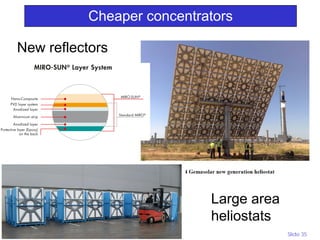
El heliostato de SenerCheaper concentrators
Large area
heliostats
New reflectors
Slide 36
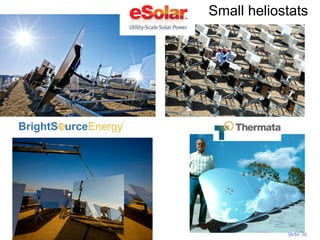
The Solar Energy Development Center
Small heliostats
Slide 37
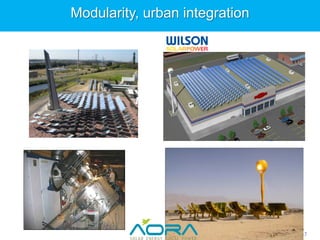
Modularity, urban integration
Slide 38
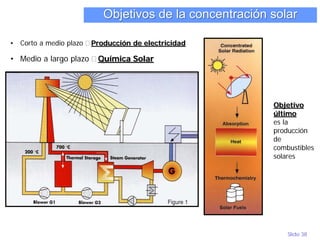
• Corto a medio plazo  Producción de electricidad
Objetivos de la concentración solar
Objetivo
último
es la
producción
de
combustibles
solares
• Medio a largo plazo  Química Solar
Slide 3939
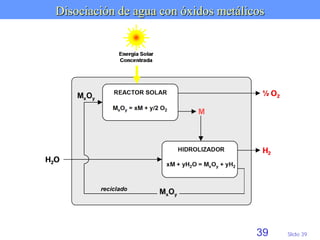
Disociación de agua con óxidos metálicos
Slide 40
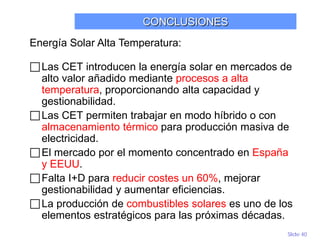
CONCLUSIONES
Las CET introducen la energía solar en mercados de
alto valor añadido mediante procesos a alta
temperatura, proporcionando alta capacidad y
gestionabilidad.
Las CET permiten trabajar en modo híbrido o con
almacenamiento térmico para producción masiva de
electricidad.
El mercado por el momento concentrado en España
y EEUU.
Falta I+D para reducir costes un 60%, mejorar
gestionabilidad y aumentar eficiencias.
La producción de combustibles solares es uno de los
elementos estratégicos para las próximas décadas.
Energía Solar Alta Temperatura:

M romero diasolar_print

  • 1.
    Slide 1 Manuel Romero InstitutoIMDEA Energía Avda. Ramón de la Sagra 3 28935 Móstoles Energía Solar Térmica de Alta Temperatura
  • 2.
    Slide 2 • ensurethe development, together with the SET Plan stakeholders, of an Integrated Roadmap around the priorities identified in the EU Energy technology and innovation strategy by the end of 2013. • define, together with the Member States, an Action Plan of joint and individual investments in support of the Integrated Roadmap by mid 2014. • invite, together with the Member States in the context of the Steering Group, the European Industrial Initiatives and associated European Technology Platforms to adjust their mandate, structure and participation to update their Technology Roadmaps and to contribute to the Integrated Roadmap. • establish a coordination structure, under the Steering Group of the SET Plan, to promote investments in research and innovation on energy efficiency
  • 3.
    Slide 3 The EUis committed to reducing greenhouse gas emissions to 80- 95% below 1990 levels by 2050 in the context of necessary Reductions by developed countries as a group. The Commission analysed the implications of this in its "Roadmap for moving to a competitive low-carbon economy in 2050“.
  • 4.
  • 5.
    Slide 5 The public consultationwas open between 20 December 2012 and 15 March 2013.
  • 6.
  • 7.
    Slide 7 Objetivo sostenibleen el crecimiento de la demanda energética primaria mundial AñoFuente: German Advisory Council on Global Change, 2003, www.wbgu.de Geotérmica Otras renovables Solar térmica (calor y frio) Electricidad solar (fotovoltaica y solar termoeléctrica) Eólica Biomasa (avanzada) Biomasa (tradicional) Hidroeléctrica Nuclear Gas Carbón Petróleo
  • 8.
    Slide 8 RADIACIÓN SOLAR CENTRALESELÉCTRICAS TERMOSOLARES ESPEJOS RECEPTOR ALMA- CENAMIENTO FOCO FRIO FOCO CALIENTE TURBINA
  • 9.
    Slide 9 Maricopa SolarSES, USA Archimede Priolo Italia, ENEA LFC en Liddell Power plant de Areva, Australia PS10 torre solar de Abengoa, España Centrales Eléctricas Termosolares: Foco puntual (3D) Foco lineal (2D)
  • 10.
    Slide 10 Majadas, España,50 MW, Acciona Energía Gemasolar, España, 19 MW, Torresol Energy Primeras plantas desplegadas en el mundo >2GW La electricidad termosolar en el mundo
  • 11.
  • 12.
  • 13.
  • 14.
  • 15.
  • 16.
  • 17.
  • 18.
  • 19.
    Slide 19 Cilindro-parabólicos ycentrales de torre operando a temperaturas modestas, por debajo de 400 ºC . Consecuencias de estos diseños conservadores: Uso de sistemas con eficiencias menores del 20% nominal en conversión de solar a electricidad. Fuertes limitaciones en el uso eficiente de sistemas almacenamiento de energía. Alto consumo de agua y de terreno por la ineficiencia de la integración con el bloque de potencia. Ausencia de esquemas racionales de integración con sistemas de generación distribuida. No se alcanzan temperaturas necesarias para la producción de combustibles solares e hidrógeno. Limitaciones de la primera generación de CET Implantación mercado de plantas avanzadas Electricidad Termosolar Reflectores solares de muy bajo coste Automatismo y operación remota Gestionabilidad (almacenamiento térmico/híbrido)/Combustibles solares Eficiencia (alta temperatura y altas irradiancias/nuevos fluidos térmicos y receptores solares) Modularidad Impacto ambiental (agua, terreno) Integración en ciclos avanzados y procesos de conversión directa
  • 20.
  • 21.
  • 22.
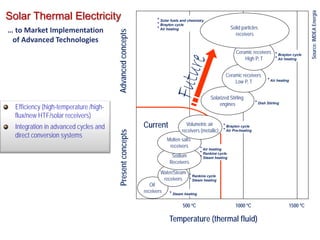
    Slide 22 • Steamheating • Brayton cycle • Air heating • Air heating • Dish Stirling • Air heating • Rankine cycle • Steam heating Oil receivers Water/Steam receivers Solarized Stirling engines Ceramic receivers Low P, T Temperature (thermal fluid) PresentconceptsAdvancedconcepts • Solar fuels and chemistry • Brayton cycle • Air heating Ceramic receivers High P, T Sodium Receivers Molten salts receivers • Brayton cycle • Air Pre-heating 500 ºC 1000 ºC 1500 ºC • Rankine cycle • Steam heating Current Source:IMDEAEnergía Solid particles receivers Volumetric air receivers (metallic) … to Market Implementation of Advanced Technologies Solar Thermal Electricity Efficiency (high-temperature /high- flux/new HTF/solar receivers) Integration in advanced cycles and direct conversion systems
  • 23.
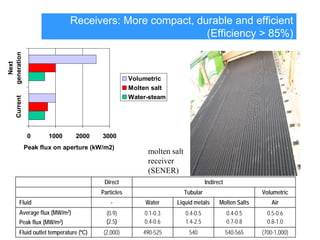
    Slide 23 Receivers: Morecompact, durable and efficient (Efficiency > 85%) molten salt receiver (SENER) 0 1000 2000 3000 Current Next generation Peak flux on aperture (kW/m2) Volumetric Molten salt Water-steam Direct Indirect Particles Tubular Volumetric Fluid - Water Liquid metals Molten Salts Air Average flux (MW/m2) Peak flux (MW/m2) (0.9) (2.5) 0.1-0.3 0.4-0.6 0.4-0.5 1.4-2.5 0.4-0.5 0.7-0.8 0.5-0.6 0.8-1.0 Fluid outlet temperature (ºC) (2,000) 490-525 540 540-565 (700-1,000)
  • 24.
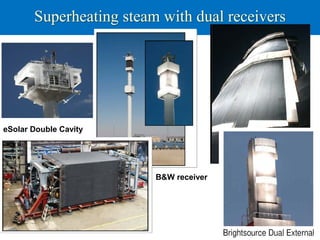
    Slide 24 Superheating steamwith dual receivers eSolar Double Cavity B&W receiver
  • 25.
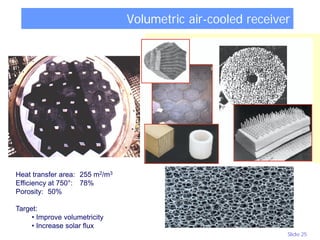
    Slide 25 Volumetric air-cooledreceiver Heat transfer area: 255 m2/m3 Efficiency at 750°: 78% Porosity: 50% Target: • Improve volumetricity • Increase solar flux
  • 26.
  • 27.
    Slide 27 Some recentdata on production in Spain Source REE Important milestones in July 2012:  Max. contribution 4,1% (July the 11th at 17:00) Max daily contribution 3,2% (July the 15th) Monthly production 2,3% (524 GWh in July) Solar Thermal Electricity production in Spain. July 2012MWh
  • 28.
    Slide 28 Average density Average heat conduc- tivity Average heat capacity Volume specific heat capacity Media costs per kg Media costs perkWht Cold Hot Storage Medium ºC ºC kg/m3 W/mK kJ/kgK kWht/m3 $/kg $/kWht Solid media Sand-rock-oil 200 300 1 700 1 1.30 60 0.15 14 Reinforced concrete 200 400 2 200 1.5 0.85 100 0.05 1 NaCl (solid) 200 500 2 160 7 0.85 150 0.15 1.5 Cast iron 200 400 7 200 37 0.56 160 1.00 32 Cast steel 200 700 7 800 40 0.60 450 5.00 60 Silica fire bricks 200 700 1 820 1.5 1.00 150 1.00 7 Magnesia fire bricks 200 1 200 3 000 5 1.15 600 2.00 6 Liquid media Mineral oil 200 300 770 0.12 2.6 55 0.30 4.2 Synthetic oil 250 350 900 0.11 2.3 57 3.00 43 Silicone oil 300 400 900 0.10 2.1 52 5.00 80 Nitrite salts 250 450 1 825 0.57 1.5 152 1.00 12 Nitrate salts 265 565 1 870 0.52 1.6 250 0.70 5.2 Carbonate salts 450 850 2 100 2 1.8 430 2.40 11 Liquid sodium 270 530 850 71 1.3 80 2.00 21 Phase change media NaNO3 308 2.257 0.5 200 125 0.20 3.6 KNO3 333 2.11 0.5 267 156 0.30 4.1 KOH 380 2.044 0.5 150 85 1.00 24 Salt-ceramics 500- 850 2.6 5 420 300 2.00 17 (Na2CO3-BaCO3/MgO) NaCl 802 2.16 5 520 280 0.15 1.2 Na2CO3 854 2.533 2 276 194 0.20 2.6 K2CO3 897 2.29 2 236 150 0.60 9.1 Temperature
  • 29.
    Slide 29 0 10000 20000 30000 40000 50000 60000 70000 80000 90000 1 59 13 17 21 1 5 9 13 17 21 1 5 9 13 17 21 1 5 9 13 17 21 Generation(MW) CSP5 Wind15 PV10 PV CSP Wind Hydro PHS/CAES Gas Other Biomass Coal Nuclear Geothermal Curtailment Due to Minimum Generation Constraints 29National Renewable Energy Laboratory Innovation for Our Energy Future Extensive coal and nuclear cycling unlikely to occur in current system • Marginal curtailment rate of PV moving from 10% to 15% of generation was 5% • At SunShot goals (~6 cents/kWh) this increases effective PV cost by about 0.3 cents/kWh due to underused capacity 0 10000 20000 30000 40000 50000 60000 70000 80000 90000 1 5 9 13 17 21 1 5 9 13 17 21 1 5 9 13 17 21 1 5 9 13 17 21 Generation(MW) CSP5 Wind15 PV10 PV CSP Wind Hydro PHS/CAES Gas Other Biomass Coal Nuclear Geothermal 10% PV 5 % CSP 15% PV No CSP • PV curtailment would be reduced if grid flexibility were increased • CSP/TES provides an option to replace “baseload” capacity with more flexible generation
  • 30.
    Slide 30 System marginalprice and corresponding CSP generation on January 22–24 (low RE case)
  • 31.
    Slide 31 Thermal energystorage Challenge: < 20-30 €/kWhth
  • 32.
    Slide 32 Innovative LatentThermal Energy Storage System for Concentrating Solar Power Plants Heat Transfer Fluid HTF Encapsulated PCM Storage Container Encapsulated PCM Tubes for fluid flow HTF Storage Container Fluid HTF Different concepts that will be modeled and tested Test setup - Schematic PCM (Solidified) PCM (Melting) PCM Melting point (0C) Latent Heat (kJ/kg) NaNO3 308 172 NaOH 318 316 KNO3 + 4.5%KCl 320 150 KNO3 333 266 Poly ether ether ketone 340 130 KNO3 + 4.7%KBr + 7.3%KCl 342 140 KOH 360 167 NaCl(26.8)/NaOH 370 370 42.5%NaCl + 20.5% KCl + MgCl2 390 410
  • 33.
    Slide 33 Ca(OH)2 +ΔH ↔ CaO + H2O (800K) Thermochemical Energy Storage for Concentrated Solar Power Plants 3Mn2O3 → 2Mn3O4 + ½ O2 (1180 K),
  • 34.
  • 35.
    Slide 35 El heliostatode SenerCheaper concentrators Large area heliostats New reflectors
  • 36.
    Slide 36 The SolarEnergy Development Center Small heliostats
  • 37.
  • 38.
    Slide 38 • Cortoa medio plazo  Producción de electricidad Objetivos de la concentración solar Objetivo último es la producción de combustibles solares • Medio a largo plazo  Química Solar
  • 39.
    Slide 3939 Disociación deagua con óxidos metálicos
  • 40.
    Slide 40 CONCLUSIONES Las CETintroducen la energía solar en mercados de alto valor añadido mediante procesos a alta temperatura, proporcionando alta capacidad y gestionabilidad. Las CET permiten trabajar en modo híbrido o con almacenamiento térmico para producción masiva de electricidad. El mercado por el momento concentrado en España y EEUU. Falta I+D para reducir costes un 60%, mejorar gestionabilidad y aumentar eficiencias. La producción de combustibles solares es uno de los elementos estratégicos para las próximas décadas. Energía Solar Alta Temperatura: