Direct Marketing
Why Direct Marketing Sparks Interest
and Increases ROI
The consumer’s and marketers point
of view
Consumers are experiencing information overload
– Consumers receive endless amounts of marketing messages .
• The average consumer is exposed to almost 3000 media messages every day
• 78%of people read their mail directly over a garbage can.
The internet has changed the way consumers respond to advertising.
• 50%of direct mail recipients prefer to respond to direct mail online.
• 66%of consumers who respond to offline ads visit the web to learn more—but 14%
• still call phone numbers from the ad.
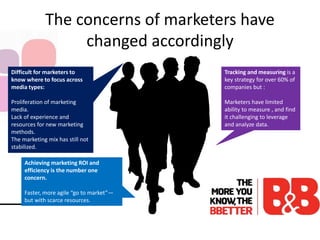
The concerns of marketers have
changed accordingly
Achieving marketing ROI and
efficiency is the number one
concern.
Faster, more agile “go to market”—
but with scarce resources.
Difficult for marketers to
know where to focus across
media types:
Proliferation of marketing
media.
Lack of experience and
resources for new marketing
methods.
The marketing mix has still not
stabilized.
Tracking and measuring is a
key strategy for over 60% of
companies but :
Marketers have limited
ability to measure , and find
it challenging to leverage
and analyze data.
Marketing activities must meet new
demands
• Improve segmentation, profiling, targeting
and lead generation
• Analyze effectiveness and optimize the
marketing mix
• Accurately deliver personalized messages
• and better engage customer’s interest
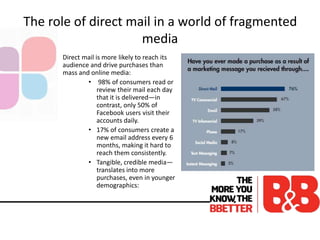
The role of direct mail in a world of fragmented
media
Direct mail is more likely to reach its
audience and drive purchases than
mass and online media:
• 98% of consumers read or
review their mail each day
that it is delivered—in
contrast, only 50% of
Facebook users visit their
accounts daily.
• 17% of consumers create a
new email address every 6
months, making it hard to
reach them consistently.
• Tangible, credible media—
translates into more
purchases, even in younger
demographics:
Targeted Direct Mail
What is targeted direct mail?
Targeted direct marketing addresses specific consumers using
customized and personalized communications.
– Customized marketing communications addresses the needs and interests
of a group of customers. Only names and addresses vary for each
recipient.
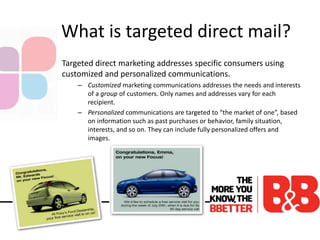
– Personalized communications are targeted to “the market of one”, based
on information such as past purchases or behavior, family situation,
interests, and so on. They can include fully personalized offers and
images.
Benefits of targeted direct mail
– Precise targeting of individuals builds
lasting customer relationships resulting
in improved retention rates and reduced
customer churn.
– This translates into bottom line
improvement—sales increases from
personalization and customization range
between 1% and 30%. There could also
be improvement to the deal size, speed
to close, and more…
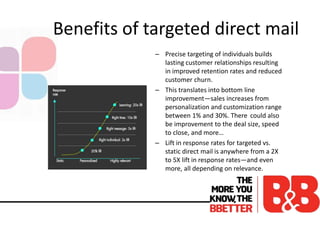
– Lift in response rates for targeted vs.
static direct mail is anywhere from a 2X
to 5X lift in response rates—and even
more, all depending on relevance.
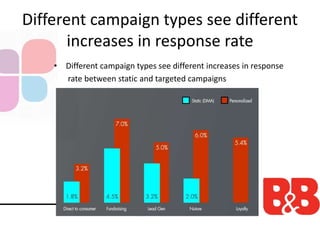
Different campaign types see different
increases in response rate
• Different campaign types see different increases in response
rate between static and targeted campaigns
Is targeted direct mail worth its cost?
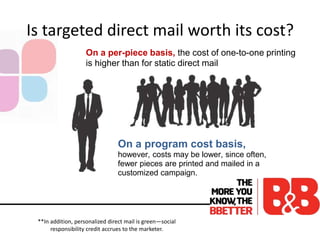
On a per-piece basis, the cost of one-to-one printing
is higher than for static direct mail
On a program cost basis,
however, costs may be lower, since often,
fewer pieces are printed and mailed in a
customized campaign.
**In addition, personalized direct mail is green—social
responsibility credit accrues to the marketer.
The essentials of a targeted direct mail
campaign
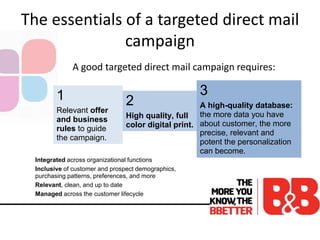
A good targeted direct mail campaign requires:
1
Relevant offer
and business
rules to guide
the campaign.
2
High quality, full
color digital print.
3
A high-quality database:
the more data you have
about customer, the more
precise, relevant and
potent the personalization
can become.
Integrated across organizational functions
Inclusive of customer and prospect demographics,
purchasing patterns, preferences, and more
Relevant, clean, and up to date
Managed across the customer lifecycle
What if the data doesn’t exist, or isn’t
good enough?
•Ideally, some historical customer (and potential customer)
information, has been collected and can be refined.
•Even if no information has been collected, you can start by
purchasing a qualified mailing list, reflecting the desired target
market.
•Surveys, loyalty programs, offers, and leads are excellent
resources for gathering and qualifying additional
information.
•Personalized URL campaigns can be a highly effective
database development technique.
•Specialized programs such as genderizing and mapping software
can boost campaign relevance for poorly differentiated databases.
Multichannel Marketing
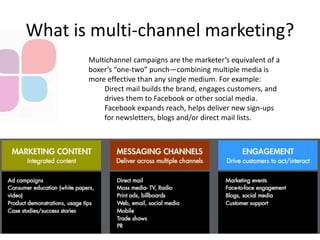
What is multi-channel marketing?
Multichannel campaigns are the marketer’s equivalent of a
boxer’s “one-two” punch—combining multiple media is
more effective than any single medium. For example:
Direct mail builds the brand, engages customers, and
drives them to Facebook or other social media.
Facebook expands reach, helps deliver new sign-ups
for newsletters, blogs and/or direct mail lists.
Multichannel doesn’t mean
complicated
• Goal is to reinforce a consistent, relevant message,
theme and brand.
– Today, multichannel marketing usually means print,
email, and web; text messaging can be used to
“prime the pump” or as follow-up.
– Driving to social media sites will engage customers
in real-time conversations, continually—even
between direct mail and email “sends”.
Marketing Storefronts
How do Marketing Storefronts work?
Marketing Storefronts are websites that provide the ability for your
customers’ employees or franchisees to use the web to create and
order direct mail campaigns and print products that are standardized,
but can still be tailored.
You define the storefront together with your customer:
Look and feel
Templates to be included (Storefront templates can be updated or
changed over time)
End user (your customer’s employees or franchisees) order jobs
based on the templates
Customize per needs (e.g., add the logo of a specific branch, the image
of the branch manager)
Add database of customers
End user pays for job.
Price is automatically calculated
Job is printed and mailed
Benefits of Marketing Storefronts
Standardize customer facing communications; Every
branch, sales rep, or franchisee uses the same template
Allow individuals to customize and personalize—but
stay within brand guidelines.
Manage costs by location/organization.
Every location can order their jobs and pay for it from their
budgets.
Consolidate print purchases.
All branches/employees use the same print vendor to
achieve volume discounts.
“Reuse” templates and campaigns that were successful.
Create once—and then multiple people can use the same
template, across the organization. For example:
Personalized mail piece from sales executives or
branch managers
Branch sales event invitation
Special offers and sales
Measuring and Maximizing ROI
Ground rules
Key metrics of a successful campaign
•Number of qualified leads.
•Number of transactions.
•Store traffic (for retail), consider halo and cannibalization effects.
•Conversion rate —number of closed deals divided by number of
respondents (percentage who convert from leads to sales).
•Total Campaign cost.
•Cost per lead—cost to get a person to respond.
•Cost per sale—cost to get a person to buy.
•Revenue per sale—likely to increase with a targeted campaign;
more engaged respondents are likely to spend more per sale.
•Return on investment—revenue generated by the campaign, minus
the costs, divided by the costs of the campaign.
•Speed of response—quicker responses will also have a financial
impact.
Key metrics of a successful campaign
(cont'd)
•Results over time.
•Lifetime customer value—an important measure, even
though most companies are not well-equipped to
measure it, because customer satisfaction and loyalty
drives more long term than short term value. LCV
increases significantly with targeted campaigns, since
customers will not only purchase more, but will also be
more loyal.
•Customer frequency, reach and yield—transactions per
month, number of new customers reached, customer
spend per transaction, reduction in customer churn, etc.
Best practices in managing a campaign
Plan, experiment, test, measure, and
evaluate.
Define business
objectives up front.
For consistent
messaging, involve
PR, traditional media,
and other disciplines in
interactive campaign
planning
Always build success
metrics into campaigns;
split campaigns so you
can compare results.
Metrics should be
simple, meaningful, and
easily measurable.
Try to measure the
true isolated
impact of the
campaign (taking
into account any
halo and
cannibalization
effects).
Many campaigns
build slowly—give
them time to
succeed!
Using data to improve future
campaigns
Understand what worked and didn’t work in the campaign.
• Track activity and results for each respondent.
• With which consumers and in what locations is the campaign most effective?
• What components of the marketing campaign truly drive the impact, versus merely
increasing complexity and cost?
Understand how future campaigns can be further
tailored and targeted.
Use database analytics to understand your customer base.
Identify meaningful behavioral, attitudinal, and
demographic differences between groups.

The Ultimate Guide To Pumping Up Your Direct Mail Marketing

  • 1.
    Direct Marketing Why DirectMarketing Sparks Interest and Increases ROI
  • 2.
    The consumer’s andmarketers point of view Consumers are experiencing information overload – Consumers receive endless amounts of marketing messages . • The average consumer is exposed to almost 3000 media messages every day • 78%of people read their mail directly over a garbage can. The internet has changed the way consumers respond to advertising. • 50%of direct mail recipients prefer to respond to direct mail online. • 66%of consumers who respond to offline ads visit the web to learn more—but 14% • still call phone numbers from the ad.
  • 3.
    The concerns ofmarketers have changed accordingly Achieving marketing ROI and efficiency is the number one concern. Faster, more agile “go to market”— but with scarce resources. Difficult for marketers to know where to focus across media types: Proliferation of marketing media. Lack of experience and resources for new marketing methods. The marketing mix has still not stabilized. Tracking and measuring is a key strategy for over 60% of companies but : Marketers have limited ability to measure , and find it challenging to leverage and analyze data.
  • 4.
    Marketing activities mustmeet new demands • Improve segmentation, profiling, targeting and lead generation • Analyze effectiveness and optimize the marketing mix • Accurately deliver personalized messages • and better engage customer’s interest
  • 5.
    The role ofdirect mail in a world of fragmented media Direct mail is more likely to reach its audience and drive purchases than mass and online media: • 98% of consumers read or review their mail each day that it is delivered—in contrast, only 50% of Facebook users visit their accounts daily. • 17% of consumers create a new email address every 6 months, making it hard to reach them consistently. • Tangible, credible media— translates into more purchases, even in younger demographics:
  • 6.
  • 7.
    What is targeteddirect mail? Targeted direct marketing addresses specific consumers using customized and personalized communications. – Customized marketing communications addresses the needs and interests of a group of customers. Only names and addresses vary for each recipient. – Personalized communications are targeted to “the market of one”, based on information such as past purchases or behavior, family situation, interests, and so on. They can include fully personalized offers and images.
  • 8.
    Benefits of targeteddirect mail – Precise targeting of individuals builds lasting customer relationships resulting in improved retention rates and reduced customer churn. – This translates into bottom line improvement—sales increases from personalization and customization range between 1% and 30%. There could also be improvement to the deal size, speed to close, and more… – Lift in response rates for targeted vs. static direct mail is anywhere from a 2X to 5X lift in response rates—and even more, all depending on relevance.
  • 9.
    Different campaign typessee different increases in response rate • Different campaign types see different increases in response rate between static and targeted campaigns
  • 10.
    Is targeted directmail worth its cost? On a per-piece basis, the cost of one-to-one printing is higher than for static direct mail On a program cost basis, however, costs may be lower, since often, fewer pieces are printed and mailed in a customized campaign. **In addition, personalized direct mail is green—social responsibility credit accrues to the marketer.
  • 11.
    The essentials ofa targeted direct mail campaign A good targeted direct mail campaign requires: 1 Relevant offer and business rules to guide the campaign. 2 High quality, full color digital print. 3 A high-quality database: the more data you have about customer, the more precise, relevant and potent the personalization can become. Integrated across organizational functions Inclusive of customer and prospect demographics, purchasing patterns, preferences, and more Relevant, clean, and up to date Managed across the customer lifecycle
  • 12.
    What if thedata doesn’t exist, or isn’t good enough? •Ideally, some historical customer (and potential customer) information, has been collected and can be refined. •Even if no information has been collected, you can start by purchasing a qualified mailing list, reflecting the desired target market. •Surveys, loyalty programs, offers, and leads are excellent resources for gathering and qualifying additional information. •Personalized URL campaigns can be a highly effective database development technique. •Specialized programs such as genderizing and mapping software can boost campaign relevance for poorly differentiated databases.
  • 13.
  • 14.
    What is multi-channelmarketing? Multichannel campaigns are the marketer’s equivalent of a boxer’s “one-two” punch—combining multiple media is more effective than any single medium. For example: Direct mail builds the brand, engages customers, and drives them to Facebook or other social media. Facebook expands reach, helps deliver new sign-ups for newsletters, blogs and/or direct mail lists.
  • 15.
    Multichannel doesn’t mean complicated •Goal is to reinforce a consistent, relevant message, theme and brand. – Today, multichannel marketing usually means print, email, and web; text messaging can be used to “prime the pump” or as follow-up. – Driving to social media sites will engage customers in real-time conversations, continually—even between direct mail and email “sends”.
  • 16.
  • 17.
    How do MarketingStorefronts work? Marketing Storefronts are websites that provide the ability for your customers’ employees or franchisees to use the web to create and order direct mail campaigns and print products that are standardized, but can still be tailored. You define the storefront together with your customer: Look and feel Templates to be included (Storefront templates can be updated or changed over time) End user (your customer’s employees or franchisees) order jobs based on the templates Customize per needs (e.g., add the logo of a specific branch, the image of the branch manager) Add database of customers End user pays for job. Price is automatically calculated Job is printed and mailed
  • 18.
    Benefits of MarketingStorefronts Standardize customer facing communications; Every branch, sales rep, or franchisee uses the same template Allow individuals to customize and personalize—but stay within brand guidelines. Manage costs by location/organization. Every location can order their jobs and pay for it from their budgets. Consolidate print purchases. All branches/employees use the same print vendor to achieve volume discounts. “Reuse” templates and campaigns that were successful. Create once—and then multiple people can use the same template, across the organization. For example: Personalized mail piece from sales executives or branch managers Branch sales event invitation Special offers and sales
  • 19.
  • 20.
  • 21.
    Key metrics ofa successful campaign •Number of qualified leads. •Number of transactions. •Store traffic (for retail), consider halo and cannibalization effects. •Conversion rate —number of closed deals divided by number of respondents (percentage who convert from leads to sales). •Total Campaign cost. •Cost per lead—cost to get a person to respond. •Cost per sale—cost to get a person to buy. •Revenue per sale—likely to increase with a targeted campaign; more engaged respondents are likely to spend more per sale. •Return on investment—revenue generated by the campaign, minus the costs, divided by the costs of the campaign. •Speed of response—quicker responses will also have a financial impact.
  • 22.
    Key metrics ofa successful campaign (cont'd) •Results over time. •Lifetime customer value—an important measure, even though most companies are not well-equipped to measure it, because customer satisfaction and loyalty drives more long term than short term value. LCV increases significantly with targeted campaigns, since customers will not only purchase more, but will also be more loyal. •Customer frequency, reach and yield—transactions per month, number of new customers reached, customer spend per transaction, reduction in customer churn, etc.
  • 23.
    Best practices inmanaging a campaign Plan, experiment, test, measure, and evaluate. Define business objectives up front. For consistent messaging, involve PR, traditional media, and other disciplines in interactive campaign planning Always build success metrics into campaigns; split campaigns so you can compare results. Metrics should be simple, meaningful, and easily measurable. Try to measure the true isolated impact of the campaign (taking into account any halo and cannibalization effects). Many campaigns build slowly—give them time to succeed!
  • 24.
    Using data toimprove future campaigns Understand what worked and didn’t work in the campaign. • Track activity and results for each respondent. • With which consumers and in what locations is the campaign most effective? • What components of the marketing campaign truly drive the impact, versus merely increasing complexity and cost? Understand how future campaigns can be further tailored and targeted. Use database analytics to understand your customer base. Identify meaningful behavioral, attitudinal, and demographic differences between groups.