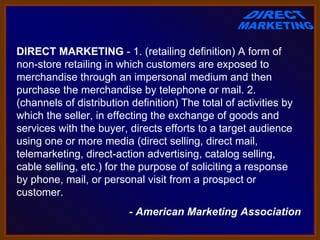
DIRECT MARKETING - 1. (retailing definition) A form of 
non-store retailing in which customers are exposed to 
merchandise through an impersonal medium and then 
purchase the merchandise by telephone or mail. 2. 
(channels of distribution definition) The total of activities by 
which the seller, in effecting the exchange of goods and 
services with the buyer, directs efforts to a target audience 
using one or more media (direct selling, direct mail, 
telemarketing, direct-action advertising, catalog selling, 
cable selling, etc.) for the purpose of soliciting a response 
by phone, mail, or personal visit from a prospect or 
customer. 
                          - American Marketing Association
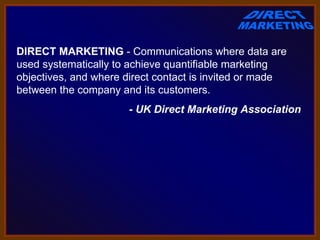
DIRECT MARKETING - Communications where data are 
used systematically to achieve quantifiable marketing 
objectives, and where direct contact is invited or made 
between the company and its customers.
                       - UK Direct Marketing Association
The Growth of Direct Marketing
  §   Sales thru DM growing at 5.3 %, sales thru other
      channels at 4.5% in the USA
  §   Changing lifestyles
  §   Working women
  §   Increased cost of traditional marketing, personal
      selling
  §   Growth of technology
  §   Need for Instant gratification
  §   Rise in income, “me” population
  §   Rising cost of fuel, lack of parking space
  §   Rising credit card base
  §   Availability of mailing lists
Benefits of Direct Marketing
    For customer
      1.   Fun, convenient, hassle-free
      2.   Saves time
      3.   More options, better comparison, better choice
      4.   Can order for self as well as others
      5.   Privacy
      6.   Can get items otherwise not available easily

    For Company
      1. Mailing list available for almost any market, geography
         no barrier
      2. Better customer understanding, Customized offer
      3. Ongoing relationship with customers
      4. Higher sales success rate
      5. Privacy in marketing strategy
      6. Measurable response
Database Marketing
   a form of direct marketing using databases of
    customers or potential customers to generate
    personalized communications in order to promote a
    product or service for marketing purposes. The
    method of communication can be any addressable
    medium.
   Sources of data
      Consumers
      Inferred by the data compiler
      Sweepstakes, contests, on-line registrations
   Analytics and Modeling. Should not be data rich,
    information poor
Benefits of Database Marketing
   Information of customer demographics, psychographics,
    tastes, preferences
   Helps in developing customized offers
   Helps in formulating cost effective strategies
   Helps in generating right leads for sales people
   Better segmentation
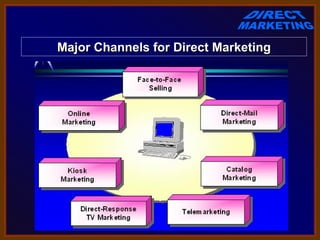
 Major Channels for Direct Marketing
  §   Face-To-Face Selling
  §   Direct Mail
  §   catalog
  §   Telephone, Fax
  §   kiosk
  §   television
  §   email, voicemail, website
Major Channels for Direct Marketing
Voicemail (or voice mail, vmail or VMS, sometimes called messagebank)
is a centralized system of managing telephone messages for a large
group of people. In its simplest form it mimics the functions of an
answering machine, uses a standard telephone handset for the user
interface, and uses a centralized, computerized system rather than
equipment at the individual telephone. Voicemail systems are much more
sophisticated than answering machines in that they can:
     • answer many phones at the same time
     • store incoming voice messages in personalized mailboxes
     associated with the user's phone number
     • enable users to forward received messages to another voice
     mailbox
     • send messages to one or more other user voice mailboxes
     • add a voice introduction to a forwarded message
     • store voice messages for future delivery
     • make calls to a telephone or paging service to notify the user a
          message has arrived in his/her mailbox
     • transfer callers to another phone number for personal assistance
     • play different message greetings to different callers.
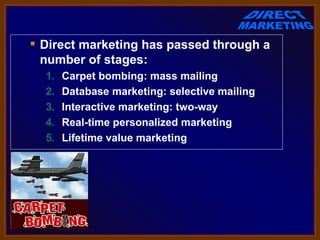
 Direct marketing has passed through a
  number of stages:
  1.   Carpet bombing: mass mailing
  2.   Database marketing: selective mailing
  3.   Interactive marketing: two-way
  4.   Real-time personalized marketing
  5.   Lifetime value marketing
 Constructing a Direct-Mail Campaign
 “sales people with wings”
    Objectives
         Sales
         Generating prospect leads
         Strengthening customer relationships
         Informing and educating customers
         Reminding customers about offers
         Reinforcing recent customer purchase decisions
    Target Markets and Prospects
       Segmentation variables
       Recency, Frequency, Monetary amount (R-F-M)
       Obtain customer database
 Constructing a Direct-Mail Campaign
    Offer Elements
         Product
         Offer (discounts, etc)
         Medium
         Distribution method
         Creative strategy
         Design / drafting of
             Envelop, Sales letter, reply form, reply envelop
             Attractive envelop with some colorful illustration, a
              catchy reason to open it, personal salutation, good
              quality paper, signature of some one very senior, toll
              free number, web site, postage-paid reply envelop
    Testing Elements
       Testing of the impact of the mail campaign
    Measuring Campaign Success
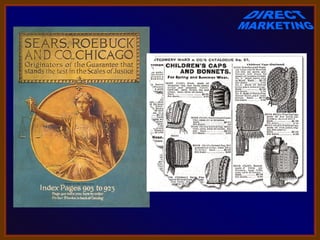
 Catalog Marketing
   Full-line merchandise catalog in print / CD / VHS /
    Online
   Success depends on:
      Managing customer list carefully – no duplication, no bad
       debt
      Care inventory management
      Quality merchandise
      Logistics
      Return policy
      Long-term customer relationship management
 Telemarketing and M-Commerce
   Inbound telemarketing
   Outbound telemarketing
   Four types of telemarketing:
     Telesales: taking orders from catalogs/ads,
      making sales calls
     Telecoverage: maintaining and nurturing key
      account relationships
     Teleprospecting: generating leads of prospects
     Customer service and technical support
 Other Media for Direct-Response Marketing
   Direct-response advertising on TV
   At-home shopping channels: dedicated Home
    Shopping Networks
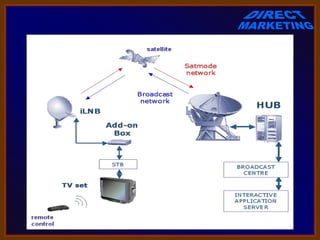
   Videotext and interactive TV
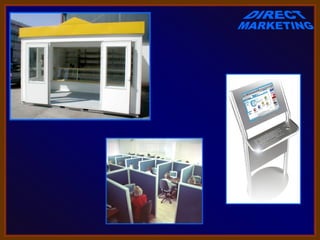
 Kiosk Marketing
 E-commerce
   Electronic commerce, EC, e-commerce or ecommerce consists 
    primarily of the distributing, buying, selling, marketing, and 
    servicing of products or services over electronic systems such 
    as the Internet and other computer networks. The information 
    technology industry might see it as an electronic business 
    application aimed at commercial transactions. It can involve 
    electronic funds transfer, supply chain management, e-
    marketing, online marketing, online transaction processing, 
    electronic data interchange (EDI), automated inventory 
    management systems, and automated data collection systems. 
    It typically uses electronic communications technology such as 
    the Internet, extranets, e-mail, e-books, databases, and mobile 
    phones.
 M-commerce
   M-commerce or mobile commerce stands for electronic 
    commerce made through mobile devices, e.g. mobile phones, 
    PDAs.
   M-commerce is currently mainly used for the sale of mobile 
    phone ring-tones and games, although as 3G services roll out it 
    is increasingly used to enable payment for location-based 
    services such as maps, as well as video and audio content, 
    including full length music tracks. Other services include the 
    sending of information such as football scores via SMS.
   Currently the main payment methods used to enable m-
    commerce are:
       premium-rate calling numbers, 
       charging to the mobile telephone user's bill or 
       deducting from their calling credit, either directly or via 
         reverse-charged SMS.
 Internet Marketing
   use of the Internet to advertise and sell goods and 
    services. Internet Marketing includes pay per click 
    advertising, banner ads, e-mail marketing, search 
    engine marketing, blog marketing, and article 
    marketing.
   Designing attractive websites: Context (layout & 
    design), Content (text, pictures, sound, vdo), 
    Customization, Communication (two-way), 
    Connection (to other websites), Commerce, Constant 
    change
 Internet Marketing - Ads
   Banner ads : small rectangular boxes
   Sponsorships : sponsoring special content
   Microsite : a limited area on the web managed by 
    and paid for, low interest products like insurance
   Pop Ups and Pop under
   Interstitials: pop ups between changes on a website
   Search-related ads
   Affiliate programs
 E-Marketing
   Permission Marketing
      Levels of Permission Marketing:(Seth Godin)

              No permission level
              Low permission level
              Medium permission level
              High permission level
              Transaction level
   E-Marketing Guidelines
        Give the customer a reason to respond
        Personalize the content of your e-mails
        Offer something the customer could not get via direct mail
        Make it easy for the customer to “unsubscribe”

Direct mktg

  • 2.
  • 3.
  • 4.
    The Growth ofDirect Marketing § Sales thru DM growing at 5.3 %, sales thru other channels at 4.5% in the USA § Changing lifestyles § Working women § Increased cost of traditional marketing, personal selling § Growth of technology § Need for Instant gratification § Rise in income, “me” population § Rising cost of fuel, lack of parking space § Rising credit card base § Availability of mailing lists
  • 5.
    Benefits of DirectMarketing  For customer 1. Fun, convenient, hassle-free 2. Saves time 3. More options, better comparison, better choice 4. Can order for self as well as others 5. Privacy 6. Can get items otherwise not available easily  For Company 1. Mailing list available for almost any market, geography no barrier 2. Better customer understanding, Customized offer 3. Ongoing relationship with customers 4. Higher sales success rate 5. Privacy in marketing strategy 6. Measurable response
  • 6.
    Database Marketing  a form of direct marketing using databases of customers or potential customers to generate personalized communications in order to promote a product or service for marketing purposes. The method of communication can be any addressable medium.  Sources of data  Consumers  Inferred by the data compiler  Sweepstakes, contests, on-line registrations  Analytics and Modeling. Should not be data rich, information poor
  • 7.
    Benefits of DatabaseMarketing  Information of customer demographics, psychographics, tastes, preferences  Helps in developing customized offers  Helps in formulating cost effective strategies  Helps in generating right leads for sales people  Better segmentation
  • 8.
     Major Channelsfor Direct Marketing § Face-To-Face Selling § Direct Mail § catalog § Telephone, Fax § kiosk § television § email, voicemail, website
  • 9.
    Major Channels forDirect Marketing
  • 12.
    Voicemail (or voicemail, vmail or VMS, sometimes called messagebank) is a centralized system of managing telephone messages for a large group of people. In its simplest form it mimics the functions of an answering machine, uses a standard telephone handset for the user interface, and uses a centralized, computerized system rather than equipment at the individual telephone. Voicemail systems are much more sophisticated than answering machines in that they can: • answer many phones at the same time • store incoming voice messages in personalized mailboxes associated with the user's phone number • enable users to forward received messages to another voice mailbox • send messages to one or more other user voice mailboxes • add a voice introduction to a forwarded message • store voice messages for future delivery • make calls to a telephone or paging service to notify the user a message has arrived in his/her mailbox • transfer callers to another phone number for personal assistance • play different message greetings to different callers.
  • 13.
     Direct marketinghas passed through a number of stages: 1. Carpet bombing: mass mailing 2. Database marketing: selective mailing 3. Interactive marketing: two-way 4. Real-time personalized marketing 5. Lifetime value marketing
  • 14.
     Constructing aDirect-Mail Campaign  “sales people with wings”  Objectives  Sales  Generating prospect leads  Strengthening customer relationships  Informing and educating customers  Reminding customers about offers  Reinforcing recent customer purchase decisions  Target Markets and Prospects  Segmentation variables  Recency, Frequency, Monetary amount (R-F-M)  Obtain customer database
  • 15.
     Constructing aDirect-Mail Campaign  Offer Elements  Product  Offer (discounts, etc)  Medium  Distribution method  Creative strategy  Design / drafting of  Envelop, Sales letter, reply form, reply envelop  Attractive envelop with some colorful illustration, a catchy reason to open it, personal salutation, good quality paper, signature of some one very senior, toll free number, web site, postage-paid reply envelop  Testing Elements  Testing of the impact of the mail campaign  Measuring Campaign Success
  • 16.
     Catalog Marketing  Full-line merchandise catalog in print / CD / VHS / Online  Success depends on:  Managing customer list carefully – no duplication, no bad debt  Care inventory management  Quality merchandise  Logistics  Return policy  Long-term customer relationship management
  • 17.
     Telemarketing andM-Commerce  Inbound telemarketing  Outbound telemarketing  Four types of telemarketing:  Telesales: taking orders from catalogs/ads, making sales calls  Telecoverage: maintaining and nurturing key account relationships  Teleprospecting: generating leads of prospects  Customer service and technical support
  • 18.
     Other Mediafor Direct-Response Marketing  Direct-response advertising on TV  At-home shopping channels: dedicated Home Shopping Networks  Videotext and interactive TV  Kiosk Marketing
  • 21.
     E-commerce  Electronic commerce, EC, e-commerce or ecommerce consists  primarily of the distributing, buying, selling, marketing, and  servicing of products or services over electronic systems such  as the Internet and other computer networks. The information  technology industry might see it as an electronic business  application aimed at commercial transactions. It can involve  electronic funds transfer, supply chain management, e- marketing, online marketing, online transaction processing,  electronic data interchange (EDI), automated inventory  management systems, and automated data collection systems.  It typically uses electronic communications technology such as  the Internet, extranets, e-mail, e-books, databases, and mobile  phones.
  • 22.
     M-commerce  M-commerce or mobile commerce stands for electronic  commerce made through mobile devices, e.g. mobile phones,  PDAs.  M-commerce is currently mainly used for the sale of mobile  phone ring-tones and games, although as 3G services roll out it  is increasingly used to enable payment for location-based  services such as maps, as well as video and audio content,  including full length music tracks. Other services include the  sending of information such as football scores via SMS.  Currently the main payment methods used to enable m- commerce are:  premium-rate calling numbers,   charging to the mobile telephone user's bill or   deducting from their calling credit, either directly or via  reverse-charged SMS.
  • 23.
     Internet Marketing  use of the Internet to advertise and sell goods and  services. Internet Marketing includes pay per click  advertising, banner ads, e-mail marketing, search  engine marketing, blog marketing, and article  marketing.  Designing attractive websites: Context (layout &  design), Content (text, pictures, sound, vdo),  Customization, Communication (two-way),  Connection (to other websites), Commerce, Constant  change
  • 24.
     Internet Marketing- Ads  Banner ads : small rectangular boxes  Sponsorships : sponsoring special content  Microsite : a limited area on the web managed by  and paid for, low interest products like insurance  Pop Ups and Pop under  Interstitials: pop ups between changes on a website  Search-related ads  Affiliate programs
  • 25.
     E-Marketing  Permission Marketing  Levels of Permission Marketing:(Seth Godin)  No permission level  Low permission level  Medium permission level  High permission level  Transaction level  E-Marketing Guidelines  Give the customer a reason to respond  Personalize the content of your e-mails  Offer something the customer could not get via direct mail  Make it easy for the customer to “unsubscribe”