


Make Your Emails MatterIncrease Email RelevanceThrough Segmentation and TargetingPresented by Tom Bishop, Marketing ManagerBased on white paper by Marianne CellucciCertified Email Marketing Specialist
AgendaServe Up Relevant ContentApply Targeting TechniquesAutomate Lifecycle MessagingAchieve the Right FrequencyTest the Segmentation Strategy
Segmentation?What is
What is Segmentation?The process of subdividing your market baseCreate distinct groupsPeople with similar purchase behaviorPeople with similar needs and interestsPeople who share something in common
Segmentation?Why use
It Gets Results!
It Gets Results!No more batch & blastSegmentation raises relevanceAdd value, drive response, & increase revenueFocus your marketing efforts
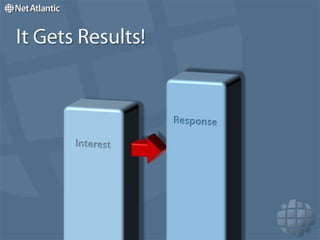
ResponseInterestIt Gets Results!
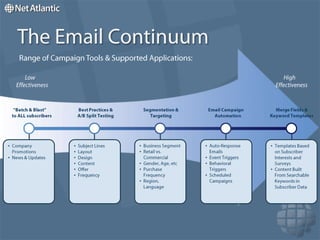
The Email ContinuumRange of Campaign Tools & Supported Applications:LowEffectivenessHigh Effectiveness“Batch & Blast”to ALL subscribersBest Practices &A/B Split TestingSegmentation &TargetingEmail Campaign AutomationMerge Fields &Keyword TemplatesCompany Promotions
News & Updates
Subject Lines
Layout
Design
Content
Offer
Frequency
Business Segment
Retail vs. Commercial
Gender, Age, etc
Purchase Frequency
Region,Language
Auto-Response Emails
Event Triggers
Behavioral Triggers
Scheduled Campaigns
Templates Based on Subscriber Interests and Surveys
Content Built From Searchable Keywords in Subscriber DataYou stay relevantYou observe patternsYou address needsYou stay engaged
Tip: Observe and Serve#1 reason people unsubscribe: Relevance (lack of it)Observe audience activityThen segment and serve them appropriately
RelevantServe UpContent
Serve Up Relevant ContentWhat you think is relevant… is irrelevantYour customer will tell you what’s relevantYou gather insight about your customer from dataMore information means more segmentsMore segments means more focused messages
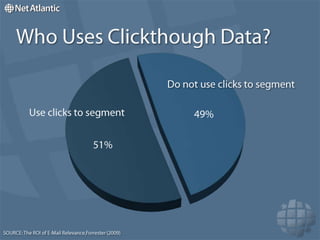
Who Uses Clickthough Data?Do not use clicks to segmentUse clicks to segmentSOURCE: The ROI of E-Mail Relevance,Forrester (2009)
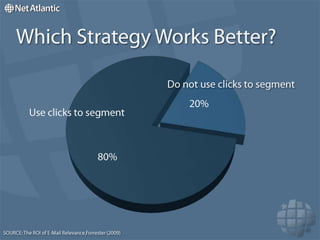
Which Strategy Works Better?  Do not use clicks to segmentUse clicks to segmentSOURCE: The ROI of E-Mail Relevance,Forrester (2009)
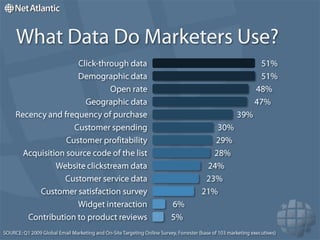
What Data Do Marketers Use?Click-through data51%Demographic data51%Open rate48%Geographic data47%Recency and frequency of purchase39%Customer spending30%Customer profitability29%Acquisition source code of the list28%Website clickstream data24%Customer service data23%Customer satisfaction survey21%Widget interaction6%Contribution to product reviews5%SOURCE: Q1 2009 Global Email Marketing and On-Site Targeting Online Survey, Forrester (base of 103 marketing executives)
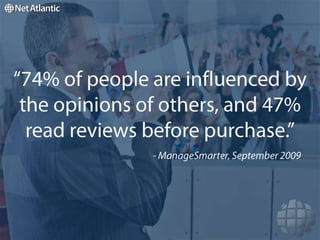
“74% of people are influenced by the opinions of others, and 47% read reviews before purchase.”- ManageSmarter, September 2009
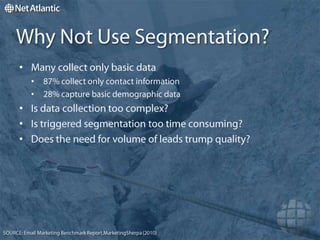
Why Not Use Segmentation?Many collect only basic data87% collect only contact information28% capture basic demographic dataIs data collection too complex?Is triggered segmentation too time consuming?Does the need for volume of leads trump quality?SOURCE: Email Marketing Benchmark Report,MarketingSherpa (2010)
You findengaged peopleYou know who to callYou offer the solutionsYou win the business
Tip: Track Social MediaUse social engagement metrics to segment readersForwards, votes, likes, follows, fansSurveys and feedbackSocial commentary and brand sentimentSelf-categorization
TargetingApplyTechniques
Apply Targeting TechniquesThe most powerful tool in email marketingUnlimited data storageDynamic segmentationConditional content fieldsOnline behavior tracking
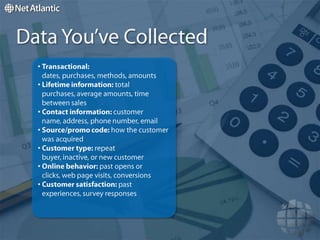
Data You’ve CollectedTransactional: dates, purchases, methods, amounts
Lifetime information: total purchases, average amounts, time between sales
Contact information: customer name, address, phone number, email
Source/promo code: how the customer was acquired
Customer type: repeat buyer, inactive, or new customer
Online behavior: past opens or clicks, web page visits, conversions
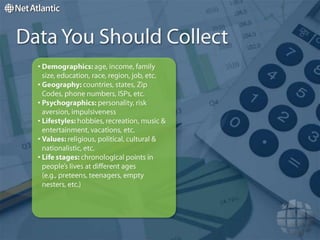
Customer satisfaction: past experiences, survey responsesData You Should CollectDemographics: age, income, family size, education, race, region, job, etc.
Geography: countries, states, Zip Codes, phone numbers, ISPs, etc.

Make Your Emails Matter

Editor's Notes

  • #2 Welcome, everybody. I’d like to say thank you for joining Net Atlantic today for “Make Your Emails Matter”.I’m Tom Bishop, Marketing Manager for Net Atlantic, an Email Marketing Service Provider founded in 1995. This presentation covers the topics discussed in our white paper of the same name, written by Marianne Cellucci, our SEO/PPC Analyst.<slow down>Marianne is a certified email marketing professional, and is our leader for everything regarding online marketing. I will send you our white paper as soon as this webinar is over.What we hope to cover today in 30 to 40 minutes, leaving 15 minutes at the end for questions, are 5 concepts for using email segmentation, targeting, and tracking to increase the relevance and effectiveness of your email marketing campaigns. I am taking questions over the GotoWebinar interface and twitter by using the hashtag #makeemailmatter.<click>
  • #3 Our agenda covers the 5 concepts that will make your emails matter:<click>First, I’ll talk about Serving Up Relevant Content, which is about collecting as much data from your customers as you can so you can match their needs.<click>Next, I’ll talk about Applying Targeting Techniques, which include Profile-Based and Behavioral-Based information that you will use to segment customers into smaller and smaller groups.<click>Then I’ll go into Automating Lifecycle Messaging, which allows you to follow people as their needs change and keep providing a relevant message.<click>Then I’ll cover achieving the right contact frequency for your audience, depending on their expectations and preferences.<click>And finally, I’ll talk about Testing and Measuring Results, such as A/B/n Split Testing, so you reach maximum precision in your segmentation strategy. In between, I’ll offer some tips on increasing relevance starting right now.<click>
  • #4 Before I dig into the 5 topics, I will answer this question; What is Segmentation?<click>
  • #5 Segmentation is <click>the process of dividing your market base into<click>distinct manageable groups of consumers that are likely to<click>display similar purchase behavior<click>or share a similar set of needs or characteristics<click>Or basically, anything they have in common. You will select each one or several groups to reach with a distinct marketing message.<click>
  • #6 Why would you want to use segmentation? That’s easy:<click>
  • #7 It Gets Results!<click>
  • #8 <click>With email marketing, batch and blast is a thing of the past.Today, organizations must gain a better understanding of their target audience.<click>The key objective of segmentation is to increase the relevance of your email communications.<click>You add more value and drive response, ultimately increasing revenue for your organization.<click>You want to learn who you engage so you can properly focus your marketing efforts and maximize efficiency, since you cannot be all things to all people.<click>
  • #9 Segmentation can greatly improve the response of your email marketing campaigns, raising the open rate from an average of 20% to 50%, and raising your clickthroughs from 5% to 30%. This improvement in response is because the message is more aligned with the reader’s interests and needs. This increases user engagement and enhances profitability.
  • #10 Let’s look at email campaigns along a continuum ranging in effectiveness, from low to high.<click>At the low end, you have blasts of newletters and promotions to your entire market base. These get the lowest clickthrough rates.<click>When you add simple best practices to your campaigns, such as optimized subject lines and layouts, it can get a lot better.<click>Adding segmentation and targeting raises relevance even further, by tailoring the message to a business segment and setting appropriate contact frequencies.<click>Campaign Automation takes this up a level by setting transactional and autoresponse emails, such as autoresponders.<click>At the top of the effectiveness range, you have the use of Merge fields and conditional content, as well as templates based on keywords you’ve stored in each customer’s record.<click>
  • #11 So segmenting you emails helps you stay relevant with your customers<click>Observing patterns in customer behavior and expectations<click>Allowing you to address needs directly, and <click>Stay engaged with customers throughout the lifetime of their experience with your brand. <click>
  • #12 The first tip is: Observe and Serve<click>The number one reason people decide to unsubscribe from an email is because the message is not relevant to them.<click>Observe your audiences’ online activity so you <click>can segment and serve them appropriately.<click>
  • #13 Number one of the five topics I’ll cover today is:Serve Up Relevant Content<click>
  • #14 <click>Delivering highly relevant content requires much more than capturing basic data, because what you think is relevant and what a prospect or customer finds relevant may be different things.<click>Relevancy should be based on customer understanding and insight gathered from both behavioral and profile-based data.<click>Segmentation lets you capture vital data about who your prospects and customers are and what interests them.<click>The more information you can collect about them, the more innovative you can make your targeting strategies. <click>The more segments you have, the more focused you can be about characterizing the various groups within your email list. The result: subscribers get useful relevant content and subsequently purchase more.<click>
  • #15 In a 2009 survey, Forrester Research found that email marketers are starting to realize that click-based behavioral segmentation works: 51 percent of email marketing executives said they’d used clickthrough data to segment audiences for email campaigns, but there are still almost half who don’t.<click>
  • #16 Yet, the same study showed that email marketers who employ segmentation strategies and integrate behavioral targeting are four to six times more effective than those who don’t. The finding is that ‘Spray and pray’ doesn’t work.<click>
  • #17 From another 2009 Forrester study, marketers were collecting these data to view the effectiveness of their lists. These are not exclusive groups, and 51% collect clickthrough and demographic data, going down to 24% who collect clickstreaming. This is following customers where they go after they click your email. Widget interaction and online review data, found at the bottom, are certain to increase as social media metrics begin to take hold in the marketing realm.<click>
  • #18 Someday those reviews will be extremely important, since according to Manage Smarter, “74% of people are influenced by the opinions of others, and 47% read reviews before purchase.”<click>
  • #19 So why would you not use segmentation?<click>According to the 2010 MarketingSherpa Email Marketing Benchmark Report, many email marketers are still not tapping the full potential of segmentation.<click>87% of marketers capture only contact information from subscribers,<click>and only 28% include basicdemographic data such as age or gender.<click>Why is this? Isit complex and daunting to ask for more detail from customers and prospects?<click>Is it still too time-consuming to set up segmentation and triggering campaigns?<click>Maybe having a high number of raw leads is still more important than quality. I know of one company that had very robust lead generation campaigns but was afraid to collect too much detail because the customers might balk at filling out the forms. They were wasting a lot of time for the sales department, and needed to get people from elsewhere in the company, such as administration and marketing to help make calls. The bottom line, if you ask for more detail, you will know who is the most valuable customer and help your sales organization be more effective.The rewards for segmenting using just a few fields of vital data are very high. So work hard at engaging in a dialogue with consumers about what they want and need, and deliver differentiated messages and experiences.<click>
  • #20 The benefits of serving up relevant content are that you find the most engaged people,<click>You know who to call first<click>You offer the solutions your customers need<click>And you win the business.<click>
  • #21 Here’s another tip: <click>If you start to track those social media metrics I mentioned earlier, such as <click>Forwards, votes, likes, follows, fans, and others<click>Surveys, feedback from support<click>Social commentary and brand sentiment, <click>And allow people to self-categorize by preferences and favorites, you will have another entire realm of data on which to segment your audience.<click>
  • #22 Next, I’ll talk about Applying Targeting Techniques<click>
  • #23 <click>The most powerful aspect of any emailmarketing solution is its segmentation feature.<click>Current email marketing tools let you storemore detailed data and run very tightlymessaged campaigns.<click>You can also create segments that are dynamic, meaning they constantly change as people take different actions, fulfill needs, and shift to new income strata.<click>Conditional content lets your email marketing campaigns do the work as they collect data automatically and insert it into your email text and graphics fields.<click>Behavior tracking lets your campaigns follow up with people automatically or according to a schedule you’ve already set for that group.<click>
  • #24 And a lot of this data you already have. You’ve probably already collected information like:<click><click>Transactional data like date purchases were made and what was bought<click>Lifetime information such as total purchases and time between orders<click>Contact Information, which is pretty standard<click>Lead Source and promo codes that tell you where the customer came from<click>Customer type like repeat buyers or new customers<click>Online behavior, such as past opens or clickthroughs and web page visits<click>Customer satisfaction data such as complaints and survey responses<click>
  • #25 But is there data you might not collect right now? Probably, and it may include:<click>Demographics such as age, gender, education, marital status, and other data like that.<click>Geographic data including countries, states, Zip codes, and even IP location<click>Psychographics likepersonality and risk aversion or impulsiveness<click>Lifestyles such as hobbies and entertainment choices<click>Belief and value systems such as religious and cultural values<click>Life stages, which are a chronological benchmark of where people are in their lives, like teenagers, young professionals, empty nesters, and so on.<click>
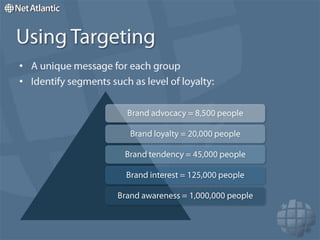
  • #26 One example of a new way to segment customers is by level of customer loyalty, which can be gathered through outside surveys and direct purchase behavior.<click>At the bottom, you have people who are aware of your brand. This is the largest population.<click>Next, there are a smaller group who know of and are interested in your brand.<click>The next group may actually prefer your brand, given the right price and attributes.<click>Finally, your loyal audience prefers you even when price and value is not equal across your competitive field.<click>Above that, are the advocates. These are supercustomers who favor your brand no matter what, and actively push the brand to others. We can think of a few companies and organizations who have this kind of following.<click>
  • #27 So targeting is all about dicovering your audiences’ various interests<click>And reacting to their online behavior. Using your static and dynamic data sources helps you <click>Offer timely solutions to your audience segments and<click>Ultimately drive customer loyalty to your brand.<click>
  • #28 Another tip is to stay completely in sync with your audience<click>Their interests change constantly, including<click>Even their email addresses, which may change once a year for a third of your audience.<click>The networking power of an interested segment is your strongest ally<click>Your real-time tracking and analysis tool is necessary to keep up.<click>And a list cleaning and appending tool, applied to your list, will allow you to keep reaching your audience.<click>
  • #29 Next, I’ll talk about automating your lifecycle messaging.<click>
  • #30 <click>Automated lifecycle messaging enables you to deliver different messages based on the relationship lifecycle.<click>Activities to use for automating campaigns include<click>opens, clicks, and conversions, which have different values for you. So you treat them separately.<click>Your past history with customers helps you create the rules you will use to apply automated campaigns.<click>And you will capture new data in real-time. Trends and changes may affect your automation rules in the future.<click>Most importantly, pay attention to internal and external influences. We’ve all heard stories from sales departments about a big opportunity that may be closing soon, only to read that the company we’re talking to is about to lay off an entire division and freeze all purchases. If your segment is based on industry, and you know that one of those industries is suffering across the board, it will affect your message and probably your strategy toward that segment.<click>
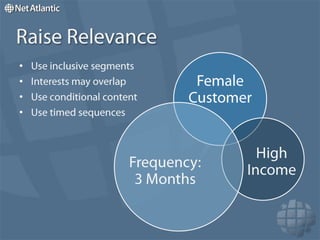
  • #31 In lifecycle marketing,<click>you use a lot of segments that are inclusive,<click>Meaning that customer interests across many groups can overlap.<click>Your conditional content and <clicks> timed sequences can take care of tailoring your message for a specific audience.Let’s say you manufacture shoes and sell them direct as well as through numerous channels. You have a new ladies’ shoe that is targeted at a high-end buyer who buys shoes frequently.<click>You may already have a campaign aimed at women<click>And another aimed at buyers with a high income<click>And another for people with a high frequency of purchase. A woman who fits all three categories will get an email with conditional content that contains exactly the value she’s looking for. We’ve all gotten emails that are irrelevant to us. Lifecycle automation helps avoid that problem.<click>
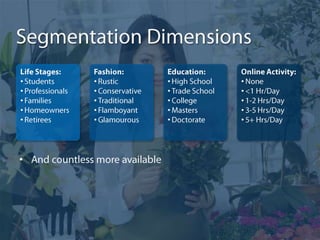
  • #32 Here are some examples of segmentation dimensions<click>Life stages are the most obvious ones<click>Fashion is another<click>Level of education provides a way to segment your audience<click>Online activity is definitely a useful metric to have.<click>And there are obviously many more that may tell you where somebody is in their buying lifecycle.<click>
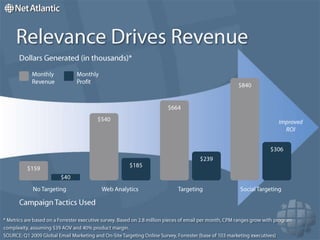
  • #33 Ultimately, using lifecycle automation helps you drive revenue<click>According to that 2009 Forrester survey of marketing executives, Those who did not use targeting generated only 159 thousand dollars in revenue and 40 thousand in profits from their campaigns<click>By using web analytics, they were able to increase that to 540 thousand in sales and 185 thousand in profits.<click>By adding targeting of message, they brought it to 664 thousand and 239 thousand.<click>And with what Forrester calls social targeting, which is knowing the lifecycle-based interests of the customers, they took it up to 840 thousand in renevues and 306 thousand in profits, which you’ll also notice is a much higher margin than the other groups as well.<click>
  • #34 So with lifecycle automation, Timing Is Everything<click>It allows you to match your customer’s frequency of purchase with <click>Their expectations<click>Improving your ROI<click>
  • #35 The next tip, is Let Your SubscribersSelf-Segment<click>We’ve all seen social media interfaces that allow you to join groups, be fans of musical groups and foods and everything else, so if you make your interface work as easily as a social media site, you can use this data as well.<click>It also helps to make the benefits of joining a group or volunteering other information very clear<click>Don’t restrict the categories, let people give you as much detail as they like<click>And then deliver on the promised benefits immediately.<click>
  • #36 The fourth topic is: Achieve the Right FrequencyThis is about how often you should send emails.<click>
  • #37 One of the most frequently asked questionswe get is, “How often should we send emailmessages to our list?”<click>Our answer: “Not too much<click>but not too little.” <click>Even across one market segment you deal with, customer preferences will vary.<click>They have different expectations from you<click>They have different preferences from each other<click>And your industry has its own norms for sending emails, which may be changing<click>Sometimes finding the right frequency just takes trial and error. See what works best over time.<click>
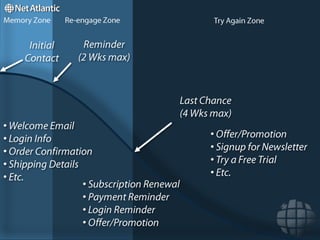
  • #38 Here is an example: With most online tools, the sooner you follow up with people who join your list, the sooner you set expectations for the frequency of your campaigns.<click>First, you have initial contact from a new subscriber. They are in the memory zone, where they will remember you.<click>Next, you have a chance to send your reminders, and the re-engage zone is probably no more than 2 weeks long.<click>Then, you may have a last chance before 4 weeks goes by, but after that, you’re in the Try Again zone.The later you wait to engage, the more interest drops off and the value of your offering goes down. For existing subscribers, going for weeks or months without any communication has the same effect.<click>
  • #39 So with finding the right frequency for your segmented campaigns, you should watch for trends.<click>And when you get feedback, directly or indirectly, heed it.<click>Always evaluate your metrics so you know the benchmarks<click>And you will find the perfect pitch for your campaigns.<click>
  • #40 Here’s another tip:Keep people Engaged by<click>Understanding that irrelevance is the number one reason people leave you<click>That’s why you need specific message for each of your segments<click>Make sure your content and your offerings are interesting<click>And match people on the frequency they’ve indicated and asked for.<click>
  • #41 Finally, to maintain best practices for your company, you need to Test and measure your results<click>
  • #42 <click>Testing is a great way to Take segmentation even further by ensuring that your campaign segments, targeting, automation, and frequency are effective<click>A/B/n splittesting gives you real-world feedback to help you optimize your campaigns<click>Testing helps you Learn each segment's preferences by sending different emails to one group so you can find out which one they liked better, by opening and clicking it.<click> You can perform tests every time you send, allowing you to constantly Optimize your message in content, look and feel, and timing<click>Once you Reach maximum precision and flexibility with your email campaigns, test again. This is about an ongoing process that is an important part of making your emails matter.<click>
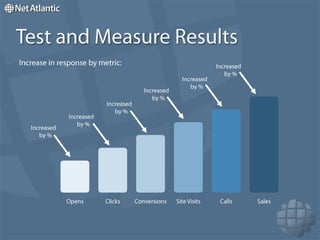
  • #43 What you should see over time is an increase in various email metrics. For instance, Opens should improve, but this leads to an increase in clickthroughs and conversions. An email service that provides clickstreaming to your website can also give you site visits. Beyond that, you should see an increase in calls as well as sales.<click>
  • #44 So what is the outcome of a good testing strategy? The possibilities become endless<click>You will truly maximize your marketing ROI<click>Because you’re no longer trying to be all things to all people<click>But just one thing to each of them.<click>
  • #45 Final Tip: Revive your lapsed customers<click>It’s always been easier to win back lost customers than find people who are completely new. Maybe a new and refined email communication strategy will impress them.<click>You don’t need to contact old customers as often but you may still track their use online if they still interface at all with your company.<click>You can also try to match milestones, such as if they left exactly one year ago, maybe they went under contract with a competitor and it’s going to end soon. Not a bad time to say hello, how’s it goin’?<click>
  • #46 So our Conclusion, we’ve talked about what segmentation is and why you’d use it, because increasing the relevance of your email campaigns greatly increases their effectiveness. So you’ve<click>Identified groups by collecting as data from your customers so you can match their needs.<click>Next, you’ve used Targeting Techniques to Create hyper-relevant, targeted content.<click>Then we discussed Automating Lifecycle Messaging, which greatlyIncreases response and productivity<click>Then I talked about achieving the right contact frequency for your audiences’ individual wants and needs<click>And then I showed the benefits of Testing and Measuring your Results, which help you provide the best possible solution to your customers.<click>Following all of this will not only help you optimize your list and your campaigns, it will have a substantial impact on your bottom line, and put you ahead of your competition.
  • #47 Thank you for joining us today. There will be a copy of this webinar as well as our whitepaper, “Make Your Emails Matter” sent out to you very shortly. Before taking questions, I want to cover a little about Net Atlantic.<click>15 Years of Service, Founded in 1995<click>Headquartered in Salem, MA <click>Privately Held, Profitable Organization<click>One of the first Email Service Providers (ESPs)<click>Development of SaaS Application (Version 10.2)<click>3,000+ Customers with 3,500+ Services <click>Stable, Long-term Partner
  • #48 <click>We can be reached at netatlantic.com or email us at<click>sales@netatlantic.com<click>978-219-1900