Copyright © 2017 IQbusiness
Customer
Segmentation
Copyright © 2017 IQbusinessCopyright © 2017 IQbusiness 2
INDEX
Introduction to IQbusiness
Segmentation
Customer Needs Led Segmentation Approach
Benefits
Questions
1
2
3
4
5
Copyright © 2017 IQbusiness
WHO WE ARE
IQbusiness is the leading independent management
consulting firm in South Africa
• Founded in 1998
• 600+ consultants
• Presence on four continents
• Two offices in South Africa
Our team helps businesses grow by solving problems and
finding new and better ways of doing things.
3
Copyright © 2017 IQbusiness
WHAT WE DO
4
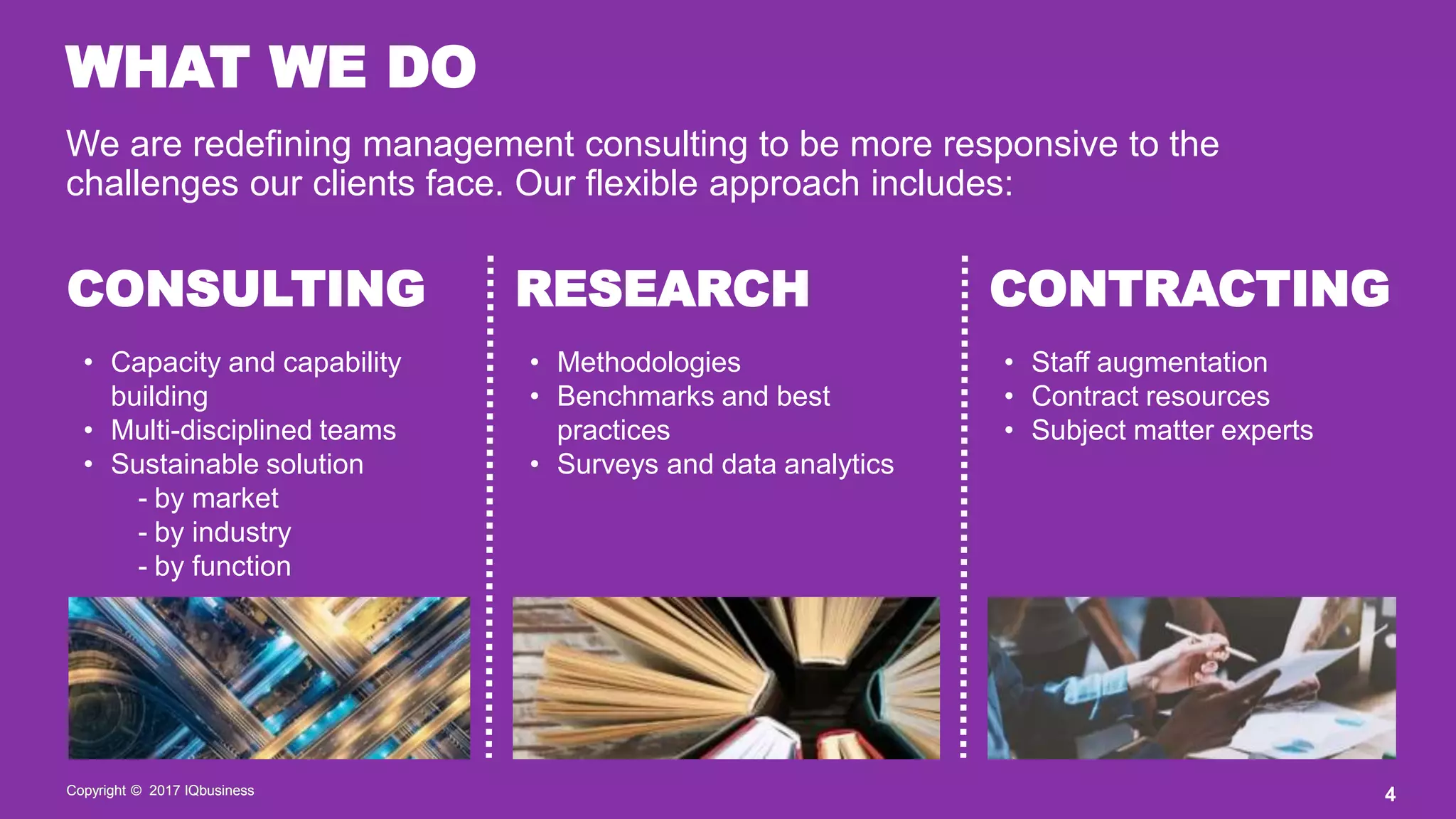
We are redefining management consulting to be more responsive to the
challenges our clients face. Our flexible approach includes:
• Capacity and capability
building
• Multi-disciplined teams
• Sustainable solution
- by market
- by industry
- by function
• Staff augmentation
• Contract resources
• Subject matter experts
CONSULTING RESEARCH CONTRACTING
• Methodologies
• Benchmarks and best
practices
• Surveys and data analytics
Copyright © 2017 IQbusiness
Copyright © 2017 IQbusinessCopyright © 2017 IQbusiness 5Copyright © 2017 IQbusiness
TRADITIONAL
SEGMENTATION
Copyright © 2017 IQbusiness
SEGMENTATION
6
What is it?
• Traditionally a marketing tool
• An approach to dividing your current and potential customer base into similar groupings
(segments), in order to create more targeted messages
• Similarities can be based on characteristics such as demographics, behavior, lifestyles,
interests, needs, etc.
Copyright © 2017 IQbusiness
SEGMENTATION
7
Why do we do it?
To Identify the types of customers we want to do business with, i.e.
• Customers that will give us a high return
• Customers that we know how to engage with
• Customers that require the products and services that we have
Copyright © 2017 IQbusiness
CURRENT SEGMENTATION APPROACHES
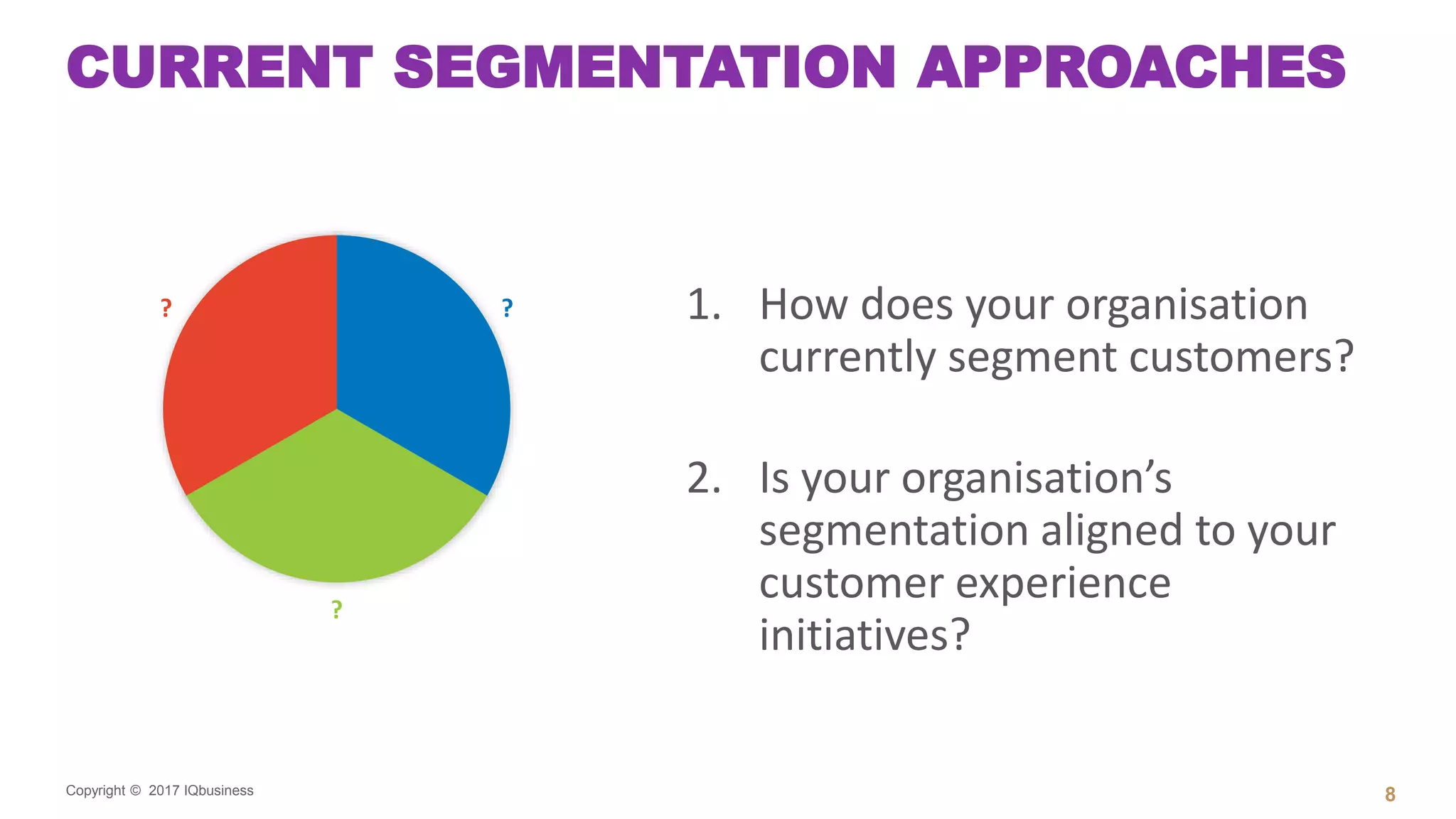
1. How does your organisation
currently segment customers?
2. Is your organisation’s
segmentation aligned to your
customer experience
initiatives?
8
?
?
?
Copyright © 2017 IQbusiness
CHALLENGES
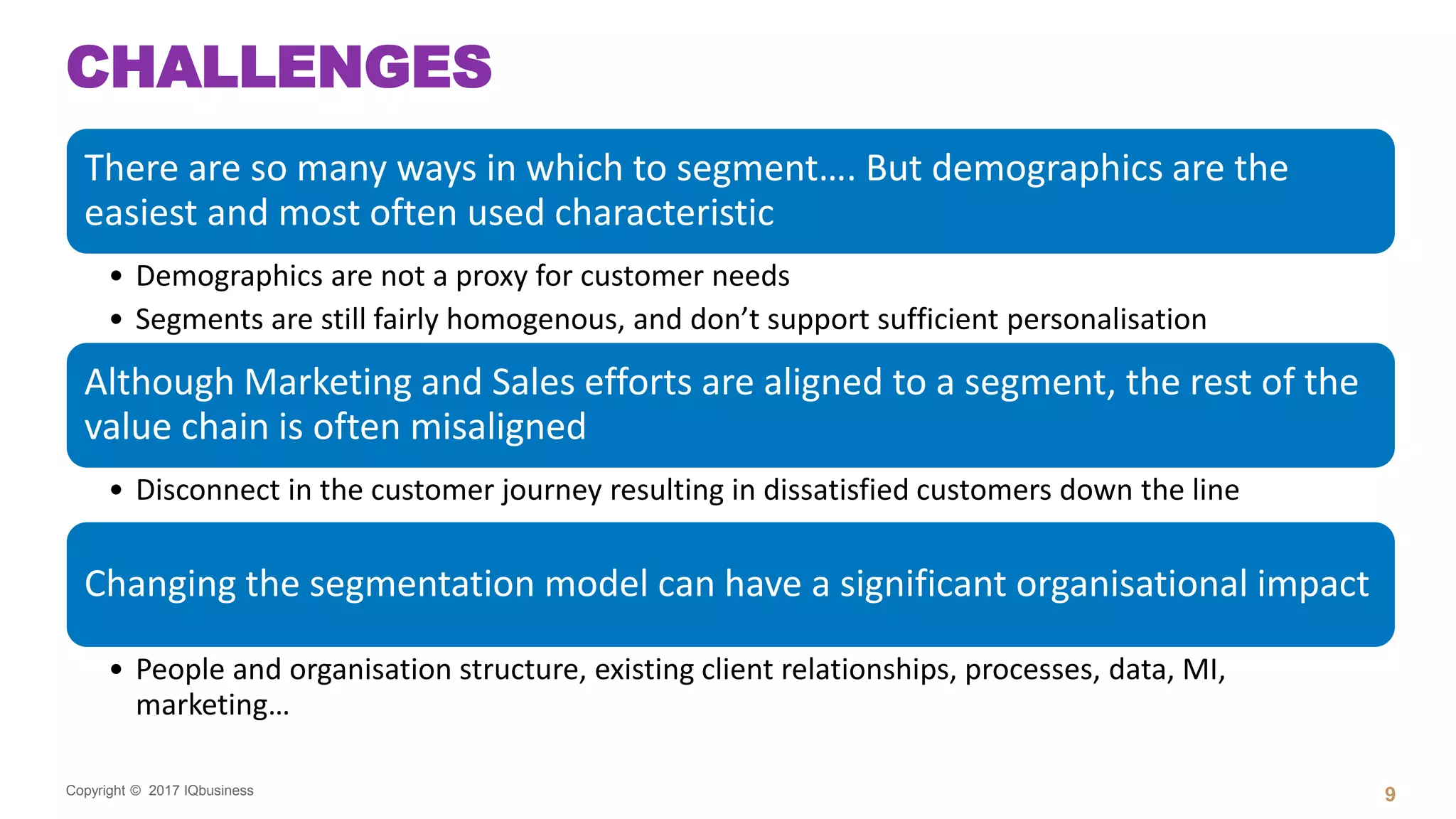
There are so many ways in which to segment…. But demographics are the
easiest and most often used characteristic
• Demographics are not a proxy for customer needs
• Segments are still fairly homogenous, and don’t support sufficient personalisation
Although Marketing and Sales efforts are aligned to a segment, the rest of the
value chain is often misaligned
• Disconnect in the customer journey resulting in dissatisfied customers down the line
Changing the segmentation model can have a significant organisational impact
• People and organisation structure, existing client relationships, processes, data, MI,
marketing…
9
Copyright © 2017 IQbusinessCopyright © 2017 IQbusiness 10
CUSTOMER NEEDS LED
SEGMENTATION
Copyright © 2017 IQbusiness
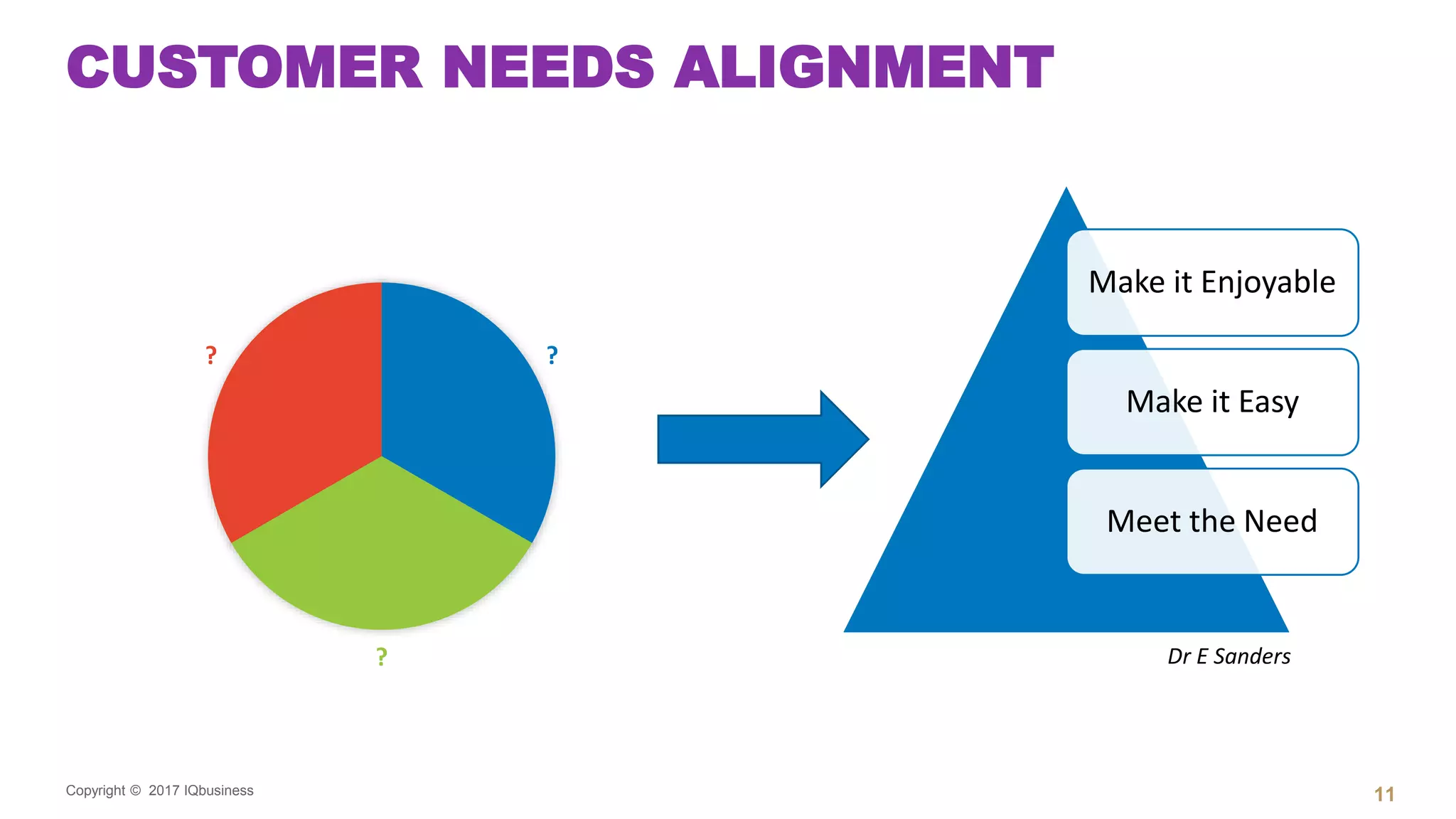
CUSTOMER NEEDS ALIGNMENT
11
?
?
?
Make it Enjoyable
Make it Easy
Meet the Need
Dr E Sanders
Copyright © 2017 IQbusiness
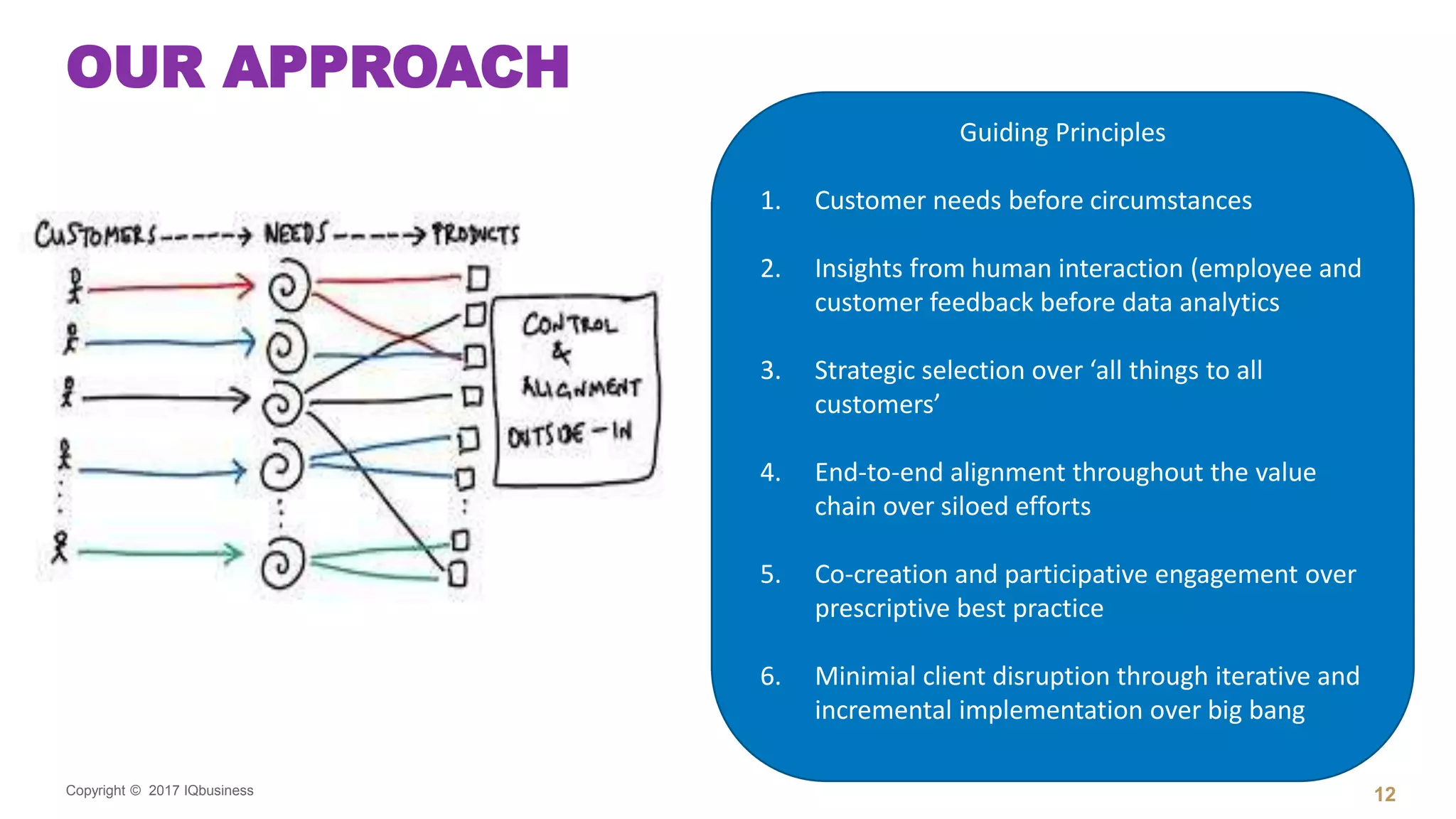
OUR APPROACH
12
Guiding Principles
1. Customer needs before circumstances
2. Insights from human interaction (employee and
customer feedback before data analytics
3. Strategic selection over ‘all things to all
customers’
4. End-to-end alignment throughout the value
chain over siloed efforts
5. Co-creation and participative engagement over
prescriptive best practice
6. Minimial client disruption through iterative and
incremental implementation over big bang
Copyright © 2017 IQbusiness
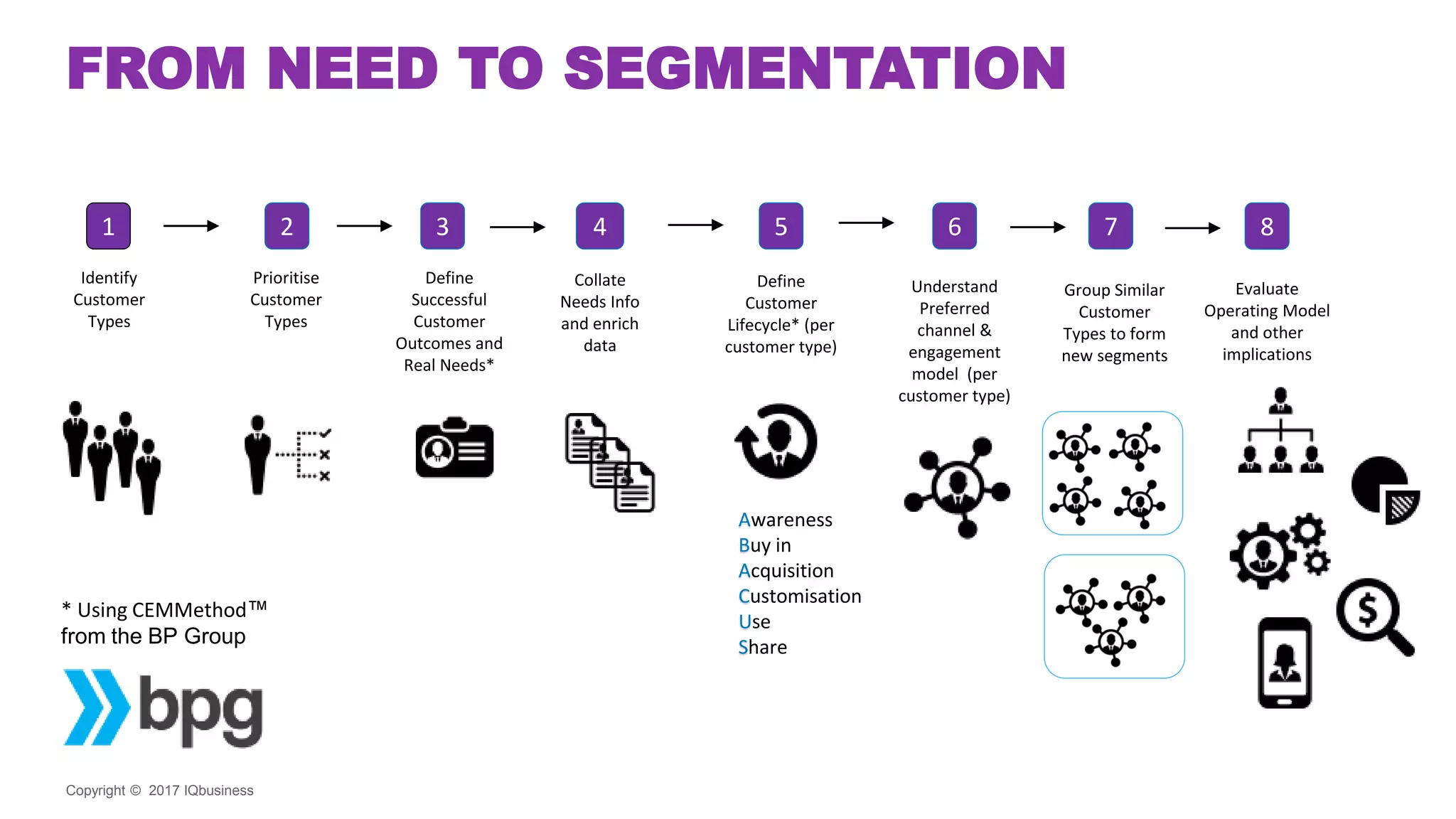
FROM NEED TO SEGMENTATION
1
Identify
Customer
Types
2
Prioritise
Customer
Types
6
Understand
Preferred
channel &
engagement
model (per
customer type)
5
Define
Customer
Lifecycle* (per
customer type)
Awareness
Buy in
Acquisition
Customisation
Use
Share
7
Group Similar
Customer
Types to form
new segments
8
Evaluate
Operating Model
and other
implications
4
Collate
Needs Info
and enrich
data
3
Define
Successful
Customer
Outcomes and
Real Needs*
* Using CEMMethod™
from the BP Group
Copyright © 2017 IQbusiness
DEFINING CUSTOMER NEEDS
14
SuccessfulCustomerOutcomeCanvas
CEMMethod™
Copyright © 2017 IQbusiness
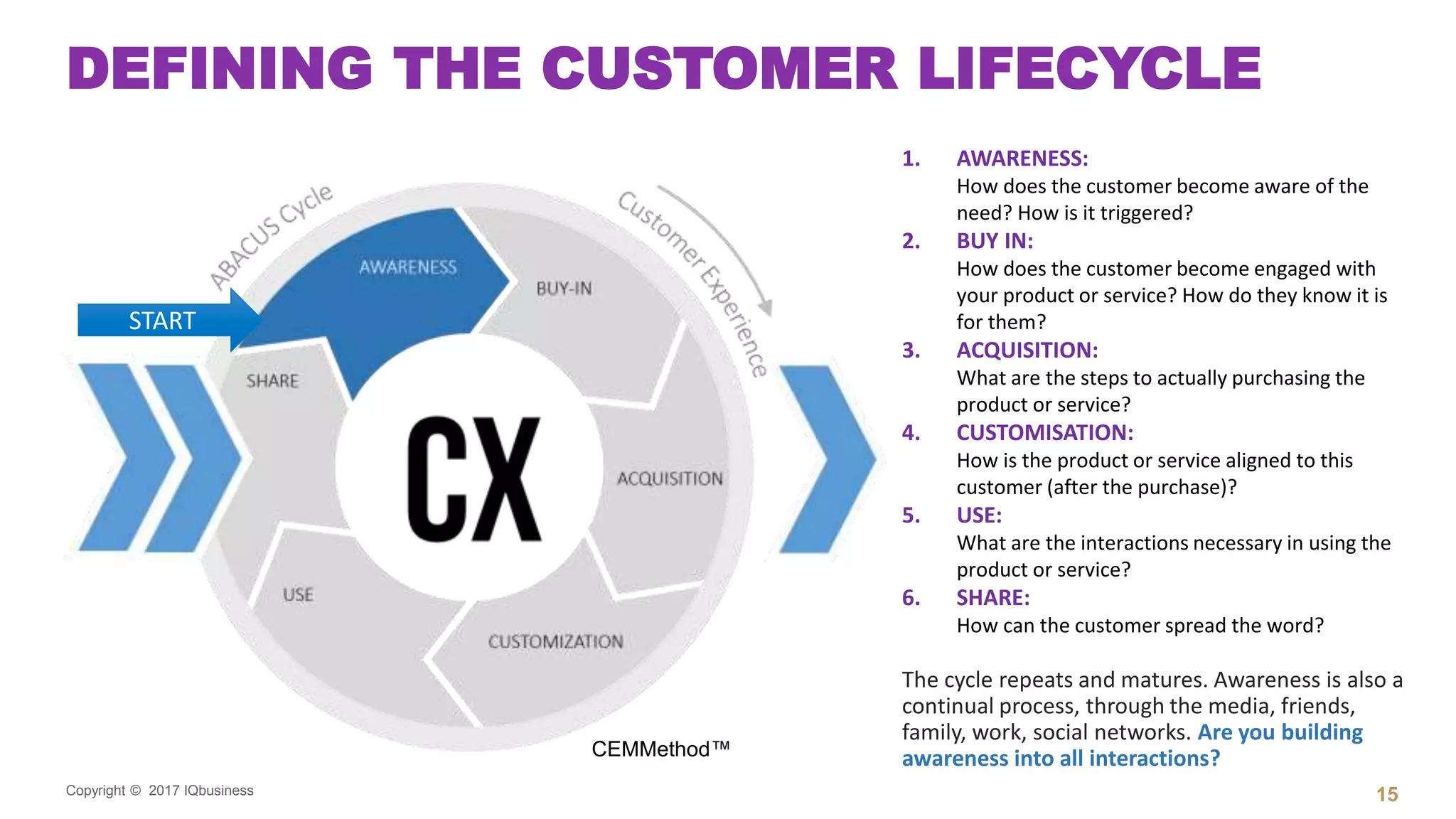
DEFINING THE CUSTOMER LIFECYCLE
15
START
1. AWARENESS:
How does the customer become aware of the
need? How is it triggered?
2. BUY IN:
How does the customer become engaged with
your product or service? How do they know it is
for them?
3. ACQUISITION:
What are the steps to actually purchasing the
product or service?
4. CUSTOMISATION:
How is the product or service aligned to this
customer (after the purchase)?
5. USE:
What are the interactions necessary in using the
product or service?
6. SHARE:
How can the customer spread the word?
The cycle repeats and matures. Awareness is also a
continual process, through the media, friends,
family, work, social networks. Are you building
awareness into all interactions?CEMMethod™
Copyright © 2017 IQbusiness
CHANNEL PREFERENCE & MATURITY
16TIME
CXMATURITY
Traditional
Customers rely on
traditional channels
and interactions—
but even then, they
leave digital traces.
Experimental
Customers selectively
engage in digital for
utility value,
discovering how the
experience improves.
Transitional
Customers strive to
leverage digital more
broadly, but may not
always be able to do
so.
Digital Savvy
Customers make
digital technology
part of all dimensions
in their lives—mobile
access is key.
1
2
3
4
CEMMethod™
Copyright © 2017 IQbusinessCopyright © 2017 IQbusiness 17
BENEFITS
Copyright © 2017 IQbusiness
BENEFITS OF CUSTOMER NEEDS LED
SEGMENTATION
18
Better Customer
Insights1
Fully Aligned
Organisation2
Efficient and Effective
Delivery3
Increased Revenue6
Reduced Operating
Costs5
Improved Customer
Experience4
Copyright © 2017 IQbusinessCopyright © 2017 IQbusiness 19
QUESTIONS
Copyright © 2017 IQbusiness
OUR CLIENTS
20
Copyright © 2017 IQbusiness
Johannesburg
Physical Address:
IQ Business Park
3, Third Avenue
Rivonia
Gauteng
South Africa
T: +27 11 259 4000
F: +27 11 259 4111
E: info@iqbusiness.net
Cape Town
Physical Address:
The Vineyards Office Estate
99 Jip de Jager
Welgemoed
Cape Town
South Africa
T: +27 21 461 9797
F: +27 21 461 9794
E: info@iqbusiness.net
For further information on this material, please contact:
Lizette Akker
Phone : +27 11 259 4000
Mobile : +27 82 852 4294
Email : lakker@iqbusiness.net
Copyright © 2017 IQbusiness
CONTACT US

Customer Segmentation

  • 1.
    Copyright © 2017IQbusiness Customer Segmentation
  • 2.
    Copyright © 2017IQbusinessCopyright © 2017 IQbusiness 2 INDEX Introduction to IQbusiness Segmentation Customer Needs Led Segmentation Approach Benefits Questions 1 2 3 4 5
  • 3.
    Copyright © 2017IQbusiness WHO WE ARE IQbusiness is the leading independent management consulting firm in South Africa • Founded in 1998 • 600+ consultants • Presence on four continents • Two offices in South Africa Our team helps businesses grow by solving problems and finding new and better ways of doing things. 3
  • 4.
    Copyright © 2017IQbusiness WHAT WE DO 4 We are redefining management consulting to be more responsive to the challenges our clients face. Our flexible approach includes: • Capacity and capability building • Multi-disciplined teams • Sustainable solution - by market - by industry - by function • Staff augmentation • Contract resources • Subject matter experts CONSULTING RESEARCH CONTRACTING • Methodologies • Benchmarks and best practices • Surveys and data analytics Copyright © 2017 IQbusiness
  • 5.
    Copyright © 2017IQbusinessCopyright © 2017 IQbusiness 5Copyright © 2017 IQbusiness TRADITIONAL SEGMENTATION
  • 6.
    Copyright © 2017IQbusiness SEGMENTATION 6 What is it? • Traditionally a marketing tool • An approach to dividing your current and potential customer base into similar groupings (segments), in order to create more targeted messages • Similarities can be based on characteristics such as demographics, behavior, lifestyles, interests, needs, etc.
  • 7.
    Copyright © 2017IQbusiness SEGMENTATION 7 Why do we do it? To Identify the types of customers we want to do business with, i.e. • Customers that will give us a high return • Customers that we know how to engage with • Customers that require the products and services that we have
  • 8.
    Copyright © 2017IQbusiness CURRENT SEGMENTATION APPROACHES 1. How does your organisation currently segment customers? 2. Is your organisation’s segmentation aligned to your customer experience initiatives? 8 ? ? ?
  • 9.
    Copyright © 2017IQbusiness CHALLENGES There are so many ways in which to segment…. But demographics are the easiest and most often used characteristic • Demographics are not a proxy for customer needs • Segments are still fairly homogenous, and don’t support sufficient personalisation Although Marketing and Sales efforts are aligned to a segment, the rest of the value chain is often misaligned • Disconnect in the customer journey resulting in dissatisfied customers down the line Changing the segmentation model can have a significant organisational impact • People and organisation structure, existing client relationships, processes, data, MI, marketing… 9
  • 10.
    Copyright © 2017IQbusinessCopyright © 2017 IQbusiness 10 CUSTOMER NEEDS LED SEGMENTATION Copyright © 2017 IQbusiness
  • 11.
    Copyright © 2017IQbusiness CUSTOMER NEEDS ALIGNMENT 11 ? ? ? Make it Enjoyable Make it Easy Meet the Need Dr E Sanders
  • 12.
    Copyright © 2017IQbusiness OUR APPROACH 12 Guiding Principles 1. Customer needs before circumstances 2. Insights from human interaction (employee and customer feedback before data analytics 3. Strategic selection over ‘all things to all customers’ 4. End-to-end alignment throughout the value chain over siloed efforts 5. Co-creation and participative engagement over prescriptive best practice 6. Minimial client disruption through iterative and incremental implementation over big bang
  • 13.
    Copyright © 2017IQbusiness FROM NEED TO SEGMENTATION 1 Identify Customer Types 2 Prioritise Customer Types 6 Understand Preferred channel & engagement model (per customer type) 5 Define Customer Lifecycle* (per customer type) Awareness Buy in Acquisition Customisation Use Share 7 Group Similar Customer Types to form new segments 8 Evaluate Operating Model and other implications 4 Collate Needs Info and enrich data 3 Define Successful Customer Outcomes and Real Needs* * Using CEMMethod™ from the BP Group
  • 14.
    Copyright © 2017IQbusiness DEFINING CUSTOMER NEEDS 14 SuccessfulCustomerOutcomeCanvas CEMMethod™
  • 15.
    Copyright © 2017IQbusiness DEFINING THE CUSTOMER LIFECYCLE 15 START 1. AWARENESS: How does the customer become aware of the need? How is it triggered? 2. BUY IN: How does the customer become engaged with your product or service? How do they know it is for them? 3. ACQUISITION: What are the steps to actually purchasing the product or service? 4. CUSTOMISATION: How is the product or service aligned to this customer (after the purchase)? 5. USE: What are the interactions necessary in using the product or service? 6. SHARE: How can the customer spread the word? The cycle repeats and matures. Awareness is also a continual process, through the media, friends, family, work, social networks. Are you building awareness into all interactions?CEMMethod™
  • 16.
    Copyright © 2017IQbusiness CHANNEL PREFERENCE & MATURITY 16TIME CXMATURITY Traditional Customers rely on traditional channels and interactions— but even then, they leave digital traces. Experimental Customers selectively engage in digital for utility value, discovering how the experience improves. Transitional Customers strive to leverage digital more broadly, but may not always be able to do so. Digital Savvy Customers make digital technology part of all dimensions in their lives—mobile access is key. 1 2 3 4 CEMMethod™
  • 17.
    Copyright © 2017IQbusinessCopyright © 2017 IQbusiness 17 BENEFITS Copyright © 2017 IQbusiness
  • 18.
    Copyright © 2017IQbusiness BENEFITS OF CUSTOMER NEEDS LED SEGMENTATION 18 Better Customer Insights1 Fully Aligned Organisation2 Efficient and Effective Delivery3 Increased Revenue6 Reduced Operating Costs5 Improved Customer Experience4
  • 19.
    Copyright © 2017IQbusinessCopyright © 2017 IQbusiness 19 QUESTIONS Copyright © 2017 IQbusiness
  • 20.
    Copyright © 2017IQbusiness OUR CLIENTS 20
  • 21.
    Copyright © 2017IQbusiness Johannesburg Physical Address: IQ Business Park 3, Third Avenue Rivonia Gauteng South Africa T: +27 11 259 4000 F: +27 11 259 4111 E: info@iqbusiness.net Cape Town Physical Address: The Vineyards Office Estate 99 Jip de Jager Welgemoed Cape Town South Africa T: +27 21 461 9797 F: +27 21 461 9794 E: info@iqbusiness.net For further information on this material, please contact: Lizette Akker Phone : +27 11 259 4000 Mobile : +27 82 852 4294 Email : lakker@iqbusiness.net Copyright © 2017 IQbusiness CONTACT US