Direct Marketing
DATA AND DATABASE MANAGEMENT
Database marketing involves collecting and utilizing customer
data for the purposes of enhancing interactions with a target
audience.
DATA AND DATABASE
MANAGEMENT
Building a Database
Internal Data Sources
External Data Sources
Building a Database
The data warehouse holds all of the customer data.
• Customer names and addresses.
• E-mail addresses and the cookies that record Web visits
to the company’s website.
• History of every purchase transaction.
• History of customer interactions, such as inquiries,
complaints, and returns.
Internal Data Sources
Ongoing interactions between a company and individuals
create many opportunities to collect data that can then
become an integral part of a data warehouse.
 Email Addresses and Other Personal Identification Data
 Purchase and Communication Histories
 Personal Preference Profiles
External Data Sources
Geocoding
One way to append demographic information is geocoding
Rented Lists
Companies that wish to go further than appending external data to
their internal lists can rent information about individuals.
1. Response Lists.
2. Compiled Lists.
3. Subscription Lists
Response Lists
organizations rent the information on customers who
have previously made specific purchases, or responded
previously to some other direct marketing campaign.
Compiled Lists
Organizations collect data on individuals’ purchases and other
behavior and make this data available to marketers.
Subscription Lists
These are lists that contain information on individuals.
DATABASE CODING AND
ANALYSIS
Once the data warehouse is created, the next component in building a
database is database coding and analysis.
1. Lifetime Value Analysis
2. RFM Analysis
3. Data Mining/ Modelling
Lifetime Value Analysis
Lifetime value is a figure that represents the profit revenue of a
customer throughout the lifetime of a relationship.
RFM Analysis
RFM refers to the use of the terms recency, frequency, and
monetary, which are used to predict customer behaviours.
 Recency notes the date of the last purchase.
 Frequency is the number of purchases within a specific time period,
normally one year.
 Monetary expenditures with a firm and is usually expressed as expenditures
per year, or other suitable time period.
Data Mining/ Modelling
Data mining is the program used to develop a
profile of the company’s best customers.
Data mining and modelling are done in two steps:
1. Building profiles of customer segments,
2. Preparing models that predict future purchase
behaviours based on past purchases.
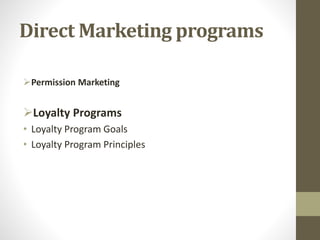
Direct Marketing programs
Permission Marketing
Loyalty Programs
• Loyalty Program Goals
• Loyalty Program Principles
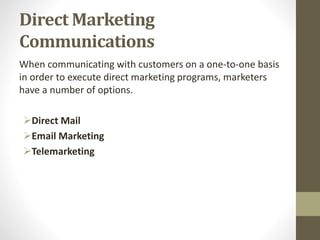
Direct Marketing
Communications
When communicating with customers on a one-to-one basis
in order to execute direct marketing programs, marketers
have a number of options.
Direct Mail
Email Marketing
Telemarketing
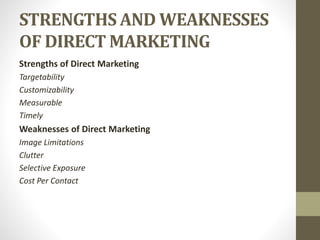
STRENGTHS AND WEAKNESSES
OF DIRECT MARKETING
Strengths of Direct Marketing
Targetability
Customizability
Measurable
Timely
Weaknesses of Direct Marketing
Image Limitations
Clutter
Selective Exposure
Cost Per Contact
COMMUNICATING ACROSS
CULTURES
Direct  Marketing

Direct Marketing

  • 2.
  • 3.
    DATA AND DATABASEMANAGEMENT Database marketing involves collecting and utilizing customer data for the purposes of enhancing interactions with a target audience.
  • 4.
    DATA AND DATABASE MANAGEMENT Buildinga Database Internal Data Sources External Data Sources
  • 5.
    Building a Database Thedata warehouse holds all of the customer data. • Customer names and addresses. • E-mail addresses and the cookies that record Web visits to the company’s website. • History of every purchase transaction. • History of customer interactions, such as inquiries, complaints, and returns.
  • 6.
    Internal Data Sources Ongoinginteractions between a company and individuals create many opportunities to collect data that can then become an integral part of a data warehouse.  Email Addresses and Other Personal Identification Data  Purchase and Communication Histories  Personal Preference Profiles
  • 7.
    External Data Sources Geocoding Oneway to append demographic information is geocoding Rented Lists Companies that wish to go further than appending external data to their internal lists can rent information about individuals. 1. Response Lists. 2. Compiled Lists. 3. Subscription Lists
  • 8.
    Response Lists organizations rentthe information on customers who have previously made specific purchases, or responded previously to some other direct marketing campaign.
  • 9.
    Compiled Lists Organizations collectdata on individuals’ purchases and other behavior and make this data available to marketers.
  • 10.
    Subscription Lists These arelists that contain information on individuals.
  • 11.
    DATABASE CODING AND ANALYSIS Oncethe data warehouse is created, the next component in building a database is database coding and analysis. 1. Lifetime Value Analysis 2. RFM Analysis 3. Data Mining/ Modelling
  • 12.
    Lifetime Value Analysis Lifetimevalue is a figure that represents the profit revenue of a customer throughout the lifetime of a relationship.
  • 13.
    RFM Analysis RFM refersto the use of the terms recency, frequency, and monetary, which are used to predict customer behaviours.  Recency notes the date of the last purchase.  Frequency is the number of purchases within a specific time period, normally one year.  Monetary expenditures with a firm and is usually expressed as expenditures per year, or other suitable time period.
  • 14.
    Data Mining/ Modelling Datamining is the program used to develop a profile of the company’s best customers. Data mining and modelling are done in two steps: 1. Building profiles of customer segments, 2. Preparing models that predict future purchase behaviours based on past purchases.
  • 15.
    Direct Marketing programs PermissionMarketing Loyalty Programs • Loyalty Program Goals • Loyalty Program Principles
  • 16.
    Direct Marketing Communications When communicatingwith customers on a one-to-one basis in order to execute direct marketing programs, marketers have a number of options. Direct Mail Email Marketing Telemarketing
  • 17.
    STRENGTHS AND WEAKNESSES OFDIRECT MARKETING Strengths of Direct Marketing Targetability Customizability Measurable Timely Weaknesses of Direct Marketing Image Limitations Clutter Selective Exposure Cost Per Contact
  • 18.