Customer relationship
management
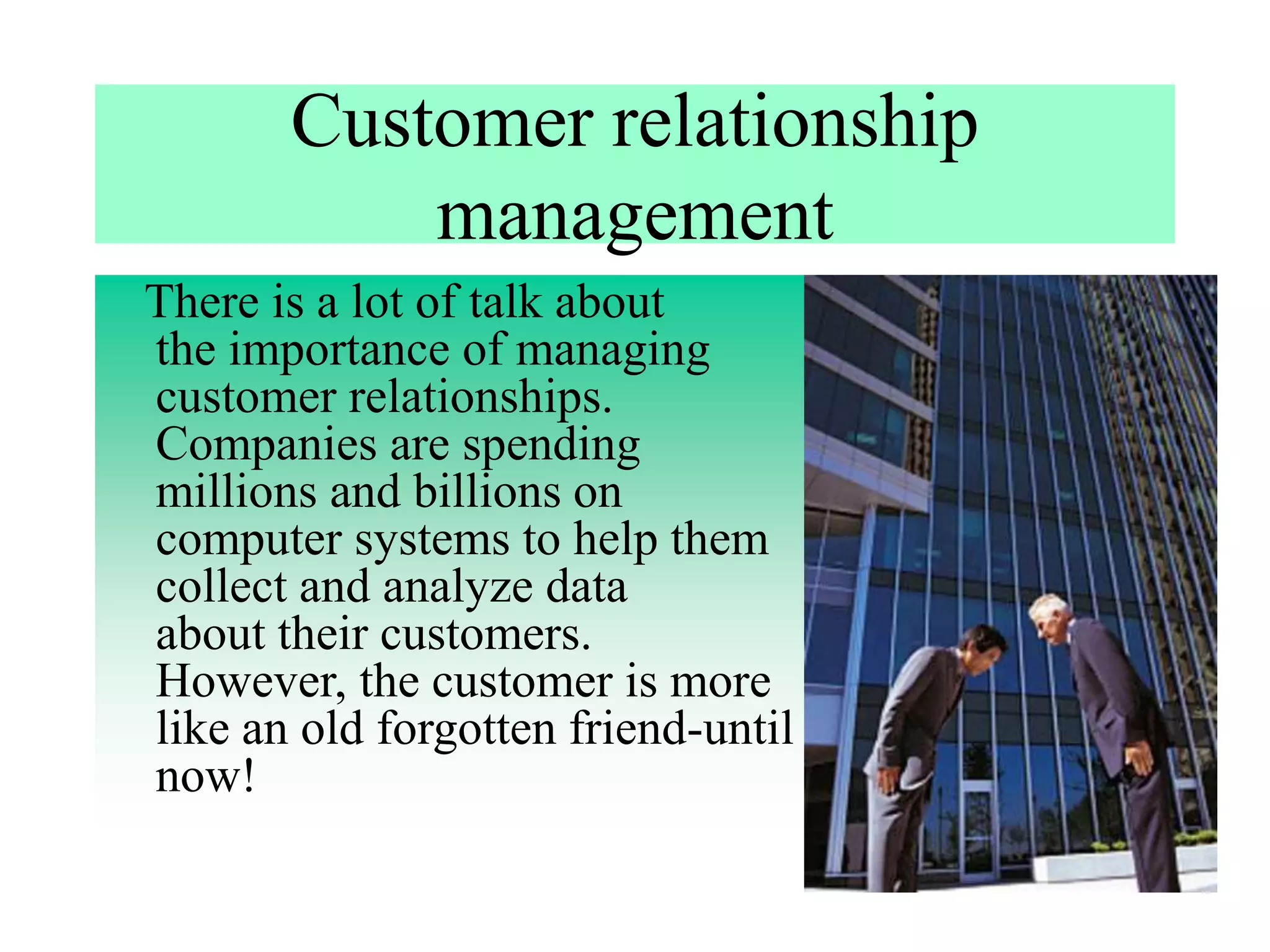
There is a lot of talk about
the importance of managing
customer relationships.
Companies are spending
millions and billions on
computer systems to help them
collect and analyze data
about their customers.
However, the customer is more
like an old forgotten friend-until
now!
Taj Malabar, Wellington Island
Ms. Angela Abraham, takes a cab from
the Nedumbasseri Airport, on her fifth
business trip to Cochin and heads for
her favorite hotel at the Wellington
Island. On her arrival at the hotel, the
doorman flings open the glass door and
welcomes her “ Good morning Ms.
Abraham, welcome back to Taj”.
• On her way to the room, the receptionist
asks her whether her stay could be charged
to American express. In her room she finds
everything in place including a fruit basket
and a bottle of French wine as welcome
gifts. Biggest delight was that she gets to
stay at her favorite room overlooking the
sea corridor in the Arabian sea, just half a
kilometer away.
Ms.Angela Abraham’s experience could be
considered as an example of the Taj’s customer
relationship management (CRM). CRM is a
business philosophy and set of strategies,
programs, and systems that focuses on identifying
and building loyalty with a retailer’s most valued
customers. It is based on the philosophy that
retailers can increase profitability by building
relationships with their better customers.
Effectively managing merchandise inventory and
stores enable retailers to provide value and support
the primary objective of building customer loyalty.
The goal will be to develop a base of loyal
customers who patronizes the retailer quite
frequently.
CRM Process
Traditionally, retailers have been encouraging
customers to visit their stores, use the catalogs,
and visit web sites. Mass media advertising, price
and sales promotions, were being resorted to target
all customers alike.
Now retailers try to provide more value to their
better customers using targeted promotions and
services to increase their share of wallet- the
percentage of the customers’ purchases made from
the retailers- with these customers. This shift is in
lieu of the research findings that it costs over six
times more to sell products and services to new
customers than existing ones and that small
increases in customer retention can lead to
dramatic increases in profits.
Loyalty
Customer loyalty, the objective of CRM, is more
than having customers make repeat visits to a
retailer and being satisfied with their experiences
and the merchandise bought. It means to the
retailer that customers are committed to
purchasing merchandise and services from the
retailer and will resist the activities of the
competitors attempting to attract their patronage.
Obviously a bond is developed between the
retailer and its customers.
Loyal customers have emotional connection with
the retailer. Their relationship is beyond the
convenience of the retailer’s store, or the low
prices, and specific products offered by the
retailer. They develop a goodwill towards the store
that they recommend to their family and friends to
shop at the same store.
Programs that encourage repeat buying through
price reductions can easily be matched
competitors. Moreover, such discounts encourage
customers to always look for the same and never
think of developing any long term relationship
with the retailer.
On the contrary, emotional connections develop
when customers receive personal attention. Many
small restaurants, build loyalty by functioning as
neighborhood cafes, where the staff recognize
customers by names and know their preferences.
Almost 80 percent of some these cafes are regular
customers. Unusual positive experiences such as a
shop assistant remembering the particular pair of
shoes being used by a customer and arranging to
provide the same to the customer temporarily out
of his residential town.
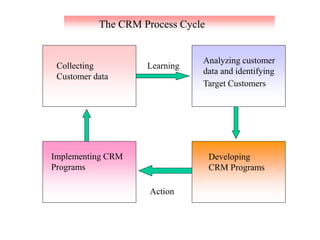
Learning
Analyzing customer
data and identifying
Target Customers
Developing
CRM Programs
Action
Implementing CRM
Programs
Collecting
Customer data
The CRM Process Cycle
CRM is an interactive process that turns
customer data into customer loyalty through four
activities:
• Collecting customer data
• Analyzing customer data and identifying target
customers
• Developing CRM programs
• Implementing CRM programs
• The first step, constructing customer data base
referred to as Customer data warehouse,
contains all of the data the firm has collected about
its customers . Ideally it should contain:
• Full details of transactions
• Customer contacts- a record of the customer
interactions
• Customer preferences
• Descriptive information about demographics and
psychographics of the customers
• Responses to marketing activities
Constructing data is relatively easy for catalog and
Internet customers and who use retailer’s credit
card while buying merchandise or services in
stores. However identifying most customers who
are making in-store transactions against cash or
personal check and using third party credit cards
like Visa and MasterCard, is more difficult.
Frequent shopper Programs
Also called loyalty programs, are programs that
identify and provide rewards to customers who
patronize a retailer.
Privacy and CRM programs
While detailed information about individual
customers helps retailers provide more
benefits to their better customers,
consumers are concerned about retailers
violating their privacy when they collect
this information
Analyzing customer data and
identifying target customers
Analyzing the customer database and converting
the data into information will help retailers
develop programs for building customer loyalty.
Data Mining is a technique used to identify
patterns in data. These typical patterns emerge
after analyzing the data. A research of this type
helped a London based retailer to figure out that
portable DVD players are mostly used by train
commuters and this helped them to restrict most of
their communication efforts to train travel and stop
commercials on TV.
Market basket analysis
It is a specific type of data analysis that focuses on
the composition of the basket or the bundle of
products purchased by households during a single
shopping occasion.
Since bananas are the most common item in
America’s grocery carts, Wal-Mart supercenters
sell bananas next to the cornflakes as well as in the
produce section.
Measuring spoons are kept in the house-wares
section.
Little Debbie snack cakes are next to the coffee.
Identifying market segments
Traditionally customer data analysis has focused on identifying market
segments-groups of customers who have similar needs, purchase
similar merchandise and respond in a similar manner to marketing
activities.
A researcher discovered two types of shoppers:
A group called “professional shoppers”- who love fashion and value
good customer service
The other group called “too busy to shop people” who wanted the
shopping experience terminated in double quick time.
Morning shoppers are price sensitive and like to avail al the discounts
Evening shoppers tended to be in the professional shopper segment
Identifying best customers
Using the customer database, retailers develop a score or
number indicating how valuable they are to the firm. This
score is then used determine which customers are to be
targeted.
Life time customer value (LTV) – is the expected
contribution from the customer to the retailer’s profits over
his/her entire relationship with the retailer.
Customer Pyramid – retailers realize that their customers
differ in terms of their profitability or LTV.
They know that a relatively small number of customers
account for the majority of their profits. This is known as
the 80-20 rule. Thus, retailers could group their customers
into two groups based on the LTV scores.
The best with a score of 20
and the rest with a score of 80
• Developing CRM Programs
• Customer retention
• Special customer services
• Personalization
• Converting good customers into best customers
• Dealing with unprofitable customers
• Implementing CRM programs

CRM-Process.ppt

  • 1.
    Customer relationship management There isa lot of talk about the importance of managing customer relationships. Companies are spending millions and billions on computer systems to help them collect and analyze data about their customers. However, the customer is more like an old forgotten friend-until now!
  • 2.
  • 3.
    Ms. Angela Abraham,takes a cab from the Nedumbasseri Airport, on her fifth business trip to Cochin and heads for her favorite hotel at the Wellington Island. On her arrival at the hotel, the doorman flings open the glass door and welcomes her “ Good morning Ms. Abraham, welcome back to Taj”.
  • 5.
    • On herway to the room, the receptionist asks her whether her stay could be charged to American express. In her room she finds everything in place including a fruit basket and a bottle of French wine as welcome gifts. Biggest delight was that she gets to stay at her favorite room overlooking the sea corridor in the Arabian sea, just half a kilometer away.
  • 6.
    Ms.Angela Abraham’s experiencecould be considered as an example of the Taj’s customer relationship management (CRM). CRM is a business philosophy and set of strategies, programs, and systems that focuses on identifying and building loyalty with a retailer’s most valued customers. It is based on the philosophy that retailers can increase profitability by building relationships with their better customers. Effectively managing merchandise inventory and stores enable retailers to provide value and support the primary objective of building customer loyalty. The goal will be to develop a base of loyal customers who patronizes the retailer quite frequently.
  • 7.
    CRM Process Traditionally, retailershave been encouraging customers to visit their stores, use the catalogs, and visit web sites. Mass media advertising, price and sales promotions, were being resorted to target all customers alike.
  • 8.
    Now retailers tryto provide more value to their better customers using targeted promotions and services to increase their share of wallet- the percentage of the customers’ purchases made from the retailers- with these customers. This shift is in lieu of the research findings that it costs over six times more to sell products and services to new customers than existing ones and that small increases in customer retention can lead to dramatic increases in profits.
  • 9.
    Loyalty Customer loyalty, theobjective of CRM, is more than having customers make repeat visits to a retailer and being satisfied with their experiences and the merchandise bought. It means to the retailer that customers are committed to purchasing merchandise and services from the retailer and will resist the activities of the competitors attempting to attract their patronage. Obviously a bond is developed between the retailer and its customers.
  • 10.
    Loyal customers haveemotional connection with the retailer. Their relationship is beyond the convenience of the retailer’s store, or the low prices, and specific products offered by the retailer. They develop a goodwill towards the store that they recommend to their family and friends to shop at the same store. Programs that encourage repeat buying through price reductions can easily be matched competitors. Moreover, such discounts encourage customers to always look for the same and never think of developing any long term relationship with the retailer.
  • 11.
    On the contrary,emotional connections develop when customers receive personal attention. Many small restaurants, build loyalty by functioning as neighborhood cafes, where the staff recognize customers by names and know their preferences. Almost 80 percent of some these cafes are regular customers. Unusual positive experiences such as a shop assistant remembering the particular pair of shoes being used by a customer and arranging to provide the same to the customer temporarily out of his residential town.
  • 12.
    Learning Analyzing customer data andidentifying Target Customers Developing CRM Programs Action Implementing CRM Programs Collecting Customer data The CRM Process Cycle
  • 13.
    CRM is aninteractive process that turns customer data into customer loyalty through four activities: • Collecting customer data • Analyzing customer data and identifying target customers • Developing CRM programs • Implementing CRM programs
  • 14.
    • The firststep, constructing customer data base referred to as Customer data warehouse, contains all of the data the firm has collected about its customers . Ideally it should contain: • Full details of transactions • Customer contacts- a record of the customer interactions • Customer preferences • Descriptive information about demographics and psychographics of the customers • Responses to marketing activities
  • 15.
    Constructing data isrelatively easy for catalog and Internet customers and who use retailer’s credit card while buying merchandise or services in stores. However identifying most customers who are making in-store transactions against cash or personal check and using third party credit cards like Visa and MasterCard, is more difficult. Frequent shopper Programs Also called loyalty programs, are programs that identify and provide rewards to customers who patronize a retailer.
  • 16.
    Privacy and CRMprograms While detailed information about individual customers helps retailers provide more benefits to their better customers, consumers are concerned about retailers violating their privacy when they collect this information
  • 17.
    Analyzing customer dataand identifying target customers Analyzing the customer database and converting the data into information will help retailers develop programs for building customer loyalty. Data Mining is a technique used to identify patterns in data. These typical patterns emerge after analyzing the data. A research of this type helped a London based retailer to figure out that portable DVD players are mostly used by train commuters and this helped them to restrict most of their communication efforts to train travel and stop commercials on TV.
  • 18.
    Market basket analysis Itis a specific type of data analysis that focuses on the composition of the basket or the bundle of products purchased by households during a single shopping occasion. Since bananas are the most common item in America’s grocery carts, Wal-Mart supercenters sell bananas next to the cornflakes as well as in the produce section. Measuring spoons are kept in the house-wares section. Little Debbie snack cakes are next to the coffee.
  • 19.
    Identifying market segments Traditionallycustomer data analysis has focused on identifying market segments-groups of customers who have similar needs, purchase similar merchandise and respond in a similar manner to marketing activities. A researcher discovered two types of shoppers: A group called “professional shoppers”- who love fashion and value good customer service The other group called “too busy to shop people” who wanted the shopping experience terminated in double quick time. Morning shoppers are price sensitive and like to avail al the discounts Evening shoppers tended to be in the professional shopper segment
  • 20.
    Identifying best customers Usingthe customer database, retailers develop a score or number indicating how valuable they are to the firm. This score is then used determine which customers are to be targeted. Life time customer value (LTV) – is the expected contribution from the customer to the retailer’s profits over his/her entire relationship with the retailer. Customer Pyramid – retailers realize that their customers differ in terms of their profitability or LTV. They know that a relatively small number of customers account for the majority of their profits. This is known as the 80-20 rule. Thus, retailers could group their customers into two groups based on the LTV scores. The best with a score of 20 and the rest with a score of 80
  • 21.
    • Developing CRMPrograms • Customer retention • Special customer services • Personalization • Converting good customers into best customers • Dealing with unprofitable customers • Implementing CRM programs