Understanding
the effects of
DILUTION
For your startup
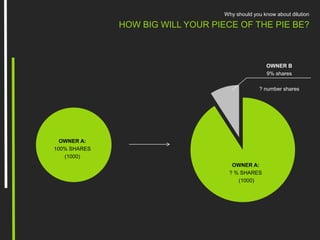
OWNER A:
100% SHARES
(1000)
OWNER A:
? % SHARES
(1000)
OWNER B
9% shares
? number shares
Why should you know about dilution
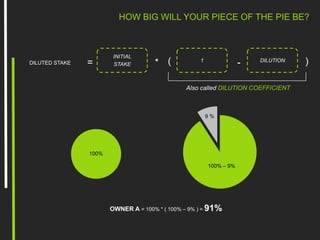
HOW BIG WILL YOUR PIECE OF THE PIE BE?
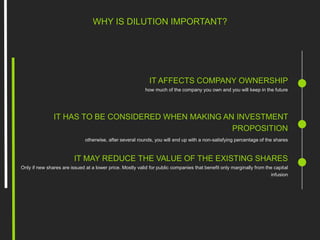
WHY IS DILUTION IMPORTANT?
IT AFFECTS COMPANY OWNERSHIP
how much of the company you own and you will keep in the future
IT HAS TO BE CONSIDERED WHEN MAKING AN INVESTMENT
PROPOSITION
otherwise, after several rounds, you will end up with a non-satisfying percentage of the shares
IT MAY REDUCE THE VALUE OF THE EXISTING SHARES
Only if new shares are issued at a lower price. Mostly valid for public companies that benefit only marginally from the capital
infusion
DEFINITION
Dilution is the reduction of ownership percentages in a company as an effect of the
issuance of new shares.
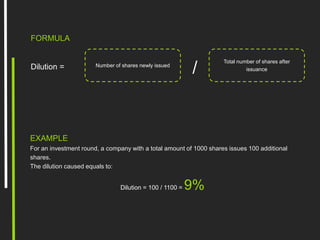
FORMULA
/
Total number of shares after
issuance
Number of shares newly issuedDilution =
EXAMPLE
For an investment round, a company with a total amount of 1000 shares issues 100 additional
shares.
The dilution caused equals to:
Dilution = 100 / 1100 = 9%
1
- DILUTION
Also called DILUTION COEFFICIENT
DILUTED STAKE =
INITIAL
STAKE * ( )
100%
9 %
100% – 9%
OWNER A = 100% * ( 100% – 9% ) = 91%
HOW BIG WILL YOUR PIECE OF THE PIE BE?
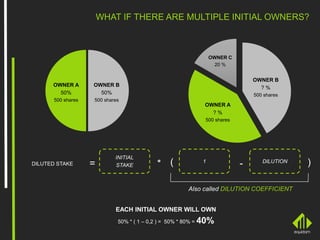
WHAT IF THERE ARE MULTIPLE INITIAL OWNERS?
OWNER A
50%
500 shares
OWNER B
50%
500 shares
OWNER A
? %
500 shares
OWNER B
? %
500 shares
OWNER C
20 %
EACH INITIAL OWNER WILL OWN
50% * ( 1 – 0,2 ) = 50% * 80% = 40%
1
- DILUTION
Also called DILUTION COEFFICIENT
DILUTED STAKE =
INITIAL
STAKE * ( )
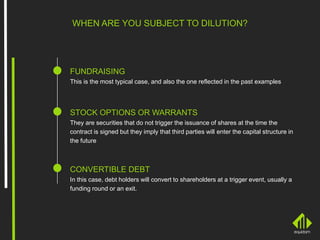
WHEN ARE YOU SUBJECT TO DILUTION?
FUNDRAISING
This is the most typical case, and also the one reflected in the past examples
STOCK OPTIONS OR WARRANTS
They are securities that do not trigger the issuance of shares at the time the
contract is signed but they imply that third parties will enter the capital structure in
the future
CONVERTIBLE DEBT
In this case, debt holders will convert to shareholders at a trigger event, usually a
funding round or an exit.
Dilution
IN FUNDRAISING
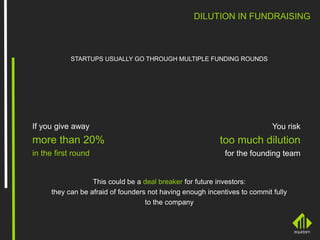
DILUTION IN FUNDRAISING
STARTUPS USUALLY GO THROUGH MULTIPLE FUNDING ROUNDS
If you give away
more than 20%
in the first round
You risk
too much dilution
for the founding team
This could be a deal breaker for future investors:
they can be afraid of founders not having enough incentives to commit fully
to the company
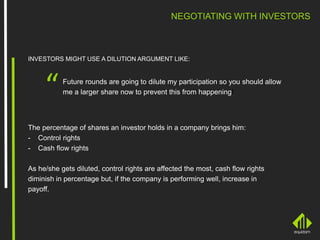
Future rounds are going to dilute my participation so you should allow
me a larger share now to prevent this from happening!“
NEGOTIATING WITH INVESTORS
INVESTORS MIGHT USE A DILUTION ARGUMENT LIKE:
The percentage of shares an investor holds in a company brings him:
- Control rights
- Cash flow rights
As he/she gets diluted, control rights are affected the most, cash flow rights
diminish in percentage but, if the company is performing well, increase in
payoff.
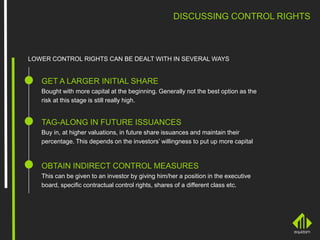
DISCUSSING CONTROL RIGHTS
LOWER CONTROL RIGHTS CAN BE DEALT WITH IN SEVERAL WAYS
GET A LARGER INITIAL SHARE
Bought with more capital at the beginning. Generally not the best option as the
risk at this stage is still really high.
TAG-ALONG IN FUTURE ISSUANCES
Buy in, at higher valuations, in future share issuances and maintain their
percentage. This depends on the investors’ willingness to put up more capital
OBTAIN INDIRECT CONTROL MEASURES
This can be given to an investor by giving him/her a position in the executive
board, specific contractual control rights, shares of a different class etc.
Dilution
IN TERMSHEETS
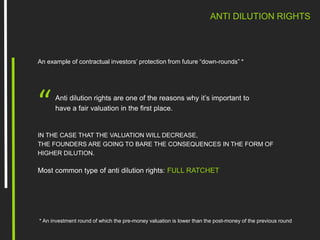
ANTI DILUTION RIGHTS
An example of contractual investors’ protection from future “down-rounds” *
Anti dilution rights are one of the reasons why it’s important to
have a fair valuation in the first place.“
* An investment round of which the pre-money valuation is lower than the post-money of the previous round
IN THE CASE THAT THE VALUATION WILL DECREASE,
THE FOUNDERS ARE GOING TO BARE THE CONSEQUENCES IN THE FORM OF
HIGHER DILUTION.
Most common type of anti dilution rights: FULL RATCHET
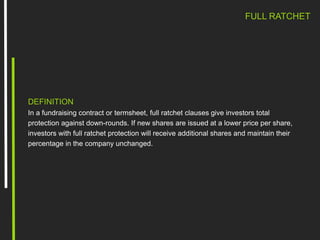
FULL RATCHET
DEFINITION
In a fundraising contract or termsheet, full ratchet clauses give investors total
protection against down-rounds. If new shares are issued at a lower price per share,
investors with full ratchet protection will receive additional shares and maintain their
percentage in the company unchanged.
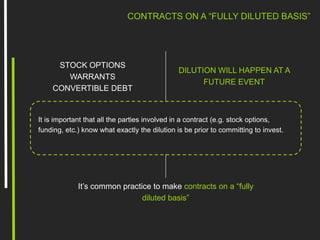
CONTRACTS ON A “FULLY DILUTED BASIS”
STOCK OPTIONS
WARRANTS
CONVERTIBLE DEBT
DILUTION WILL HAPPEN AT A
FUTURE EVENT
It is important that all the parties involved in a contract (e.g. stock options,
funding, etc.) know what exactly the dilution is be prior to committing to invest.
It’s common practice to make contracts on a “fully
diluted basis”
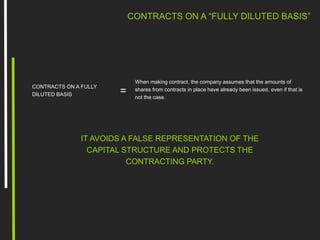
CONTRACTS ON A FULLY
DILUTED BASIS
When making contract, the company assumes that the amounts of
shares from contracts in place have already been issued, even if that is
not the case.
IT AVOIDS A FALSE REPRESENTATION OF THE
CAPITAL STRUCTURE AND PROTECTS THE
CONTRACTING PARTY.
=
CONTRACTS ON A “FULLY DILUTED BASIS”
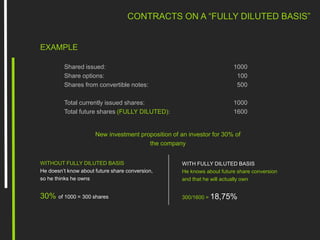
WITHOUT FULLY DILUTED BASIS
He doesn’t know about future share conversion,
so he thinks he owns
30% of 1000 = 300 shares
WITH FULLY DILUTED BASIS
He knows about future share conversion
and that he will actually own
300/1600 = 18,75%
1000
100
500
1000
1600
Shared issued:
Share options:
Shares from convertible notes:
Total currently issued shares:
Total future shares (FULLY DILUTED):
New investment proposition of an investor for 30% of
the company
EXAMPLE
CONTRACTS ON A “FULLY DILUTED BASIS”
Computing Dilution
FOR FUTURE EVENTS
STOCK OPTIONS AND WARRANTS
Computing the future dilution in these cases is relatively simple, because
you know already the exact amount of shares that are going to be issued.
You should then follow the formulas in the previous slides.
CONVERTIBLE DEBT
For convertible debt, the situation is a bit more difficult because:
There is no certainty in the number of shares that will be issued
In this case,
CONSIDER THE BASE CASE SCENARIO
that is
ASSUME THAT THE DEBT HOLDERS
WILL CONVERT AT THE CAP
CONCLUSION
Dilution is inevitable, if you need to raise capital.
But don’t worry:
THE GOAL SHOULD BE TO INCREASE THE VALUE OF YOUR COMPANY
SO THAT YOU OWN
A SMALLER PERCENTAGE OF A MUCH BIGGER PIE,
AND YOUR PERSONAL VALUE GOES UP.
You should now understand how important it is to
KEEP TRACK OF YOUR VALUATION
Try Equidam for Free at
www.equidam.com

Dilution in startup fundraising

  • 1.
  • 2.
    OWNER A: 100% SHARES (1000) OWNERA: ? % SHARES (1000) OWNER B 9% shares ? number shares Why should you know about dilution HOW BIG WILL YOUR PIECE OF THE PIE BE?
  • 3.
    WHY IS DILUTIONIMPORTANT? IT AFFECTS COMPANY OWNERSHIP how much of the company you own and you will keep in the future IT HAS TO BE CONSIDERED WHEN MAKING AN INVESTMENT PROPOSITION otherwise, after several rounds, you will end up with a non-satisfying percentage of the shares IT MAY REDUCE THE VALUE OF THE EXISTING SHARES Only if new shares are issued at a lower price. Mostly valid for public companies that benefit only marginally from the capital infusion
  • 4.
    DEFINITION Dilution is thereduction of ownership percentages in a company as an effect of the issuance of new shares.
  • 5.
    FORMULA / Total number ofshares after issuance Number of shares newly issuedDilution = EXAMPLE For an investment round, a company with a total amount of 1000 shares issues 100 additional shares. The dilution caused equals to: Dilution = 100 / 1100 = 9%
  • 6.
    1 - DILUTION Also calledDILUTION COEFFICIENT DILUTED STAKE = INITIAL STAKE * ( ) 100% 9 % 100% – 9% OWNER A = 100% * ( 100% – 9% ) = 91% HOW BIG WILL YOUR PIECE OF THE PIE BE?
  • 7.
    WHAT IF THEREARE MULTIPLE INITIAL OWNERS? OWNER A 50% 500 shares OWNER B 50% 500 shares OWNER A ? % 500 shares OWNER B ? % 500 shares OWNER C 20 % EACH INITIAL OWNER WILL OWN 50% * ( 1 – 0,2 ) = 50% * 80% = 40% 1 - DILUTION Also called DILUTION COEFFICIENT DILUTED STAKE = INITIAL STAKE * ( )
  • 8.
    WHEN ARE YOUSUBJECT TO DILUTION? FUNDRAISING This is the most typical case, and also the one reflected in the past examples STOCK OPTIONS OR WARRANTS They are securities that do not trigger the issuance of shares at the time the contract is signed but they imply that third parties will enter the capital structure in the future CONVERTIBLE DEBT In this case, debt holders will convert to shareholders at a trigger event, usually a funding round or an exit.
  • 9.
  • 10.
    DILUTION IN FUNDRAISING STARTUPSUSUALLY GO THROUGH MULTIPLE FUNDING ROUNDS If you give away more than 20% in the first round You risk too much dilution for the founding team This could be a deal breaker for future investors: they can be afraid of founders not having enough incentives to commit fully to the company
  • 11.
    Future rounds aregoing to dilute my participation so you should allow me a larger share now to prevent this from happening!“ NEGOTIATING WITH INVESTORS INVESTORS MIGHT USE A DILUTION ARGUMENT LIKE: The percentage of shares an investor holds in a company brings him: - Control rights - Cash flow rights As he/she gets diluted, control rights are affected the most, cash flow rights diminish in percentage but, if the company is performing well, increase in payoff.
  • 12.
    DISCUSSING CONTROL RIGHTS LOWERCONTROL RIGHTS CAN BE DEALT WITH IN SEVERAL WAYS GET A LARGER INITIAL SHARE Bought with more capital at the beginning. Generally not the best option as the risk at this stage is still really high. TAG-ALONG IN FUTURE ISSUANCES Buy in, at higher valuations, in future share issuances and maintain their percentage. This depends on the investors’ willingness to put up more capital OBTAIN INDIRECT CONTROL MEASURES This can be given to an investor by giving him/her a position in the executive board, specific contractual control rights, shares of a different class etc.
  • 13.
  • 14.
    ANTI DILUTION RIGHTS Anexample of contractual investors’ protection from future “down-rounds” * Anti dilution rights are one of the reasons why it’s important to have a fair valuation in the first place.“ * An investment round of which the pre-money valuation is lower than the post-money of the previous round IN THE CASE THAT THE VALUATION WILL DECREASE, THE FOUNDERS ARE GOING TO BARE THE CONSEQUENCES IN THE FORM OF HIGHER DILUTION. Most common type of anti dilution rights: FULL RATCHET
  • 15.
    FULL RATCHET DEFINITION In afundraising contract or termsheet, full ratchet clauses give investors total protection against down-rounds. If new shares are issued at a lower price per share, investors with full ratchet protection will receive additional shares and maintain their percentage in the company unchanged.
  • 16.
    CONTRACTS ON A“FULLY DILUTED BASIS” STOCK OPTIONS WARRANTS CONVERTIBLE DEBT DILUTION WILL HAPPEN AT A FUTURE EVENT It is important that all the parties involved in a contract (e.g. stock options, funding, etc.) know what exactly the dilution is be prior to committing to invest. It’s common practice to make contracts on a “fully diluted basis”
  • 17.
    CONTRACTS ON AFULLY DILUTED BASIS When making contract, the company assumes that the amounts of shares from contracts in place have already been issued, even if that is not the case. IT AVOIDS A FALSE REPRESENTATION OF THE CAPITAL STRUCTURE AND PROTECTS THE CONTRACTING PARTY. = CONTRACTS ON A “FULLY DILUTED BASIS”
  • 18.
    WITHOUT FULLY DILUTEDBASIS He doesn’t know about future share conversion, so he thinks he owns 30% of 1000 = 300 shares WITH FULLY DILUTED BASIS He knows about future share conversion and that he will actually own 300/1600 = 18,75% 1000 100 500 1000 1600 Shared issued: Share options: Shares from convertible notes: Total currently issued shares: Total future shares (FULLY DILUTED): New investment proposition of an investor for 30% of the company EXAMPLE CONTRACTS ON A “FULLY DILUTED BASIS”
  • 19.
  • 20.
    STOCK OPTIONS ANDWARRANTS Computing the future dilution in these cases is relatively simple, because you know already the exact amount of shares that are going to be issued. You should then follow the formulas in the previous slides.
  • 21.
    CONVERTIBLE DEBT For convertibledebt, the situation is a bit more difficult because: There is no certainty in the number of shares that will be issued In this case, CONSIDER THE BASE CASE SCENARIO that is ASSUME THAT THE DEBT HOLDERS WILL CONVERT AT THE CAP
  • 22.
    CONCLUSION Dilution is inevitable,if you need to raise capital. But don’t worry: THE GOAL SHOULD BE TO INCREASE THE VALUE OF YOUR COMPANY SO THAT YOU OWN A SMALLER PERCENTAGE OF A MUCH BIGGER PIE, AND YOUR PERSONAL VALUE GOES UP.
  • 23.
    You should nowunderstand how important it is to KEEP TRACK OF YOUR VALUATION Try Equidam for Free at www.equidam.com

Editor's Notes

  • #4 Is the third point right
  • #13 Talk to daniel to ask expaination about economist and investor on dilution
  • #15 Ask daniel about full ratchet
  • #16 Ask daniel about full ratchet
  • #22 Reference to convertible debt
  • #24 To discuss A list of discount rates? An example Sources slides necessary or not?