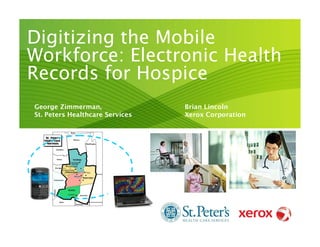
Digitizing the Mobile
   Workforce: Electronic Health
   Records for Hospice
     George Zimmerman,                Brian Lincoln
     St. Peters Healthcare Services   Xerox Corporation


AIIM 2011
The old problem – Information and
Application overload         Complexity of
                                                       Healthcare
                                                       Many application areas exist
                                                       in a healthcare organization
                                                       – EHR/EMR, patient
                                                       management, health
                                                       information management,
                                                       education/training,
                                                       diagnostics, billing, etc. etc.

                                                       Hospitals typically have a
                                                       multitude of IT systems –
                                                       •Multiple EHR/EMR
Information (and paper) overload:                      •PACS
                                                       •Lab systems
     Healthcare workers spend almost twice as much     •Payroll/Finance/Scheduling
     time with documents as in other industries (and   •Compliance
     33% of information searches are unsuccessful).    •Patient Accounting
     IDC, 2007                                         •Specialized clinical systems
                                                       – for ER, Pathology, Mental
In a 2010 survey of healthcare providers, Forrester
                                                       Health, Obstetrics, Hospice,
found over 50% of providers were still driven by
                                                       etc. etc.
paper-
paper-based processes and had not committed
              processes,
to an enterprise wide EMR.
2011 Technology Challenge and Driver:
‘Meaningful Use’
•Healthcare providers striving to support:
   •   Electronic Medical Records (EMR)
   •   Health Information Exchange (HIE)
   •   Cross-provider Electronic Health Records (EHR)
•2009 American Recovery and Reinvestment Act (ARRA),
 HiTECH Act
   •   Accelerate EMR/EHR via incentive payments; but providers must
       also show “meaningful use” of EHR, meeting a matrix of
       objectives
                   Example ‘Meaningful Use’ requirements:
                   Better process capabilities
                   Improved patient engagement, communication
                   Quick patient access to records on request
                   Transmittal of prescriptions electronically
                   Cross-system coordination
                   Participation in HIE networks
                   Compliance – Strong auditing and reporting
And the next frontier – Going Mobile
•Use of PDA devices, tablets, Web applications has exploded


                                                     GPS, 3G, Wi-Fi, Bluetooth
                                                      all growing at over 40%


In Healthcare:
• New media tablets with better screen size and availability mean
  more effective use by physicians, clinicians
     •   Mobile tool must match the purpose – laptops, smart phones, wireless
         devices are acceptable for different clinical activities
     •   Security and compliance requirements are key
•   Emerging mobile technologies give Healthcare providers new
    options for supporting Hospice workers and other mobile teams
Internet Administrator/Webmaster, St. Peters Health Care Services
                                             George Zimmerman
                 Senior Product Line Manager, Xerox Corporation
                                                   Brian Lincoln
• Who we are
• About Hospice
• Relationship to St. Peter’s
• Relationship to the area
  health care community
• Special Regulations regarding
  patient information
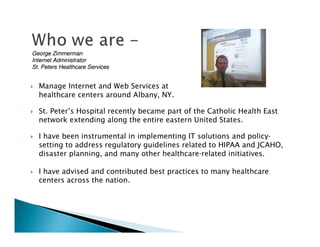
George Zimmerman
Internet Administrator
St. Peters Healthcare Services


  Manage Internet and Web Services at
  healthcare centers around Albany, NY.

  St. Peter’s Hospital recently became part of the Catholic Health East
  network extending along the entire eastern United States.

  I have been instrumental in implementing IT solutions and policy-
  setting to address regulatory guidelines related to HIPAA and JCAHO,
  disaster planning, and many other healthcare-related initiatives.

  I have advised and contributed best practices to many healthcare
  centers across the nation.
• First founded by the Religious
Sisters of Mercy in 1869 as St.
Peter's Hospital, St. Peter's Health
Care Services today provides New
York's Capital Region with a
comprehensive, integrated
continuum of care.

• Hospital has 442 beds, 4,600
employees (currently merging with
two additional acute healthcare
systems).

• 25 Facilities with a wide range of
programs and services, from birth
to LTC.

• Member of Catholic Health East
(CHE).
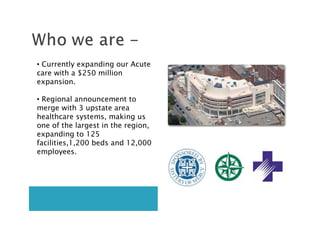
• Currently expanding our Acute
care with a $250 million
expansion.
• Regional announcement to
merge with 3 upstate area
healthcare systems, making us
one of the largest in the region,
expanding to 125
facilities,1,200 beds and 12,000
employees.
The Community Hospice
provides expert care to
those who are very ill with
any disease, plus help and
support for their families.
We show patients and their
loved ones how to focus on
the things that matter
most, and we encourage
them to set goals and
embrace life.
St. Peter’s Healthcare
Services’ Web Services
group provides critical
infrastructure, network,
application, and internet
related support to help
the foundation reach its
goals.
The Community Hospice is a non-profit
serving 7 counties: Albany, Rensselaer,
Columbia, Greene, Schenectady, Saratoga
and Montgomery and employees
approximately 500 staff.
Of the approximately 8600 deaths last
year, 39% were receiving hospice services.
The Community Hospice set a record for
“patients under care,” caring for average
of 658 patients per day.
Approximately 64% are homecare, 33%
are residents of local nursing homes,
and about 3% are hospital patients and
receive inpatient hospice care.
Services are provided at little or no cost to
patients.
Patients often keep their current doctors,
and we work with them to ensure they are
receiving the best care possible.
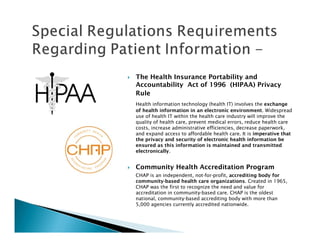
The Health Insurance Portability and
Accountability Act of 1996 (HIPAA) Privacy
Rule
Health information technology (health IT) involves the exchange
of health information in an electronic environment. Widespread
use of health IT within the health care industry will improve the
quality of health care, prevent medical errors, reduce health care
costs, increase administrative efficiencies, decrease paperwork,
and expand access to affordable health care. It is imperative that
the privacy and security of electronic health information be
ensured as this information is maintained and transmitted
electronically.


Community Health Accreditation Program
CHAP is an independent, not-for-profit, accrediting body for
community-based health care organizations. Created in 1965,
CHAP was the first to recognize the need and value for
accreditation in community-based care. CHAP is the oldest
national, community-based accrediting body with more than
5,000 agencies currently accredited nationwide.
The dangers of not having document management:
• Don’t let HIPPA guidelines or JCAHO eat you up
St. Peters Background:
Document Management Solutions to date

                                                                Diagnosis:
                                          Many Hospital-related documents
  #1 – Key Challenges                       to manage and keep up to date
                          #2 - Benefits


  New compliance, disaster recovery initiatives required information to
   New compliance, disaster recovery initiatives required information to
  be available, accessible anywhere anytime ::
   be available, accessible anywhere anytime
       HIPAA Policies (frequent versions)
       HIPAA Policies (frequent versions)
       Disaster/Emergency Preparedness Manual
       Disaster/Emergency Preparedness Manual
St. Peters Background:
Document Management Solutions to date
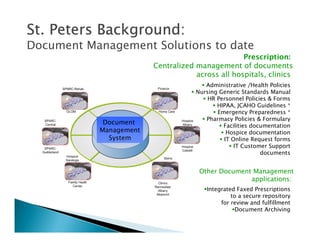
                                                  Prescription:
                        Centralized management of documents
                                    across all hospitals, clinics
                                       Administrative /Health Policies
                                    Nursing Generic Standards Manual
                                        HR Personnel Policies & Forms
                                           HIPAA, JCAHO Guidelines *
                                           Emergency Preparedness *
                                       Pharmacy Policies & Formulary
            Document                         Facilities documentation
           Management                         Hospice documentation
             System                          IT Online Request forms
                                                 IT Customer Support
                                                           documents


                                     Other Document Management
                                                   applications:
                                       Integrated Faxed Prescriptions
                                                to a secure repository
                                            for review and fulfillment
                                                  Document Archiving
St. Peters Background:
Document Management Solutions to date


  #1 – Key Challenges                #2 – Benefits

  Polices , ,Procedures and forms ––Now “Up to date”
   Polices Procedures and forms Now “Up to date”
  Printing cost savings ––High volume printers downsized, huge paper $$$ savings
   Printing cost savings High volume printers downsized, huge paper $$$ savings
  IT cost savings ––Email Inbox & Storage downsized
   IT cost savings Email Inbox & Storage downsized
  Trash savings and Privacy ––Less trash
   Trash savings and Privacy Less trash
  Quicker access to updated information ––no more binders, nurses can read and text-
   Quicker access to updated information no more binders, nurses can read and text-
  search Nursing Manual instantly at desktops
   search Nursing Manual instantly at desktops
  Employees can download HR Forms from Web --Massive reduction in printed forms
   Employees can download HR Forms from Web Massive reduction in printed forms
  Emergency Preparedness Manual ––readily available
   Emergency Preparedness Manual readily available
  Up-to-date HIPAA Guidelines are on-line
   Up-to-date HIPAA Guidelines are on-line
  Remote clinics and affiliates can access centralized documents from St. Peters’ intranet
   Remote clinics and affiliates can access centralized documents from St. Peters’ intranet
  Hospice organization can share documents with International affiliates
   Hospice organization can share documents with International affiliates
•   What Hospice does
•   How services are delivered
•   Administrative vs. Clinical Staff
•   Overhead associated with process
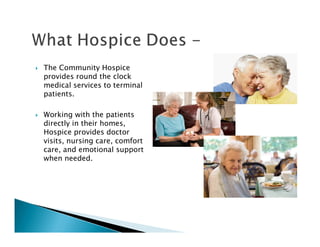
The Community Hospice
provides round the clock
medical services to terminal
patients.

Working with the patients
directly in their homes,
Hospice provides doctor
visits, nursing care, comfort
care, and emotional support
when needed.
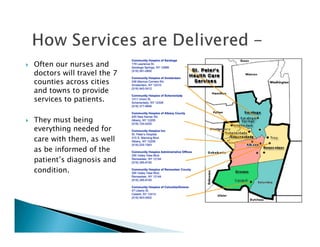
Often our nurses and
doctors will travel the 7
counties across cities
and towns to provide
services to patients.

They must being
everything needed for
care with them, as well
as be informed of the
patient’s diagnosis and
condition.
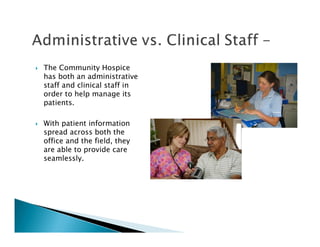
The Community Hospice
has both an administrative
staff and clinical staff in
order to help manage its
patients.

With patient information
spread across both the
office and the field, they
are able to provide care
seamlessly.
Every day the Community
Hospice deals with patient
data and the need to have
current information with
them at a site.

With a largely mobile
workforce this information
needs to be available nearly
anywhere, secured, and as
up to date as possible.
• Providing care remotely from
  outside the facility walls
• How to access records back at the
  office if needed
• Centralized Document Store
• Meaningful Use
• Security issues- the “open file on
  the car seat” problem
• Disseminating information to
  employees in the field
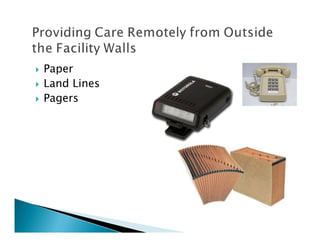
Paper
Land Lines
Pagers
Dial up Modems
File Cabinets
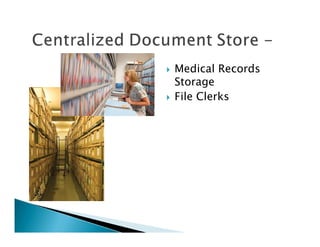
Medical Records
Storage
File Clerks
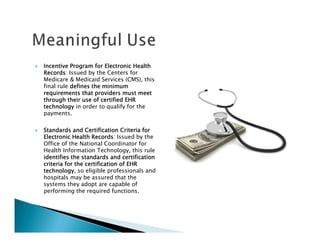
Incentive Program for Electronic Health
Records:
Records Issued by the Centers for
Medicare & Medicaid Services (CMS), this
final rule defines the minimum
requirements that providers must meet
through their use of certified EHR
technology in order to qualify for the
payments.

Standards and Certification Criteria for
Electronic Health Records Issued by the
                   Records:
Office of the National Coordinator for
Health Information Technology, this rule
identifies the standards and certification
criteria for the certification of EHR
technology,
technology so eligible professionals and
hospitals may be assured that the
systems they adopt are capable of
performing the required functions.
Patient Data at risk
HIPAA concerns
Word of Mouth
Postings
Training Manuals
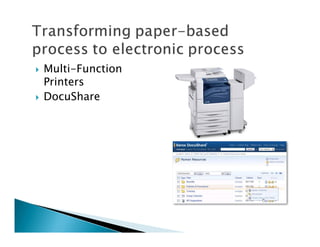
• Transforming paper-based
  process to electronic process
• Facilitating electronic document
  exchange with other health care
  providers and insurers
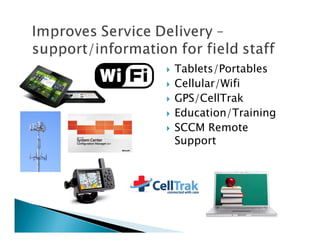
    • Improves service delivery –
      support/information for field
      staff
    • Improves productivity –
      Information always available
      when needed
    • Easier to secure information
Multi-Function
Printers
DocuShare
HIXNY
Created through a unique collaboration
of health care providers and insurers, the
purpose of HIXNY is to mobilize medical
information for the benefit of the
patients that our member organizations
serve. By improving health care delivery
serve
in our community, HIXNY will promote
quality care and reduce costs. HIXNY
provides a secure technology
infrastructure and services to enable
physicians, hospitals, health plans, and
other health care providers to interact,
share information resources, and
conduct the business of healthcare in a
collaborative manner.
Tablets/Portables
Cellular/Wifi
GPS/CellTrak
Education/Training
SCCM Remote
Support
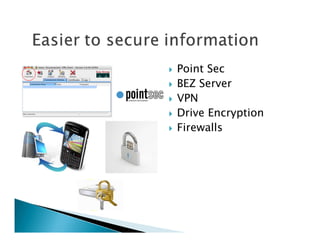
Point Sec
BEZ Server
VPN
Drive Encryption
Firewalls
• The technology chosen
• Streamlined workflows
• Reduced time required to maintain
  records
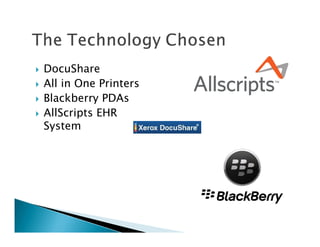
DocuShare
All in One Printers
Blackberry PDAs
AllScripts EHR
System
Mileage Tracking
Automated
Maps on Demand
Voice Recognition
Scanning
• Return on Investment
• Recommendations
• Summary
Things you can’t
Measure
Soft cost
Availability of
information
Joke- slide
Q&A
Thank you!


      George Zimmerman, IT Administrator,
          St. Peters Healthcare Services
        gzimmerman@stpetershealth.org

   Brian Lincoln, Senior Product Line Manager,
                  Xerox DocuShare
             brian.lincoln@xerox.com

Digitizing the mobile_workforce_electronic_health_records_for_hospice

  • 1.
    Digitizing the Mobile Workforce: Electronic Health Records for Hospice George Zimmerman, Brian Lincoln St. Peters Healthcare Services Xerox Corporation AIIM 2011
  • 2.
    The old problem– Information and Application overload Complexity of Healthcare Many application areas exist in a healthcare organization – EHR/EMR, patient management, health information management, education/training, diagnostics, billing, etc. etc. Hospitals typically have a multitude of IT systems – •Multiple EHR/EMR Information (and paper) overload: •PACS •Lab systems Healthcare workers spend almost twice as much •Payroll/Finance/Scheduling time with documents as in other industries (and •Compliance 33% of information searches are unsuccessful). •Patient Accounting IDC, 2007 •Specialized clinical systems – for ER, Pathology, Mental In a 2010 survey of healthcare providers, Forrester Health, Obstetrics, Hospice, found over 50% of providers were still driven by etc. etc. paper- paper-based processes and had not committed processes, to an enterprise wide EMR.
  • 3.
    2011 Technology Challengeand Driver: ‘Meaningful Use’ •Healthcare providers striving to support: • Electronic Medical Records (EMR) • Health Information Exchange (HIE) • Cross-provider Electronic Health Records (EHR) •2009 American Recovery and Reinvestment Act (ARRA), HiTECH Act • Accelerate EMR/EHR via incentive payments; but providers must also show “meaningful use” of EHR, meeting a matrix of objectives Example ‘Meaningful Use’ requirements: Better process capabilities Improved patient engagement, communication Quick patient access to records on request Transmittal of prescriptions electronically Cross-system coordination Participation in HIE networks Compliance – Strong auditing and reporting
  • 4.
    And the nextfrontier – Going Mobile •Use of PDA devices, tablets, Web applications has exploded GPS, 3G, Wi-Fi, Bluetooth all growing at over 40% In Healthcare: • New media tablets with better screen size and availability mean more effective use by physicians, clinicians • Mobile tool must match the purpose – laptops, smart phones, wireless devices are acceptable for different clinical activities • Security and compliance requirements are key • Emerging mobile technologies give Healthcare providers new options for supporting Hospice workers and other mobile teams
  • 5.
    Internet Administrator/Webmaster, St.Peters Health Care Services George Zimmerman Senior Product Line Manager, Xerox Corporation Brian Lincoln
  • 6.
    • Who weare • About Hospice • Relationship to St. Peter’s • Relationship to the area health care community • Special Regulations regarding patient information
  • 7.
    George Zimmerman Internet Administrator St.Peters Healthcare Services Manage Internet and Web Services at healthcare centers around Albany, NY. St. Peter’s Hospital recently became part of the Catholic Health East network extending along the entire eastern United States. I have been instrumental in implementing IT solutions and policy- setting to address regulatory guidelines related to HIPAA and JCAHO, disaster planning, and many other healthcare-related initiatives. I have advised and contributed best practices to many healthcare centers across the nation.
  • 8.
    • First foundedby the Religious Sisters of Mercy in 1869 as St. Peter's Hospital, St. Peter's Health Care Services today provides New York's Capital Region with a comprehensive, integrated continuum of care. • Hospital has 442 beds, 4,600 employees (currently merging with two additional acute healthcare systems). • 25 Facilities with a wide range of programs and services, from birth to LTC. • Member of Catholic Health East (CHE).
  • 9.
    • Currently expandingour Acute care with a $250 million expansion. • Regional announcement to merge with 3 upstate area healthcare systems, making us one of the largest in the region, expanding to 125 facilities,1,200 beds and 12,000 employees.
  • 10.
    The Community Hospice providesexpert care to those who are very ill with any disease, plus help and support for their families. We show patients and their loved ones how to focus on the things that matter most, and we encourage them to set goals and embrace life.
  • 11.
    St. Peter’s Healthcare Services’Web Services group provides critical infrastructure, network, application, and internet related support to help the foundation reach its goals.
  • 12.
    The Community Hospiceis a non-profit serving 7 counties: Albany, Rensselaer, Columbia, Greene, Schenectady, Saratoga and Montgomery and employees approximately 500 staff. Of the approximately 8600 deaths last year, 39% were receiving hospice services. The Community Hospice set a record for “patients under care,” caring for average of 658 patients per day. Approximately 64% are homecare, 33% are residents of local nursing homes, and about 3% are hospital patients and receive inpatient hospice care. Services are provided at little or no cost to patients. Patients often keep their current doctors, and we work with them to ensure they are receiving the best care possible.
  • 13.
    The Health InsurancePortability and Accountability Act of 1996 (HIPAA) Privacy Rule Health information technology (health IT) involves the exchange of health information in an electronic environment. Widespread use of health IT within the health care industry will improve the quality of health care, prevent medical errors, reduce health care costs, increase administrative efficiencies, decrease paperwork, and expand access to affordable health care. It is imperative that the privacy and security of electronic health information be ensured as this information is maintained and transmitted electronically. Community Health Accreditation Program CHAP is an independent, not-for-profit, accrediting body for community-based health care organizations. Created in 1965, CHAP was the first to recognize the need and value for accreditation in community-based care. CHAP is the oldest national, community-based accrediting body with more than 5,000 agencies currently accredited nationwide.
  • 14.
    The dangers ofnot having document management: • Don’t let HIPPA guidelines or JCAHO eat you up
  • 15.
    St. Peters Background: DocumentManagement Solutions to date Diagnosis: Many Hospital-related documents #1 – Key Challenges to manage and keep up to date #2 - Benefits New compliance, disaster recovery initiatives required information to New compliance, disaster recovery initiatives required information to be available, accessible anywhere anytime :: be available, accessible anywhere anytime HIPAA Policies (frequent versions) HIPAA Policies (frequent versions) Disaster/Emergency Preparedness Manual Disaster/Emergency Preparedness Manual
  • 16.
    St. Peters Background: DocumentManagement Solutions to date Prescription: Centralized management of documents across all hospitals, clinics Administrative /Health Policies Nursing Generic Standards Manual HR Personnel Policies & Forms HIPAA, JCAHO Guidelines * Emergency Preparedness * Pharmacy Policies & Formulary Document Facilities documentation Management Hospice documentation System IT Online Request forms IT Customer Support documents Other Document Management applications: Integrated Faxed Prescriptions to a secure repository for review and fulfillment Document Archiving
  • 17.
    St. Peters Background: DocumentManagement Solutions to date #1 – Key Challenges #2 – Benefits Polices , ,Procedures and forms ––Now “Up to date” Polices Procedures and forms Now “Up to date” Printing cost savings ––High volume printers downsized, huge paper $$$ savings Printing cost savings High volume printers downsized, huge paper $$$ savings IT cost savings ––Email Inbox & Storage downsized IT cost savings Email Inbox & Storage downsized Trash savings and Privacy ––Less trash Trash savings and Privacy Less trash Quicker access to updated information ––no more binders, nurses can read and text- Quicker access to updated information no more binders, nurses can read and text- search Nursing Manual instantly at desktops search Nursing Manual instantly at desktops Employees can download HR Forms from Web --Massive reduction in printed forms Employees can download HR Forms from Web Massive reduction in printed forms Emergency Preparedness Manual ––readily available Emergency Preparedness Manual readily available Up-to-date HIPAA Guidelines are on-line Up-to-date HIPAA Guidelines are on-line Remote clinics and affiliates can access centralized documents from St. Peters’ intranet Remote clinics and affiliates can access centralized documents from St. Peters’ intranet Hospice organization can share documents with International affiliates Hospice organization can share documents with International affiliates
  • 18.
    What Hospice does • How services are delivered • Administrative vs. Clinical Staff • Overhead associated with process
  • 19.
    The Community Hospice providesround the clock medical services to terminal patients. Working with the patients directly in their homes, Hospice provides doctor visits, nursing care, comfort care, and emotional support when needed.
  • 20.
    Often our nursesand doctors will travel the 7 counties across cities and towns to provide services to patients. They must being everything needed for care with them, as well as be informed of the patient’s diagnosis and condition.
  • 21.
    The Community Hospice hasboth an administrative staff and clinical staff in order to help manage its patients. With patient information spread across both the office and the field, they are able to provide care seamlessly.
  • 22.
    Every day theCommunity Hospice deals with patient data and the need to have current information with them at a site. With a largely mobile workforce this information needs to be available nearly anywhere, secured, and as up to date as possible.
  • 23.
    • Providing careremotely from outside the facility walls • How to access records back at the office if needed • Centralized Document Store • Meaningful Use • Security issues- the “open file on the car seat” problem • Disseminating information to employees in the field
  • 24.
  • 25.
  • 26.
  • 27.
    Incentive Program forElectronic Health Records: Records Issued by the Centers for Medicare & Medicaid Services (CMS), this final rule defines the minimum requirements that providers must meet through their use of certified EHR technology in order to qualify for the payments. Standards and Certification Criteria for Electronic Health Records Issued by the Records: Office of the National Coordinator for Health Information Technology, this rule identifies the standards and certification criteria for the certification of EHR technology, technology so eligible professionals and hospitals may be assured that the systems they adopt are capable of performing the required functions.
  • 28.
    Patient Data atrisk HIPAA concerns
  • 29.
  • 30.
    • Transforming paper-based process to electronic process • Facilitating electronic document exchange with other health care providers and insurers • Improves service delivery – support/information for field staff • Improves productivity – Information always available when needed • Easier to secure information
  • 31.
  • 32.
    HIXNY Created through aunique collaboration of health care providers and insurers, the purpose of HIXNY is to mobilize medical information for the benefit of the patients that our member organizations serve. By improving health care delivery serve in our community, HIXNY will promote quality care and reduce costs. HIXNY provides a secure technology infrastructure and services to enable physicians, hospitals, health plans, and other health care providers to interact, share information resources, and conduct the business of healthcare in a collaborative manner.
  • 33.
  • 35.
    Point Sec BEZ Server VPN DriveEncryption Firewalls
  • 36.
    • The technologychosen • Streamlined workflows • Reduced time required to maintain records
  • 37.
    DocuShare All in OnePrinters Blackberry PDAs AllScripts EHR System
  • 38.
    Mileage Tracking Automated Maps onDemand Voice Recognition
  • 39.
  • 40.
    • Return onInvestment • Recommendations • Summary
  • 41.
    Things you can’t Measure Softcost Availability of information
  • 42.
  • 44.
    Q&A Thank you! George Zimmerman, IT Administrator, St. Peters Healthcare Services gzimmerman@stpetershealth.org Brian Lincoln, Senior Product Line Manager, Xerox DocuShare brian.lincoln@xerox.com