DIGITAL TRANSFORMATION
CONSULTING PROPOSAL
+31 615 890 800
errol.vanengelen@yahoo.com
Jan Meertensstraat 30
3065 PB Rotterdam
Bizzmaxx
Digital Transformation Consulting Proposal
If your company, either startup or existing, is considering migrating from a 'brick and mortar'
organization to a digital business, I can recommend you to develop a step-by-step plan that migrates
you from the current situation to the new situation. This step-by-step roadmap helps you overcome
barriers, avoid costly mistakes and eliminate time-consuming detours that prevent you from reaching
your goals and your decision destination.
Problem Statement
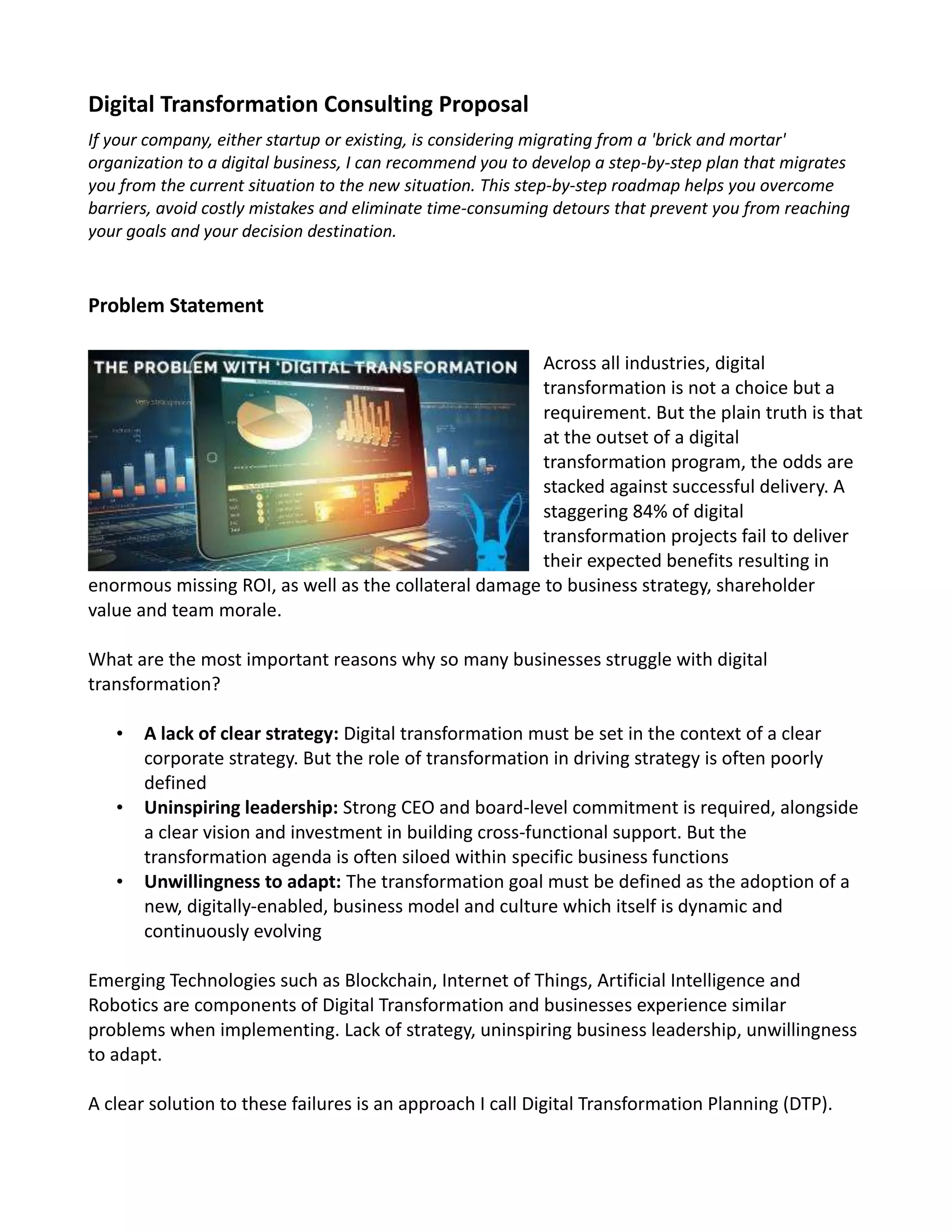
Across all industries, digital
transformation is not a choice but a
requirement. But the plain truth is that
at the outset of a digital
transformation program, the odds are
stacked against successful delivery. A
staggering 84% of digital
transformation projects fail to deliver
their expected benefits resulting in
enormous missing ROI, as well as the collateral damage to business strategy, shareholder
value and team morale.
What are the most important reasons why so many businesses struggle with digital
transformation?
• A lack of clear strategy: Digital transformation must be set in the context of a clear
corporate strategy. But the role of transformation in driving strategy is often poorly
defined
• Uninspiring leadership: Strong CEO and board-level commitment is required, alongside
a clear vision and investment in building cross-functional support. But the
transformation agenda is often siloed within specific business functions
• Unwillingness to adapt: The transformation goal must be defined as the adoption of a
new, digitally-enabled, business model and culture which itself is dynamic and
continuously evolving
Emerging Technologies such as Blockchain, Internet of Things, Artificial Intelligence and
Robotics are components of Digital Transformation and businesses experience similar
problems when implementing. Lack of strategy, uninspiring business leadership, unwillingness
to adapt.
A clear solution to these failures is an approach I call Digital Transformation Planning (DTP).
Scope of Work
DTP requires an integrated, holistic approach
To make DTP work in any type of
business, the following is required:
• Put together a multi-functional
team consisting of business and
technical managers and professionals.
The aim of this business / IT alignment
is a better understanding between
business and IT resulting in a shorter
path from strategy to operation, and
an end product of high quality, which is the digital blueprint. This blueprint is the basis
for further digital projects
• Use an integral method - Digital Transformation Planning (DTP) - to develop your
blueprint. The best approach is a mix of two existing methods, Business Model Canvas
and SOSTAC®. The aim of this approach is combining digital planning with business
planning, which results in a blueprint that is better and more complete than each
method apart
• The customer needs to have both business and technical managers and professionals
available to participate in these Business Model Canvas and SOSTAC® sessions
(Business-Technology-Alignment)
Business Model Canvas
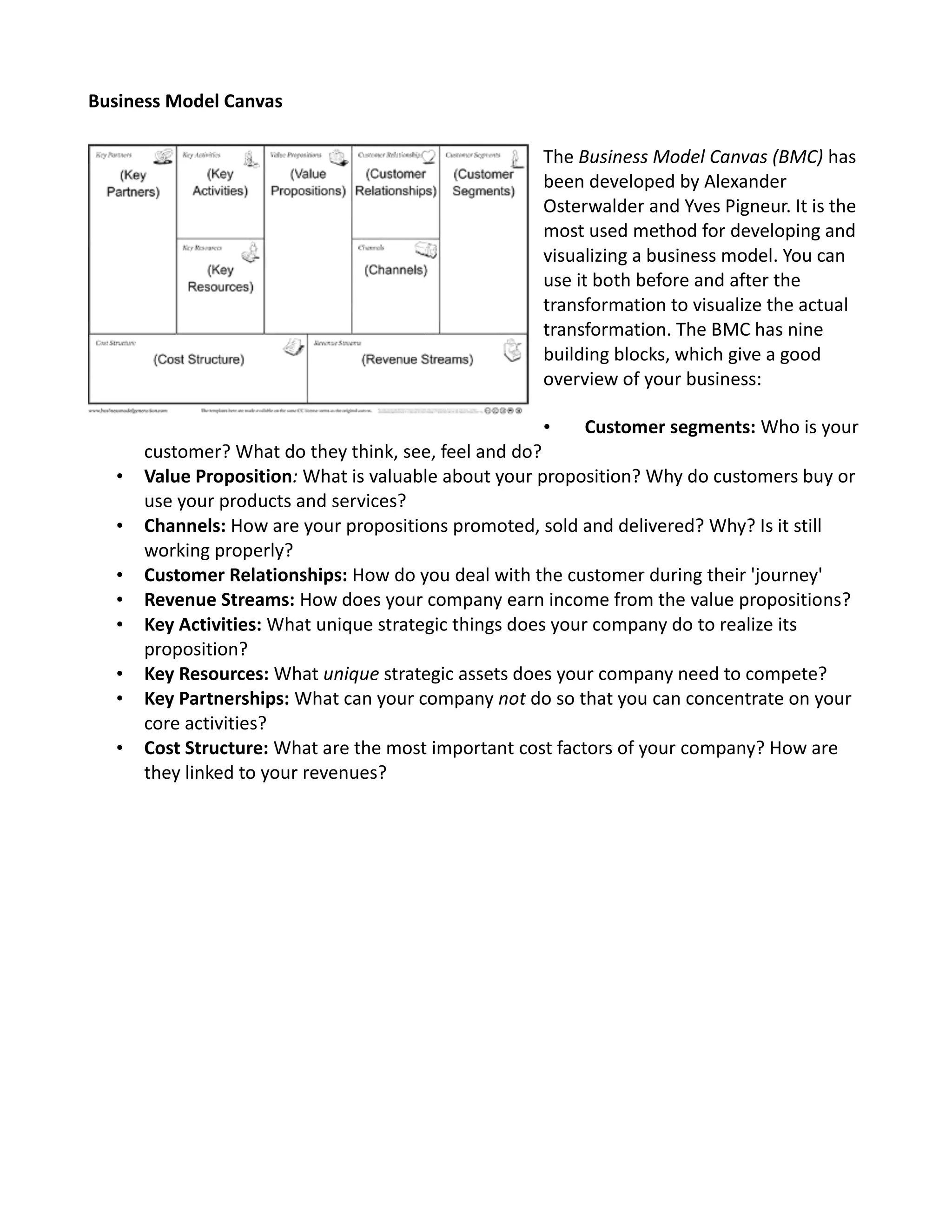
The Business Model Canvas (BMC) has
been developed by Alexander
Osterwalder and Yves Pigneur. It is the
most used method for developing and
visualizing a business model. You can
use it both before and after the
transformation to visualize the actual
transformation. The BMC has nine
building blocks, which give a good
overview of your business:
• Customer segments: Who is your
customer? What do they think, see, feel and do?
• Value Proposition: What is valuable about your proposition? Why do customers buy or
use your products and services?
• Channels: How are your propositions promoted, sold and delivered? Why? Is it still
working properly?
• Customer Relationships: How do you deal with the customer during their 'journey'
• Revenue Streams: How does your company earn income from the value propositions?
• Key Activities: What unique strategic things does your company do to realize its
proposition?
• Key Resources: What unique strategic assets does your company need to compete?
• Key Partnerships: What can your company not do so that you can concentrate on your
core activities?
• Cost Structure: What are the most important cost factors of your company? How are
they linked to your revenues?
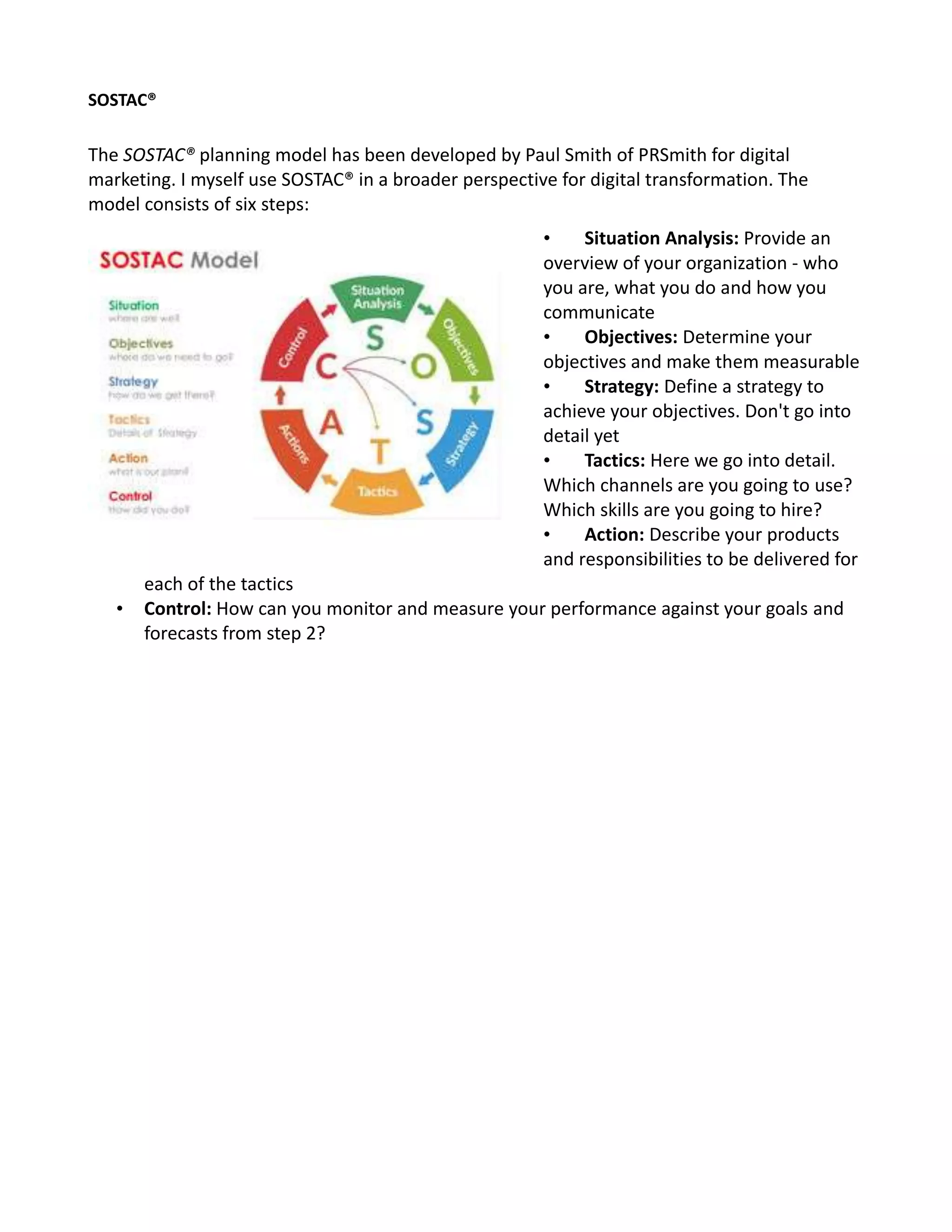
SOSTAC®
The SOSTAC® planning model has been developed by Paul Smith of PRSmith for digital
marketing. I myself use SOSTAC® in a broader perspective for digital transformation. The
model consists of six steps:
• Situation Analysis: Provide an
overview of your organization - who
you are, what you do and how you
communicate
• Objectives: Determine your
objectives and make them measurable
• Strategy: Define a strategy to
achieve your objectives. Don't go into
detail yet
• Tactics: Here we go into detail.
Which channels are you going to use?
Which skills are you going to hire?
• Action: Describe your products
and responsibilities to be delivered for
each of the tactics
• Control: How can you monitor and measure your performance against your goals and
forecasts from step 2?
The benefits of Digital Transformation Planning
Of course you're interested why DTP
will help you avoid the failures your
peers are experiencing when using a
'siloed' approach:
• Fast: By participating key people
in business and technology you have
quickly developed a digital blueprint
• Reliable: Thanks to the usage of a
multi-functional team (business and
technology) and two existing,
successful methods, DTP enables a
complete transformation from strategy to implementation
• Easy: Both methodologies within DTP are easy to learn and easy to implement
• Effective: You can use DTP broadly for each technology both at enterprise and business
unit level, so with one approach you can do the transformation
Need more information? End of January 2019 I published a management book entitled "New
World Technologies: 2020 and Beyond". In chapter 4 “Digital Transformation Planning” you
will find a further explanation of the method including examples.
Deliverables
A DTP includes the following
deliverables:
1. Business Model Canvas (BMC)
before transformation: You need to
have an overview of your original
business model as a starting point.
Fundamentally, I find it delivers three
things:
◦ Focus: Stripping away the 40+
pages of ‘stuff’ in a traditional business
plan, I’ve seen users of the BMC
improve their clarify and focus on what’s driving the business (and what’s non-core
and getting in the way)
◦ Flexibility: It’s a lot easier to tweak the model and try things (from a planning
perspective) with something that’s sitting on a single page
◦ Transparency: Your team will have a much easier time understanding your business
model and be much more likely to buy in to your vision when it’s laid out on a single
page
2. SOSTAC®: This planning model reflects the digital transformation of your business in six
steps. SOSTAC® is a widely used tool for marketing and business planning which is rated
in the top 3 most popular marketing models in the Smart Insights review of Marketing
Models that have stood the test of time. “Although most businesses are now doing
digital marketing, nearly half don’t have a plan – that’s shocking! SOSTAC® gives you an
awesomely simple framework to put that right.” Dave Chaffey, CEO Smart Insights
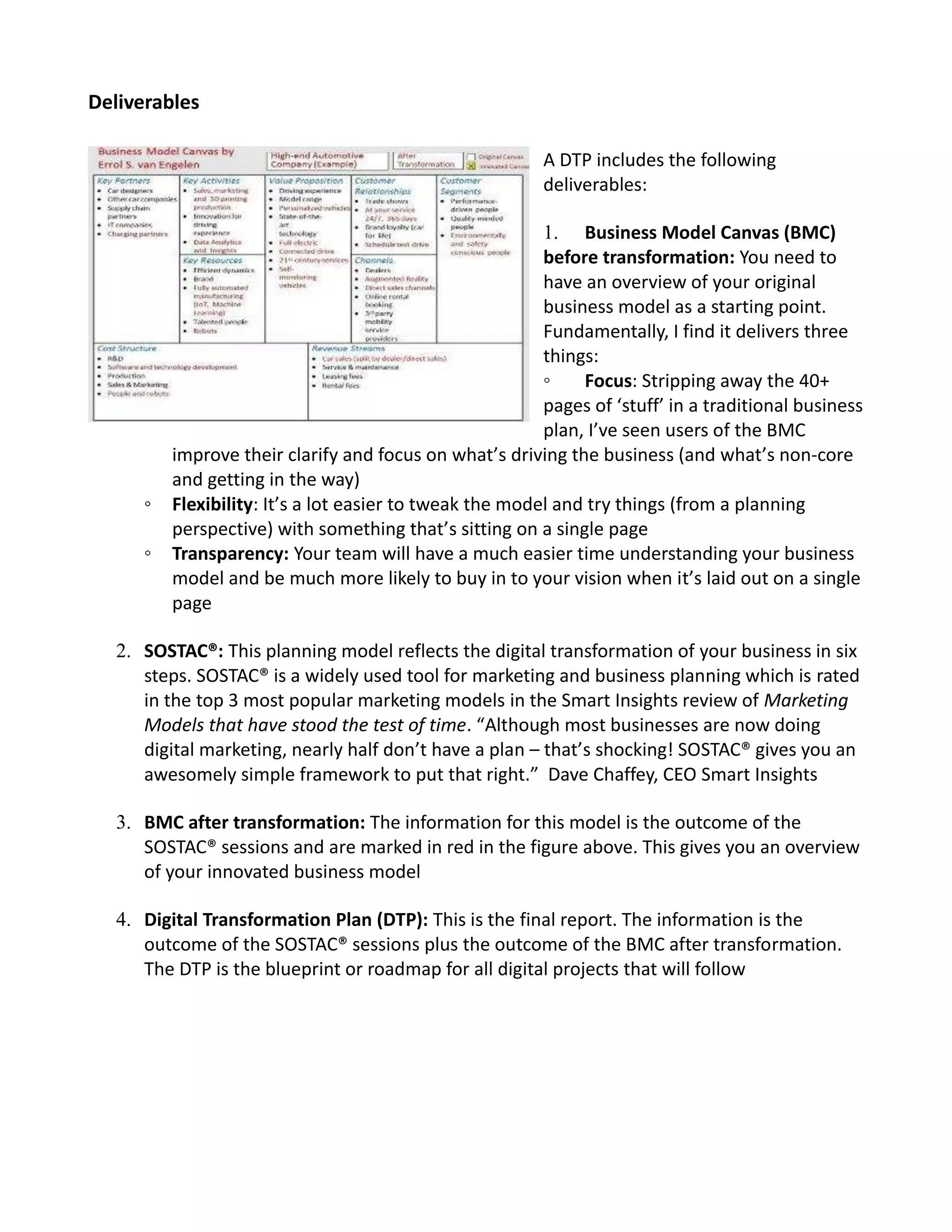
3. BMC after transformation: The information for this model is the outcome of the
SOSTAC® sessions and are marked in red in the figure above. This gives you an overview
of your innovated business model
4. Digital Transformation Plan (DTP): This is the final report. The information is the
outcome of the SOSTAC® sessions plus the outcome of the BMC after transformation.
The DTP is the blueprint or roadmap for all digital projects that will follow
Costs of creating a DTP
This methodology can be used for all
sizes of organizations and companies –
just adjust how much detail you want
in your plan.
Here are three cost scenarios per
business size. Note that each cost
scenario is an average forecast and
may differ based on requirements per
individual customer:
 SME (up to 50 employees)
 Midsized (50+ to 500 employees)
 Enterprise (500+ employees)
1. SME example
◦ BMC before transformation 5 days
◦ SOSTAC 5 days
◦ BMC after transformation 3 days
◦ Reporting 2 days
◦ Total 15 days
2. Midsized example
◦ BMC before transformation 10 days
◦ SOSTAC 10 days
◦ BMC after transformation 6 days
◦ Reporting 4 days
◦ Total 30 days
3. Enterprise example
◦ BMC before transformation 20 days
◦ SOSTAC 20 days
◦ BMC after transformation 12 days
◦ Reporting 8 days
◦ Total 60 days
Certainly, a significant investment, but a properly implemented DTP will pay for itself quickly.
For ongoing results, the DTP needs to be updated every 1-2 years.
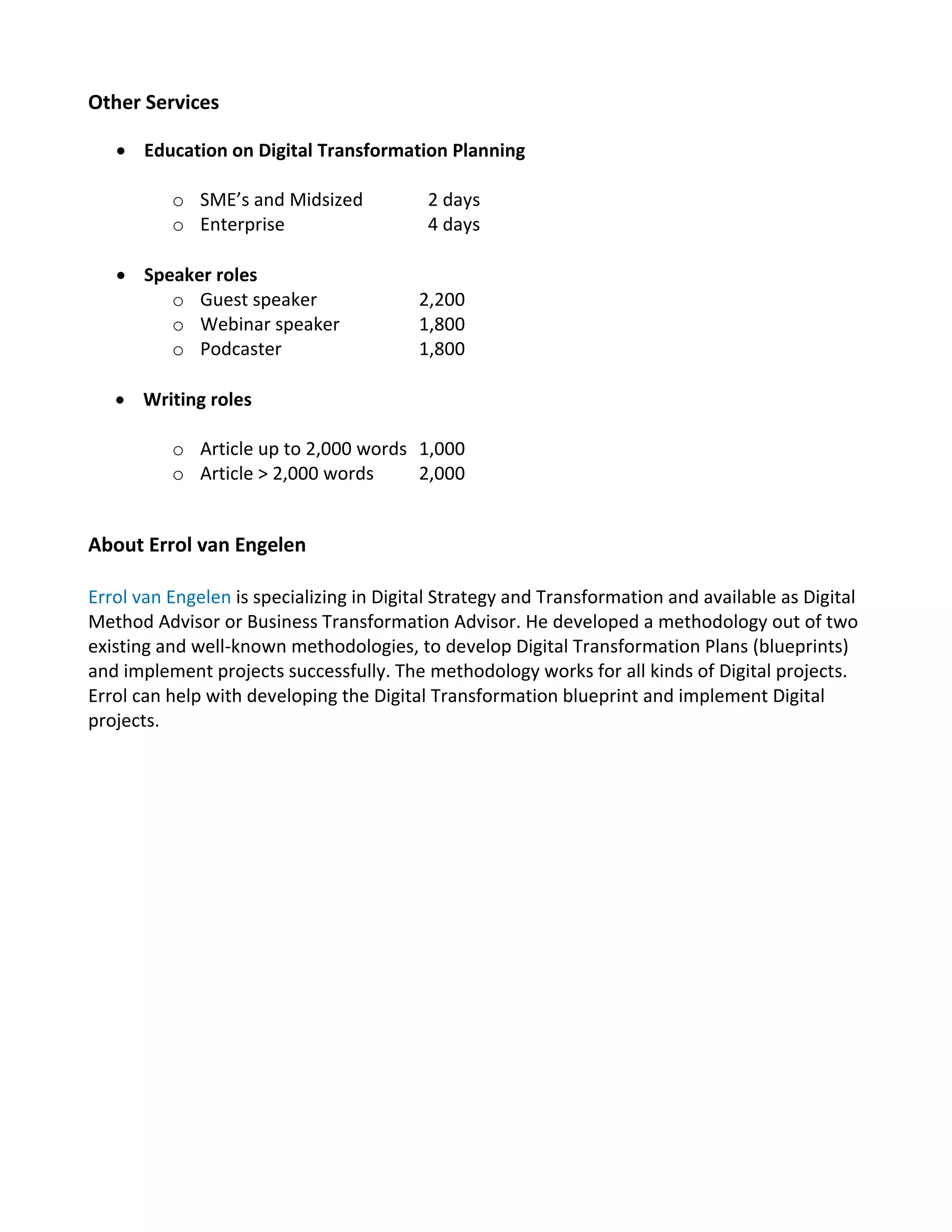
Other Services
 Education on Digital Transformation Planning
o SME’s and Midsized 2 days
o Enterprise 4 days
 Speaker roles
o Guest speaker 2,200
o Webinar speaker 1,800
o Podcaster 1,800
 Writing roles
o Article up to 2,000 words 1,000
o Article > 2,000 words 2,000
About Errol van Engelen
Errol van Engelen is specializing in Digital Strategy and Transformation and available as Digital
Method Advisor or Business Transformation Advisor. He developed a methodology out of two
existing and well-known methodologies, to develop Digital Transformation Plans (blueprints)
and implement projects successfully. The methodology works for all kinds of Digital projects.
Errol can help with developing the Digital Transformation blueprint and implement Digital
projects.

Digital Transformation Consulting Proposal

  • 1.
    DIGITAL TRANSFORMATION CONSULTING PROPOSAL +31615 890 800 errol.vanengelen@yahoo.com Jan Meertensstraat 30 3065 PB Rotterdam Bizzmaxx
  • 2.
    Digital Transformation ConsultingProposal If your company, either startup or existing, is considering migrating from a 'brick and mortar' organization to a digital business, I can recommend you to develop a step-by-step plan that migrates you from the current situation to the new situation. This step-by-step roadmap helps you overcome barriers, avoid costly mistakes and eliminate time-consuming detours that prevent you from reaching your goals and your decision destination. Problem Statement Across all industries, digital transformation is not a choice but a requirement. But the plain truth is that at the outset of a digital transformation program, the odds are stacked against successful delivery. A staggering 84% of digital transformation projects fail to deliver their expected benefits resulting in enormous missing ROI, as well as the collateral damage to business strategy, shareholder value and team morale. What are the most important reasons why so many businesses struggle with digital transformation? • A lack of clear strategy: Digital transformation must be set in the context of a clear corporate strategy. But the role of transformation in driving strategy is often poorly defined • Uninspiring leadership: Strong CEO and board-level commitment is required, alongside a clear vision and investment in building cross-functional support. But the transformation agenda is often siloed within specific business functions • Unwillingness to adapt: The transformation goal must be defined as the adoption of a new, digitally-enabled, business model and culture which itself is dynamic and continuously evolving Emerging Technologies such as Blockchain, Internet of Things, Artificial Intelligence and Robotics are components of Digital Transformation and businesses experience similar problems when implementing. Lack of strategy, uninspiring business leadership, unwillingness to adapt. A clear solution to these failures is an approach I call Digital Transformation Planning (DTP).
  • 3.
    Scope of Work DTPrequires an integrated, holistic approach To make DTP work in any type of business, the following is required: • Put together a multi-functional team consisting of business and technical managers and professionals. The aim of this business / IT alignment is a better understanding between business and IT resulting in a shorter path from strategy to operation, and an end product of high quality, which is the digital blueprint. This blueprint is the basis for further digital projects • Use an integral method - Digital Transformation Planning (DTP) - to develop your blueprint. The best approach is a mix of two existing methods, Business Model Canvas and SOSTAC®. The aim of this approach is combining digital planning with business planning, which results in a blueprint that is better and more complete than each method apart • The customer needs to have both business and technical managers and professionals available to participate in these Business Model Canvas and SOSTAC® sessions (Business-Technology-Alignment)
  • 4.
    Business Model Canvas TheBusiness Model Canvas (BMC) has been developed by Alexander Osterwalder and Yves Pigneur. It is the most used method for developing and visualizing a business model. You can use it both before and after the transformation to visualize the actual transformation. The BMC has nine building blocks, which give a good overview of your business: • Customer segments: Who is your customer? What do they think, see, feel and do? • Value Proposition: What is valuable about your proposition? Why do customers buy or use your products and services? • Channels: How are your propositions promoted, sold and delivered? Why? Is it still working properly? • Customer Relationships: How do you deal with the customer during their 'journey' • Revenue Streams: How does your company earn income from the value propositions? • Key Activities: What unique strategic things does your company do to realize its proposition? • Key Resources: What unique strategic assets does your company need to compete? • Key Partnerships: What can your company not do so that you can concentrate on your core activities? • Cost Structure: What are the most important cost factors of your company? How are they linked to your revenues?
  • 5.
    SOSTAC® The SOSTAC® planningmodel has been developed by Paul Smith of PRSmith for digital marketing. I myself use SOSTAC® in a broader perspective for digital transformation. The model consists of six steps: • Situation Analysis: Provide an overview of your organization - who you are, what you do and how you communicate • Objectives: Determine your objectives and make them measurable • Strategy: Define a strategy to achieve your objectives. Don't go into detail yet • Tactics: Here we go into detail. Which channels are you going to use? Which skills are you going to hire? • Action: Describe your products and responsibilities to be delivered for each of the tactics • Control: How can you monitor and measure your performance against your goals and forecasts from step 2?
  • 6.
    The benefits ofDigital Transformation Planning Of course you're interested why DTP will help you avoid the failures your peers are experiencing when using a 'siloed' approach: • Fast: By participating key people in business and technology you have quickly developed a digital blueprint • Reliable: Thanks to the usage of a multi-functional team (business and technology) and two existing, successful methods, DTP enables a complete transformation from strategy to implementation • Easy: Both methodologies within DTP are easy to learn and easy to implement • Effective: You can use DTP broadly for each technology both at enterprise and business unit level, so with one approach you can do the transformation Need more information? End of January 2019 I published a management book entitled "New World Technologies: 2020 and Beyond". In chapter 4 “Digital Transformation Planning” you will find a further explanation of the method including examples.
  • 7.
    Deliverables A DTP includesthe following deliverables: 1. Business Model Canvas (BMC) before transformation: You need to have an overview of your original business model as a starting point. Fundamentally, I find it delivers three things: ◦ Focus: Stripping away the 40+ pages of ‘stuff’ in a traditional business plan, I’ve seen users of the BMC improve their clarify and focus on what’s driving the business (and what’s non-core and getting in the way) ◦ Flexibility: It’s a lot easier to tweak the model and try things (from a planning perspective) with something that’s sitting on a single page ◦ Transparency: Your team will have a much easier time understanding your business model and be much more likely to buy in to your vision when it’s laid out on a single page 2. SOSTAC®: This planning model reflects the digital transformation of your business in six steps. SOSTAC® is a widely used tool for marketing and business planning which is rated in the top 3 most popular marketing models in the Smart Insights review of Marketing Models that have stood the test of time. “Although most businesses are now doing digital marketing, nearly half don’t have a plan – that’s shocking! SOSTAC® gives you an awesomely simple framework to put that right.” Dave Chaffey, CEO Smart Insights 3. BMC after transformation: The information for this model is the outcome of the SOSTAC® sessions and are marked in red in the figure above. This gives you an overview of your innovated business model 4. Digital Transformation Plan (DTP): This is the final report. The information is the outcome of the SOSTAC® sessions plus the outcome of the BMC after transformation. The DTP is the blueprint or roadmap for all digital projects that will follow
  • 8.
    Costs of creatinga DTP This methodology can be used for all sizes of organizations and companies – just adjust how much detail you want in your plan. Here are three cost scenarios per business size. Note that each cost scenario is an average forecast and may differ based on requirements per individual customer:  SME (up to 50 employees)  Midsized (50+ to 500 employees)  Enterprise (500+ employees) 1. SME example ◦ BMC before transformation 5 days ◦ SOSTAC 5 days ◦ BMC after transformation 3 days ◦ Reporting 2 days ◦ Total 15 days 2. Midsized example ◦ BMC before transformation 10 days ◦ SOSTAC 10 days ◦ BMC after transformation 6 days ◦ Reporting 4 days ◦ Total 30 days 3. Enterprise example ◦ BMC before transformation 20 days ◦ SOSTAC 20 days ◦ BMC after transformation 12 days ◦ Reporting 8 days ◦ Total 60 days Certainly, a significant investment, but a properly implemented DTP will pay for itself quickly. For ongoing results, the DTP needs to be updated every 1-2 years.
  • 9.
    Other Services  Educationon Digital Transformation Planning o SME’s and Midsized 2 days o Enterprise 4 days  Speaker roles o Guest speaker 2,200 o Webinar speaker 1,800 o Podcaster 1,800  Writing roles o Article up to 2,000 words 1,000 o Article > 2,000 words 2,000 About Errol van Engelen Errol van Engelen is specializing in Digital Strategy and Transformation and available as Digital Method Advisor or Business Transformation Advisor. He developed a methodology out of two existing and well-known methodologies, to develop Digital Transformation Plans (blueprints) and implement projects successfully. The methodology works for all kinds of Digital projects. Errol can help with developing the Digital Transformation blueprint and implement Digital projects.