Digital Potentiometers Replace Mechanical Potentiometers Source: Maxim
Introduction Purpose This module discusses the advantages of  digital potentiometers comparing with mechanical potentiometers. Objectives   Describe the advantages of digital potentiometers over mechanical potentiometers Introduce Maxim MAX5427/MAX5428/MAX5429 family of digital pots Content 11 pages Duration 10 minutes
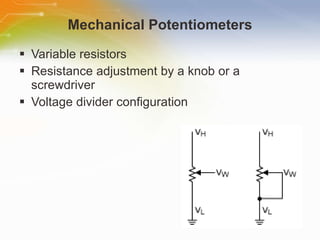
Mechanical Potentiometers Variable resistors Resistance adjustment by a knob or a screwdriver Voltage divider configuration
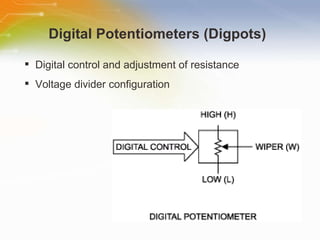
Digital Potentiometers (Digpots) Digital control and adjustment of resistance Voltage divider configuration
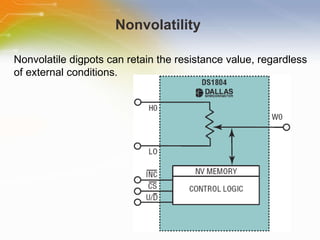
Nonvolatility  Nonvolatile digpots can retain the resistance value, regardless of external conditions.
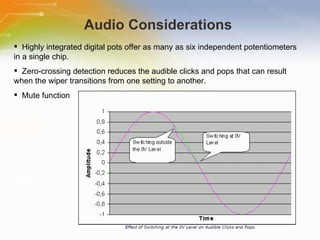
Audio Considerations  Highly integrated digital pots offer as many as six independent potentiometers in a single chip. Zero-crossing detection reduces the audible clicks and pops that can result when the wiper transitions from one setting to another. Mute function
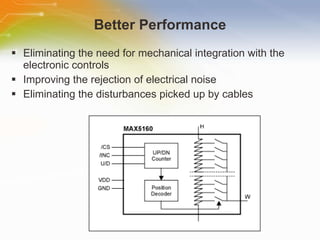
Better Performance Eliminating the need for mechanical integration with the electronic controls Improving the rejection of electrical noise Eliminating the disturbances picked up by cables
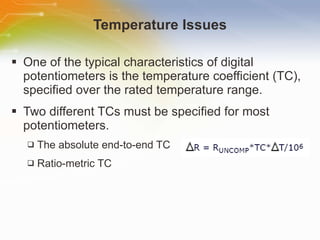
Temperature Issues One of the typical characteristics of digital potentiometers is the temperature coefficient (TC), specified over the rated temperature range. Two different TCs must be specified for most potentiometers. The absolute end-to-end TC Ratio-metric TC
High-Resolution Applications An op amp and a digpot (the lower IC) together implement a precision, programmable gain amplifier (PGA).
Advantages of Digital Potentiometers More reliable than mechanical pots Space saving Much more writing cycles than the mechanical parts Wide range of resolution Insensitive to hash environment Available in volatile and nonvolatile types
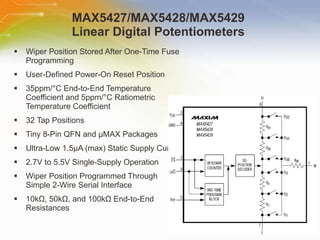
MAX5427/MAX5428/MAX5429  Linear Digital Potentiometers  Wiper Position Stored After One-Time Fuse Programming  User-Defined Power-On Reset Position  35ppm/°C End-to-End Temperature Coefficient and 5ppm/°C Ratiometric Temperature Coefficient  32 Tap Positions  Tiny 8-Pin QFN and µMAX Packages  Ultra-Low 1.5µA (max) Static Supply Current  2.7V to 5.5V Single-Supply Operation  Wiper Position Programmed Through Simple 2-Wire Serial Interface  10kΩ, 50kΩ, and 100kΩ End-to-End Resistances
Additional Resource For ordering the Maxim Digital Potentiometers, please click the part list or call our sales hotline For additional inquires contact our technical service Hotline For more product information go to http://www.maxim-ic.com/products/digi_pot/   Newark Farnell

Digital Potentiometers Replace Mechanical Potentiometers

  • 1.
    Digital Potentiometers ReplaceMechanical Potentiometers Source: Maxim
  • 2.
    Introduction Purpose Thismodule discusses the advantages of digital potentiometers comparing with mechanical potentiometers. Objectives Describe the advantages of digital potentiometers over mechanical potentiometers Introduce Maxim MAX5427/MAX5428/MAX5429 family of digital pots Content 11 pages Duration 10 minutes
  • 3.
    Mechanical Potentiometers Variableresistors Resistance adjustment by a knob or a screwdriver Voltage divider configuration
  • 4.
    Digital Potentiometers (Digpots)Digital control and adjustment of resistance Voltage divider configuration
  • 5.
    Nonvolatility Nonvolatiledigpots can retain the resistance value, regardless of external conditions.
  • 6.
    Audio Considerations Highly integrated digital pots offer as many as six independent potentiometers in a single chip. Zero-crossing detection reduces the audible clicks and pops that can result when the wiper transitions from one setting to another. Mute function
  • 7.
    Better Performance Eliminatingthe need for mechanical integration with the electronic controls Improving the rejection of electrical noise Eliminating the disturbances picked up by cables
  • 8.
    Temperature Issues Oneof the typical characteristics of digital potentiometers is the temperature coefficient (TC), specified over the rated temperature range. Two different TCs must be specified for most potentiometers. The absolute end-to-end TC Ratio-metric TC
  • 9.
    High-Resolution Applications Anop amp and a digpot (the lower IC) together implement a precision, programmable gain amplifier (PGA).
  • 10.
    Advantages of DigitalPotentiometers More reliable than mechanical pots Space saving Much more writing cycles than the mechanical parts Wide range of resolution Insensitive to hash environment Available in volatile and nonvolatile types
  • 11.
    MAX5427/MAX5428/MAX5429 LinearDigital Potentiometers Wiper Position Stored After One-Time Fuse Programming User-Defined Power-On Reset Position 35ppm/°C End-to-End Temperature Coefficient and 5ppm/°C Ratiometric Temperature Coefficient 32 Tap Positions Tiny 8-Pin QFN and µMAX Packages Ultra-Low 1.5µA (max) Static Supply Current 2.7V to 5.5V Single-Supply Operation Wiper Position Programmed Through Simple 2-Wire Serial Interface 10kΩ, 50kΩ, and 100kΩ End-to-End Resistances
  • 12.
    Additional Resource Forordering the Maxim Digital Potentiometers, please click the part list or call our sales hotline For additional inquires contact our technical service Hotline For more product information go to http://www.maxim-ic.com/products/digi_pot/ Newark Farnell

Editor's Notes

  • #2 Welcome to this module on Digital Potentiometers. In this module we will discuss the advantages of Digital Potentiometers comparing with the Conventional Mechanical Potentiometers. It contains 10 Pages and will take approximately 10 minutes to finish.
  • #3 Welcome to this module on Digital Potentiometers. In this module we will discuss the advantages of Digital Potentiometers comparing with the Conventional Mechanical Potentiometers. It contains 10 Pages and will take approximately 10 minutes to finish.
  • #4 The mechanical potentiometers are also called resistor potentiometers or timmer potentiometers, which are still available in a wide range applications. The adjustment of wiper of a mechanical potentiometer is manually by a knob or a screwdriver. Typically, they are used in a voltage divider configuration for different types of task, such as gain adjust.
  • #5 Digital potentiometers, or digpots, exhibit the same fundamental operation as the mechanical parts with only one exception. The wiper position is digitally adjusted. Digpots produce an analog output in the form of a variable resistance. They use digital input signals to set an analog output. A digpot usually has three analog connections: the high connection, the wiper (or analog output), and a low connection. However, it can also be configured as a two-terminal variable resistor by connecting the wiper to either the high or low end, or by floating either the high or low end.
  • #6 For certain applications, the digital pot requires a nonvolatile memory function. A nonvolatile digital pot is most similar to its mechanical counterpart because it retains the resistance value, regardless of external conditions such as whether or not the supply voltage is present. Digital pots with nonvolatile memory are widely used in audio equipment because the internal stored value guarantees the same resistor settings always after power up, even if the power supply was completely switched off.
  • #7 Logarithmic potentiometers are often used to adjust volume in hi-fi audio, because each step of a logarithmic pot creates a linear change of volume for the nonlinear human ear. Today’s highly integrated digital pots offer as many as six independent potentiometers in a single chip, which can support the many audio applications that require multiple channels, such as stereo and Dolby-surround systems. If a wiper does not switch exactly at 0V, the audio can include annoying clicks and pops. Fortunately, certain recent-generation digital pots include a feature called zero-crossing detection, which reduces the audible noise generated during wiper transitions. Sometimes the device includes a mute function, which further attenuates the signal by a significant amount
  • #8 Digital pots have yet another performance advantage over mechanical potentiometers. Digitally adjustable pots can now be mounted on the circuit board directly in the signal path, thereby eliminating the need for complex and expensive mechanical integration with the electronic controls. Digital pots improve the rejection of electrical noise, and they eliminate the disturbances picked up by the cables required to interface a mechanical potentiometer.
  • #9 One of the typical characteristics of digital potentiometers is the temperature coefficient (TC), specified over the rated temperature range. First, the absolute end-to-end TC is a large value indicating the absolute variation of resistance with temperature, and is calculated as the equation listed here, where R UNCOMP is the uncompensated resistance value, TC is the temperature coefficient, and ∆T is the temperature variation. The second type of TC is a ratio-metric TC. Potentiometers are typically used as voltage dividers, especially in ratio-metric applications for which the absolute resistance value is far less critical than the absolute TC and the variation between steps. A ratio-metric TC of only 5ppm, for example, would allow a very stable configuration for adjustable gain over temperature.
  • #10 The digital potentiometer found in programmable gain amplifiers and instrumentation amplifiers require much higher accuracies than do those used in standard adjustable circuits. Divider-ratio tolerances (accuracies) as low as 0.025% over the -40 ℃ to +85 ℃ range are often needed for these applications.
  • #11 Digital potentiometers have many significant advantages over mechanical potentiometers. Digital potentiometers are far more reliable than mechanical potentiometers. Digital pots can easily guarantee 50,000 writing cycles, while the mechanical parts rate only a few thousand, and sometimes only a few hundred. Digital pots are insensitive to dust, dirt, and moisture, which can kill a mechanical part if they intrude. They use less space and have better electrical performance because of the reduced parasitics and lower susceptibility to noise. Digital pots can replace mechanical types in virtually every application, thus allowing the designer and the eventual user to enjoy the associated benefits.
  • #12 The MAX5427/MAX5428/MAX5429 linear-taper digital potentiometers function as mechanical potentiometers, but replace the mechanics with a simple 2-wire digital interface. These digital potentiometers are unique in that they have an optional one-time programmable feature that either sets the wiper's power-on reset (POR) position to a user-defined value, or the wiper can be set and the interface disabled to prevent further adjustment.
  • #13 Thank you for taking the time to view this presentation on Maxim Digital Potentiometers . If you would like to learn more or go on to purchase some of these devices, you can either click on the link embedded in this presentation, or simple call our sales hotline. For more technical information you can either visit the Maxim site – link shown – or if you would prefer to speak to someone live, please call our hotline number shown, or even use our ‘live chat’ online facility.