




DIGITAL MARKETING
Presented by:
Betsy Chase
Guest Lecturer
Who am I?
 Ten years working in online marketing
— Director of Marketing
— Marketing Consultant
— Web Analytics Manager
— Affiliate Program Manager
 Companies I’ve worked for or with:
— Walmart.com, Hanes, Thrifty Rent-A-Car, Rodale Publishing, H&R
Block, DexKnows.com, Gaiam and several small startups
 Masters of Science in Integrated Marketing Communications
from Northwestern University
AND YOU ARE….?
Agenda
 Integrated Marketing Communications
 Digital Marketing
 Digital Channels
— Websites
— Search Engine Optimization
— Search Engine Marketing
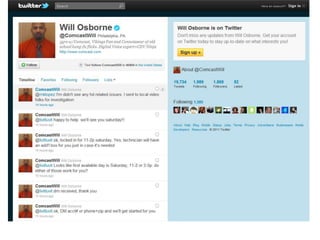
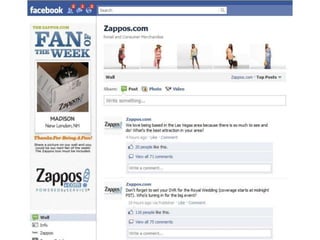
— Social Media
— Email
— Affiliates
 Group project
 Integrated Digital Marketing Case study
INTEGRATED MARKETING
What is Integrated Marketing?
Integrated Marketing is…
 “Mixing and matching marketing activities to maximize their
individual and collective efforts.” – Kotler& Keller
 “A planning process designed to assure that all brand contacts
received by a customer or prospect for a product, service, or
organization are relevant to that person and consistent over
time.” – American Marketing Association
 “A single brand message across all your marketing channels” -
American Marketing Association
 “A data-driven, customer-centric approach to developing
marketing strategy” – Don Schultz, founder of the Northwestern
IMC program
Which is it?
Why is an Integrated Approach Important?
 Multiple customer touch points
— Consumers interact with your brand more than once before they buy
 An abundance of media channels
— Cut through the clutter
— Fish where the fish are
 Your brand is in your customer’s hands
— Reinforce your message
 Data is easier to access than ever before
— Segment your audience, target the message so it’s relevant
WHAT IS DIGITAL
MARKETING?
Is it….
 Channel
 Strategy
 Platform
 Segment
Why is Digital Important?
 Highly measurable
 Customizable
 Lower cost to execute/acquire customers (in many cases)
 Allows for fast iterations
 Supports complexity
 Platform for creativity
 Produces interaction and engagement
DIGITAL CHANNELS
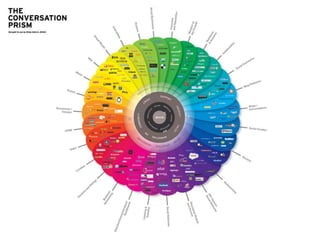
“Markets Are Conversations”
The Cluetrain Manifesto
By Rick Levine, Christopher Locke, Doc Searls&
David Weinberger
WEBSITES
Why Do You Need a Website?
 Table stakes
 Customer touch point
 Lead generation
 Demand generation
 24/7 Commerce opportunity
 Branding
 Customer service
 Information channel
 Fish where the fish are
 Customers expect it
What Makes a Good Website
 Focused on the segment you want to attract
 Clear messaging and call to action
 Easy navigation
 Speed
 Functionality
 Design
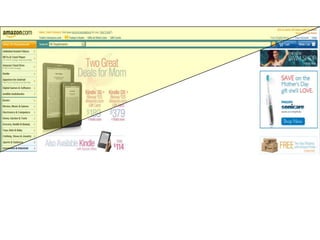
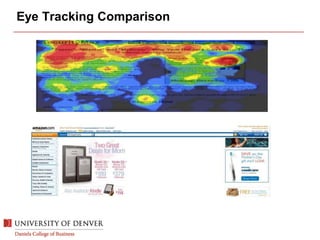
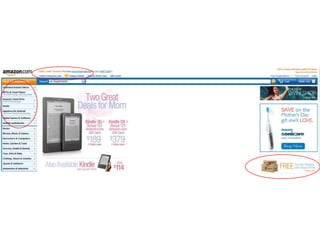
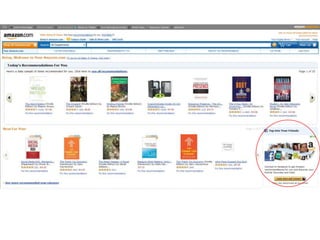
Page Design Matters
Eye Tracking Comparison
SEARCH ENGINE
OPTIMIZATION
Search Engine Optimization
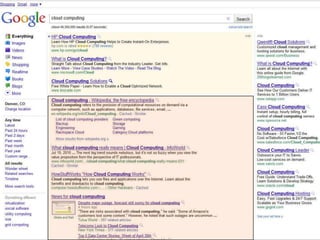
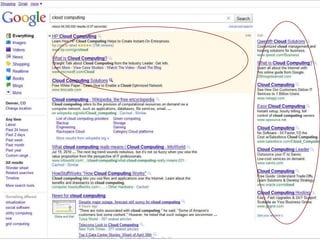
 Search Engine Optimization (SEO) aims to get a site
near the top of the organic (or algorithmic) results of
search engines
 It is also frequently referred to as Natural Search
Optimization (NSO)
Matt Cutts – Google SEO Evangelist
http://www.youtube.com/watch?v=5GK0aQrCDEo
www.mattcutts.com/blog/
Factors impacting SEO
Algorithm looks for pages with high “Authority”
 Tagging
— Meta tags (title and description, not keywords)
— Keyword density within content
— Alt text
 Link popularity
 Site and page architecture
 URL construct
 Inbound Social links
 Site speed
 Duplicate content
 High quality original content
Advantages & Disadvantages of SEO
 Advantages
— Cost effective (especially if done in-house)
— Most content management systems allow for easy
additions/changes
— More cost control
— Better opportunities to deliver your marketing message
— Lots of tools available
 Disadvantages
— Results take time to see
— Natural search algorithms are black box
— Site architecture plays a big role
— Demand must exist
SEARCH ENGINE MARKETING
SEM Basic Concept
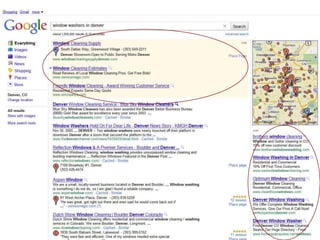
 Advertiser selects a specific word or phrase
(keyword) on which to bid
 Advertiser creates an ad title and description and
enters a maximum bid amount for clicks on that ad
 When a user enters the specific word or phrase into
the search engine, ad appears
 Advertiser is charged only when a user clicks on the
ad
Search Engine Share
Advantages& Disadvantages of SEM
 Advantages
— Ability to target by location
— Some control over match type
 Broad, exact, negative
— Manage marketing spend to a daily budget
— Control your bids based on day of the week and time of day
— Search engines offer tools to help you create, track, measure and
optimize campaigns
 Disadvantages
— Search engine algorithms are top secret, so you never have total
control
— Pay to play, minimum bids can be high
— Demand must exist
SOCIAL MEDIA
What Makes it Social?
Types of Social Media
 Crowd sourcing (Groupon, LivingSocial, Trada)
 Video (YouTube, Vimeo, Boxee)
 Blogs (Blogger, Wordpress, Typepad, Tumblr)
 Photos (Flckr, Shutterfly, Picasa)
 Gaming (Raptr, GamerDNA, UGAME)
 Social Networks (Facebook, LinkedIn, Bebo, Orkut)
 Ratings &Reviews (Yelp, UrbanSpoon)
 Location based (FourSquare, Gowalla)
Advantages & Disadvantages of Social Media
 Advantages
— Great opportunity to engage with customers 1-1 or 1-few
— Outlet to resolve customer service issues
— Flexible platforms for consumers to engage with your brand
— Good customer retention tool
— Enables category creation/product input/new products
 Disadvantages
— Shiny Object Syndrome
— Difficult to scale
— Difficult to track ROAS and therefore it’s impact to bottom line
EMAIL MARKETING
Email
 Email is not dead…
 Forrester Research recently reported that spending on email
marketing in the United States is expected to expand to $2 billion
by 2014; this is an annual compound growth rate of nearly 11%.
 MarketingSherpa survey: email is one of only two tactics where
more marketers increased budgets than decreased budgets in
2009. The other was social media.
 Highest ROI of digital channels
— Averages $40/$1 or higher (Direct Marketing Association)
45
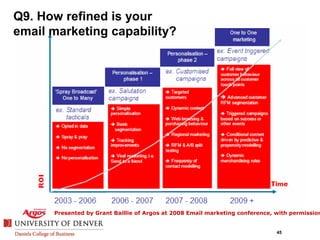
Presented by Grant Baillie of Argos at 2008 Email marketing conference, with permission
Q9. How refined is your
email marketing capability?
Advantages & Disadvantages of Email
Advantages:
 Highly customizable
 Ability to target
 Ability to track metrics and show value
 Easy/fast to test
 Comparatively low cost to execute
Disadvantages:
 Building a list takes time
 Must adhere to CAN SPAM legislation
 Requires commitment of resources
 Easy for consumers to ignore
AFFILIATE MARKETING
Affiliate Marketing
 Similar to partnership marketing – a merchant pays an affiliate to sell
their products
— Revenue share
— Bounty
 Affiliate = website
— Focus on driving traffic to their site(s)
 Opt-in email, keyword buys or search engine optimization, social media
— May build multiple sites based on different verticals
 Affiliate networks are companies that provide a technology platform
that allows merchants and affiliates to connect
 The network makes money on licensing fees, up selling services and
takes a cut of the commission
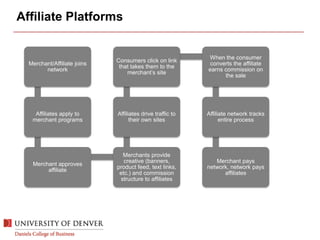
Affiliate Platforms
Merchant/Affiliate joins
network
Affiliates apply to
merchant programs
Merchant approves
affiliate
Merchants provide
creative (banners,
product feed, text links,
etc.) and commission
structure to affiliates
Affiliates drive traffic to
their own sites
Consumers click on link
that takes them to the
merchant’s site
When the consumer
converts the affiliate
earns commission on
the sale
Affiliate network tracks
entire process
Merchant pays
network, network pays
affiliates
Advantages of Affiliate Marketing
 For Merchants:
— Use other people’s website traffic to sell your products
— If you go with a network you can get broad distribution and some of
the work is taken off your hands
— Ability to manage to a budget
 For Affiliates:
— Great opportunity to monetize your website
— Networks offer easy access to merchants &trackability
— Access to new creative to refresh your site
— Strong affiliate community – lots of support
— Excellent home-based business model
Disadvantages of Affiliate Marketing
 For Merchants:
— Loss of brand control
— Large affiliates may dictate terms
— Need resources to manage it
 For Affiliates:
— If you go through a network you may make less
— Merchants terms may limit your ability to market their products
 Commission structure might not be enough to support the way they
drive traffic
 Merchants’ agreement may limit the channels they want to use to market
products
DISPLAY ADVERTISING
Uses of Display Advertising
 New product introductions
 Category creation
 Brand building
 Sales promotion
 Lead generation
 Retargeting
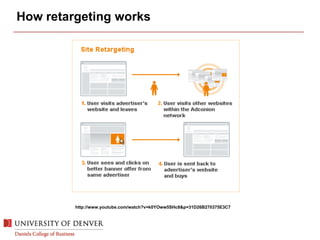
How retargeting works
http://www.youtube.com/watch?v=k0YOww5SHc8&p=31D26B270375E3C7
Advantages & Disadvantages of Display
 Advantages
— Target based on location, demographics, behavior
— Build brand awareness
— Retargeting opportunities
— Trackable
— Some types are very cost effective
 Disadvantages
— Low conversion rates on regular display
— Need to keep refreshing creative inventory
— Difficult to determine contribution to conversion
GROUP PROJECT
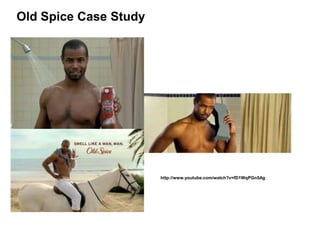
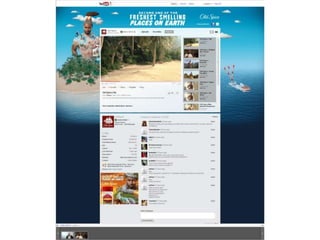
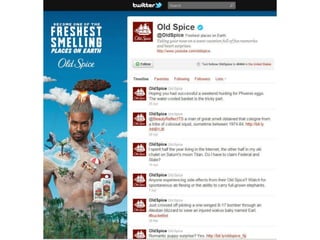
Old Spice Case Study
http://www.youtube.com/watch?v=fD1WqPGn5Ag
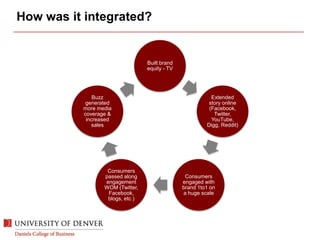
How was it integrated?
Built brand
equity - TV
Extended
story online
(Facebook,
Twitter,
YouTube,
Digg, Reddit)
Consumers
engaged with
brand 1to1 on
a huge scale
Consumers
passed along
engagement
WOM (Twitter,
Facebook,
blogs, etc.)
Buzz
generated
more media
coverage &
increased
sales
Old Spice campaign results
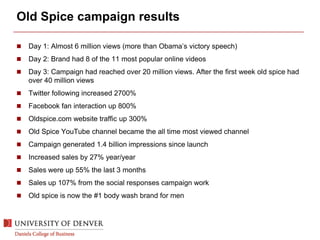
 Day 1: Almost 6 million views (more than Obama’s victory speech)
 Day 2: Brand had 8 of the 11 most popular online videos
 Day 3: Campaign had reached over 20 million views. After the first week old spice had
over 40 million views
 Twitter following increased 2700%
 Facebook fan interaction up 800%
 Oldspice.com website traffic up 300%
 Old Spice YouTube channel became the all time most viewed channel
 Campaign generated 1.4 billion impressions since launch
 Increased sales by 27% year/year
 Sales were up 55% the last 3 months
 Sales up 107% from the social responses campaign work
 Old spice is now the #1 body wash brand for men
Then What Happened?
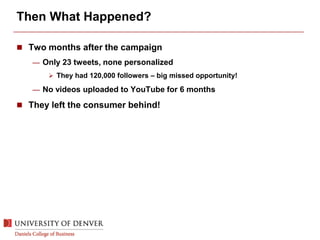
 Two months after the campaign
— Only 23 tweets, none personalized
 They had 120,000 followers – big missed opportunity!
— No videos uploaded to YouTube for 6 months
 They left the consumer behind!
He’s Back
http://www.youtube.com/watch?v=qt6iEGzLPjg
THANK YOU
@BetsyChase
Betsy.chase@gmail.com
http://linkedin.com/in/betsyrchase
APPENDIX
Email
 CAN-SPAM
— Passed in 2003, established first national standard for the commercial
use of email and is enforced by the FTC.
— Regulates compliance to standards around unsubscribe functionality,
content and the way emails are sent.
What is the impact to business?
— All email marketing must be permission based
— Email service providers take an active role enforcing compliance
 Merchant must be able to document the date and time a consumer opted-in,
and the IP address for the machine they used to do it.
Affiliate Tax Law
 Also known as “Amazon Tax”
 State governments faced with huge budget deficits enact law
that requires large online retailers to either collect sales tax for
online transactions or provide a summary of people’s online
purchases
 Went into effect in Colorado in March of 2010
 Amazon immediately terminated all affiliates in the state of
Colorado and followed suit with subsequent states who passed
the law
 Should they have done it?

Digital Marketing - Daniels Executive MBA

  • 1.
  • 2.
    Who am I? Ten years working in online marketing — Director of Marketing — Marketing Consultant — Web Analytics Manager — Affiliate Program Manager  Companies I’ve worked for or with: — Walmart.com, Hanes, Thrifty Rent-A-Car, Rodale Publishing, H&R Block, DexKnows.com, Gaiam and several small startups  Masters of Science in Integrated Marketing Communications from Northwestern University
  • 4.
  • 5.
    Agenda  Integrated MarketingCommunications  Digital Marketing  Digital Channels — Websites — Search Engine Optimization — Search Engine Marketing — Social Media — Email — Affiliates  Group project  Integrated Digital Marketing Case study
  • 6.
  • 7.
  • 8.
    Integrated Marketing is… “Mixing and matching marketing activities to maximize their individual and collective efforts.” – Kotler& Keller  “A planning process designed to assure that all brand contacts received by a customer or prospect for a product, service, or organization are relevant to that person and consistent over time.” – American Marketing Association  “A single brand message across all your marketing channels” - American Marketing Association  “A data-driven, customer-centric approach to developing marketing strategy” – Don Schultz, founder of the Northwestern IMC program Which is it?
  • 9.
    Why is anIntegrated Approach Important?  Multiple customer touch points — Consumers interact with your brand more than once before they buy  An abundance of media channels — Cut through the clutter — Fish where the fish are  Your brand is in your customer’s hands — Reinforce your message  Data is easier to access than ever before — Segment your audience, target the message so it’s relevant
  • 10.
  • 11.
    Is it….  Channel Strategy  Platform  Segment
  • 12.
    Why is DigitalImportant?  Highly measurable  Customizable  Lower cost to execute/acquire customers (in many cases)  Allows for fast iterations  Supports complexity  Platform for creativity  Produces interaction and engagement
  • 13.
  • 14.
    “Markets Are Conversations” TheCluetrain Manifesto By Rick Levine, Christopher Locke, Doc Searls& David Weinberger
  • 16.
  • 17.
    Why Do YouNeed a Website?  Table stakes  Customer touch point  Lead generation  Demand generation  24/7 Commerce opportunity  Branding  Customer service  Information channel  Fish where the fish are  Customers expect it
  • 18.
    What Makes aGood Website  Focused on the segment you want to attract  Clear messaging and call to action  Easy navigation  Speed  Functionality  Design
  • 19.
  • 21.
  • 24.
  • 25.
    Search Engine Optimization Search Engine Optimization (SEO) aims to get a site near the top of the organic (or algorithmic) results of search engines  It is also frequently referred to as Natural Search Optimization (NSO)
  • 27.
    Matt Cutts –Google SEO Evangelist http://www.youtube.com/watch?v=5GK0aQrCDEo www.mattcutts.com/blog/
  • 28.
    Factors impacting SEO Algorithmlooks for pages with high “Authority”  Tagging — Meta tags (title and description, not keywords) — Keyword density within content — Alt text  Link popularity  Site and page architecture  URL construct  Inbound Social links  Site speed  Duplicate content  High quality original content
  • 29.
    Advantages & Disadvantagesof SEO  Advantages — Cost effective (especially if done in-house) — Most content management systems allow for easy additions/changes — More cost control — Better opportunities to deliver your marketing message — Lots of tools available  Disadvantages — Results take time to see — Natural search algorithms are black box — Site architecture plays a big role — Demand must exist
  • 30.
  • 31.
    SEM Basic Concept Advertiser selects a specific word or phrase (keyword) on which to bid  Advertiser creates an ad title and description and enters a maximum bid amount for clicks on that ad  When a user enters the specific word or phrase into the search engine, ad appears  Advertiser is charged only when a user clicks on the ad
  • 34.
  • 35.
    Advantages& Disadvantages ofSEM  Advantages — Ability to target by location — Some control over match type  Broad, exact, negative — Manage marketing spend to a daily budget — Control your bids based on day of the week and time of day — Search engines offer tools to help you create, track, measure and optimize campaigns  Disadvantages — Search engine algorithms are top secret, so you never have total control — Pay to play, minimum bids can be high — Demand must exist
  • 36.
  • 37.
  • 38.
    Types of SocialMedia  Crowd sourcing (Groupon, LivingSocial, Trada)  Video (YouTube, Vimeo, Boxee)  Blogs (Blogger, Wordpress, Typepad, Tumblr)  Photos (Flckr, Shutterfly, Picasa)  Gaming (Raptr, GamerDNA, UGAME)  Social Networks (Facebook, LinkedIn, Bebo, Orkut)  Ratings &Reviews (Yelp, UrbanSpoon)  Location based (FourSquare, Gowalla)
  • 42.
    Advantages & Disadvantagesof Social Media  Advantages — Great opportunity to engage with customers 1-1 or 1-few — Outlet to resolve customer service issues — Flexible platforms for consumers to engage with your brand — Good customer retention tool — Enables category creation/product input/new products  Disadvantages — Shiny Object Syndrome — Difficult to scale — Difficult to track ROAS and therefore it’s impact to bottom line
  • 43.
  • 44.
    Email  Email isnot dead…  Forrester Research recently reported that spending on email marketing in the United States is expected to expand to $2 billion by 2014; this is an annual compound growth rate of nearly 11%.  MarketingSherpa survey: email is one of only two tactics where more marketers increased budgets than decreased budgets in 2009. The other was social media.  Highest ROI of digital channels — Averages $40/$1 or higher (Direct Marketing Association)
  • 45.
    45 Presented by GrantBaillie of Argos at 2008 Email marketing conference, with permission Q9. How refined is your email marketing capability?
  • 46.
    Advantages & Disadvantagesof Email Advantages:  Highly customizable  Ability to target  Ability to track metrics and show value  Easy/fast to test  Comparatively low cost to execute Disadvantages:  Building a list takes time  Must adhere to CAN SPAM legislation  Requires commitment of resources  Easy for consumers to ignore
  • 47.
  • 48.
    Affiliate Marketing  Similarto partnership marketing – a merchant pays an affiliate to sell their products — Revenue share — Bounty  Affiliate = website — Focus on driving traffic to their site(s)  Opt-in email, keyword buys or search engine optimization, social media — May build multiple sites based on different verticals  Affiliate networks are companies that provide a technology platform that allows merchants and affiliates to connect  The network makes money on licensing fees, up selling services and takes a cut of the commission
  • 49.
    Affiliate Platforms Merchant/Affiliate joins network Affiliatesapply to merchant programs Merchant approves affiliate Merchants provide creative (banners, product feed, text links, etc.) and commission structure to affiliates Affiliates drive traffic to their own sites Consumers click on link that takes them to the merchant’s site When the consumer converts the affiliate earns commission on the sale Affiliate network tracks entire process Merchant pays network, network pays affiliates
  • 50.
    Advantages of AffiliateMarketing  For Merchants: — Use other people’s website traffic to sell your products — If you go with a network you can get broad distribution and some of the work is taken off your hands — Ability to manage to a budget  For Affiliates: — Great opportunity to monetize your website — Networks offer easy access to merchants &trackability — Access to new creative to refresh your site — Strong affiliate community – lots of support — Excellent home-based business model
  • 51.
    Disadvantages of AffiliateMarketing  For Merchants: — Loss of brand control — Large affiliates may dictate terms — Need resources to manage it  For Affiliates: — If you go through a network you may make less — Merchants terms may limit your ability to market their products  Commission structure might not be enough to support the way they drive traffic  Merchants’ agreement may limit the channels they want to use to market products
  • 52.
  • 53.
    Uses of DisplayAdvertising  New product introductions  Category creation  Brand building  Sales promotion  Lead generation  Retargeting
  • 54.
  • 55.
    Advantages & Disadvantagesof Display  Advantages — Target based on location, demographics, behavior — Build brand awareness — Retargeting opportunities — Trackable — Some types are very cost effective  Disadvantages — Low conversion rates on regular display — Need to keep refreshing creative inventory — Difficult to determine contribution to conversion
  • 56.
  • 57.
    Old Spice CaseStudy http://www.youtube.com/watch?v=fD1WqPGn5Ag
  • 60.
    How was itintegrated? Built brand equity - TV Extended story online (Facebook, Twitter, YouTube, Digg, Reddit) Consumers engaged with brand 1to1 on a huge scale Consumers passed along engagement WOM (Twitter, Facebook, blogs, etc.) Buzz generated more media coverage & increased sales
  • 61.
    Old Spice campaignresults  Day 1: Almost 6 million views (more than Obama’s victory speech)  Day 2: Brand had 8 of the 11 most popular online videos  Day 3: Campaign had reached over 20 million views. After the first week old spice had over 40 million views  Twitter following increased 2700%  Facebook fan interaction up 800%  Oldspice.com website traffic up 300%  Old Spice YouTube channel became the all time most viewed channel  Campaign generated 1.4 billion impressions since launch  Increased sales by 27% year/year  Sales were up 55% the last 3 months  Sales up 107% from the social responses campaign work  Old spice is now the #1 body wash brand for men
  • 62.
    Then What Happened? Two months after the campaign — Only 23 tweets, none personalized  They had 120,000 followers – big missed opportunity! — No videos uploaded to YouTube for 6 months  They left the consumer behind!
  • 63.
  • 64.
  • 65.
  • 66.
    Email  CAN-SPAM — Passedin 2003, established first national standard for the commercial use of email and is enforced by the FTC. — Regulates compliance to standards around unsubscribe functionality, content and the way emails are sent. What is the impact to business? — All email marketing must be permission based — Email service providers take an active role enforcing compliance  Merchant must be able to document the date and time a consumer opted-in, and the IP address for the machine they used to do it.
  • 67.
    Affiliate Tax Law Also known as “Amazon Tax”  State governments faced with huge budget deficits enact law that requires large online retailers to either collect sales tax for online transactions or provide a summary of people’s online purchases  Went into effect in Colorado in March of 2010  Amazon immediately terminated all affiliates in the state of Colorado and followed suit with subsequent states who passed the law  Should they have done it?