IT Careers for
  the Future
IT Future is Bright

     Nearly every business uses business systems – and
      that need is expanding

     All large corporations rely heavily on IT

     Businesses need business systems and people to
      design, develop and manage them

     Becoming more fundamental to many careers

     Very broad in scope and applicability
Demand is higher than supply
   The college “pipeline” is a trickle
   Baby boomers are retiring
   Businesses need HELP!
   Salaries are rising
   Promotions are becoming more frequent
   Companies need both Administrative &
    Technical support:
    –   People who understand how business and systems interact
    –   People who understand how to develop business programs
        and systems
IT Trends
    Shared services

    Enterprise Resource Planning (ERP)
      – Integrate business functionalities, including
        Finance / Accounting, Sales / Marketing, HR /
        Payroll, Purchasing, Manufacturing, etc.

    E-business (e.g., Amazon, online checking)

    Automation of business processes (e.g., direct
     deposit, workflow)
IT Trends
    Security and bio-technologies (e.g., retinal scans,
     fingerprint authentication)

    Emergency management (e.g., disaster planning)

    Wireless initiatives
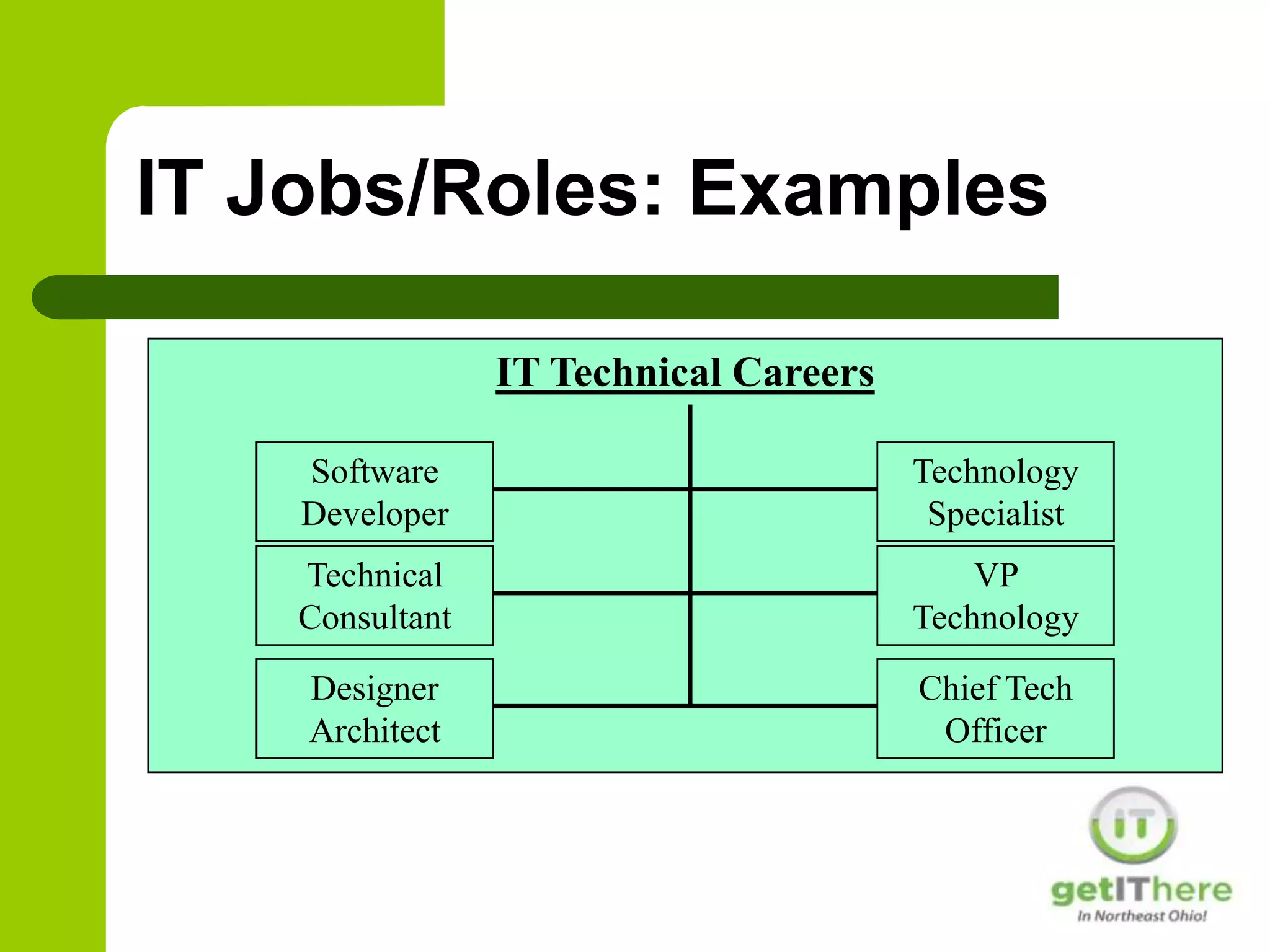
IT Jobs/Roles: Examples

                 IT Technical Careers

    Software                            Technology
    Developer                            Specialist
    Technical                               VP
    Consultant                          Technology

    Designer                            Chief Tech
    Architect                            Officer
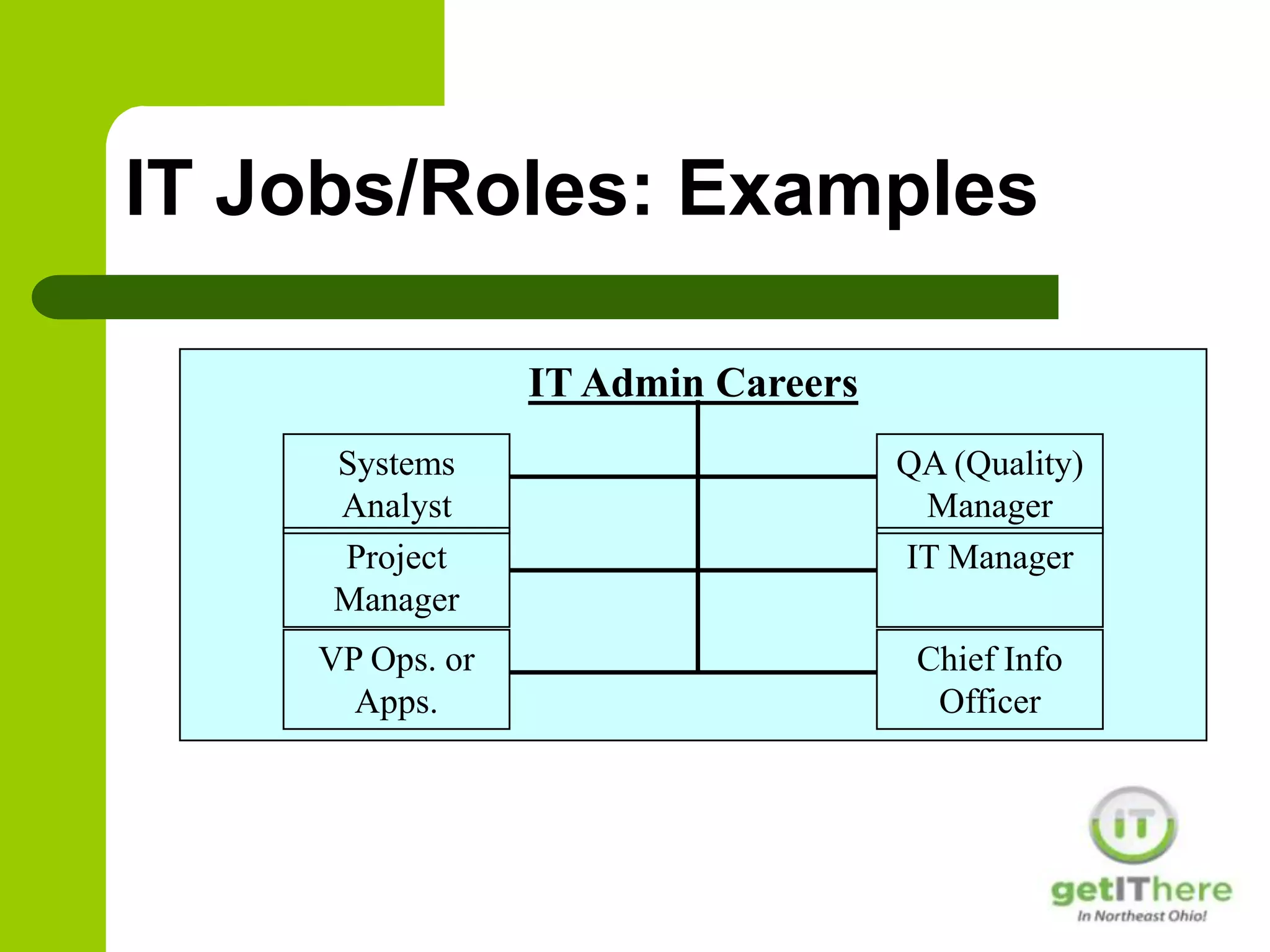
IT Jobs/Roles: Examples

                 IT Admin Careers
     Systems                        QA (Quality)
     Analyst                         Manager
     Project                        IT Manager
     Manager
    VP Ops. or                       Chief Info
      Apps.                           Officer
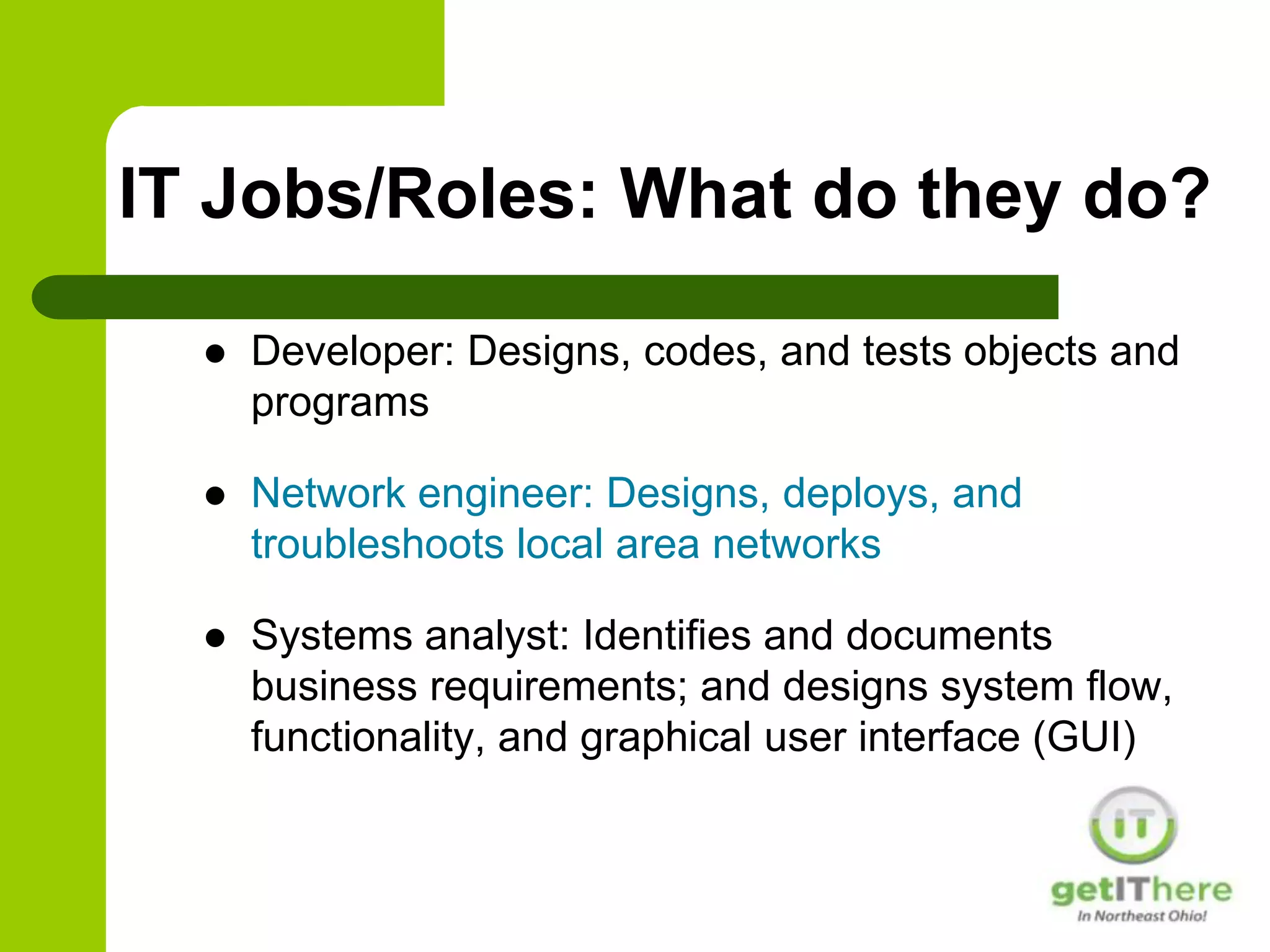
IT Jobs/Roles: What do they do?

     Developer: Designs, codes, and tests objects and
      programs

     Network engineer: Designs, deploys, and
      troubleshoots local area networks

     Systems analyst: Identifies and documents
      business requirements; and designs system flow,
      functionality, and graphical user interface (GUI)
IT Skills
“If you have these skills and traits, I.T. may be for you”


                 Skill & Trait                           Corporate / IT Value
    Problem-solvers                  Tech support to project hurdles
    Analytical / Abstract Thinkers   Business process re-engineering

    Leadership                       Guide others through adversity; Lead projects, teams,
                                     departments, divisions
    Planning & Vision                Prioritize & fund projects
    Practical / Pragmatic            Support things that help business; Ensure match between IT
                                     and business needs
    Goal-oriented / Focused          Manage complex projects
    Innovative                       Create, learn & apply new technologies
    Self-motivated / Ambitious       Hungry to learn new things
    Ability to Communicate           Clarify requirements / expectations
    Team player                      Work with teams of specialists
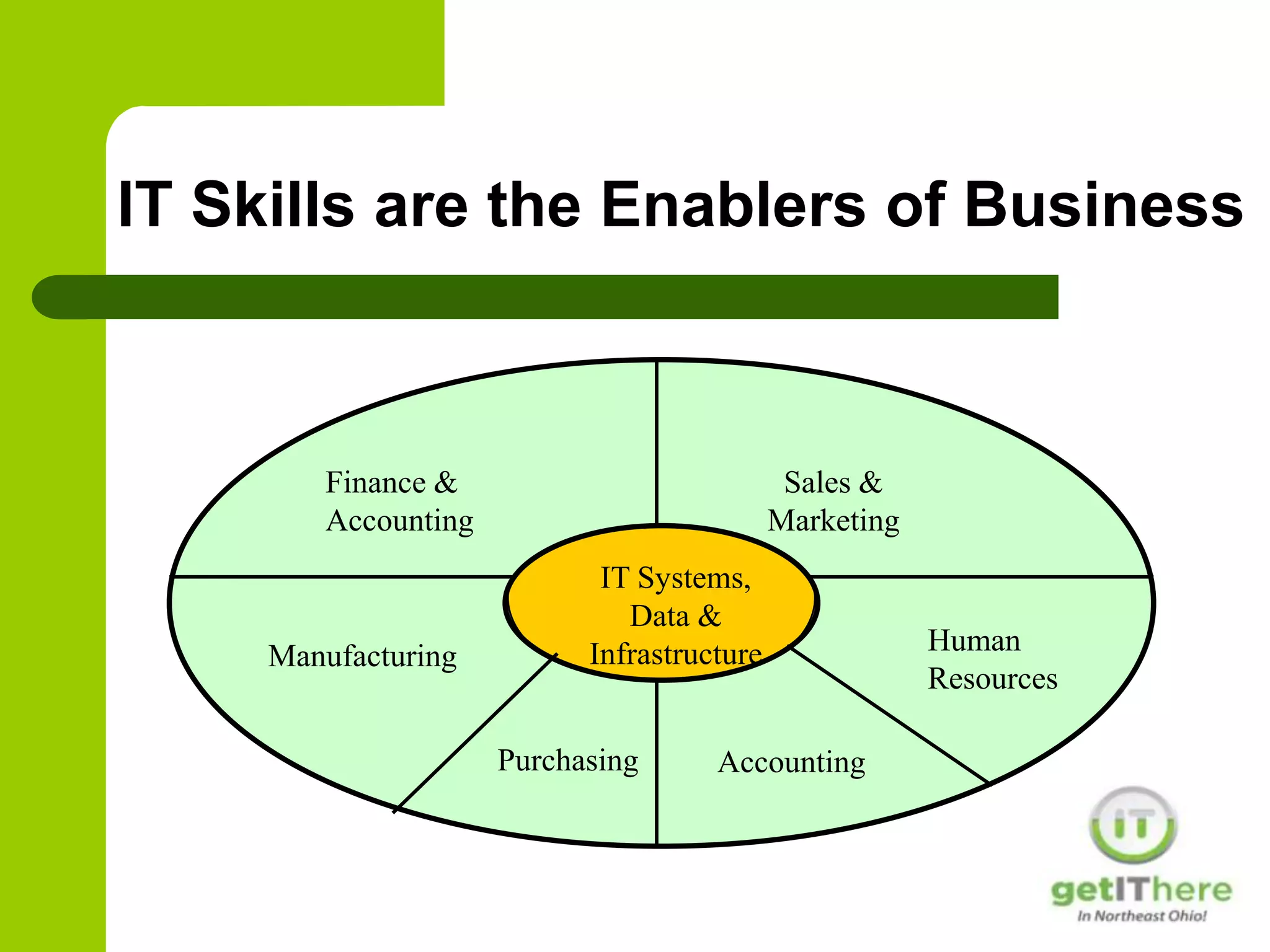
IT Skills are the Enablers of Business


        Finance &                            Sales &
        Accounting                          Marketing
                            IT Systems,
                              Data &
     Manufacturing         Infrastructure               Human
                                                        Resources

                     Purchasing      Accounting
IT Future: Video

 Did You Know?
       (Shift Happens)
    The world is growing and changing

    Information is doubling

    Many jobs, technologies, and problems don’t
     exist yet
Myths 1 and 2

          1. There are no IT jobs

          2. IT-Related Educational
          Degrees Are Worth Less
Reality: IT jobs are HOT!
                               Percent      Median
                               Growth     Salary (May   1.      Two of the top 15 fastest
Job Type                      2008-2018      2008)              growing occupation
Biomedical engineers            72%        $77,400
Network systems & data
                                                                categories in the United
communications analysts          53         71,100              States are IT-related, with
Home health aides                50         20,460
Personal and home care
                                                                Bachelor’s degrees
aides                            46         19,180
Financial examiners              41         70,930      2.      IT salaries are relatively
Medical scientists, except
epidemiologists                  40         72,590              high
Physician assistants             39         81,230      Source: BLS Occupational Handbook, 2010-2011
Skin care specialists            38         28,730
Biochemists & biophysicists      37         82,840
Athletic trainers                37         39,640
Physical therapist aids          36         23,760
Dental hygienists                36         66,570
Veterinary technologists &
technicians                      36         28,900
Dental assistants                36         32,380
Computer software
engineers, applications          34         85,430
Reality: IT jobs are HOT!
                                                                             Mean Annual
                                                                                Salary
Job Type                                                                      (May 2008)
Computer and Mathematical Science                                                $74,500
Computer and Information Scientists, Research                                    100,900
Computer Programmers                                                              73,470
Computer Software Engineers, Applications                                         87,900
Computer Software Engineers, Systems Software                                     94,520
Computer Support Specialists                                                      46,370
Computer System Analysts                                                          78,830
Database Administrators                                                           72,900
Network and Computer Systems Administrators                                       69,570
Network Systems and Data Communications Analysts                                  73,830
Computer Specialists, All Other                                                   76,000
                      Source: BLS, May 2008 National Occupational Employment and Wage Estimates, United States
And…
Salaries May Go Even Higher

 • If current trends continue (i.e., decreased
   enrollment, significant job growth), there will
   soon be a shortfall of adequately skilled IT
   labor.

 • Demand for labor will outstrip supply, putting
   further upward pressure on salaries. This is
   the same thing that happened during the dot-
   com boom when we saw a significant increase
   to salaries for critically skilled IT labor.
Myth 3

         3. All IT-Related Jobs Are
            Getting Sourced Offshore
Some Jobs Will Go Overseas
 • Some basic jobs (e.g., some programming,
   help desk) will go overseas. While some
   programming is going offshore, integration and
   testing functions remain onshore.

 • Highly skilled jobs and jobs that relate to a
   company’s core competencies or products will
   stay

 • Global companies may outsource to the U.S.
Some Jobs Will Go Overseas
 • Jobs that require close contact with the
   business will also stay. (CIO Magazine)

 • Companies Outsource for Price but Pay for
   Value
So What Can You Do?

        How can you increase your
        odds for getting those high-
        paying, in-demand IT-
        related jobs when you
        graduate?
Research Relevant Degrees
• Research degrees that match your interests (Need an
  Associate or Bachelor’s degree)

• Experience, continuous education, and certifications
  provide a competitive advantage

• Technical Skills:
   •   Operating Systems (e.g., Windows, Unix)
   •   Databases (e.g., Oracle, SQL)
   •   Programming Languages (e.g., ASP, C++, Java)
   •   Enterprise Systems (e.g., Oracle, PeopleSoft, SAP)
Research Relevant Degrees
• Business Skills:
   • “Since the one and only purpose of IT is to support
     and enable the business … everyone in IT… must
     know the business better than ever before.”
     (Computerworld, 5/04)
Develop Skills

• Certifications include:
 Network engineering           Development


 Certified Network             Microsoft Certified Professional (MCP)
 Administrator, CAN
 Certified Netware Engineer,   Microsoft Certified Solutions Developer
 CNE                           (MCSD)
 Microsoft Certified System    Microsoft Certified Database Administrator
 Engineer, MCSE                (MCDBA)
 Cisco Certified Network       Oracle Certified Professional (OCP)
 Engineer, CCNE
Develop Skills
 • Learn business software and skills
    • Microsoft Office Software (e.g., Word, Excel,
      PowerPoint, Project, Visio, etc.)

    • Project management methodology

    • Flow charting

    • Requirements analysis
Get Some Experience
• The highest paying jobs are for those with
  experience:
   • Co-ops / Internships
   • Part-Time Jobs
   • Volunteering
   • Student groups / Hobbies

• The best experiences will expose you to the type
  of work that you would like to do after
  graduation.
Recent Grad Experiences

     Current Job Title

     Personal Decisions

     Personal Lessons

     Internships / Co-ops

     Experiences To-Date / Career Path
Summary
1.   IT career offers tremendous opportunity
     –   Excitement & satisfaction
     –   High pay and rapid advancement
     –   Flexibility in career path
     –   New technology every day – never gets old!
     –   The world is changing
     –   Jobs, technologies, problems don’t exist yet
2.   Business needs IT workers
     –   Business and technology are inseparable
     –   Business impact (value) – Make a difference
     –   Advantage to understand data and how collected (what it
         means)
     –   Demand is high and will remain high

3.   IT careers can retain appeal over a lifetime
Do what you love and
                                          you’ll never work a
What to do next?                            day in your life!


   If this is interesting, find out more
     – You owe it to yourself
     – You owe it to your future employers


   Decide what your “passion” is and why

   Decide the best path to live in that passion

   Take the first step
Thank You!
                   Questions?


 Regional Information Technology Engagement (RITE) Board

IT Careers

  • 1.
    IT Careers for the Future
  • 2.
    IT Future isBright  Nearly every business uses business systems – and that need is expanding  All large corporations rely heavily on IT  Businesses need business systems and people to design, develop and manage them  Becoming more fundamental to many careers  Very broad in scope and applicability
  • 3.
    Demand is higherthan supply  The college “pipeline” is a trickle  Baby boomers are retiring  Businesses need HELP!  Salaries are rising  Promotions are becoming more frequent  Companies need both Administrative & Technical support: – People who understand how business and systems interact – People who understand how to develop business programs and systems
  • 4.
    IT Trends  Shared services  Enterprise Resource Planning (ERP) – Integrate business functionalities, including Finance / Accounting, Sales / Marketing, HR / Payroll, Purchasing, Manufacturing, etc.  E-business (e.g., Amazon, online checking)  Automation of business processes (e.g., direct deposit, workflow)
  • 5.
    IT Trends  Security and bio-technologies (e.g., retinal scans, fingerprint authentication)  Emergency management (e.g., disaster planning)  Wireless initiatives
  • 6.
    IT Jobs/Roles: Examples IT Technical Careers Software Technology Developer Specialist Technical VP Consultant Technology Designer Chief Tech Architect Officer
  • 7.
    IT Jobs/Roles: Examples IT Admin Careers Systems QA (Quality) Analyst Manager Project IT Manager Manager VP Ops. or Chief Info Apps. Officer
  • 8.
    IT Jobs/Roles: Whatdo they do?  Developer: Designs, codes, and tests objects and programs  Network engineer: Designs, deploys, and troubleshoots local area networks  Systems analyst: Identifies and documents business requirements; and designs system flow, functionality, and graphical user interface (GUI)
  • 9.
    IT Skills “If youhave these skills and traits, I.T. may be for you” Skill & Trait Corporate / IT Value Problem-solvers Tech support to project hurdles Analytical / Abstract Thinkers Business process re-engineering Leadership Guide others through adversity; Lead projects, teams, departments, divisions Planning & Vision Prioritize & fund projects Practical / Pragmatic Support things that help business; Ensure match between IT and business needs Goal-oriented / Focused Manage complex projects Innovative Create, learn & apply new technologies Self-motivated / Ambitious Hungry to learn new things Ability to Communicate Clarify requirements / expectations Team player Work with teams of specialists
  • 10.
    IT Skills arethe Enablers of Business Finance & Sales & Accounting Marketing IT Systems, Data & Manufacturing Infrastructure Human Resources Purchasing Accounting
  • 11.
    IT Future: Video Did You Know? (Shift Happens)  The world is growing and changing  Information is doubling  Many jobs, technologies, and problems don’t exist yet
  • 12.
    Myths 1 and2 1. There are no IT jobs 2. IT-Related Educational Degrees Are Worth Less
  • 13.
    Reality: IT jobsare HOT! Percent Median Growth Salary (May 1. Two of the top 15 fastest Job Type 2008-2018 2008) growing occupation Biomedical engineers 72% $77,400 Network systems & data categories in the United communications analysts 53 71,100 States are IT-related, with Home health aides 50 20,460 Personal and home care Bachelor’s degrees aides 46 19,180 Financial examiners 41 70,930 2. IT salaries are relatively Medical scientists, except epidemiologists 40 72,590 high Physician assistants 39 81,230 Source: BLS Occupational Handbook, 2010-2011 Skin care specialists 38 28,730 Biochemists & biophysicists 37 82,840 Athletic trainers 37 39,640 Physical therapist aids 36 23,760 Dental hygienists 36 66,570 Veterinary technologists & technicians 36 28,900 Dental assistants 36 32,380 Computer software engineers, applications 34 85,430
  • 14.
    Reality: IT jobsare HOT! Mean Annual Salary Job Type (May 2008) Computer and Mathematical Science $74,500 Computer and Information Scientists, Research 100,900 Computer Programmers 73,470 Computer Software Engineers, Applications 87,900 Computer Software Engineers, Systems Software 94,520 Computer Support Specialists 46,370 Computer System Analysts 78,830 Database Administrators 72,900 Network and Computer Systems Administrators 69,570 Network Systems and Data Communications Analysts 73,830 Computer Specialists, All Other 76,000 Source: BLS, May 2008 National Occupational Employment and Wage Estimates, United States
  • 15.
    And… Salaries May GoEven Higher • If current trends continue (i.e., decreased enrollment, significant job growth), there will soon be a shortfall of adequately skilled IT labor. • Demand for labor will outstrip supply, putting further upward pressure on salaries. This is the same thing that happened during the dot- com boom when we saw a significant increase to salaries for critically skilled IT labor.
  • 16.
    Myth 3 3. All IT-Related Jobs Are Getting Sourced Offshore
  • 17.
    Some Jobs WillGo Overseas • Some basic jobs (e.g., some programming, help desk) will go overseas. While some programming is going offshore, integration and testing functions remain onshore. • Highly skilled jobs and jobs that relate to a company’s core competencies or products will stay • Global companies may outsource to the U.S.
  • 18.
    Some Jobs WillGo Overseas • Jobs that require close contact with the business will also stay. (CIO Magazine) • Companies Outsource for Price but Pay for Value
  • 19.
    So What CanYou Do? How can you increase your odds for getting those high- paying, in-demand IT- related jobs when you graduate?
  • 20.
    Research Relevant Degrees •Research degrees that match your interests (Need an Associate or Bachelor’s degree) • Experience, continuous education, and certifications provide a competitive advantage • Technical Skills: • Operating Systems (e.g., Windows, Unix) • Databases (e.g., Oracle, SQL) • Programming Languages (e.g., ASP, C++, Java) • Enterprise Systems (e.g., Oracle, PeopleSoft, SAP)
  • 21.
    Research Relevant Degrees •Business Skills: • “Since the one and only purpose of IT is to support and enable the business … everyone in IT… must know the business better than ever before.” (Computerworld, 5/04)
  • 22.
    Develop Skills • Certificationsinclude: Network engineering Development Certified Network Microsoft Certified Professional (MCP) Administrator, CAN Certified Netware Engineer, Microsoft Certified Solutions Developer CNE (MCSD) Microsoft Certified System Microsoft Certified Database Administrator Engineer, MCSE (MCDBA) Cisco Certified Network Oracle Certified Professional (OCP) Engineer, CCNE
  • 23.
    Develop Skills •Learn business software and skills • Microsoft Office Software (e.g., Word, Excel, PowerPoint, Project, Visio, etc.) • Project management methodology • Flow charting • Requirements analysis
  • 24.
    Get Some Experience •The highest paying jobs are for those with experience: • Co-ops / Internships • Part-Time Jobs • Volunteering • Student groups / Hobbies • The best experiences will expose you to the type of work that you would like to do after graduation.
  • 25.
    Recent Grad Experiences  Current Job Title  Personal Decisions  Personal Lessons  Internships / Co-ops  Experiences To-Date / Career Path
  • 26.
    Summary 1. IT career offers tremendous opportunity – Excitement & satisfaction – High pay and rapid advancement – Flexibility in career path – New technology every day – never gets old! – The world is changing – Jobs, technologies, problems don’t exist yet 2. Business needs IT workers – Business and technology are inseparable – Business impact (value) – Make a difference – Advantage to understand data and how collected (what it means) – Demand is high and will remain high 3. IT careers can retain appeal over a lifetime
  • 27.
    Do what youlove and you’ll never work a What to do next? day in your life!  If this is interesting, find out more – You owe it to yourself – You owe it to your future employers  Decide what your “passion” is and why  Decide the best path to live in that passion  Take the first step
  • 28.
    Thank You! Questions? Regional Information Technology Engagement (RITE) Board