


DIGITAL IMAGE COMMUNICATION
AND ENHANCEMENT
PROJECT SUPERVISOR:
• DR JAMEEL AHMED
TEAM MEMBERS
• NISAR AHMED RANA
• SHEIKH M ARSHAD
• GHAZAL ARSHAD
• MARIA MINHAS
HITEC University Taxila
Department of Electrical Engineering
PROJECT ADVISOR
• ENGR WAQAS AHMED
Sequence of Presentation
1 •Introduction
2 •Proposed Solution
3 •Implementation
4 •Results
5 •Conclusion
6 •Appendix
Introduction
 Image communication and enhancement is
vital in today’s world.
 Every image needs more or less enhancement
to make it clearer for visual perception.
 Images captured at remote areas are needed
to be transferred at a desired location with
speed, more accuracy and security.
Introduction
 Image enhancement techniques are used to
emphasize and sharpen image features to
obtain a visually more pleasant, more
detailed, or less noisy output image.
 Image Encryption techniques are used to
make the image secure over a public network
whereas image compression reduces size for
fast communication.
Scope
Image communication and enhancement is being used
in various fields:
 E-toll plaza (Number-plate Recognition System)
 Celestial imaging
 Security purposes(Intruder and thief check)
 Visual Surveillance
 Biometrics (Fingerprint, Iris, Facial Recognition)
 Biomedical imaging etc.
Problem Statement
 To develop a complete solution for digital
image enhancement for improved
visualization.
 Develop an efficient image encryption and
compression solution for fast and secure
communication.
Proposed Solution
Image Enhancement
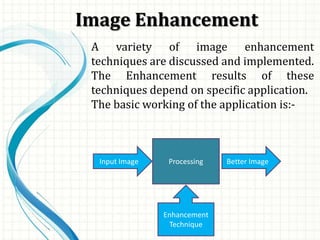
A variety of image enhancement
techniques are discussed and implemented.
The Enhancement results of these
techniques depend on specific application.
The basic working of the application is:-
Processing Better ImageInput Image
Enhancement
Technique
Image Communication
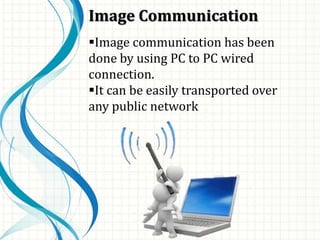
Image communication has been
done by using PC to PC wired
connection.
It can be easily transported over
any public network
Image Compression
Lossless image compression compresses on
the basis of reducing the redundancy. An
image having high correlation in its pixels
can be compressed more then an image
having low correlation.
We have encrypted the image such that the correlation of image
pixels become minimized and its histogram becomes uniform. So
lossless compression is not suitable for highly uncorrelated
images.
Simple lossy compression is implemented to reduce the size of
image which uses DCT. The image encryption and decryption
work well even after compression by lossy compression or
popular image compression standards such as JPEG.
Image Encryption
Encryption is the process of transforming
information using an algorithm to make it
unintelligible to anyone except those
possessing special knowledge, usually referred
to as a key.
The result of the process is encrypted
information.
The reverse process of encryption is called
decryption, to make the encrypted information
readable again.
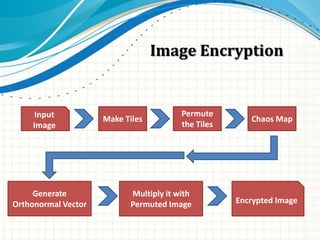
Image Encryption
Input
Image
Make Tiles
Permute
the Tiles
Chaos Map
Encrypted Image
Multiply it with
Permuted Image
Generate
Orthonormal Vector
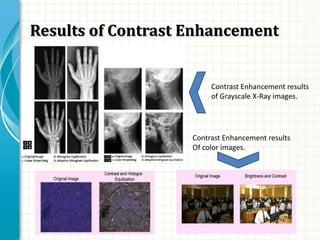
Results of Contrast Enhancement
Contrast Enhancement results
of Grayscale X-Ray images.
Contrast Enhancement results
Of color images.
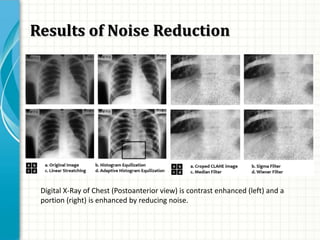
Results of Noise Reduction
Digital X-Ray of Chest (Postoanterior view) is contrast enhanced (left) and a
portion (right) is enhanced by reducing noise.
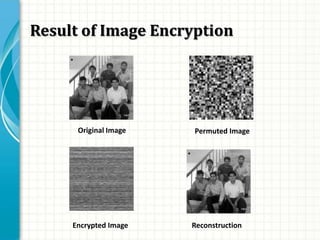
Result of Image Encryption
Original Image Permuted Image
ReconstructionEncrypted Image
CONCLUSION
The proposed algorithm has been tested on a
large set of images from digital radiographic
images, celestial images to digital camera images.
FUTURISTIC
Though various aspects of image enhancement are catered
for in the implementation and subsequent exercise of
results, nevertheless, we understand that it is so
demanding and absorbing area for research that the work
could substantially be carried forward in following
directions as a future work:
Improvement in selective noise reduction techniques.
Implementation in real time environment.
ACHIEVEMENT
 Digital Radiographic Image Enhancement for Improved
Visualization, Nisar Ahmed, Waqas Ahmed, Sheikh
Muhammad Arshad, EMCOT COMSAT Institute of
Information Technology, Page 38, May 9-10, 2011.
 The Application of Image Enhancement on Color and
Grayscale Images, Nisar Ahmed, Waqas Ahmed, APTEC
2011 CIIT-IEEE Proceeding. Page 17, April 10, 2011.
 A Compression Friendly Image Encryption Scheme, Nisar
Ahmed, under process
Digital Image Communication and Enhancement

Digital Image Communication and Enhancement

  • 1.
  • 2.
    PROJECT SUPERVISOR: • DRJAMEEL AHMED TEAM MEMBERS • NISAR AHMED RANA • SHEIKH M ARSHAD • GHAZAL ARSHAD • MARIA MINHAS HITEC University Taxila Department of Electrical Engineering PROJECT ADVISOR • ENGR WAQAS AHMED
  • 3.
    Sequence of Presentation 1•Introduction 2 •Proposed Solution 3 •Implementation 4 •Results 5 •Conclusion 6 •Appendix
  • 4.
    Introduction  Image communicationand enhancement is vital in today’s world.  Every image needs more or less enhancement to make it clearer for visual perception.  Images captured at remote areas are needed to be transferred at a desired location with speed, more accuracy and security.
  • 5.
    Introduction  Image enhancementtechniques are used to emphasize and sharpen image features to obtain a visually more pleasant, more detailed, or less noisy output image.  Image Encryption techniques are used to make the image secure over a public network whereas image compression reduces size for fast communication.
  • 6.
    Scope Image communication andenhancement is being used in various fields:  E-toll plaza (Number-plate Recognition System)  Celestial imaging  Security purposes(Intruder and thief check)  Visual Surveillance  Biometrics (Fingerprint, Iris, Facial Recognition)  Biomedical imaging etc.
  • 7.
    Problem Statement  Todevelop a complete solution for digital image enhancement for improved visualization.  Develop an efficient image encryption and compression solution for fast and secure communication.
  • 8.
  • 9.
    Image Enhancement A varietyof image enhancement techniques are discussed and implemented. The Enhancement results of these techniques depend on specific application. The basic working of the application is:- Processing Better ImageInput Image Enhancement Technique
  • 10.
    Image Communication Image communicationhas been done by using PC to PC wired connection. It can be easily transported over any public network
  • 11.
    Image Compression Lossless imagecompression compresses on the basis of reducing the redundancy. An image having high correlation in its pixels can be compressed more then an image having low correlation. We have encrypted the image such that the correlation of image pixels become minimized and its histogram becomes uniform. So lossless compression is not suitable for highly uncorrelated images. Simple lossy compression is implemented to reduce the size of image which uses DCT. The image encryption and decryption work well even after compression by lossy compression or popular image compression standards such as JPEG.
  • 12.
    Image Encryption Encryption isthe process of transforming information using an algorithm to make it unintelligible to anyone except those possessing special knowledge, usually referred to as a key. The result of the process is encrypted information. The reverse process of encryption is called decryption, to make the encrypted information readable again.
  • 13.
    Image Encryption Input Image Make Tiles Permute theTiles Chaos Map Encrypted Image Multiply it with Permuted Image Generate Orthonormal Vector
  • 14.
    Results of ContrastEnhancement Contrast Enhancement results of Grayscale X-Ray images. Contrast Enhancement results Of color images.
  • 15.
    Results of NoiseReduction Digital X-Ray of Chest (Postoanterior view) is contrast enhanced (left) and a portion (right) is enhanced by reducing noise.
  • 16.
    Result of ImageEncryption Original Image Permuted Image ReconstructionEncrypted Image
  • 17.
    CONCLUSION The proposed algorithmhas been tested on a large set of images from digital radiographic images, celestial images to digital camera images.
  • 18.
    FUTURISTIC Though various aspectsof image enhancement are catered for in the implementation and subsequent exercise of results, nevertheless, we understand that it is so demanding and absorbing area for research that the work could substantially be carried forward in following directions as a future work: Improvement in selective noise reduction techniques. Implementation in real time environment.
  • 19.
    ACHIEVEMENT  Digital RadiographicImage Enhancement for Improved Visualization, Nisar Ahmed, Waqas Ahmed, Sheikh Muhammad Arshad, EMCOT COMSAT Institute of Information Technology, Page 38, May 9-10, 2011.  The Application of Image Enhancement on Color and Grayscale Images, Nisar Ahmed, Waqas Ahmed, APTEC 2011 CIIT-IEEE Proceeding. Page 17, April 10, 2011.  A Compression Friendly Image Encryption Scheme, Nisar Ahmed, under process

Editor's Notes

  • #8 Give a brief overview of the presentation. Describe the major focus of the presentation and why it is important.Introduce each of the major topics.To provide a road map for the audience, you can repeat this Overview slide throughout the presentation, highlighting the particular topic you will discuss next.
  • #9 This is another option for an Overview slides using transitions.
  • #13 Use a section header for each of the topics, so there is a clear transition to the audience.
  • #14 Use a section header for each of the topics, so there is a clear transition to the audience.