




Digital
differences
New data and trends
Kathryn Zickuhr, Research Specialist
Pew Research Center’s Internet & American Life Project

American Library Association Spectrum Leadership Institute
Anaheim, CA - June 25, 2012
Kathryn Zickuhr
Research Specialist
Pew Internet & American Life Project
kzickuhr@pewinternet.org

@kzickuhr
@pewinternet
@pewresearch
About Pew Internet
• Part of the Pew Research Center, a non-partisan “fact
  tank” in Washington, DC
• Studies how people use digital technologies
• Does not promote specific technologies or make policy
  recommendations
• Data for this talk is from nationally representative
  telephone surveys of U.S. adults and teens (on landlines
  and cell phones)

All slides and reports are available at
pewinternet.org
PewResearchCenter
• Public opinion attitudes toward the press, politics and
  public policy issues (people-press.org)
• The performance of the U.S. press (journalism.org)
• The impact of technology (pewinternet.org)
• Worldwide public opinion (pewglobal.org)
• Religion and public life (pewforum.org)
• The U.S. Hispanic population (pewhispanic.org)
• Social and demographic trends (pewsocialtrends.org)

More: pewresearch.org
Factors
•   Age group
•   Race/ethnicity
•   Household income
•   Educational attainment
•   Quality of access
Internet
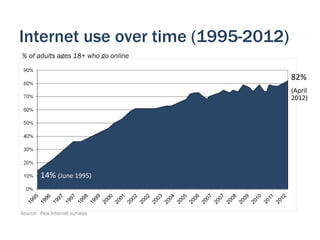
Internet use over time (1995-2012)
% of adults ages 18+ who go online


                                     82%
                                     (April
                                     2012)


        14% (June 1995)


Source: Pew Internet surveys
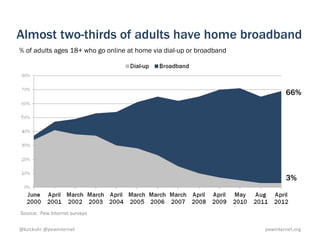
Almost two-thirds of adults have home broadband
% of adults ages 18+ who go online at home via dial-up or broadband


                                                                              66%


                                                                              3%


Source: Pew Internet surveys


@kzickuhr @pewinternet                                                pewinternet.org
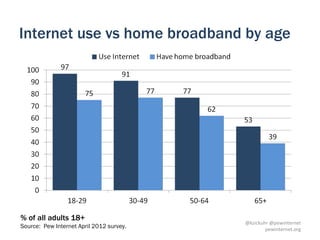
Internet use vs home broadband by age


% of all adults 18+
                                          @kzickuhr @pewinternet
Source: Pew Internet April 2012 survey.           pewinternet.org
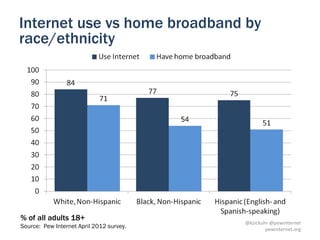
Internet use vs home broadband by
race/ethnicity


% of all adults 18+
                                          @kzickuhr @pewinternet
Source: Pew Internet April 2012 survey.           pewinternet.org
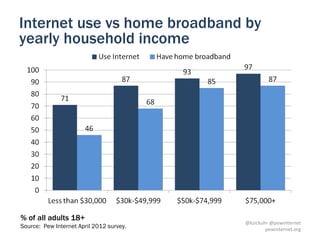
Internet use vs home broadband by
yearly household income


% of all adults 18+
                                          @kzickuhr @pewinternet
Source: Pew Internet April 2012 survey.           pewinternet.org
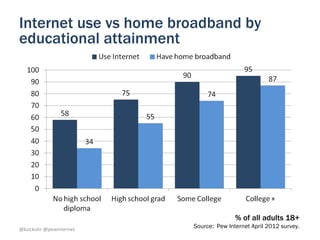
Internet use vs home broadband by
educational attainment


                                        % of all adults 18+
@kzickuhr @pewinternet
                         Source: Pew Internet April 2012 survey.
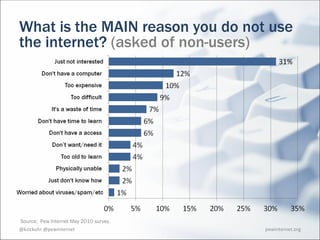
What is the MAIN reason you do not use
the internet? (asked of non-users)


Source: Pew Internet May 2010 survey.
@kzickuhr @pewinternet                  pewinternet.org
Gadgets
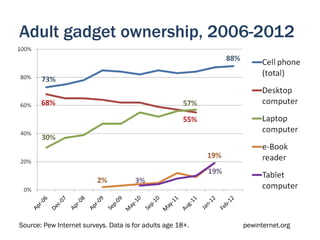
Adult gadget ownership, 2006-2012


Source: Pew Internet surveys. Data is for adults age 18+.   pewinternet.org
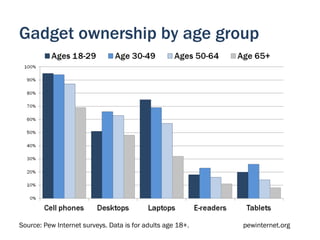
Gadget ownership by age group


Source: Pew Internet surveys. Data is for adults age 18+.   pewinternet.org
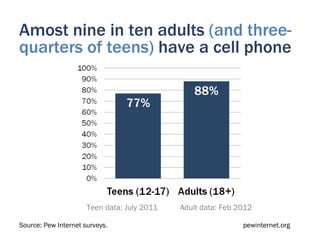
Amost nine in ten adults (and three-
quarters of teens) have a cell phone


                      Teen data: July 2011   Adult data: Feb 2012

Source: Pew Internet surveys.                                 pewinternet.org
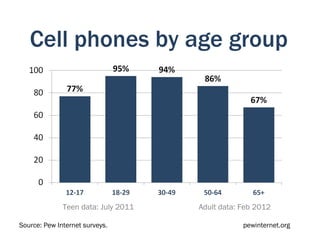
Cell phones by age group


              Teen data: July 2011   Adult data: Feb 2012

Source: Pew Internet surveys.                    pewinternet.org
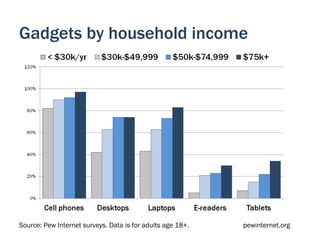
Gadgets by household income


Source: Pew Internet surveys. Data is for adults age 18+.   pewinternet.org
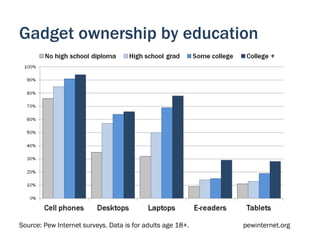
Gadget ownership by education


Source: Pew Internet surveys. Data is for adults age 18+.   pewinternet.org
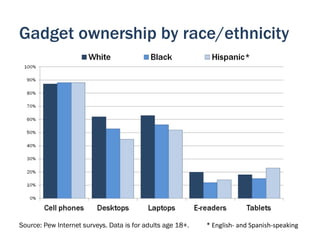
Gadget ownership by race/ethnicity


Source: Pew Internet surveys. Data is for adults age 18+.   * English- and Spanish-speaking
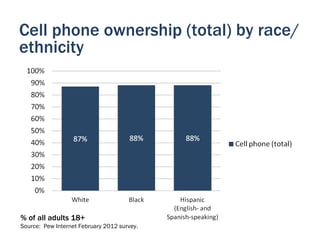
Cell phone ownership (total) by race/
ethnicity


% of all adults 18+
Source: Pew Internet February 2012 survey.
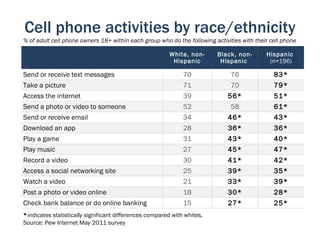
Cell phone activities by race/ethnicity
% of adult cell phone owners 18+ within each group who do the following activities with their cell phone

                                                         White, non-     Black, non-        Hispanic
                                                          Hispanic        Hispanic           (n=196)

Send or receive text messages                                 70               76              83*
Take a picture                                                71               70              79*
Access the internet                                           39             56*               51*
Send a photo or video to someone                              52              58               61*
Send or receive email                                         34             46*               43*
Download an app                                               28             36*               36*
Play a game                                                   31             43*               40*
Play music                                                    27             45*               47*
Record a video                                                30             41*               42*
Access a social networking site                               25             39*               35*
Watch a video                                                 21             33*               39*
Post a photo or video online                                  18             30*               28*
Check bank balance or do online banking                       15             27*               25*
*indicates statistically significant differences compared with whites.
Source: Pew Internet May 2011 survey
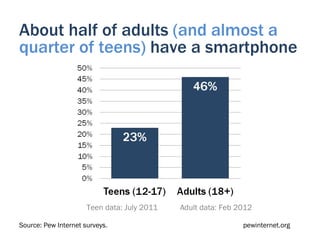
About half of adults (and almost a
quarter of teens) have a smartphone


                      Teen data: July 2011   Adult data: Feb 2012

Source: Pew Internet surveys.                                 pewinternet.org
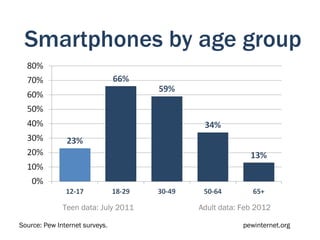
Smartphones by age group


              Teen data: July 2011   Adult data: Feb 2012

Source: Pew Internet surveys.                    pewinternet.org
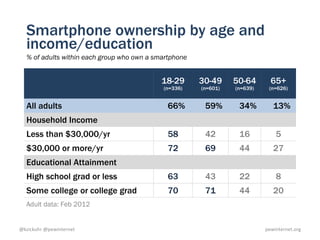
Smartphone ownership by age and
  income/education
  % of adults within each group who own a smartphone


                                            18-29      30-49     50-64       65+
                                            (n=336)    (n=601)   (n=639)    (n=626)


  All adults                                  66%       59%       34%         13%
  Household Income
  Less than $30,000/yr                        58        42        16           5
  $30,000 or more/yr                          72        69        44          27
  Educational Attainment
  High school grad or less                    63        43        22           8
  Some college or college grad                70        71        44          20
  Adult data: Feb 2012


@kzickuhr @pewinternet                                                     pewinternet.org
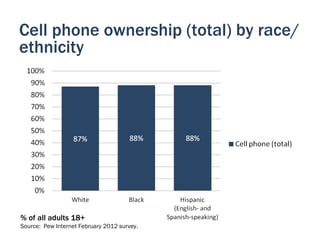
Cell phone ownership (total) by race/
ethnicity


% of all adults 18+
Source: Pew Internet February 2012 survey.
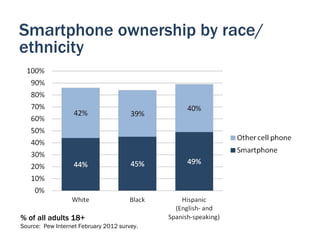
Smartphone ownership by race/
ethnicity


% of all adults 18+
Source: Pew Internet February 2012 survey.
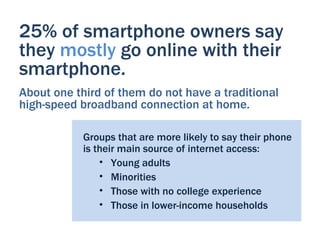
25% of smartphone owners say
they mostly go online with their
smartphone.
About one third of them do not have a traditional
high-speed broadband connection at home.

            Groups that are more likely to say their phone
            is their main source of internet access:
                • Young adults
                • Minorities
                • Those with no college experience
                • Those in lower-income households
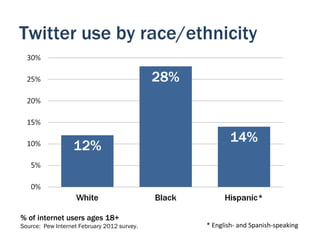
Twitter use by race/ethnicity


% of internet users ages 18+
Source: Pew Internet February 2012 survey.   * English- and Spanish-speaking
Questions?
@kzickuhr
@pewinternet
@pewresearch
Libraries
of today and tomorrow
About our libraries research

• Goal: To study the changing role of public
  libraries and library users in the digital age

• Funded by a three-year, $1.4 million grant
  from the Bill and Melinda Gates Foundation


      libraries.pewinternet.org
RESEARCH TIMELINE
Stage I (August 2011-July 2012)
Libraries + new technologies
  • The rise of e-reading (April 2012)

• E-books, patrons, and libraries – JUST PUBLISHED
  – Includes quotes from librarians and patrons
  – Available online at libraries.pewinternet.org


• Library use in different community types (summer)
• The habits of younger library users (summer)
The rise of e-reading
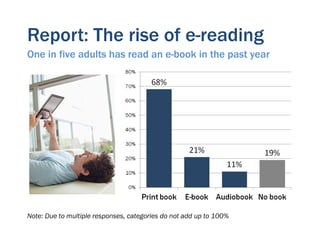
Report: The rise of e-reading
One in five adults has read an e-book in the past year


Note: Due to multiple responses, categories do not add up to 100%
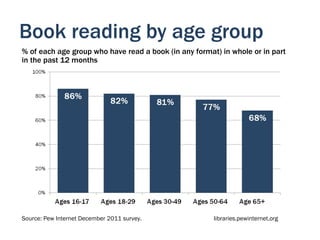
Book reading by age group
% of each age group who have read a book (in any format) in whole or in part
in the past 12 months


Source: Pew Internet December 2011 survey.             libraries.pewinternet.org
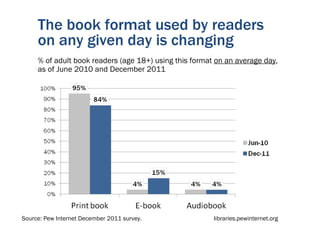
The book format used by readers
     on any given day is changing
     % of adult book readers (age 18+) using this format on an average day,
     as of June 2010 and December 2011


Source: Pew Internet December 2011 survey.              libraries.pewinternet.org
Who reads e-books?
-book readers are more likely than other
readers to be:
 Under age 50

 College educated

 Living in households earning $50K+


ther key characteristics:
Source: Pew Internet December 2011 survey.   libraries.pewinternet.org
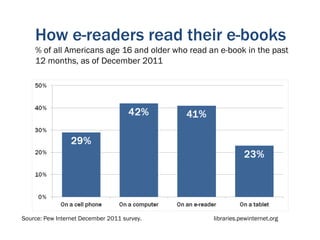
How e-readers read their e-books
    % of all Americans age 16 and older who read an e-book in the past
    12 months, as of December 2011


Source: Pew Internet December 2011 survey.        libraries.pewinternet.org
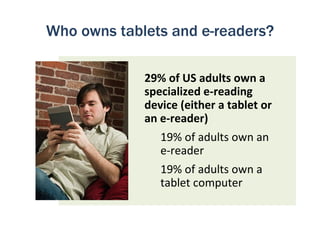
Who owns tablets and e-readers?

             29% of US adults own a
             specialized e-reading
             device (either a tablet or
             an e-reader)
                19% of adults own an
                e-reader
                19% of adults own a
                tablet computer
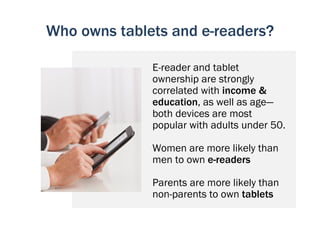
Who owns tablets and e-readers?

              E-reader and tablet
              ownership are strongly
              correlated with income &
              education, as well as age—
              both devices are most
              popular with adults under 50.

              Women are more likely than
              men to own e-readers

              Parents are more likely than
              non-parents to own tablets
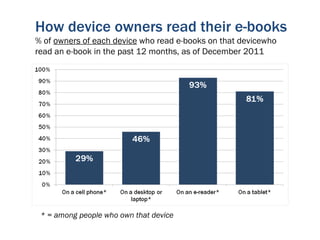
How device owners read their e-books
% of owners of each device who read e-books on that devicewho
read an e-book in the past 12 months, as of December 2011


 * = among people who own that device
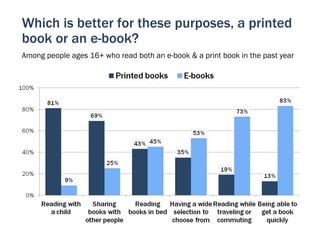
Which is better for these purposes, a printed
book or an e-book?
Among people ages 16+ who read both an e-book & a print book in the past year
“My Kindle fits in my purse, so I
can carry my Kindle places I
wouldn’t carry a book. I find
myself taking it almost
everywhere I go so if I find
myself with a free couple of
minutes, I can read a couple of
pages.”
                      – E-book borrower
E-books at
libraries
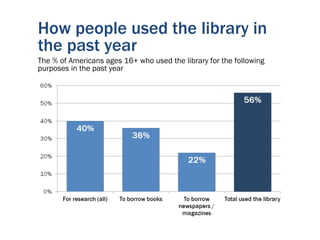
How people used the library in
the past year
The % of Americans ages 16+ who used the library for the following
purposes in the past year
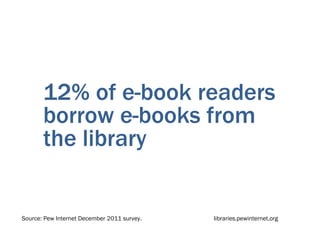
12% of e-book readers
       borrow e-books from
       the library


Source: Pew Internet December 2011 survey.   libraries.pewinternet.org
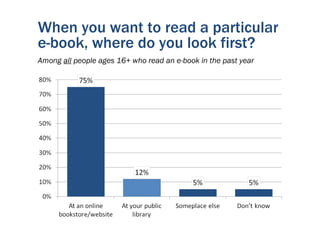
When you want to read a particular
e-book, where do you look first?
Among all people ages 16+ who read an e-book in the past year
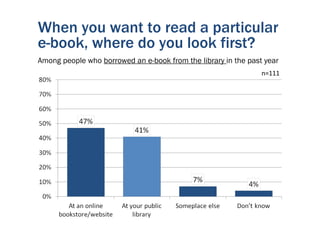
When you want to read a particular
e-book, where do you look first?
Among people who borrowed an e-book from the library in the past year
                                                                n=111
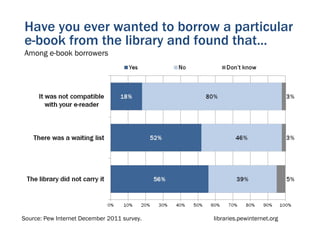
Have you ever wanted to borrow a particular
e-book from the library and found that...
Among e-book borrowers


Source: Pew Internet December 2011 survey.   libraries.pewinternet.org
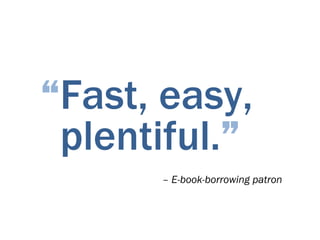
“Fast, easy,
 plentiful.”
      – E-book-borrowing patron
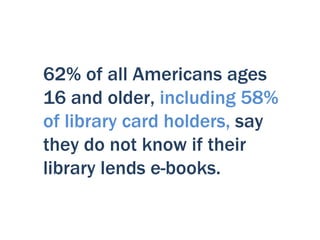
62% of all Americans ages
16 and older, including 58%
of library card holders, say
they do not know if their
library lends e-books.
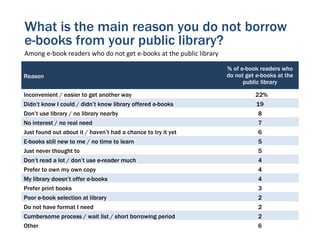
What is the main reason you do not borrow
e-books from your public library?
Among e-book readers who do not get e-books at the public library

                                                                    % of e-book readers who
Reason                                                              do not get e-books at the
                                                                          public library

Inconvenient / easier to get another way                                      22%
Didn’t know I could / didn’t know library offered e-books                      19
Don’t use library / no library nearby                                          8
No interest / no real need                                                     7
Just found out about it / haven’t had a chance to try it yet                   6
E-books still new to me / no time to learn                                     5
Just never thought to                                                          5
Don’t read a lot / don’t use e-reader much                                     4
Prefer to own my own copy                                                      4
My library doesn’t offer e-books                                               4
Prefer print books                                                             3
Poor e-book selection at library                                               2
Do not have format I need                                                      2
Cumbersome process / wait list / short borrowing period                        2
Other                                                                          6
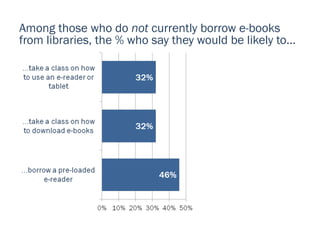
Among those who do not currently borrow e-books
from libraries, the % who say they would be likely to…
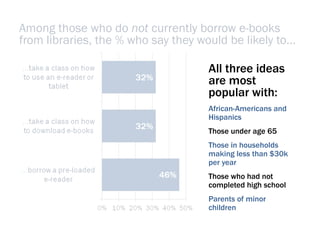
Among those who do not currently borrow e-books
from libraries, the % who say they would be likely to…

                                    All three ideas
                                    are most
                                    popular with:
                                    African-Americans and
                                    Hispanics
                                    Those under age 65
                                    Those in households
                                    making less than $30k
                                    per year
                                    Those who had not
                                    completed high school
                                    Parents of minor
                                    children
What these
changes
[could] mean
for libraries
“Our customers are still using
the library but in different ways.
They browse our catalog online,
place reserves on the items they
want, then pick them up at their
location of choice. Many fewer
browse the collection in person,”
                 – E-book-borrowing patron
“People are asking for digital
content. Anything digital. They
are hungry for it.”
                   – Library staff member
“We spend a significant part of
our day explaining how to get
library books onto e-book
readers.”
                  – Library staff member
“The greatest change has
been the need not only for
computer access, but
computer assistance.”
                – Library staff member
“It all feels pretty murky. Some
clarity and good advice would
be nice. It’s OK for libraries with
big budgets to plunge into e-
book readers. As a small library
with limited collection funds, we
have to be more careful.”
                    – Library staff member
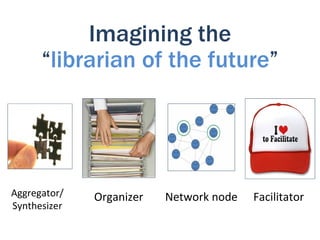
Imagining the
      “librarian of the future”


Aggregator/   Organizer   Network node   Facilitator
Synthesizer
“Our library is a critical
link in our community.
It provides access to
books, computers,
[and] knowledge, and is
a critical social center.”
             – E-book-borrowing patron
RESEARCH TIMELINE
Stage II (May-November 2012)
  The changing world of library services

  • The evolving role of libraries in communities
     – New library services
     – People’s expectations of libraries
     – “The library of the future”


  • The role of libraries in the life of special populations
     – Lower-income users, minorities, rural residents, senior
       citizens
RESEARCH TIMELINE
Stage III (Sept. 2012–April 2013)
 A closer analysis of who does – and does not – use
   libraries

 • A “library user” typology
    – Different user “types” based on:
       • What their local libraries are like
       • How they use libraries
       • Attitudes about libraries in general


 • An updated, in-depth portrait of how teens & young
   adults use libraries
Thank you!
Kathryn Zickuhr
Research Specialist
Pew Internet & American Life Project
kzickuhr@pewinternet.org
@kzickuhr @pewinternet @pewresearch

All data, slides, and reports available at
pewinternet.org

Digital differences

  • 1.
    Digital differences New data andtrends Kathryn Zickuhr, Research Specialist Pew Research Center’s Internet & American Life Project American Library Association Spectrum Leadership Institute Anaheim, CA - June 25, 2012
  • 2.
    Kathryn Zickuhr Research Specialist PewInternet & American Life Project kzickuhr@pewinternet.org @kzickuhr @pewinternet @pewresearch
  • 3.
    About Pew Internet •Part of the Pew Research Center, a non-partisan “fact tank” in Washington, DC • Studies how people use digital technologies • Does not promote specific technologies or make policy recommendations • Data for this talk is from nationally representative telephone surveys of U.S. adults and teens (on landlines and cell phones) All slides and reports are available at pewinternet.org
  • 4.
    PewResearchCenter • Public opinionattitudes toward the press, politics and public policy issues (people-press.org) • The performance of the U.S. press (journalism.org) • The impact of technology (pewinternet.org) • Worldwide public opinion (pewglobal.org) • Religion and public life (pewforum.org) • The U.S. Hispanic population (pewhispanic.org) • Social and demographic trends (pewsocialtrends.org) More: pewresearch.org
  • 6.
    Factors • Age group • Race/ethnicity • Household income • Educational attainment • Quality of access
  • 7.
  • 8.
    Internet use overtime (1995-2012) % of adults ages 18+ who go online 82% (April 2012) 14% (June 1995) Source: Pew Internet surveys
  • 9.
    Almost two-thirds ofadults have home broadband % of adults ages 18+ who go online at home via dial-up or broadband 66% 3% Source: Pew Internet surveys @kzickuhr @pewinternet pewinternet.org
  • 10.
    Internet use vshome broadband by age % of all adults 18+ @kzickuhr @pewinternet Source: Pew Internet April 2012 survey. pewinternet.org
  • 11.
    Internet use vshome broadband by race/ethnicity % of all adults 18+ @kzickuhr @pewinternet Source: Pew Internet April 2012 survey. pewinternet.org
  • 12.
    Internet use vshome broadband by yearly household income % of all adults 18+ @kzickuhr @pewinternet Source: Pew Internet April 2012 survey. pewinternet.org
  • 13.
    Internet use vshome broadband by educational attainment % of all adults 18+ @kzickuhr @pewinternet Source: Pew Internet April 2012 survey.
  • 14.
    What is theMAIN reason you do not use the internet? (asked of non-users) Source: Pew Internet May 2010 survey. @kzickuhr @pewinternet pewinternet.org
  • 15.
  • 16.
    Adult gadget ownership,2006-2012 Source: Pew Internet surveys. Data is for adults age 18+. pewinternet.org
  • 17.
    Gadget ownership byage group Source: Pew Internet surveys. Data is for adults age 18+. pewinternet.org
  • 18.
    Amost nine inten adults (and three- quarters of teens) have a cell phone Teen data: July 2011 Adult data: Feb 2012 Source: Pew Internet surveys. pewinternet.org
  • 19.
    Cell phones byage group Teen data: July 2011 Adult data: Feb 2012 Source: Pew Internet surveys. pewinternet.org
  • 20.
    Gadgets by householdincome Source: Pew Internet surveys. Data is for adults age 18+. pewinternet.org
  • 21.
    Gadget ownership byeducation Source: Pew Internet surveys. Data is for adults age 18+. pewinternet.org
  • 22.
    Gadget ownership byrace/ethnicity Source: Pew Internet surveys. Data is for adults age 18+. * English- and Spanish-speaking
  • 23.
    Cell phone ownership(total) by race/ ethnicity % of all adults 18+ Source: Pew Internet February 2012 survey.
  • 24.
    Cell phone activitiesby race/ethnicity % of adult cell phone owners 18+ within each group who do the following activities with their cell phone White, non- Black, non- Hispanic Hispanic Hispanic (n=196) Send or receive text messages 70 76 83* Take a picture 71 70 79* Access the internet 39 56* 51* Send a photo or video to someone 52 58 61* Send or receive email 34 46* 43* Download an app 28 36* 36* Play a game 31 43* 40* Play music 27 45* 47* Record a video 30 41* 42* Access a social networking site 25 39* 35* Watch a video 21 33* 39* Post a photo or video online 18 30* 28* Check bank balance or do online banking 15 27* 25* *indicates statistically significant differences compared with whites. Source: Pew Internet May 2011 survey
  • 25.
    About half ofadults (and almost a quarter of teens) have a smartphone Teen data: July 2011 Adult data: Feb 2012 Source: Pew Internet surveys. pewinternet.org
  • 26.
    Smartphones by agegroup Teen data: July 2011 Adult data: Feb 2012 Source: Pew Internet surveys. pewinternet.org
  • 27.
    Smartphone ownership byage and income/education % of adults within each group who own a smartphone 18-29 30-49 50-64 65+ (n=336) (n=601) (n=639) (n=626) All adults 66% 59% 34% 13% Household Income Less than $30,000/yr 58 42 16 5 $30,000 or more/yr 72 69 44 27 Educational Attainment High school grad or less 63 43 22 8 Some college or college grad 70 71 44 20 Adult data: Feb 2012 @kzickuhr @pewinternet pewinternet.org
  • 28.
    Cell phone ownership(total) by race/ ethnicity % of all adults 18+ Source: Pew Internet February 2012 survey.
  • 29.
    Smartphone ownership byrace/ ethnicity % of all adults 18+ Source: Pew Internet February 2012 survey.
  • 30.
    25% of smartphoneowners say they mostly go online with their smartphone. About one third of them do not have a traditional high-speed broadband connection at home. Groups that are more likely to say their phone is their main source of internet access: • Young adults • Minorities • Those with no college experience • Those in lower-income households
  • 31.
    Twitter use byrace/ethnicity % of internet users ages 18+ Source: Pew Internet February 2012 survey. * English- and Spanish-speaking
  • 32.
  • 33.
  • 34.
    About our librariesresearch • Goal: To study the changing role of public libraries and library users in the digital age • Funded by a three-year, $1.4 million grant from the Bill and Melinda Gates Foundation libraries.pewinternet.org
  • 35.
    RESEARCH TIMELINE Stage I(August 2011-July 2012) Libraries + new technologies • The rise of e-reading (April 2012) • E-books, patrons, and libraries – JUST PUBLISHED – Includes quotes from librarians and patrons – Available online at libraries.pewinternet.org • Library use in different community types (summer) • The habits of younger library users (summer)
  • 36.
    The rise ofe-reading
  • 37.
    Report: The riseof e-reading One in five adults has read an e-book in the past year Note: Due to multiple responses, categories do not add up to 100%
  • 38.
    Book reading byage group % of each age group who have read a book (in any format) in whole or in part in the past 12 months Source: Pew Internet December 2011 survey. libraries.pewinternet.org
  • 39.
    The book formatused by readers on any given day is changing % of adult book readers (age 18+) using this format on an average day, as of June 2010 and December 2011 Source: Pew Internet December 2011 survey. libraries.pewinternet.org
  • 40.
    Who reads e-books? -bookreaders are more likely than other readers to be: Under age 50 College educated Living in households earning $50K+ ther key characteristics: Source: Pew Internet December 2011 survey. libraries.pewinternet.org
  • 41.
    How e-readers readtheir e-books % of all Americans age 16 and older who read an e-book in the past 12 months, as of December 2011 Source: Pew Internet December 2011 survey. libraries.pewinternet.org
  • 42.
    Who owns tabletsand e-readers? 29% of US adults own a specialized e-reading device (either a tablet or an e-reader) 19% of adults own an e-reader 19% of adults own a tablet computer
  • 43.
    Who owns tabletsand e-readers? E-reader and tablet ownership are strongly correlated with income & education, as well as age— both devices are most popular with adults under 50. Women are more likely than men to own e-readers Parents are more likely than non-parents to own tablets
  • 44.
    How device ownersread their e-books % of owners of each device who read e-books on that devicewho read an e-book in the past 12 months, as of December 2011 * = among people who own that device
  • 45.
    Which is betterfor these purposes, a printed book or an e-book? Among people ages 16+ who read both an e-book & a print book in the past year
  • 46.
    “My Kindle fitsin my purse, so I can carry my Kindle places I wouldn’t carry a book. I find myself taking it almost everywhere I go so if I find myself with a free couple of minutes, I can read a couple of pages.” – E-book borrower
  • 47.
  • 48.
    How people usedthe library in the past year The % of Americans ages 16+ who used the library for the following purposes in the past year
  • 49.
    12% of e-bookreaders borrow e-books from the library Source: Pew Internet December 2011 survey. libraries.pewinternet.org
  • 50.
    When you wantto read a particular e-book, where do you look first? Among all people ages 16+ who read an e-book in the past year
  • 51.
    When you wantto read a particular e-book, where do you look first? Among people who borrowed an e-book from the library in the past year n=111
  • 52.
    Have you everwanted to borrow a particular e-book from the library and found that... Among e-book borrowers Source: Pew Internet December 2011 survey. libraries.pewinternet.org
  • 53.
    “Fast, easy, plentiful.” – E-book-borrowing patron
  • 54.
    62% of allAmericans ages 16 and older, including 58% of library card holders, say they do not know if their library lends e-books.
  • 55.
    What is themain reason you do not borrow e-books from your public library? Among e-book readers who do not get e-books at the public library % of e-book readers who Reason do not get e-books at the public library Inconvenient / easier to get another way 22% Didn’t know I could / didn’t know library offered e-books 19 Don’t use library / no library nearby 8 No interest / no real need 7 Just found out about it / haven’t had a chance to try it yet 6 E-books still new to me / no time to learn 5 Just never thought to 5 Don’t read a lot / don’t use e-reader much 4 Prefer to own my own copy 4 My library doesn’t offer e-books 4 Prefer print books 3 Poor e-book selection at library 2 Do not have format I need 2 Cumbersome process / wait list / short borrowing period 2 Other 6
  • 56.
    Among those whodo not currently borrow e-books from libraries, the % who say they would be likely to…
  • 57.
    Among those whodo not currently borrow e-books from libraries, the % who say they would be likely to… All three ideas are most popular with: African-Americans and Hispanics Those under age 65 Those in households making less than $30k per year Those who had not completed high school Parents of minor children
  • 58.
  • 59.
    “Our customers arestill using the library but in different ways. They browse our catalog online, place reserves on the items they want, then pick them up at their location of choice. Many fewer browse the collection in person,” – E-book-borrowing patron
  • 60.
    “People are askingfor digital content. Anything digital. They are hungry for it.” – Library staff member
  • 61.
    “We spend asignificant part of our day explaining how to get library books onto e-book readers.” – Library staff member
  • 62.
    “The greatest changehas been the need not only for computer access, but computer assistance.” – Library staff member
  • 63.
    “It all feelspretty murky. Some clarity and good advice would be nice. It’s OK for libraries with big budgets to plunge into e- book readers. As a small library with limited collection funds, we have to be more careful.” – Library staff member
  • 64.
    Imagining the “librarian of the future” Aggregator/ Organizer Network node Facilitator Synthesizer
  • 65.
    “Our library isa critical link in our community. It provides access to books, computers, [and] knowledge, and is a critical social center.” – E-book-borrowing patron
  • 66.
    RESEARCH TIMELINE Stage II(May-November 2012) The changing world of library services • The evolving role of libraries in communities – New library services – People’s expectations of libraries – “The library of the future” • The role of libraries in the life of special populations – Lower-income users, minorities, rural residents, senior citizens
  • 67.
    RESEARCH TIMELINE Stage III(Sept. 2012–April 2013) A closer analysis of who does – and does not – use libraries • A “library user” typology – Different user “types” based on: • What their local libraries are like • How they use libraries • Attitudes about libraries in general • An updated, in-depth portrait of how teens & young adults use libraries
  • 68.
    Thank you! Kathryn Zickuhr ResearchSpecialist Pew Internet & American Life Project kzickuhr@pewinternet.org @kzickuhr @pewinternet @pewresearch All data, slides, and reports available at pewinternet.org

Editor's Notes

  • #9 In June 1995, 14% of American adults used the internet. By the year 2000, just five years later, half of adults were online. Now, eight in ten adults use the internet, including half of seniors 65 and older.
  • #10 Overall, about seven in ten adults have internet at home. (No significant differences by gender.)
  • #15 What would it take to get you to switch to broadband? Asked of internet users who do not have home broadband Price must fall: 35% Nothing would get me to switch: 20% Don't know: 16% It would have to become available where I live: 17% Other: 13% Source: May 2010 Pew Internet survey http://pewinternet.org/Reports/2009/10-Home-Broadband-Adoption-2009/5-Barriers-to-broadband-adoption.aspx?view=all
  • #16 Part 1: Patterns and trends in device ownership
  • #17 Trends in device ownership among American adults (18+), 2006-2012
  • #20 Even among those over the age of 75, at least half (56%) have a cell phone. For comparison, just 31% have a desktop computer.
  • #24 No significant differences by race/ethnicity
  • #26 Some 46% of American adults have a smartphone, defined as adults who either say their phone is a smartphone when asked, or who describe their phone as running on the Android, Blackberry, iPhone, Palm or Windows platforms. Two in five adults (41%) own a cell phone that is not a smartphone, which means that smartphone owners are now more prevalent within the overall population than owners of more basic mobile phones. As we found in our May 2011 study of smartphone adoption, several demographic groups have higher than average levels of smartphone adoption, including groups that traditionally have higher rates of tech adoption in general: the financially well-off, the well-educated, and adults under age 50.
  • #27 Almost half (46%) of U.S. adults own a smartphone in 2012, up from 35% in 2011 18-24 year-olds: 67% 25-34 year-olds: 71% 23% of teens (ages 12-17) have smartphones as of July 2011 31% of 14-17 year-olds 8% of 12-13 year-olds
  • #28 Young adults continue to have higher-than-average levels of smartphone ownership regardless of income or educational attainment. Younger adults under age 30 with a high school diploma or less are significantly more likely to own a smartphone than adults 50 and older who have attended college. Similarly, adults under age 30 who live in households making less than $30,000 per year are still more likely to own a smartphone than those over age 50 in higher income brackets.
  • #29 No significant differences by race/ethnicity
  • #30 No significant differences by race/ethnicity We see a similar pattern when looking at mobile internet in general—when we look at the six in ten adults who access the internet wirelessly with a laptop, cell phone, or tablet. Looking at this overall picture of mobile internet access, we see the same patterns by age, household income, education—and the same lack of differences by race/ethnicity.
  • #31 Previously, in May of 2011, we found that young adults, minorities, those with no college experience, and those with lower household income levels who owned smartphones were more likely to say that their phone was their main source of internet access. Many of “cell mostly” internet users have other ways to connect to the internet—most have a desktop or laptop computer at home, for instance. But about one third of these adults do not have a traditional high-speed broadband connection at home. For them, their smartphone is a way for them to access the online world. We’re also coming out with a really interesting report tomorrow that updates these numbers and also takes a deeper look at people who go online mostly with their cell phones, so be sure to check that out.
  • #32 African American internet users are roughly twice as likely to use Twitter as whites or Hispanics.
  • #34 Part 1: Patterns and trends in device ownership
  • #38 Some 78% of those 16 and older had read at least one book in any format in the previous 12 months. 21% of American adults read an e-book in the last year 68% read a print book 11% listened to an audiobook 19% of adults say they read NO books in the past year, in any format
  • #39 Some 78% of those 16 and older had read at least one book in any format in the previous 12 months. 19% of adults say they read NO books in the past year, in any format. This group is more likely to be: male than female (23% vs. 14%), Hispanic than white or black (28% vs. 17% and 16%), age 65 or older (27%), lacking a high school diploma (34%), living in households earning less than $30,000 (26%), unemployed (22%), and residents of rural areas 25%. Those who did not read a book last year also tended not to be technology users.
  • #41 Readers of e-books are more likely than other readers to be: Under age 50 College educated Living in households earning $50K+ Other key characteristics: They read more books, more often, and for a wider range of reasons More likely to buy than borrow
  • #46 E-books don’t seem to supplant print books so much as supplement them in readers’ habits.
  • #50 In general, library card holders are pretty heavy readers, but most are not aware they can borrow e-books.
  • #51 A majority of print readers (54%) and e-book readers (61%) prefer to purchase their own copies of these books; most audiobook listeners (61%) prefer to borrow their audiobooks.
  • #52 A majority of print readers (54%) and e-book readers (61%) prefer to purchase their own copies of these books; most audiobook listeners (61%) prefer to borrow their audiobooks.
  • #53 About half of e-book borrowers have encountered waiting lists for books they wanted to check out, and a similar number had wanted to borrow a book but found the library did not carry it. Patrons’ vision of e-book borrowing: “ Fast, easy, plentiful. ”
  • #56 Among these folks, just 4% had tried to borrow and e-book from their library; 96% had not.
  • #57 In particular, African-Americans and Hispanics are more likely to be interested in these services compared with whites, as are those who live in lower-income households (compared with those in higher-income households).
  • #58 Women are more interested than men in taking classes on how to use handheld reading devices such as e-readers or tablets. While adults ages 65+ are least likely to be interested in any of the ideas, adults ages 50-64 are more interested in taking classes on using e-readers or downloading e-books than any other age group. Urban users are more interested than suburban or rural users in pre-loaded e-readers, while rural users are the least interested geographic group. Urban users are also somewhat more likely than users in other areas to be interested in classes on using handheld reading devices.
  • #59 What these changes [could] mean for libraries
  • #60 A patron respondent had a similar story: “Fifteen years ago, I regularly visited the library twice a week. Now I go about once a month and often that is just to drop off books that are due or pick up books that I have reserved. I would prefer to do ALL of my library business online and have many more materials available in e-book format.” One patron’s description of her library habits was representative of many in our online panel: “I go to the library branch much less often and I use the library website several times per week. Before I got my e-book reader, I visited my library at least weekly and almost never used the website, except to reserve books.” Patrons with limited access to their library’s physical branch, including adults living with disability and those who live in very rural areas, mentioned how e-books helped them read more. “A few months ago I was housebound due to a nasty illness,” one told us, and “thanks to the digital download system I was able to check out books and was able to keep on reading. That was an immense help since I live by myself and there was no one who could go get books for me.”
  • #61 “ My library serves an economically challenged area so we have not had the demand for e-books that other libraries are experiencing,” one director wrote. “Large numbers of our patrons have not been able to invest in e-book readers or tablets.” However, she added that the library had also seen “an increase in people using their mobile phones to access library services.”
  • #62 “ Many of our older patrons received electronic devices as gifts over the past two years. This group of library users asks for lots of help with their devices, from plugging them in to turning them on to trying to make them interface with the e-book portion of the library website.” “ Showing patrons how to use digital content and e-book readers is not much different than showing people how to use the micro-film machine or our public computers except it might take a little more time.” Many of the library staff members who responded to our online questionnaire wrote that they not only provide access to technology, but also must help patrons learn tech fundamentals. Their patrons often need help with many basic tasks, from setting up an email account and filling out online forms, to finding and navigating necessary websites. As one library staff member explained, “The greatest change has been the need not only for computer access, but computer assistance. Since people are required to apply for jobs and government services online, and many people in our area lack the skills to do so, we have seen a substantial rise in the need for computers, computer classes, and especially one-on-one assistance.”
  • #63 Since people are required to apply for jobs and government services online, and many people in our area lack the skills to do so, we have seen a substantial rise in the need for computers, computer classes, and especially one-on-one assistance.
  • #65 patrons: diy + google = less references, more tech support